
In This Article
A manual vs electric lawn edger choice comes down to how the cut happens. A manual edger is a long-handled half-moon blade driven into the turf with your foot, slicing a crisp vertical wall. An electric edger is usually a corded or cordless trimmer with an edging mode that shears grass along the border. One buys you a trench; the other buys you speed.
A freshly mown lawn with fuzzy edges is a bit like a sharp suit with scuffed shoes. Everything else is right, and your eye goes straight to the one thing that isn’t. As the RHS explains in its guide to creating a lawn edge, a defined edge keeps grass out of your borders and makes the whole garden look finished.
So which tool should you pick? It depends on three things: how much precision control you want, how much you’ll spend upfront, and how many metres of border you actually have. A tool that suits a postage-stamp front lawn will bore you rigid on a long driveway, and the reverse is just as true.
This guide covers seven real tools, from a tool in the under-£10 range to a premium cordless system. I haven’t tested any of them hands-on. Everything here comes from published spec sheets, expert testing (chiefly Expert Reviews’ lawn edger round-up, first published in 2023 and still live in 2026) and retailer review themes. I’ll say plainly where I couldn’t verify something. Prices are ranges only, and availability varies between retailers, so check current listings before you buy.
Manual vs Electric Lawn Edger at a Glance
Before the product deep-dive, here’s the quick version. This table sums up how the two camps differ on the factors that matter most.
| Factor | Manual (half-moon) | Electric (corded or cordless) | Best For |
|---|---|---|---|
| Upfront cost | Under £10 to around £40 | Around £25 to £350 | Unibos Carbon Steel Head Lawn Edger for the tightest budgets |
| Precision control | Very high, you set depth and line | Good along hard edges, weaker for new trenches | Fiskars Solid Lawn Edger for straight lines |
| Speed on long runs | Slow and physical | Fast | Flymo Contour 500E for long, repeat tidy-ups |
| Cutting a brand-new edge | Excellent | Poor to limited | Draper Stainless Steel Lawn Edger for reshaping beds |
| Noise | Silent | Moderate to loud (corded) or quiet (premium cordless) | STIHL FSA 57 for low noise |
| Ongoing upkeep | Occasional sharpening | Line, batteries, cable care | Wolf-Garten RMM Multi-Change Lawn Edge Iron for low maintenance |
Looking at the comparison above, the manual route wins on precision control, silence and long-term cost. The electric route wins whenever the sheer length of edge is the problem. Most gardens aren’t purely one or the other. Many people cut the edge in once by hand, then maintain it with a trimmer. We’ll come back to that hybrid approach later.
💬 Just one click — help others make better buying decisions too!😊
Top 7 Manual vs Electric Lawn Edger Picks: Expert Analysis
I’ve split these into four manual tools and three electric ones. That way you can compare the two camps without leaping between unrelated price brackets.
1. Fiskars Solid Lawn Edger — straightest lines of the manual bunch
That trapezoidal blade is the whole story. Its squared-off shoulders keep the cut dead straight, where a rounded half-moon tends to wander.
At roughly 110cm long, with a boron steel blade and ash handle, it lets most adults work upright instead of stooping, which is a real back-saver over a 20-metre run. Expert Reviews lists the weight at about 1.85kg, noticeably heavier than the other manual tools here at around 0.6-0.75kg. Gravity helps drive the blade in, but your wrists will notice it in a long session. The wide top of the blade gives your foot a generous tread, and the T handle makes downward pressure easy.
Based on the spec comparison, this is the tool for formal lawns, where a straight line against a path or patio is the entire point. It’s overkill for wiggly, cottage-style beds, where a lighter blade turns corners more happily.
I couldn’t verify a large pool of customer reviews I’d be comfortable summarising for this listing. What is verifiable is that Expert Reviews’ testers named it best for straight edges and praised the back-friendly handle and the tread.
Pros:
- ✅ Trapezoidal blade cuts exceptionally straight lines
- ✅ Long handle keeps your back upright
- ✅ Generous tread makes pressing down effortless
Cons:
- ❌ Heaviest manual option in this round-up
- ❌ Less nimble around tight curves
Expect the £30-£40 range at the time of research, so check current price. For straight borders, that’s strong value for a tool that should outlast several electric ones.
2. Draper Stainless Steel Lawn Edger — built to last for decades
Stainless steel, a double-riveted socket and an ash handle: this is the sort of tool your grandad would recognise and approve of.
The blade head is around 24.5cm wide on a 100cm shaft, and the whole tool weighs about 0.75kg. That’s light enough for an hour’s work without wrist ache, yet deep and wide enough in the tread to bite properly into firm turf. Expert Reviews highlighted the riveted socket, which stops the blade working loose, and noted the slightly smaller blade suits delicate edging. The ash handle is sourced from FSC-certified forests, a nice bonus if provenance matters to you.
What most buyers overlook is the blade width. A narrower head gives you better precision control on curves, because there’s less steel fighting the arc you’re trying to cut. If your beds are curvy rather than ruler-straight, this beats the wider Fiskars.
Customer-review volume for this specific model was too thin for me to summarise confidently. The verified signal is Expert Reviews’ Best Buy award for durability.
Pros:
- ✅ Double-riveted socket resists loosening over time
- ✅ Narrower blade follows curves cleanly
- ✅ Light enough for long sessions
Cons:
- ❌ Not self-sharpening, so occasional filing needed
- ❌ Sold through fewer mainstream retailers
Look for the £25-£30 range at the time of research, and check current price. Good value for a tool this solid.
3. Wolf-Garten RMM Multi-Change Lawn Edge Iron — one handle, endless heads
Here’s the clever one. Any head in Wolf-Garten’s “multi-change” family clicks onto any handle in the range.
The aluminium-and-iron head weighs about 0.61kg, making it the lightest manual edger here. Expert Reviews noted the head is self-sharpening and has a deep tread plate that suits bigger feet. You can pair it with a telescopic handle, which is handy when two people of very different heights share the job. The D-ring handle is the likeliest match but, according to testers, gives less leverage than a traditional T-grip.
Think about what that modularity means in practice. You buy once, then add a hoe or cultivator head later without a second handle, which spreads your upfront cost across more jobs. It’s a quiet bit of long-term value you won’t spot on the box.
On build quality, Expert Reviews flagged the plastic release button as feeling slightly flimsy. I couldn’t verify enough customer reviews to summarise confidently, so treat this as a tester observation rather than a crowd verdict.
Pros:
- ✅ Lightest manual head here at roughly 0.6kg
- ✅ Self-sharpening head cuts maintenance
- ✅ Interchangeable with Wolf-Garten’s wider range
Cons:
- ❌ Plastic release button feels slightly flimsy
- ❌ D-ring grip offers less leverage than a T-handle
Under £20 at the time of research, so check current price. A clever, low-cost buy for anyone planning to expand their toolkit.
4. Unibos Carbon Steel Head Lawn Edger — sharp lines for pocket money
For under £10, the Unibos proves you don’t need to spend big to get a respectable edge.
The carbon steel head measures about 10 x 22cm, with a steel shaft and a rust-resistant finish, and the tool weighs roughly 0.75kg. Expert Reviews found the half-moon blade sturdy enough to cut sharp edges with ease. The trade-offs are a shallow tread, which can be awkward for larger feet, and a plastic handle that testers called a little flimsy. The sturdy shaft and blade largely compensate.
In my reading of the spec sheet, this is the sensible first purchase if you’re unsure whether manual edging suits you. If it does, you can upgrade to a heavier tool later without having wasted much. If it doesn’t, you’ve lost the price of a sandwich.
No robust customer-review dataset was verifiable for this exact listing, so the evidence here is Expert Reviews’ Best Budget designation.
Pros:
- ✅ Cheapest credible option in this round-up
- ✅ Carbon steel blade cuts sharply
- ✅ Rust-resistant finish helps longevity
Cons:
- ❌ Shallow tread is awkward for larger feet
- ❌ Plastic handle feels flimsy under pressure
It sits in the under-£10 range at the time of research, so check current price. On upfront cost alone, this is the standout.
5. VonHaus 2 in 1 Cordless Trimmer & Edger — pocket-sized tidy-up tool
Think of this as a cordless pair of scissors with ambition. It’s less a full edger than a rapid-fire finishing tool.
At only about 700g, with 7cm grass shears and 10cm trimmer blades, it clips overhanging grass along kerbs and beds in seconds. Blades click in without tools. A three-hour charge gives roughly 30 minutes of edging or 40 of trimming, according to Expert Reviews. A two-stage safety trigger guards against accidental starts.
The honest take: this is for maintenance, not creation. Expert Reviews was explicit that it isn’t designed for cutting new borders or heavy edging work. Use it after mowing to snip stray blades, and keep a half-moon edger for the structural job. For small lawns, the pair covers everything for a modest outlay.
Retailer-level customer feedback wasn’t verifiable in enough volume for me to summarise. Expert Reviews’ verdict was best for tidy-ups.
Pros:
- ✅ Featherlight at around 700g
- ✅ Tool-free blade changes
- ✅ Two-stage safety trigger
Cons:
- ❌ Not suited to cutting new borders
- ❌ Short runtime for larger gardens
Expect the £25-£35 range at the time of research, so check current price. A good-value complement, but a poor standalone choice.
6. Flymo Contour 500E — corded trimmer with a twist-to-edge head
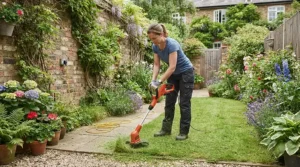
Twist the head, and a line trimmer becomes an edger. That’s the Flymo’s trick.
It packs a 500W motor, 25cm cutting width and a 10-metre cable, and an edging wheel helps it track along hard borders. The 500W motor gives it enough grunt for tough grass, and it has a plant guard to protect delicate planting. A telescopic handle adjusts to your height. One caution: retailer listings disagree on weight, with figures ranging from roughly 3kg to 3.9kg, and one retailer quotes about 80.3 dB(A) for noise, so check the listing before buying.
An important point on precision control: this is a line trimmer in edging mode, so it trims the grass at the border but doesn’t cut a vertical trench. It’s brilliant for maintaining a border that already exists. It’s the wrong tool for creating one.
Argos reviewers’ feedback, as summarised on its listing, praises effectiveness and sturdy build, though some find it heavy and the assembly instructions poor.
Pros:
- ✅ Twist-to-edge head switches modes quickly
- ✅ Wheel helps track straight along kerbs
- ✅ Telescopic handle suits different heights
Cons:
- ❌ Heavy for its category, per some users
- ❌ Can’t cut a new vertical trench
Look for the £60-£70 range at the time of research, and check current price. Strong value for longer runs of established border.
7. STIHL FSA 57 — the premium, quiet cordless option
If budget isn’t the problem, this is where electric edging gets properly civilised.
Expert Reviews describes it as quiet and lightweight, at around 2.7kg and 149cm long, with an adjustable loop and extendable handle. It’s part of STIHL’s AK battery system, so batteries can be shared across other tools. Three battery options deliver roughly 25 to 60 minutes of runtime. The recommended AK10 gives about 25 minutes but weighs less and keeps the tool better balanced, which is a useful trade-off most buyers overlook.
Here’s the real-world meaning: if you already own, or plan to buy, other tools in the AK range, the effective upfront cost drops because batteries are shared. If you’d be buying into the system just for edging, it’s hard to justify against a £60-£70 corded trimmer.
I couldn’t verify a sufficient pool of customer reviews for me to summarise honestly, so I’m relying on Expert Reviews’ Best Battery-Powered designation. Availability varies by retailer, so check whether your preferred store stocks the bundle you want, and whether a battery and charger are included.
Pros:
- ✅ Quiet in use, according to testers
- ✅ Shared AK battery system saves money across tools
- ✅ Adjustable loop and extendable handle
Cons:
- ❌ Very high upfront cost
- ❌ Short runtime on the recommended light battery
Expect the £300-£350 range for the tool at the time of research, so check current price and what’s included. Premium value only if you’ll use the wider range.
Top 7 Comparison Table
| Product | Type | Key spec | Price range | Review signal | Best For |
|---|---|---|---|---|---|
| Fiskars Solid Lawn Edger | Manual | Trapezoidal boron steel blade, about 1.85kg | £30-£40 | Expert Reviews: best for straight edges | Formal lawns and straight borders |
| Draper Stainless Steel Lawn Edger | Manual | Stainless blade, about 0.75kg | £25-£30 | Expert Reviews: Best Buy for durability | Curved beds and long-term ownership |
| Wolf-Garten RMM Multi-Change Lawn Edge Iron | Manual | Self-sharpening head, about 0.61kg | Under £20 | Expert Reviews: largest tread plate | Shared household tools |
| Unibos Carbon Steel Head Lawn Edger | Manual | Carbon steel head, about 0.75kg | Under £10 | Expert Reviews: best budget | First-time buyers |
| VonHaus 2 in 1 Cordless Trimmer & Edger | Cordless | 3.6V, about 700g, 30 min edging | £25-£35 | Expert Reviews: best for tidy-ups | Small gardens, finishing touches |
| Flymo Contour 500E | Corded | 500W, 25cm width, 10m cable | £60-£70 | Retailer feedback: effective, some find it heavy | Longer established border runs |
| STIHL FSA 57 | Cordless | AK battery system, about 2.7kg | £300-£350 | Expert Reviews: best battery-powered | Large gardens and existing STIHL owners |
The table makes the trade-off blunt: manual tools cluster under £40 and win on precision control, while the electric range spans from a £30 tidy-up tool to a £300+ system. If I had to pick one value standout, it would be the Draper Stainless Steel Lawn Edger, which is cheap enough to buy without agonising yet solid enough to last. For larger edge runs, the Flymo Contour 500E hits the sweet spot between price and capability.
How to Choose Between a Manual vs Electric Lawn Edger
If you’re weighing a manual vs electric lawn edger, work through these seven steps in order. Each narrows the field faster than browsing product pages.
- Measure your total edge length. Walk the borders and count the metres. Under about 30 metres, manual is very manageable. Rolawn’s edging guide suggests manual edging suits most lawns and that a motorised edger is worth considering for large ones.
- Identify the edge type. Soft edges against beds need a vertical cut. Hard edges against paths and kerbs suit a trimmer’s edging wheel.
- Decide whether you’re creating or maintaining. Creating a trench needs a blade. Maintaining one is where electric excels.
- Check your soil. Clay and chalk soils reward heavier, sharper steel. Light loam is forgiving for almost any tool.
- Be realistic about your body. Manual edging is a workout. If you have back or wrist issues, a lighter tool or a powered option may suit better.
- Set a total budget. Include extras such as a plug-in RCD for corded tools, spare batteries or spare line.
- Count your existing tools. Already own a battery ecosystem? That tilts the maths in favour of a compatible cordless option.

Precision Control: How Manual vs Electric Lawn Edger Cuts Compare
Precision control is where the manual vs electric lawn edger debate gets interesting. It’s the place where the cheaper tool often beats the pricier one.
A half-moon blade cuts exactly where you put it, at the depth you press it. Mark the line with string or cut against a board, and the results can look surgically precise. As the RHS advises, you stand on the flattened top of the blade so it goes in fully, then work along your line. That’s a slow, deliberate process, and the slowness is the precision control.
An electric trimmer in edging mode trades that for speed. The wheel tracks along a hard edge, so it’s brilliant against a patio or kerb, but along a soft bed edge it relies on your steady hand and eye. It also trims rather than slices, so it can’t give you a vertical wall of turf.
Here’s the practical rule. For absolute precision control on beds, choose manual. For good-enough precision on long, hard-edged runs, a powered tool is faster. If you want both, buy a cheap manual edger for the annual reshaping and a trimmer for the quick weekly tidy.
Upfront Cost vs Long-Term Value: What You Really Pay
Upfront cost is the number that sells you the tool, but it’s rarely the whole story.
| Tool type | Upfront cost range | Extra running costs | Best For |
|---|---|---|---|
| Manual half-moon | Under £10 to around £40 | Occasional sharpening | Unibos Carbon Steel Head Lawn Edger for tight budgets |
| Cordless mini edger | Around £25 to £35 | Eventual battery replacement | VonHaus 2 in 1 Cordless Trimmer & Edger for small lawns |
| Corded trimmer-edger | Around £60 to £70 | Spare line, plus a plug-in RCD of around £10 | Flymo Contour 500E for long established borders |
| Premium cordless | Around £300 to £350 | Spare batteries | STIHL FSA 57 for existing STIHL owners |
A manual tool in the £25-£35 range used 15 times a year for a decade works out at roughly 15-25p per session. A corded trimmer in the £60-£70 range, used 20 times a year for five years, lands near 60-70p per session before line and electricity. A premium cordless system at £300-£350 used 20 times a year for eight years comes to around £2 per session.
None of that makes premium wrong. It makes it a convenience purchase, not a value one. Unless the premium tool replaces other tools or saves your back, the cheapest route usually wins on cost per use.
Best Lawn Edger for Clean Borders: Match the Tool to the Edge
There’s no universal best lawn edger for clean borders. There’s only the best tool for the border in front of you.
Straight formal edges along paths and patios suit the Fiskars Solid Lawn Edger, whose squared blade holds a line beautifully. Curved flower beds suit the narrower Draper Stainless Steel Lawn Edger or the lighter Wolf-Garten RMM Multi-Change Lawn Edge Iron, which turn smoothly without fighting the arc. Tough clay or chalk is where heavier stainless steel earns its keep. Expert Reviews rated the Wilkinson Sword stainless steel edging blade, a manual tool in the £40 range at the time of its review, best for hard ground.
Long hard-edged runs against kerbs and driveways suit a trimmer with an edging wheel, like the Flymo Contour 500E. Quick tidy-ups between big sessions suit the VonHaus 2 in 1 Cordless Trimmer & Edger. Finally, a mixed garden with all of the above is where the hybrid approach shines: a manual tool for structure, a powered tool for upkeep.
When shoppers search for the best lawn edger for clean borders, the real answer is a short list, not a single winner.
Practical Usage Guide: Getting a Crisp Edge in Your First 30 Days
Most guides skip how to actually use these tools. Here’s a practical routine that works for either camp.
Setting up a manual edge. Mark your line with string for straight edges, or a garden hose for curves. Stand with your back to the lawn, press the blade vertically about 5cm deep, and overlap each cut slightly. Aim for a drop of around 7.5cm from lawn to border, as the RHS recommends in its edge maintenance guide, which helps keep plants off the grass and grass out of the border.
Maintaining with a trimmer. Mow first, then edge. Tilt the head into edging mode, rest the wheel on the hard surface, and walk steadily. Keep the line short and fresh.
Common first-month mistakes:
- Edging wet turf, which tears rather than cuts.
- Skipping the string line and drifting off-course.
- Trying to create a new trench with a line trimmer.
- Letting the blade go blunt, which turns edging into hard labour.
A simple schedule. Redefine edges once a year with the manual tool, often over winter. Trim after each mow in the growing season. Wipe blades dry after each use.
Real-World Scenarios: Which Tool for Which Garden?
These are illustrative profiles, not testimonials. They show how the maths changes with your situation.
Scenario A: the compact terrace front lawn. Around 20 metres of edge, mostly straight, on a tight budget. The Unibos Carbon Steel Head Lawn Edger under £10 handles the annual cut. Add the VonHaus 2 in 1 Cordless Trimmer & Edger for tidy-ups. Total outlay stays well under £50.
Scenario B: the family garden with curvy beds. Around 60 metres of edge, mixed soft and hard. Buy the Draper Stainless Steel Lawn Edger for the annual bed reshaping and the Flymo Contour 500E for weekly tidying along the driveway and patio. That’s roughly £90 for a robust two-tool setup.
Scenario C: the large garden with existing battery tools. Over 100 metres of border, regular use, and an existing STIHL battery stash. The STIHL FSA 57 makes sense because batteries are already paid for. Pair it with a Fiskars Solid Lawn Edger for annual structural work.

Buyer’s Decision Framework: If This, Then That
Short on time? Use this checklist.
- If your upfront cost ceiling is £10: choose the Unibos Carbon Steel Head Lawn Edger, because it’s the cheapest credible blade.
- If your borders are straight: choose the Fiskars Solid Lawn Edger, because the squared blade keeps lines true.
- If your beds curve: choose the Draper Stainless Steel Lawn Edger, because the narrower blade turns cleanly.
- If you share the job with someone of a different height: choose the Wolf-Garten RMM Multi-Change Lawn Edge Iron, because handles are interchangeable.
- If you only need quick snips: choose the VonHaus 2 in 1 Cordless Trimmer & Edger, because it’s light and cheap.
- If you have long, established hard edges: choose the Flymo Contour 500E, because the wheel does the tracking.
- If you own battery tools already: consider the STIHL FSA 57, because the shared batteries cut the true cost.
When in doubt, start with a manual tool. You can always add a powered one later.
Features That Actually Matter (And Those That Don’t)
Marketing copy loves a long feature list. Most of it won’t change your edge.
Features that matter:
- Tread depth and width. A shallow tread hurts your foot over long sessions, which is why testers flagged it on the Unibos Carbon Steel Head Lawn Edger.
- Handle length. A longer shaft keeps your back straighter.
- Blade material. Stainless or carbon steel resists wear. Self-sharpening heads, like the Wolf-Garten RMM Multi-Change Lawn Edge Iron, reduce maintenance.
- Edging wheel. On powered tools, it’s what makes straight tracking possible.
- Battery ecosystem. Shared batteries can decide the whole purchase.
Features that matter less:
- “4-in-1” multi-modes you’ll never use.
- Extra spools and accessories bundled to inflate the box.
- Top-end wattage on tools you’ll use briefly.
Lawn Edgers vs Traditional Alternatives: Spade, Shears and Trimmers
You don’t strictly need a dedicated edger. A spade, shears or a line trimmer can all do part of the job.
| Tool | Strength | Weakness | Best For |
|---|---|---|---|
| Garden spade | Already owned, cuts a vertical edge | Awkward angle, tiring | One-off jobs on a tight budget |
| Edging shears | Perfect for post-mow tidying | Slow on long runs | Weekly neatening with the VonHaus 2 in 1 Cordless Trimmer & Edger as a faster alternative |
| Half-moon edger | Best precision control, cheap | Physical effort | Draper Stainless Steel Lawn Edger for curved beds |
| Line trimmer in edging mode | Fast, wheel-guided | Can’t cut a trench | Flymo Contour 500E for hard edges |
Rolawn notes a spade can substitute if you can’t get a proper tool. In practice, the half-moon shape is simply better designed for the job. For anyone who edges more than once a year, a dedicated tool pays for itself in comfort, and a spade is best treated as a stopgap.
Safety, Noise and Regulations: What UK Gardeners Should Know
Edging looks gentle, but a few safety basics are worth knowing.
Corded electric tools. Always use a residual current device (RCD). Electrical Safety First has found that over a quarter of Brits had never heard of an RCD, and it says a plug-in version can cost as little as around £10. Avoid wet grass, keep the cable behind you, and check the lead for damage before each use. The Flymo Contour 500E is a mains tool, so this applies directly.
Cordless tools. Charge batteries on a hard surface away from flammable material, and use the supplied charger. For tools like the STIHL FSA 57, follow the manufacturer’s battery guidance.
Manual tools. Wear sturdy boots because you’re pressing a sharp blade down with your foot. Store blades dry and guarded.
Markings. Look for CE or UKCA marking on electrical equipment, and check the current listing since marking requirements evolve. Noise matters for neighbours, too: quiet cordless tools are friendlier on a Sunday morning.
Frequently Asked Questions
❓ Is a manual or electric lawn edger better for a small garden?
❓ Can a cordless electric lawn edger cut a brand-new border?
❓ How much should I spend on a lawn edger in the UK?
❓ Do I need an RCD for a corded electric lawn edger?
❓ How often should I edge my lawn?
Conclusion
If you take one thing from this manual vs electric lawn edger comparison, make it this: the best tool depends less on the tool and more on your edges. Manual tools win on precision control and long-term cost. Electric tools win when sheer distance is the enemy.
For most UK gardens, the smartest setup is a hybrid. Buy one manual edger, such as the Draper Stainless Steel Lawn Edger for curved beds or the Fiskars Solid Lawn Edger for straight lines, and use it once a year to define the edge. If you’re counting pennies, the Unibos Carbon Steel Head Lawn Edger gets you started for under £10. Then add a powered tool for upkeep, such as the Flymo Contour 500E for longer hard-edged runs, or the VonHaus 2 in 1 Cordless Trimmer & Edger for small gardens. Only consider the STIHL FSA 57 if you already own, or plan to buy, a battery system that makes the premium upfront cost worthwhile.
Whatever you choose, prices and availability change, so check current listings before you buy.
✨ Ready to Sharpen Up Your Borders!
🌿 Pick the tool that fits your garden, click through to check current pricing and availability, and give your lawn the crisp finish it deserves. Your borders will thank you!
Recommended for You
- Lawn Edgers Under £50: 7 Proven Picks, No Regrets (2026)
- Brush Cutter For Brambles: 7 Best Picks For UK Gardens (2026)
- Brush Cutter For Smallholdings: 7 Best Picks For UK Land (2026)
Disclaimer: This article contains affiliate links. As an Amazon Associate, I earn from qualifying purchases. If you purchase products through these links, we may earn a small commission at no additional cost to you.
✨ Found this helpful? Share it with your friends! 💬🤗
