
In This Article
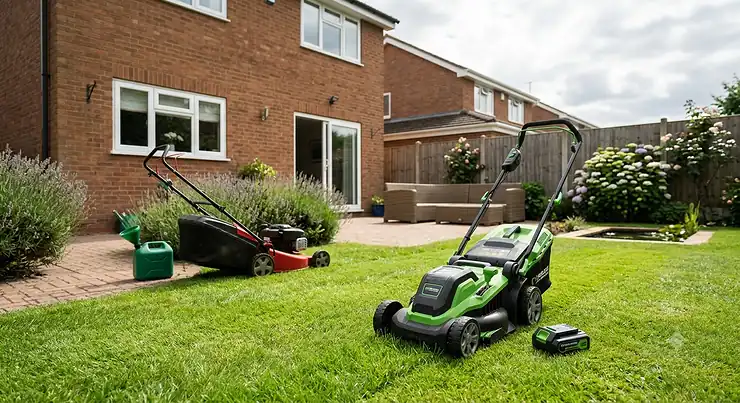
There’s a quiet revolution happening in British gardens. Not dramatic, not especially fast — it’s been creeping along for a few years now — but by 2026, it’s essentially complete. The petrol mower, that temperamental, noise-making, fuel-reeking institution of the British weekend, is losing ground to cordless battery mowers at a pace that would have seemed faintly ridiculous a decade ago.
And yet, petrol hasn’t surrendered entirely. For larger lawns, rough terrain, or gardeners who’d rather not think about charging schedules, petrol still makes a compelling case. So the question of cordless vs petrol lawn mower isn’t as settled as the battery camp would have you believe — it genuinely depends on your situation.
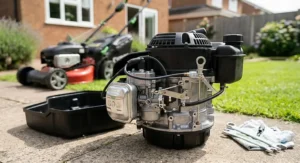
What is a cordless lawn mower, exactly? It’s a battery-powered rotary mower that runs on a removable lithium-ion pack — no cable, no fuel, no fumes. Petrol mowers, by contrast, use a small four-stroke engine, typically between 120cc and 200cc, to drive a steel blade through your lawn with considerably more brute force.
This guide cuts through the marketing noise (both brands are guilty of it) and gives you seven real, currently available products on Amazon.co.uk with honest assessments of who each one is actually for. Whether your garden is a trim 80m² courtyard in Chorlton or a sloping half-acre in the Surrey Hills, there’s a right answer here. Let’s find it.
Quick Comparison: Cordless vs Petrol Lawn Mower at a Glance
| Feature | Cordless | Petrol |
|---|---|---|
| Running cost (annual) | £5–£15 (electricity) | £40–£80 (fuel + oil) |
| Servicing cost | Minimal | £50–£120/year |
| Noise level | ~75 dB | ~95 dB |
| Max practical lawn size | Up to ~800m² (premium) | Unlimited |
| Startup | Instant | Pull-cord or key start |
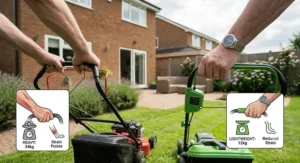
| Weight | 10–25 kg | 25–40 kg |
| Wet weather performance | Good (modern models) | Excellent |
| Environmental impact | Zero emissions in use | CO₂ + noise pollution |
| Best for | Most UK suburban gardens | Large lawns, rough terrain |
The table makes the pattern clear: cordless wins on convenience, cost, and ease; petrol wins on raw power and unlimited runtime. What it doesn’t show is how dramatically that gap has narrowed since 2020. A premium cordless mower in 2026 will handle grass that would have bogged down a battery mower three years ago — and it’ll do it considerably more quietly than your neighbours would prefer you knew.
💬 Just one click — help others make better buying decisions too! 😊
✨ Don’t Miss These Exclusive Deals!
🔍 Ready to upgrade your lawn care game? Click on any highlighted product below to check current pricing and availability on Amazon.co.uk. These are hand-picked for real British gardens — not just impressive on paper.
Top 7 Cordless and Petrol Lawn Mowers: Expert Analysis
1. EGO Power+ LM1903E-SP — Best Overall Cordless
The EGO LM1903E-SP is, without exaggeration, the mower that made serious gardeners stop dismissing cordless as a “small garden” option. It’s the one most petrol converts reach for. The 56V Arc Lithium battery platform is genuinely class-leading — EGO claim up to 800m² on a single 5Ah charge, and while British conditions (longer, wetter grass) will knock that down to roughly 500–600m², that still covers the vast majority of UK domestic gardens comfortably.
The 47cm cutting width is what elevates it beyond the competition at a similar price. More deck width means fewer passes, which matters when you’re battling the kind of lush, slightly damp grass that a typical English summer produces. The self-propelled drive system takes the effort out of slopes — and if you live anywhere hilly, like Bristol, Sheffield, or most of Scotland, that’s not a luxury, it’s essential. Seven cutting heights between 25mm and 80mm, a 55-litre grass box, and a brushless motor that should outlast the garden it’s mowing round off an impressively complete package.
UK reviewers consistently note the transition from petrol: “So much easier than my old four-stroke. Folds flat, stores upright, no petrol fumes in the shed.” That sums it up rather well.
✅ 56V platform compatible with other EGO tools (string trimmers, blowers)
✅ Self-propelled — ideal for sloping gardens
✅ 5-year warranty on mower body
❌ Premium price point — probably overkill for a small town garden
❌ Mulching plug sold separately
Price range: £500–£650 | Amazon.co.uk: In stock, Prime-eligible | Best for: Medium to large gardens (300–800m²), petrol-to-cordless converts, anyone with a slope.
2. Bosch AdvancedRotak 36-660 — Best Value for Most UK Gardens
If the EGO is the Tesla of cordless mowers, the Bosch AdvancedRotak 36-660 is the dependable Golf GTI — less flashy, arguably better suited to everyday British life, and considerably easier on the wallet. The 36V system is Bosch’s POWER FOR ALL platform, which means your batteries work across their full range of garden tools. Already own a Bosch hedgetrimmer or grass trimmer? Your existing batteries slot straight in. That’s not a trivial point when you consider how quickly a tool ecosystem adds up.
The 40cm cutting deck covers lawns up to around 660m², though in practice the twin 2Ah batteries deliver closer to 45–50 minutes of real-world mowing — sufficient for most British suburban gardens of 200–350m². The ProSilence motor technology genuinely reduces noise by up to 60% compared to a comparable petrol mower, which your Sunday morning neighbours will notice with gratitude. ErgoSlide handles adjust to your height, keeping your back happy over a long mowing session.
One spec worth highlighting: the LeafCollect blade isn’t just a marketing flourish. It genuinely shreds and collects leaves efficiently, making this mower useful right through to November in a typical British garden.
✅ Bosch 36V POWER FOR ALL battery compatibility
✅ Whisper-quiet ProSilence motor
✅ LeafCollect blade extends usability into autumn
❌ 40cm deck means more passes on larger lawns
❌ Included 2Ah batteries could be more substantial — 4Ah upgrade recommended
Price range: £280–£380 | Amazon.co.uk: In stock | Best for: Suburban gardens up to 300m², Bosch tool ecosystem owners, noise-conscious households.
3. Worx WG779E.2 — Best Compact Cordless for Small Urban Gardens
Small garden, tight gate, awkward corners, and a shed already full of things you’ve forgotten you own. Sound familiar? The Worx WG779E.2 is designed with exactly this sort of constrained British garden in mind. At 34cm cutting width and notably lighter than most competitors, it’s manoeuvrable in a way that larger mowers simply cannot match.
The 40V PowerShare platform is Worx’s cross-tool ecosystem — the same batteries run their string trimmers, hedgecutters, and leaf blowers. The two included 2Ah batteries give around 30 minutes of combined runtime, which is tight for anything over 150m² but perfectly adequate for the compact gardens it’s designed for. The built-in rear roller is a genuine bonus here: it gives you those classic lawn stripes, which on a small garden makes an outsized visual difference. Getting stripes from a cordless mower at this price point is quite the trick.
UK reviewers note it struggles in longer growth — if you’ve left the grass for three weeks (we’ve all been there), reduce speed or expect the motor to work harder. Weekly mowing keeps it happy.
✅ Lightweight and highly manoeuvrable
✅ Rear roller for lawn striping
✅ 40V PowerShare ecosystem
❌ 30-minute runtime is limiting for gardens over 150m²
❌ Not suited for long or wet grass
Price range: £150–£200 | Amazon.co.uk: In stock, Prime-eligible | Best for: Small urban gardens up to 150m², terraced houses, those wanting stripes on a budget.
4. Greenworks G40LM41K2X — Best Budget Cordless with Wide Cut
Here’s something the marketing doesn’t always tell you: Greenworks is not a brand you should be snobby about. The G40LM41K2X is a 40V machine with a 41cm cutting deck — wider than you’d typically expect at this budget level — paired with two 2Ah batteries and a charger. That means you’re getting a genuinely capable mower for lawns up to around 400–500m², which covers a significant chunk of the UK detached-house garden market.
The 50-litre grass box is generous, the five cutting heights (25–75mm) cover everything from a bowling-green finish to tackling a lawn that’s had a fortnight’s holiday to grow undisturbed, and the build quality feels surprisingly solid for the price. Where it earns its caveats: the dual-battery system means swapping packs mid-mow on larger areas, and in long wet grass the motor slows perceptibly — you’ll need to ease off the pace. A 3-year Greenworks guarantee adds meaningful peace of mind.
For anyone hesitant about spending over £400 on their first cordless mower, this is the sensible starting point.
✅ Wide 41cm deck for the price bracket
✅ Two batteries included — no extra purchase needed
✅ 3-year guarantee
❌ Slows in long, wet grass
❌ 40V platform less powerful than 56V alternatives
Price range: £130–£180 | Amazon.co.uk: In stock | Best for: Budget-conscious buyers, first-time cordless, gardens up to 400m².
5. Hyundai HYM380LI — Best Cordless from a Trusted Petrol Brand
Hyundai has been one of the UK’s most-trusted petrol mower brands for years — sensibly priced, reliably built, and well-supported with UK-based parts and service. Their 40V cordless range brings that same philosophy to battery power. The HYM380LI features a 38cm cutting width, five cutting heights (25–65mm), a 40-litre grass box, and that reassuring 3-year Hyundai warranty — longer than most rivals at this price.
The brushless motor is the key technical spec here, and it matters more than the voltage number printed on the box. Brushless motors run cooler, last longer, and deliver more consistent power than older brushed designs — particularly important in the damp British summer, where motors run harder than the manufacturer’s test conditions. At just over 13kg (without battery), it’s lighter than petrol equivalents and manageable for most adults without strain.
This mower occupies a sensible middle ground: more capable than the entry-level options, less costly than the EGO or Greenworks premium tiers. For a typical semi-detached garden of 150–250m², it’s rather hard to argue against.
✅ Brushless motor for efficiency and longevity
✅ 3-year Hyundai warranty with UK parts support
✅ Lightweight at ~13kg
❌ 38cm deck is narrower than some rivals at the price
❌ 40-litre bag fills quickly on longer grass
Price range: £180–£250 | Amazon.co.uk: In stock | Best for: Mid-size gardens, Hyundai brand loyalists upgrading from petrol, those prioritising warranty support.
6. Hyundai HYM510SPE — Best Self-Propelled Petrol for Large Lawns
Now we cross into petrol territory, and the shift is immediately apparent. The Hyundai HYM510SPE is a 196cc self-propelled petrol mower with a 51cm cutting deck, electric start, and a 60-litre grass box. It’s designed for lawns from 400m² upward, and it takes them in its stride with a calm authority that no battery mower at a comparable price can currently match.
The electric start is the feature that transforms petrol mowing from a Saturday morning arm workout into something approaching civilised. No more pull-cord lottery — press the button, it starts. The 51cm deck means serious ground coverage per pass, and the self-propelled drive handles inclines that would have a cordless motor working at full tilt. The 60-litre bag means far fewer interruptions for emptying.
The honest caveat: annual servicing is non-negotiable. Budget approximately £60–£100 per year for a professional service (air filter, spark plug, oil change, blade sharpening), and factor in fuel — around £40–£60 per season for a typical large garden. Over five years, you’re looking at a considerably higher total running cost than cordless. But for a lawn above 500m², or terrain that’s genuinely rough and uneven, petrol remains the pragmatic choice.
✅ Electric start — genuinely transforms the petrol experience
✅ 51cm deck for rapid coverage of large areas
✅ Self-propelled for slopes
❌ Annual servicing required (£60–£100)
❌ Petrol storage, noise, and emissions are real considerations
Price range: £350–£450 | Amazon.co.uk: In stock | Best for: Large gardens (500m²+), rough terrain, rural properties.
7. Mountfield SP53 Elite — Best Premium Petrol with Honda Engine
The Mountfield SP53 Elite sits at the top of the petrol mainstream market, and its engine is why: the Honda GCVx170 with Autochoke. Honda’s small engines have a near-legendary reputation in the UK gardening world — they start reliably, run smoothly, and last for years with basic care. The Autochoke system eliminates the need to fiddle with a choke lever, which removes approximately 40% of the reasons petrol mowers frustrate people.
The 51cm deck (high-wheeler design with 280mm rear wheels) handles uneven ground with noticeably more composure than budget petrol alternatives. Five cutting heights from 27mm to 90mm — that upper range is particularly useful for managing a lawn that’s been left longer than intended, which in Britain’s unpredictable growing season happens more often than anyone admits. The 60-litre collector includes a full indicator, and a mulching plug is included as standard.
UK reviews are almost uniformly positive about cut quality and engine reliability. The main complaint: the instructions aren’t particularly clear during assembly. Once assembled, however, this is a machine that simply works, season after season. For a large-garden buyer who wants to buy once and not revisit the decision for a decade, the Mountfield SP53 Elite is the sensible premium choice.
✅ Honda GCVx170 with Autochoke — exceptional reliability
✅ High-wheel design for uneven terrain
✅ 90mm max cutting height for neglected lawns
❌ Higher price than comparable non-Honda petrol mowers
❌ Heavier than cordless at ~34kg
Price range: £450–£550 | Amazon.co.uk: In stock | Best for: Large gardens, buyers wanting long-term reliability, anyone with uneven terrain.
How to Choose: Cordless or Petrol in the UK — A Decision Framework
The honest answer is that your garden makes the decision for you, if you let it. Here’s how to think through it.
If your lawn is under 300m², cordless wins. Full stop. The EGO, Bosch, or Hyundai battery models will handle it on a single charge, with zero fuss and significantly lower running costs. The only reason to choose petrol at this size is if you genuinely leave the grass for three or four weeks between mowing — in which case, you’re creating a problem for yourself regardless of what you’re using.
If your lawn is 300–500m², it depends. A premium cordless like the EGO LM1903E-SP or the Greenworks 48V self-propelled will cope — just about — but you’ll be watching the battery indicator. If mowing frequency is weekly and terrain is reasonably flat, stay cordless. If the terrain is hilly or you mow less often, petrol is worth the servicing cost.
If your lawn exceeds 500m², petrol is still the practical choice for most people. The Hyundai HYM510SPE or Mountfield SP53 Elite will cover it in one session, every time, without any thought about charge levels.
Climate consideration: British weather adds nuance that the spec sheets ignore. Lithium-ion batteries lose approximately 10–15% performance in cold temperatures — relevant in Scotland, the north of England, or any region that sees regular sub-5°C mornings in spring and autumn when mowing sessions are most common. Petrol is indifferent to the cold. Cordless is not.
Storage consideration: Petrol mowers need ventilated storage to safely house fuel. In a terraced house with a narrow side passage or shared outbuilding, this matters more than most buyers consider in advance.
Real-World Scenarios: Which Mower for Which UK Garden?
Profile 1 — Jamie, Manchester, semi-detached with a 200m² rear garden. Jamie mows weekly in summer, bi-weekly in spring and autumn. Garden is mostly flat with a small slope near the fence. Budget: under £300. Recommendation: Greenworks G40LM41K2X. Wide deck, two batteries included, no servicing costs, and the 3-year guarantee removes most of the risk. Weekly mowing keeps the grass manageable for its modest motor.
Profile 2 — Sarah and Tom, Surrey, detached house with ~600m² of lawn including a modest bank. They mow every ten days to two weeks. Budget: up to £550. Recommendation: Hyundai HYM510SPE petrol. At this lawn size and mowing frequency, the battery mowers will either require multiple charges or won’t handle the slightly longer growth comfortably. The electric start makes the petrol experience bearable, and the self-propelled drive handles the bank.
Profile 3 — Marcus, Edinburgh, compact terraced garden around 90m², stored in a narrow shed. Mows once a week in season. No room or ventilation for petrol storage. Budget: up to £200. Recommendation: Worx WG779E.2. It’s light enough to manoeuvre in a tight space, the rear roller gives those satisfying stripes, and it charges in the shed without the fuel storage headache.
Profile 4 — David, rural Cotswolds, ~1 acre of mixed terrain including rougher edges. Mows every two weeks. Prioritises reliability over convenience. Budget: flexible. Recommendation: Mountfield SP53 Elite. The Honda engine and high-wheeler design were made for this type of garden. This mower will still be working in 2036.
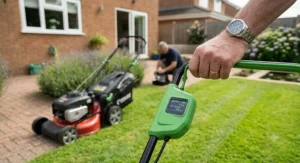
Running Costs Compared: What Cordless vs Petrol Lawn Mower Really Costs in the UK
This is where the cordless argument gets most compelling for the average British homeowner, and where the maths repays careful attention.
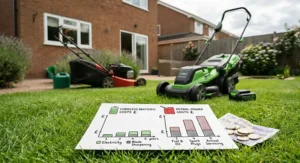
A typical petrol lawn mower for a medium garden (400m²) will consume roughly 3–4 litres of unleaded fuel per season. At current UK pump prices, that’s around £5–£6 per season in fuel — modest enough. But petrol also needs oil changes, and an annual service is genuinely non-negotiable if you want the engine to last. Factor in a professional service at a garden machinery dealer: £50–£120 per year depending on location and model. New spark plug every two seasons (£5–£10). Blade sharpening (£15–£20 annually). Over five years, you’re realistically spending £350–£600 on maintenance alone, on top of the purchase price.
Cordless mowers have no such ongoing costs. Electricity to charge a 5Ah, 56V battery costs approximately £0.25–£0.35 per full charge at current UK electricity rates. Mow weekly for 30 weeks a year — that’s roughly £10 in electricity per season. The blade will need sharpening every two to three years (£15–£20, or a DIY job). The battery is the main long-term cost: quality lithium-ion packs lose capacity after 500–800 charge cycles. Replacement batteries for premium brands run £80–£150. Even accounting for that, the five-year total running cost of a good cordless mower is substantially lower than petrol.
For the majority of UK gardens, cordless is the more economical choice over the life of the machine. Petrol justifies its cost through capability, not economy.
Common Buying Mistakes: What UK Buyers Get Wrong
Underestimating battery runtime in British conditions. Manufacturer runtime figures are typically measured on short, dry grass at room temperature. British autumn grass — damp, dense, and often left a week longer than planned — will reduce that figure by 20–30%. If your garden is near the stated limit of a battery mower, buy the next model up or budget for a spare battery upfront.
Ignoring the battery ecosystem. Batteries are expensive, and they’re not cross-brand compatible. If you’re already using Bosch garden tools, the AdvancedRotak’s 36V POWER FOR ALL system makes compelling sense. Worx, Greenworks, EGO, and Hyundai all run separate ecosystems. Choose one and commit — you’ll save significant money on subsequent purchases within the same system.
Buying US-spec petrol mowers. This is rarer than it used to be, but it occasionally catches buyers on marketplace listings. UK petrol mowers use unleaded (E10 compliant) fuel and are tuned for UK conditions. More commonly: always check that a mower listed on Amazon.co.uk is dispatched from UK stock, not a grey import.
Forgetting about storage. A 40cm+ petrol mower is a substantial object. Before purchasing, measure your shed or storage space, particularly gate width and door width. Some mowers that look manageable in product photos are surprisingly large in person — the Mountfield SP53, for example, isn’t a machine you want to navigate through a standard-width back gate if it doesn’t fit.
Assuming cordless can’t handle a large lawn. Equally, don’t dismiss cordless based on outdated assumptions. Premium 56V machines in 2026 are legitimately capable on lawns up to 600m² with the right battery capacity. Check the actual coverage figure for the included battery, not the maximum theoretical figure.
Maintenance: What Each Type Really Demands
Cordless and petrol mowers both require upkeep, but of very different kinds — and knowing the difference before you buy saves frustration later.
Cordless maintenance is simple and infrequent. Clean the underside of the deck after each mow (a stiff brush and a hose works fine — just keep water away from the battery contacts). Check the blade every season; a blunt blade tears rather than cuts, which stresses the motor and leaves a ragged finish. Sharpen or replace annually. Store the battery at around 50–60% charge if storing over winter — fully charging and leaving it dormant for months degrades lithium-ion cells faster. In a damp British shed, keep the machine elevated off the floor to avoid moisture ingress.
Petrol maintenance is more involved but well-understood. Before winter storage, run the engine dry of fuel (stale petrol is the number one cause of starting problems in spring) or use a fuel stabiliser like Briggs & Stratton’s product, readily available on Amazon.co.uk. Change the oil at the start of each season. Clean or replace the air filter annually. Check and replace the spark plug every two seasons. Have the blade professionally sharpened, or learn to do it yourself — a drill-mounted blade sharpener (under £10 on Amazon) makes it accessible.
The practical upshot: cordless requires about 20 minutes of annual maintenance. Petrol requires either three to four hours of your time each year, or a professional service. Both are manageable. Only you know which suits your temperament.
✨ Don’t Miss These Exclusive Deals!
🔍 Whether you’re going cordless or sticking with petrol, these seven picks are the ones worth your money in 2026. Click any highlighted product to check current pricing on Amazon.co.uk — all are in stock and eligible for Prime delivery.
Environmental Impact: The Honest Picture
A petrol lawn mower produces approximately 1kg of CO₂ per hour of operation — roughly equivalent to driving a modern car at motorway speeds. For a garden mowed weekly over a 30-week British season, that’s around 30kg of CO₂ per year, plus particulate emissions and hydrocarbon vapour. The UK government’s net zero strategy identifies small petrol engines as a non-trivial source of garden pollution, particularly in urban areas.
Cordless mowers produce zero direct emissions. The indirect emissions from grid electricity generation have fallen substantially as the UK has shifted its energy mix towards renewables — currently over 50% of UK electricity comes from low-carbon sources. If you charge from a domestic solar panel setup, the operational emissions are negligible. Even on grid power, a cordless mower’s lifecycle carbon footprint is significantly lower than petrol.
There’s a nuanced counterpoint, however: battery manufacturing does carry an environmental cost (lithium mining, cobalt processing), and batteries that aren’t responsibly recycled become a waste problem. Most UK local authorities accept lithium-ion batteries for recycling; the Battery Recycling guidance on GOV.UK covers disposal obligations. Responsible brands like Bosch and EGO offer take-back programmes. Use them.
UK Regulations & Safety Standards
🇬🇧 Garden machinery sold in Great Britain must carry UKCA marking (the post-Brexit equivalent of CE marking) confirming compliance with UK safety and electromagnetic compatibility standards. Products on Amazon.co.uk dispatched from UK stock will be UKCA or CE compliant (CE remains accepted under current transitional arrangements).
For petrol mowers specifically, noise regulations under the Outdoor Machinery Directive apply; permitted hours of use in residential areas vary by local council — most English councils recommend avoiding powered garden machinery before 8am and after 8pm on weekdays, and before 9am on weekends. This is guidance rather than enforceable law in most areas, but neighbour relations being what they are, it’s worth observing.
Under the Consumer Rights Act 2015, you’re entitled to a repair, replacement, or refund for products that develop faults within six years of purchase (England and Wales). Amazon UK’s return policy and the Consumer Contracts Regulations also provide a 14-day cooling-off period on all online purchases — longer than any comparable US consumer protection.
FAQ
❓ Is a cordless lawn mower as powerful as petrol in 2026?
❓ How long do cordless lawn mower batteries last in UK weather?
❓ Can I use a cordless mower on wet grass?
❓ What is the annual running cost of a petrol mower in the UK?
❓ Are petrol lawn mowers being phased out in the UK?
Conclusion
The cordless vs petrol lawn mower debate has, in 2026, largely resolved itself for the majority of British gardeners. If your garden is under 400m², on reasonably manageable terrain, and you mow with reasonable regularity — cordless is the sensible modern choice. Lower running costs, zero fumes, quieter operation, and a storage footprint that won’t terrify a terraced-house shed owner. The EGO LM1903E-SP is the premium benchmark. The Bosch AdvancedRotak 36-660 is the most balanced all-rounder. The Greenworks G40LM41K2X is the value entry point that won’t embarrass itself.
Petrol retains its crown for larger, rougher, or less frequently mowed lawns — and for the gardener who simply wants maximum capability without thinking about battery levels. The Hyundai HYM510SPE and Mountfield SP53 Elite are the two machines most worth considering in 2026, with the Mountfield’s Honda engine offering a level of long-term reliability that justifies its premium.
The honest final word: buy the smallest, quietest machine that genuinely handles your lawn. Your neighbours, your shed space, and your wallet will all thank you.
✨ Don’t Miss These Exclusive Deals!
🔍 All seven mowers reviewed here are available on Amazon.co.uk right now. Click any highlighted product to check current pricing and Prime availability. Whether you’re going battery or petrol, these are the picks worth your money in 2026.
Recommended for You
- Best Cordless Lawn Mower for Large Garden UK 2026: 7 Expert Picks
- Best Cordless Lawn Mower Under £200 UK: 7 Top Picks for 2026
- Cordless Lawn Mower UK: 7 Best Picks for British Gardens 2026
Disclaimer: This article contains affiliate links. As an Amazon Associate, I earn from qualifying purchases. If you purchase products through these links, we may earn a small commission at no additional cost to you.
✨ Found this helpful? Share it with your mates! 💬🤗
