

In This Article
Brush cutters under £250 are petrol, cordless or mains-powered garden machines that swing a nylon line head or metal blade on a long shaft, priced below £250. They tackle brambles, nettles and neglected grass that would make an ordinary strimmer sulk, while still trimming lawn edges when asked nicely.
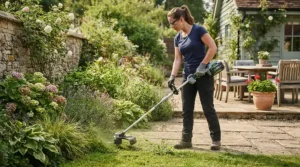
Every British garden has That Corner. Behind the shed, along the fence, down the bank where the mower can’t go. The string trimmer family has been fighting that battle since the 1970s. Even the word “strimmer” began life as a Black+Decker UK trademark in 1977. Brush cutters are its heavier-duty cousins: more power, sturdier shafts, and the option of a metal blade.
Why £250? Below about £100 you’re mostly buying a strimmer with ambitions. Above £250 you’re paying for professional durability that most households never fully use. In between, brush cutters under £250 offer real cutting power, sensible warranties and a choice of fuel type that suits your garden rather than your ego.
One thing up front: everything below comes from manufacturer specifications and aggregated reviewer sentiment. None of it claims hands-on testing. I’ve matched seven real machines to real garden problems, and tied each to what the spec sheet means in practice. Prices are ranges at the time of research and will move.
Quick Comparison: Best Brush Cutters Under £250 at a Glance
| Model | Power source | Cutting width (blade / line) | Best for |
|---|---|---|---|
| Hyundai HYBC5200X | 52cc petrol | 255mm / 450mm | Best-value petrol power |
| Einhell GC-BC 52 I AS | 51.7cc petrol | 255mm / 420mm | Big, overgrown plots |
| Stihl FS 38 | 27.2cc petrol | Line only / 380mm | Light trimming, small gardens |
| Greenworks GD40BC | 40V battery | Blade included / roughly 350-400mm | Quiet, low-maintenance gardens |
| Einhell AGILLO 36/255 BL | 36V (2×18V) battery | 255mm / 300mm | Einhell battery owners |
| Ryobi OBC1820B | 18V battery | 200mm / 300mm | Ryobi ONE+ owners, light brush |
| Bosch AFS 23-37 | 950W mains | 230mm / 370mm | Small plots near a socket |
Read across the “Best for” column and a pattern emerges. The two 52cc petrol machines are for land that fights back, and the three battery models are for people who value peace, quiet and no petrol can. The Bosch AFS 23-37 is the outlier: cheap, capable, and tethered to an extension lead. If your garden is small and your patience for fuel mixing is smaller, the middle of that table is where you’ll probably end up.
💬 Just one click — help others make better buying decisions too!😊
Top 7 Brush Cutters Under £250: Expert Analysis
Three petrol machines, three cordless, one corded. Each entry below explains what the specs mean in practice, what reviewers keep saying, and who should skip it. Where I couldn’t verify a rating, I say so rather than invent one.
1. Hyundai HYBC5200X — petrol power with a three-year warranty
The standout is the paperwork: Hyundai backs this machine with a 3-year home-use warranty (1 year commercial, terms apply), which is rare at this price.
The 52cc two-stroke engine comes with a bump-feed head (450mm swath) and a 3-tooth metal blade (255mm swath). Hyundai stresses strong mid-range torque, which on paper means the engine can pull through thick growth without being screamed at full revs. That matters for longevity. The pre-mix ratio is listed at 40:1 on older listings, and it needs a twin harness because older listings put the weight around 9kg.
Based on the specs, this suits large, scruffy plots, brambles and river banks rather than a tidy semi. In a UK owner-forum thread on this budget, several members praised Hyundai’s build quality. Others said they’d pay more for a Stihl if they used the machine heavily. I couldn’t verify a retailer star rating for this article, so check current reviews.
Pros:
- ✅ Strong three-year home warranty
- ✅ Blade and line head both supplied
- ✅ Split shaft eases storage and transport
Cons:
- ❌ Heavy for anyone with a bad back
- ❌ Two-stroke pre-mix fuel is a faff
Price: roughly £130-£200 depending on retailer. For sheer cutting capacity per pound, it’s hard to beat.
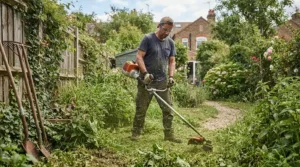
2. Einhell GC-BC 52 I AS — big engine, digital ignition
Einhell’s pitch is a 51.7cc engine rated at 1.5kW, with digital ignition for dependable starting.
The spool is quoted at around 7,000rpm with a 420mm swath, and a 3-tooth blade covers 255mm. A double-bearing crankshaft and anti-vibration design aim to tame the shake that makes petrol machines tiring. Sources quote the weight anywhere from about 8kg to 10kg, so treat that as an unsettled figure and lean on the carry strap.
Compared with the Hyundai HYBC5200X, this is the closer call for people who want a European brand name over a longer warranty. One reviewer at EasyLawnMowing liked the two-in-one design and split shaft, but found the handle unpadded, which they said calls for good gloves. That’s a useful detail the spec sheet never mentions.
Pros:
- ✅ Serious 1.5kW power for dense growth
- ✅ Double-bearing crank, anti-vibration design
- ✅ Blade and auto-feed spool included
Cons:
- ❌ Heavy, with an unpadded handle
- ❌ Reported weight varies between sources
Price: roughly £150-£240 depending on retailer. Great for big clearances, though I’d budget for decent gloves.
3. Stihl FS 38 — the featherweight petrol option
Stihl’s own retailers call it the lightest machine in the range, at about 4.2kg.
The 27.2cc 2-MIX engine produces 0.65kW (0.9hp), with a loop handle and an AutoCut line head giving a 380mm swath. The primer bulb helps starting after a long break. Here’s the catch, stated plainly: Stihl-listed details say this model cannot take a steel blade, only line or a PolyCut plastic-blade head. So it’s a premium lightweight trimmer, not a bramble-basher. It earns a place because it’s the best lightweight brush cutter alternative for people whose “brush” is really long grass and weeds.
Aggregator sites report high satisfaction, but treat those rankings with scepticism because methods vary. Sound pressure is listed around 94dB(A) with a plastic head, which still warrants ear defenders.
Pros:
- ✅ Very light at roughly 4.2kg
- ✅ Trusted dealer network for servicing
- ✅ Easy-start primer system
Cons:
- ❌ Cannot fit a steel blade
- ❌ Pricey for its modest power
Price: around the £200-£250 mark, right at this budget’s edge, so check current price. Buy it for lightness, not for brambles.
4. Greenworks GD40BC — the quiet, blade-ready battery option
The GD40BC pairs a brushless 40V motor with a 4.9kg body, roughly half the weight of the big petrol machines.
The dual 2mm nylon line head bump-feeds, and a steel brush cutter blade is included for thicker growth. Variable-speed control means gentle work near gravel paths, and the maximum head speed is quoted at 5,500rpm. Greenworks lists a 40cm swath, though a Screwfix listing quotes 35cm, so check the exact listing before you buy. The aluminium split shaft folds down neatly.
Reviewers such as Pyracantha position it as the more affordable runner-up among cordless models. The trade-off is run time: you buy the machine, then the battery, and batteries are where the real money goes.
Pros:
- ✅ Light and easy to manoeuvre
- ✅ Blade included for thicker growth
- ✅ Battery fits other Greenworks 40V tools
Cons:
- ❌ Batteries often sold separately
- ❌ Run time limits big jobs
Price: about £140-£200, depending on whether batteries are included. Ideal for small-to-medium gardens where noise matters.
5. Einhell AGILLO 36/255 BL — best value if you own Einhell batteries
This is a value story for Power X-Change owners: a brushless 36V machine (two 18V batteries) that ships bare.
It has a 3-tooth 255mm blade, a spool with a 300mm swath and a spindle lock to change heads quickly. Einhell advertises a brushless motor warranty of up to 10 years after online registration. BrushcutterHQ calls it strong value, but says the string head divides opinion while blade performance is hard to fault.
The tricky bit is total cost. Bare, it sits comfortably within budget. Add a starter kit with two 4.0Ah batteries and a twin charger, and you may nudge past £250. If you already own Einhell batteries, this is one of the strongest brush cutters under £250. If you don’t, check the bundle price before falling in love.
Pros:
- ✅ Brushless motor for longevity
- ✅ Real 255mm metal blade
- ✅ Batteries shared across the range
Cons:
- ❌ Bare unit needs batteries
- ❌ String head gets mixed opinions
Price: bare unit under about £150; kits can climb well beyond that, so check current price.

6. Ryobi OBC1820B — lightest blade-equipped 18V option
The OBC1820B is a bike-handle 2-in-1 that weighs around 4.7kg bare or 5.1kg with a battery pack.
It has a 20cm TriArc steel blade and a 30cm line head with 1.6mm line, powered by any 18V ONE+ battery. Ryobi’s data lists vibration around 1.4-1.6m/s² at the handles and sound power of 93.5dB(A), which is modest for a machine that can handle brambles. It’s balanced around a central motor, which makes it feel calmer in the hand.
Buyer reviews on a UK tool retailer describe it as surprisingly capable and not too heavy. One owner used it on Himalayan balsam and brambles and said it managed well, though a mains model had a bigger kick. A separate review notes that the 20cm blade may struggle with really dense vegetation. That’s honest and fits the spec.
Pros:
- ✅ Light, balanced bike-handle design
- ✅ Blade and line head both included
- ✅ Huge ONE+ battery ecosystem
Cons:
- ❌ 20cm blade limits dense-growth speed
- ❌ Batteries and charger usually extra
Price: roughly £100-£190 depending on whether batteries are bundled. Great for light-to-medium brush, especially if you already own ONE+ tools.
7. Bosch AFS 23-37 — corded simplicity for small plots
The Bosch AFS 23-37 is the quiet achiever: a 950W corded machine with a 23cm blade and a 37cm line head.
It ships with an extra-strong 3.5mm line and a metal blade, and switches between them without removing the guard. Weight is quoted between about 4.5kg and 5.7kg depending on the source, and the aluminium motor housing suggests decent durability. The 950W motor (Bosch’s “1.3hp” claim) is in the range typical of mains machines, which Wikipedia notes generally run from 400 to about 1,200W.
One reviewer on a UK tool retailer praised the power and service. There’s no fuel to mix, no battery to charge, and no run-time anxiety, but you’re on a lead, so it suits plots within extension-cable range. It’s also the one machine here that will never be sold in a sad “battery not included” bundle.
Pros:
- ✅ No fuel, battery or run-time worries
- ✅ Blade and heavy 3.5mm line included
- ✅ Light enough for long sessions
Cons:
- ❌ Cable limits range
- ❌ Less power than 52cc petrol
Price: roughly £100-£150. Superb value for small plots near a socket.
Here’s how the seven stack up on the numbers that matter most.
| Model | Power | Weight (approx.) | Warranty / notes | Price range |
|---|---|---|---|---|
| Hyundai HYBC5200X | 52cc petrol | ~9kg | 3-year home warranty | £130-£200 |
| Einhell GC-BC 52 I AS | 51.7cc, 1.5kW | ~8-10kg | Check manufacturer terms | £150-£240 |
| Stihl FS 38 | 27.2cc, 0.65kW | ~4.2kg | Dealer-backed, no blade | ~£200-£250 |
| Greenworks GD40BC | 40V brushless | ~4.9kg | 3-year (UK listing) | £140-£200 |
| Einhell AGILLO 36/255 BL | 36V brushless | Check listing | Motor warranty on registration | Bare <£150 |
| Ryobi OBC1820B | 18V | ~4.7kg bare | Extended on registration | £100-£190 |
| Bosch AFS 23-37 | 950W mains | ~4.5-5.7kg | Bosch manufacturer warranty | £100-£150 |
Two patterns jump out. The petrol pair (Hyundai HYBC5200X and Einhell GC-BC 52 I AS) give you the most raw power but weigh twice as much as anything else. Meanwhile the Ryobi OBC1820B, Greenworks GD40BC and Bosch AFS 23-37 cluster around 5kg, which is why they win on comfort. If your body, not your budget, is the limiting factor, pick from the lighter cluster.
How to Choose the Best Brush Cutter Under £250
The best brush cutter isn’t the biggest one. It’s the one that matches your vegetation, your body and your existing batteries. Work through these steps in order.
- Name the enemy. Long grass and nettles want a line head. Brambles, saplings and woody stems want a metal blade and enough power to carry it.
- Pick your fuel type. Petrol gives the most grunt and freedom. Battery gives quiet and easy starts. Mains gives limitless run time within cable range.
- Match engine power to the job. A 27cc petrol or 18V battery handles trimming; 50cc-plus or 36V-plus handles serious clearing.
- Weigh the machine honestly. Anything above about 8kg needs a proper harness and reasonable fitness.
- Check blade compatibility. Not every machine that looks like a brush cutter can take a steel blade. The Stihl FS 38 cannot.
- Count the whole cost. Batteries, chargers, harnesses and spare line all add up. A “bare” machine is a headline price, not a total.
- Read the warranty. Three years (Hyundai HYBC5200X, Greenworks GD40BC) is a meaningful edge over one.
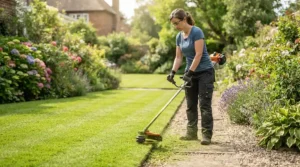
Best Lightweight Brush Cutter: What to Pick Under £250
The best lightweight brush cutter under £250 depends on what you’re cutting. Weight is a trade-off: less mass usually means less power.
The Stihl FS 38 is the featherweight at about 4.2kg, but it’s a trimmer at heart. The Ryobi OBC1820B (about 4.7kg bare) and Greenworks GD40BC (about 4.9kg) are the lightest that also take a steel blade. The Bosch AFS 23-37 sits around 5kg once you allow for source-to-source variation. By contrast, both 52cc petrol machines are roughly double that, which is why they come with strong harnesses.
Here’s the practical takeaway. A kilo you barely notice at minute one becomes a genuine drag by minute thirty. If you’re clearing for an hour at a stretch, that’s where the lighter cluster wins. For occasional edge work and light brush on a small plot, the Ryobi OBC1820B is my pick for the best lightweight brush cutter if you own ONE+ batteries. The Stihl FS 38 takes the crown if you want petrol and only need a line head. Anyone cutting dense brambles regularly should accept the weight of a petrol machine and lean on the harness.
Blade vs Line Heads: Which Cutting Head Wins?
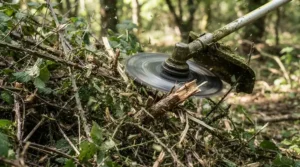
The blade vs line heads decision is really a question about vegetation and risk. Get it wrong and you’ll either bog down in brambles or waste time re-spooling line.
| Feature | Line head | Metal blade |
|---|---|---|
| Best vegetation | Grass, weeds, nettles | Brambles, saplings, woody stems |
| Debris thrown | Moderate (guard essential) | Lower, but kickback risk if it snags |
| Running cost | Line re-spooling | Occasional sharpening or replacement |
| Best for | Stihl FS 38, Bosch AFS 23-37 | Hyundai HYBC5200X, Einhell GC-BC 52 I AS |
The table simplifies things, but the logic holds. A line head is forgiving, cheap to run and gentler around fences, but it gives up on anything woody. A blade slices through stems that line would just fray, though it demands respect: if it snags on a stump it can kick. The Greenworks GD40BC, Ryobi OBC1820B and Bosch AFS 23-37 all include both, which is the smartest way to buy at this price.
One safety note worth knowing. The HSE has published guidance on the dangers of non-standard cutting attachments on brush cutters, such as chain flails, after a fatal accident. Stick to attachments approved by your machine’s manufacturer, always fit the supplied guard, and check that your machine actually supports a blade before you buy one.
Engine Power: What cc, Watts and Volts Really Mean
Engine power is the most misleading number on any listing. Peak figures sound impressive, but what you actually want is torque under load.
For petrol, displacement is the shorthand. The Stihl FS 38 offers 27.2cc and about 0.65kW. The two big machines, the Hyundai HYBC5200X and Einhell GC-BC 52 I AS, sit at 52cc, and the Einhell quotes 1.5kW. Wikipedia notes that a 32cc engine can swing heavier line and often takes metal blades, which tells you where the “real” brush-cutting threshold starts. For mains models such as the Bosch AFS 23-37, watts are the measure: 950W here, in a typical 400-1,200W band.
Battery tools muddy things. Volts describe the pressure, but amp-hours describe the tank. A 36V machine like the Einhell AGILLO 36/255 BL with two 4.0Ah batteries will cut for far longer than an 18V machine like the Ryobi OBC1820B with a single 2.0Ah pack. Advice from Garden and Allotment is blunt and sensible: a big engine without torque, or a peak rpm figure with no real-world context, is a spec-sheet trick.
Practically, 52cc is more than most homeowners need, but under £250 the price gap over smaller petrol engines is small, so the extra power is cheap insurance for thick growth.
Fuel Type: Petrol, Battery or Mains?
Fuel type shapes everything: weight, noise, upkeep, and what you’ll pay in year three. There’s no single winner, only the right fit.
| Factor | Petrol | Battery | Mains (corded) |
|---|---|---|---|
| Power ceiling | Highest | Good, rising | Moderate |
| Run time | Refuel and continue | Limited by battery | Unlimited within cable range |
| Noise | Loudest | Quiet | Quiet |
| Upkeep | Pre-mix fuel, plugs, filters | Almost none | Almost none |
| Best pick | Hyundai HYBC5200X | Greenworks GD40BC | Bosch AFS 23-37 |
Wikipedia’s summary of the trade-off is accurate: petrol brings complete mobility and higher maximum power, but also more weight, refuelling and vibration, while electric models produce zero emissions at the point of use. Pre-mixed two-stroke fuel is the daily reality with the Hyundai HYBC5200X (listed at 40:1) and the Einhell GC-BC 52 I AS; always follow your manual’s ratio.
Choose battery if you dislike petrol and already own compatible batteries. Choose mains if your plot is small and near a socket. Choose petrol for remote, large or rough land where neither cables nor short battery life can be tolerated.
✨ Don’t Miss These Exclusive Deals!
🔍 Take your garden clearing to the next level with these carefully selected machines. Click on any highlighted product to check current pricing and availability on amazon.co.uk. These tools will help you create the tidy, bramble-free borders your family will love!
Practical Guide: Setting Up and Using Your Brush Cutter Safely
A good machine used badly is a bad machine. This is the setup routine that the box rarely tells you.
Fit the harness first. Adjust it so the cutting head hovers just above the ground with your arms relaxed. If you’re fighting the weight, the harness is wrong, not you.
Fit the right head and guard. Fit the line guard when using line, and the blade guard when using a blade. The Einhell AGILLO 36/255 BL manual specifically warns you to fit the cover appropriate to the cutting tool. On any battery model, remove the battery before changing heads.
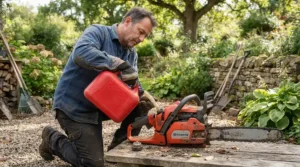
Fuel correctly (petrol only). Mix pre-mix fuel in a separate clean container using the ratio in your manual, then fuel outdoors.
Dress for it. Eye protection, sturdy boots, long trousers and ear defenders. Sound pressure on the Stihl FS 38 is listed around 94-96dB(A), which is loud enough to matter.
Sweep, don’t stab. Let the head do the work in controlled arcs. Keep children and pets well clear.
Watch the first 30 days. The classic mistakes are running the line spool empty, letting cut grass pack under the guard (Einhell’s manual advises regular cleaning of the guard’s underside), and using the wrong fuel mix. After each session, wipe down the machine and inspect the blade and line.
Real-World Scenarios: Three Gardens, Three Machines
Specs are abstract. Here’s how the choices play out for three typical UK households.
The allotment holder with brambles behind the shed. Half an acre, cutting a few times a year, no socket in sight. The Hyundai HYBC5200X is the sensible answer: 52cc, a metal blade, and a three-year warranty covering the long gaps between uses. Budget around £130-£200, and put £15-£20 aside for a better harness.
The suburban semi with borders and hedges. A 10m by 8m garden, weekly edging, occasional nettle patches, and a drawer full of Ryobi batteries. The Ryobi OBC1820B (bare, roughly £100-£190 depending on kit) reuses those batteries and takes a blade for bigger jobs. If there are no Ryobi batteries, the Greenworks GD40BC is the alternative.
The retiree near a socket. Small plot, light work, a strong preference for something easy to lift and store. The Bosch AFS 23-37 (about £100-£150) has no fuel and no battery decisions, while the Stihl FS 38 suits someone who wants petrol without the weight. Both keep costs sensible.
Each of these matches one thing: how often you cut, and how far you are from a socket.
Long-Term Cost & Maintenance
The sticker price isn’t the whole price. Total cost of ownership is where cheap petrol and cheap battery tools quietly diverge.
Petrol machines need pre-mix fuel and oil, spark plugs, air filters and fresh line or blades. For the Hyundai HYBC5200X and Einhell GC-BC 52 I AS, that’s a modest but regular spend. Battery machines like the Greenworks GD40BC, Einhell AGILLO 36/255 BL and Ryobi OBC1820B need almost no maintenance, but batteries degrade and eventually need replacing, and that can dwarf the tool’s own price. The Bosch AFS 23-37 is the cheapest to keep: line, occasional blade, an intact cable.
Here’s a rough illustration, not a quote. A £200 machine used 20 times a year for five years costs about £2 per use before consumables. Add fuel or replacement batteries and it might be £3-£4 per session. The takeaway is that a slightly dearer machine with a longer warranty, such as the Hyundai HYBC5200X, can beat a cheaper one on cost per use.
Safety, Vibration and Regulations
Brush cutters are among the tools the HSE names when discussing hand-arm vibration. It warns that regular, frequent exposure can lead to permanent damage such as hand-arm vibration syndrome (HAVS). The HSE’s hand-arm vibration guidance for employers is aimed at workplaces, but the logic applies to weekend warriors clearing a large plot: shorter sessions, sharp cutters and a machine with real anti-vibration design.
Compare spec-sheet vibration figures where you can. Ryobi lists roughly 1.4-1.6m/s² for the Ryobi OBC1820B, while petrol machines are typically higher. Remember that vibration accumulates with time, so a “gentler” machine used for hours can outweigh a rougher one used briefly.
Beyond vibration, check that any machine carries UKCA or CE marking, wear ear defenders, and store fuel in approved containers away from heat. Never remove guards, and never fit non-approved attachments.
Common Mistakes When Buying Brush Cutters Under £250
Most regrets fall into a handful of predictable traps.
- Buying on cc alone. Torque under load and weight matter as much as displacement.
- Assuming “brush cutter” means blade-ready. The Stihl FS 38 is the reminder: it’s a lovely light trimmer, but it cannot take a steel blade.
- Forgetting the battery. Bare-tool prices look wonderful until you add batteries and a charger, as with the Einhell AGILLO 36/255 BL and Greenworks GD40BC.
- Skipping the harness. A poor harness turns a good machine into a bad afternoon.
- Ignoring the weight quoted. Sources for the Einhell GC-BC 52 I AS vary by kilos, so check before you commit.
- Choosing power you don’t need. A 52cc petrol machine is overkill for a postage-stamp lawn.
A useful rule of thumb from UK reviewers: lightweight consumer trimmers sometimes get marketed as brush cutters. If a listing won’t say whether a metal blade is supported, assume it isn’t.
FAQ
❓ Can you get a decent brush cutter for under £250?
❓ Is petrol or battery better for tough brambles?
❓ Do I need a harness for a brush cutter?
❓ Does the price include batteries on cordless models?
❓ Can I fit a metal blade to any strimmer?
Conclusion: Which Brush Cutter Under £250 Should You Buy?
There’s no single champion, only the right machine for your ground. If you’ve got acres of brambles and no socket, the Hyundai HYBC5200X or Einhell GC-BC 52 I AS deliver the most cutting power per pound, so brace your shoulders and buy a good harness. If you’d rather avoid petrol, the Greenworks GD40BC and Ryobi OBC1820B are the strongest lightweight battery options, and the Einhell AGILLO 36/255 BL is a smart pick if Einhell batteries are already in your shed. For small plots near a socket, the Bosch AFS 23-37 is simple and dependable. And for petrol without the weight, the Stihl FS 38 is lovely, provided you accept it’s line-only.
The smartest way to shop for brush cutters under £250 is to decide your cutting head first (see the blade vs line heads section), then your fuel type, and only then compare prices. Check whether batteries are included, read current reviews on amazon.co.uk, and confirm the warranty. Do that, and you’ll end up with a machine that tames the corner rather than one that gathers dust in the shed.
Recommended for You
- Petrol Strimmer For Professional Use: 7 Tested Picks (2026)
- Petrol Strimmer For Thick Grass: 7 Beastly Picks For 2026
- 7 Best Petrol Strimmers For Large Gardens (UK Guide 2026)
Disclaimer: This article contains affiliate links. As an Amazon Associate, I earn from qualifying purchases. If you purchase products through these links, we may earn a small commission at no additional cost to you.
✨ Found this helpful? Share it with your friends! 💬🤗
