
In This Article
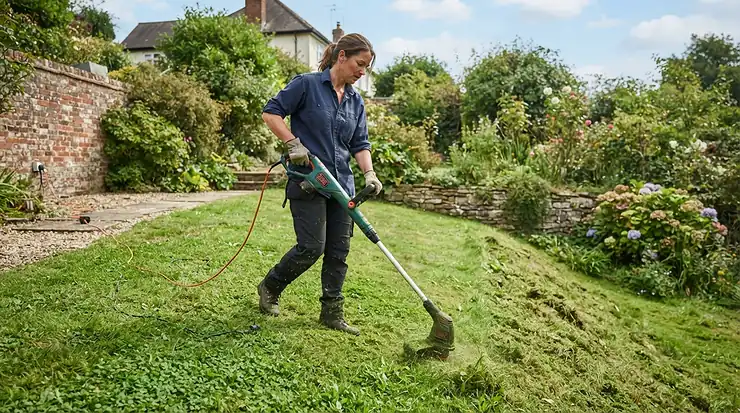
A mains strimmer for large lawn work is a corded, plug-in line trimmer that tidies edges, banks and rough patches without a battery ever running flat. Powered from a 230V socket, it gives constant torque and unlimited working time, provided you manage the lead and RCD protection sensibly.
Here’s the scene. The mower has just finished its final stripe. The lawn looks magnificent, apart from the fringe of shaggy grass hugging every fence post, border and tree base. That fringe is the strimmer’s job, and on a big plot it’s a long, tedious one. Ninety minutes in, a cordless battery is usually gasping. A mains machine hasn’t even warmed up.
I’ll be straight with you, though, because a good buying guide should be. Mains power isn’t magic. You are tethered to a cable, and a genuinely huge garden may still favour petrol or a spare battery. BBC Gardeners’ World Magazine’s grass trimmer tests make the same point: corded, cordless and petrol machines each win in different gardens. This guide is for the middle ground: big lawns with a reachable socket and a gardener who wants dependable power.
Below you’ll find seven real, currently sold models compared on their published specs, plus honest analysis of extension cable use, continuous run time, and why an electric strimmer for edging needs different features from a brush-clearing beast. If you also have a compact plot, I’ve covered where a corded strimmer for small garden duty fits too.
Quick Comparison Table: Mains Strimmers at a Glance
Specs are taken from manufacturer and published review data. Prices are indicative ranges only, so check current price before buying.
| Product | Motor | Cutting width | Weight | Best For |
|---|---|---|---|---|
| Black+Decker GL9035GB | 900W | 35cm | 3.2kg | Big-area trimming on a budget |
| Ryobi RBC1226I | 1200W | 26-38cm | 6kg | Brambles and thick weeds |
| Makita UR3000 | 450W | 30cm | 2.6kg | Comfortable, well-made all-rounder |
| Einhell GC-ET 4530 | 450W | 30cm | 2.6kg | Neat, precise edging |
| Flymo Contour 500E | 500W | 25cm | 3kg | Quiet, urban-friendly trimming |
| Black+Decker BESTA530-GB | 550W | 30cm | 3.15kg | Mid-range trim-and-edge duty |
| Bosch EasyGrassCut 23 | 280W | 23cm | 2kg | Light post-mow tidying |
Looking at the table, the Black+Decker GL9035GB offers the widest swathe and the biggest motor among the lightweight, line-only machines, which is exactly what a large plot rewards. If your priority is fine finishing rather than speed, the Einhell GC-ET 4530 and Makita UR3000 trade some width for a rotating head and better manners around obstacles. The Bosch EasyGrassCut 23 is the outlier: cheap and featherlight, but it’s really a tidy-up tool, not a large-lawn workhorse.
💬 Just one click — help others make better buying decisions too!😊
Top 7 Mains Strimmers for Large Lawn: Expert Analysis
1. Black+Decker GL9035GB — widest swathe in the lightweight class
Big motor, big cutting circle, modest weight: that’s the pitch, and the specs back it up.
The 900W motor spins a 35cm cutting circle, so every pass clears more grass than the 23-30cm heads on most rivals. At 3.2kg it stays manageable, and the automatic single-line feed means fewer stops to tap and tug. Based on the spec comparison, this is the model that most directly answers the large-lawn brief. The adjustable second handle and wheel edge guide also help you convert it into a decent edger.
Cable matters on a big plot, and this is where it stands out. Published coverage of the manufacturer’s guidance says it can run on an extension of up to 30 metres, provided it is 1.5mm² H05VV-F cable. That’s the sort of detail Amazon listings rarely surface, and it makes planning your extension cable use far easier.
Published reviews praise the price, the handle comfort and the cable length. The recurring caveat is the line feed: if you forget to bump-feed regularly, you may end up re-feeding the line by hand. I couldn’t verify a large pool of individual buyer reviews for this write-up, so treat this as a summary of published review themes, not a star rating.
Pros:
- ✅ Widest 35cm cutting circle in this roundup’s line-only group
- ✅ 900W motor handles rougher, longer growth
- ✅ Extension-friendly design with generous stated cable allowance
Cons:
- ❌ Line can need manual re-feeding if not bumped
- ❌ Heaviest of the light machines at 3.2kg
Price sits in the roughly £40-£60 range at the time of research. For a mains strimmer for large lawn duty, that’s strong value.

2. Ryobi RBC1226I — 1200W brush cutter for thick, tough growth
Some lawns come with a wild back corner. This is the machine for it.
The 1200W motor is the most powerful here by a distance. It’s a 2-in-1: the 38cm line head handles ordinary grass, while a 26cm brushcutter blade tackles thick weeds up to about 13mm. That blade turns a strimmer into something closer to a light scythe, which is why the Ryobi RBC1226I suits overgrown margins that would choke a 450W trimmer.
The trade-offs are physical. At 6kg it’s more than twice the weight of the Makita UR3000, so it is a tool for shorter, punchier sessions rather than a whole afternoon of delicate edging. Analysis point: this isn’t the best electric strimmer for edging, but it’s the best mains option for clearing rough ground before you mow.
The manual reportedly allows extension leads provided they are outdoor-rated and marked H05RNF or H05VV-F. Read your own manual before buying a lead.
Published reviews highlight the heavy-duty capability and the power. The most consistent complaint is noise: earwear is recommended. Individual buyer-review volume wasn’t something I could verify here.
Pros:
- ✅ 1200W motor tackles brambles and thick weeds
- ✅ Line head and brushcutter blade in one tool
- ✅ Extension leads permitted if correctly rated
Cons:
- ❌ Loud enough to need hearing protection
- ❌ 6kg is tiring for long edging sessions
Expect roughly £70-£110. It’s worth it only if you truly have rough ground to clear.
3. Makita UR3000 — refined build with a swivelling head
Makita doesn’t shout, but its hardware tends to feel considered.
The Makita UR3000 uses a 450W motor with a 30cm twin-line bump-feed head. Twin line cuts more with each revolution than a single line, which is why a modest 450W performs better on long grass than the wattage suggests. The head rotates through 180 degrees, so you can flick from trimming to edging without contorting your wrists.
A rigid aluminium telescopic pole and adjustable loop handle help fit different heights, while the guard and lock-off lever stop accidental starts. That combination reads as a thoughtful design for users who dislike surprises. It weighs 2.6kg, making it one of the gentler options for a long session.
With a 10m cable, it’s a realistic option for a smaller area on its own. On a big lawn you’ll want an outdoor-rated extension. Published reviews credit its long-grass ability, adjustable handle and safety features. One reviewer described it as slightly cumbersome in use, so it’s a point to weigh if you have limited grip strength or a small frame.
Pros:
- ✅ Twin-line head cuts long grass efficiently
- ✅ 180-degree rotating head for edging
- ✅ Lock-off lever adds safety
Cons:
- ❌ Can feel a little cumbersome
- ❌ Short 10m built-in lead needs extension on big plots
Price falls in the £60-£90 range at the time of research. It is good value if you prize build quality over raw power.
4. Einhell GC-ET 4530 — precision edging with plant protection
If your lawn borders rose beds and veg patches, finishing touches matter more than brute force.
The 450W Einhell GC-ET 4530 sits at 2.6kg with a 30cm twin-line head. Its motorhead rotates 180 degrees, so it tackles corners and obstacles neatly, and the edging wheel holds a straight line along paths and borders. The flower guard is a small addition with a big payoff: it stops the line whipping your delicate plants.
Built-in cable strain relief protects the power lead where it most often fails. On a large lawn with lots of dragging and turning, that’s a genuinely useful design touch. The automatic line feed also saves a lot of interruptions.
As an electric strimmer for edging, this ranks near the top of the group. Published reviews like the decent power and the flower guard; the notable complaint is the absence of a safety lock on the switch, which matters if children or pets are around. Store it out of reach and always unplug it before adjustments.
Pros:
- ✅ Flower guard protects beds and vegetables
- ✅ Automatic line feed reduces stoppages
- ✅ Cable strain relief and rotating head
Cons:
- ❌ No safety lock on the switch
- ❌ Only 450W for very rough growth
Price sits around the £30-£50 range at the time of research. It’s excellent value for a mains strimmer for large lawn perimeters that mainly need neat edging.
5. Flymo Contour 500E — quiet and manoeuvrable for tight spots
Flymo’s Contour is the strimmer for people who need to get underneath things.
The 500W Flymo Contour 500E pairs a 25cm twin-line automatic head with a telescopic shaft and soft-grip handles. Twist the head and it switches between trimming and edging. At 3kg it’s not the lightest, but the balance is well-regarded for working under garden furniture and around obstacles.
The narrower 25cm swathe means more passes on big open areas, so it isn’t my pick for wide sweeps. Where it excels is the fiddly work: benches, trampolines, tree bases. A large garden is often actually a collection of small awkward zones, and this machine suits those.
Published reviews describe it as quiet, easy to use and versatile around obstacles. That matters in a terraced or semi-detached setting where neighbours can hear everything. As with the others, I couldn’t verify the full spread of individual buyer reviews, so this reflects published editorial themes.
Pros:
- ✅ Twin-line auto-feed head keeps working
- ✅ Quiet enough for urban gardens
- ✅ Edging wheel and flower guard included
Cons:
- ❌ Narrower 25cm cutting width
- ❌ Not the strongest on thick weeds
Price is roughly £40-£60 at the time of research. It’s a solid mid-range choice when obstacles outnumber open grass.

6. Black+Decker BESTA530-GB — mid-range trim-and-edge balance
Sometimes you want the safe middle: not too heavy, not too basic.
The Black+Decker BESTA530-GB offers a 550W motor, a 30cm cutting swathe and an automatic line-feed system. It has a trim/edge mode switch, a guide wheel for straight edges, and a telescopic pole for comfort at different heights. At 3.15kg it’s slightly heavier than the Makita and Einhell, but the extra 100W gives a little more headroom in thicker growth.
What it means in practice: this is a competent generalist. It won’t win any width contest against the Black+Decker GL9035GB, and it doesn’t have the brush-clearing ability of the Ryobi. But for a family lawn where you strim edges weekly during the growing season, it hits the sweet spot between capability and manageable weight.
Published coverage calls it compact, lightweight for its output, and affordable. Because I couldn’t verify a robust sample of individual buyer comments, I’d treat the review evidence as encouraging rather than definitive.
Pros:
- ✅ 550W motor gives extra headroom
- ✅ Simple trim/edge switching
- ✅ Telescopic pole suits different heights
Cons:
- ❌ Narrower swathe than the GL9035GB
- ❌ Slightly heavier than 450W rivals
Expect roughly £35-£55 at the time of research. It’s a sensible budget-to-mid pick.
7. Bosch EasyGrassCut 23 — featherlight budget tidier
Cheap, cheerful, and honest about what it is.
At 280W with a 23cm cutting width and just 2kg, the Bosch EasyGrassCut 23 is the lightest and least powerful option here. A trigger releases fresh line as you work, and the auxiliary handle adjusts for comfort. It’s designed to neaten edges after mowing, and it does that job well. It won’t cope with long grass or weeds, and pretending otherwise would be a mistake.
For a large lawn, think of it as a supporting act. It suits someone whose mower does the heavy lifting and who only needs a quick pass around edges. It is also the lowest-fuss corded strimmer for small garden owners who occasionally help a friend with a bigger plot.
Published reviews praise the price and lightness; complaints centre on weak heavy-duty performance and less-than-ideal line feeding. Both are consistent with the 280W spec, so set your expectations accordingly.
Pros:
- ✅ Lightest here at just 2kg
- ✅ Very affordable entry price
- ✅ Good for post-mow edge tidying
Cons:
- ❌ Struggles with long grass and weeds
- ❌ Line feeding can be fiddly
Price is around £25-£40 at the time of research. Great value for light work; poor value if you hoped for a big-lawn workhorse.
Top 7 Comparison: Head Type, Cable Notes and Best-Fit
| Product | Head type | Cable / extension notes | Indicative price | Best For |
|---|---|---|---|---|
| Black+Decker GL9035GB | Auto single line | Up to 30m extension per guidance | £40-£60 | Large open lawns |
| Ryobi RBC1226I | Line + brushcutter blade | Extension allowed if H05RNF/H05VV-F | £70-£110 | Rough, overgrown ground |
| Makita UR3000 | Twin-line bump feed | 10m built-in lead | £60-£90 | Comfort and build quality |
| Einhell GC-ET 4530 | Twin-line auto feed | Strain relief on lead | £30-£50 | Precise border edging |
| Flymo Contour 500E | Twin-line auto feed | Check manual for lead length | £40-£60 | Tight, obstacle-rich gardens |
| Black+Decker BESTA530-GB | Auto line feed | Check manual for lead length | £35-£55 | Balanced mid-range use |
| Bosch EasyGrassCut 23 | Line, trigger release | Check manual for lead length | £25-£40 | Light tidying, budget |
The pattern is clear: the Black+Decker GL9035GB wins on raw coverage, the Ryobi RBC1226I wins on brute force, and everything else competes on comfort, finishing and price. Notice how many listings leave extension guidance vague. That gap is why reading the manual before buying any lead is not optional. Prices here are indicative ranges only and may vary.
Extension Cable Use: A Practical Guide for Big Lawns
Extension cable use is the single biggest practical skill for anyone running a mains strimmer for large lawn duty. Get it right and you barely notice the cable; get it wrong and you risk overheating, nuisance tripping, or worse.
Step 1: choose the right lead. Use only outdoor-rated leads with moulded connectors, and check the rating matches your machine. The manufacturer guidance reported for the Black+Decker GL9035GB cites 1.5mm² H05VV-F cable, and Ryobi RBC1226I guidance mentions H05RNF or H05VV-F markings. Thin cores lose voltage over distance, which starves the motor.
Step 2: fully unwind the drum. Electrical Safety First’s garden advice says cable reels should be fully unwound to prevent overheating, and that outdoor leads must be weather-resistant with moulded connections. A coiled reel under load can cook itself.
Step 3: plan your route. Start at the socket end furthest from you and work back toward it, so the cable trails behind rather than in front. Keep it on the mown side, away from the cutting head.
Step 4: never daisy-chain. Joining leads multiplies connection points and resistance. Buy one lead of the right length instead.
Step 5: match the load. A 900W strimmer draws roughly 4 amps, well within a 13A lead’s capacity, so the risk is heat from coiled cable rather than overload.

Continuous Run Time: Why Mains Power Still Wins
Continuous run time is where corded machines have an undeniable edge. A mains model runs for as long as you stay plugged in. Cordless machines are limited by their batteries: BBC Gardeners’ World Magazine’s tests note one small Stihl model manages around 19 minutes per charge, while other models advertise up to about 50 minutes at no load.
On a small lawn that’s fine. On a big one, where perimeter edging alone might take an hour or more, it forces a choice: buy a spare battery, wait for a recharge, or accept the interruption. Continuous run time also protects momentum. Anyone who’s had a battery die halfway along a border, leaving one ragged stripe, knows the irritation.
The catch is that unlimited run time is only useful if your cable can reach. A 10m built-in lead, like the one on the Makita UR3000, plus a sensible extension, covers a surprising area. But if your furthest corner is 60 metres from a socket, you’re into long-lead territory where cable management becomes the bottleneck instead of the battery.
My analysis: for lawns within roughly one or two socket-to-corner extensions, mains wins on cost and continuous run time. Beyond that, weigh a cordless model with two batteries.
Electric Strimmer for Edging: What Actually Matters
An electric strimmer for edging isn’t the same as a general-purpose one. Four features do the heavy lifting.
An edging wheel. This guides the head along a straight line and controls depth. The Flymo Contour 500E, Einhell GC-ET 4530 and Black+Decker BESTA530-GB all include one.
A rotating head. Being able to turn the cutting circle vertically lets you cut a clean lawn edge without holding the machine awkwardly. The Makita UR3000 and Einhell GC-ET 4530 both rotate 180 degrees.
A plant guard. Line can strip a tender stem in a second. The Einhell GC-ET 4530 and Flymo Contour 500E both include flower guards.
Sensible weight. Edging is repetitive. A 2.6kg machine is far kinder to your shoulders than a 6kg one by the end of a long lawn perimeter.
What you can ignore: extra motor power beyond about 500W for edging alone. It won’t improve neatness, and it adds weight. If your main task is trimming after the mower, prioritise finesse over wattage.
Corded Strimmer for Small Garden: Does the Same Machine Work?
A corded strimmer for small garden work is a simpler brief: short lead, light weight, minimal fuss. Interestingly, many models in this guide double up nicely.
The Bosch EasyGrassCut 23 is the obvious small-garden pick at 2kg, though the Einhell GC-ET 4530 and Makita UR3000 are also comfortable at 2.6kg. On a small plot, the built-in lead alone is usually enough, so no extension cable is needed at all. That removes a lot of the complexity discussed above.
Conversely, a 900W machine on a tiny lawn is like driving a tractor to the corner shop. It works, but you’re paying for capacity you’ll never use, and you’re lifting extra weight. If your garden is genuinely small, a lighter 280-450W corded strimmer for small garden use is the smarter buy.
The practical takeaway: match motor and width to the largest area you’ll strim, then choose the lightest machine that meets it. If you’re between sizes, the mid-range Black+Decker BESTA530-GB is a reasonable compromise.
How to Choose a Mains Strimmer for Large Lawn
- Measure your socket-to-corner distance. This determines whether mains suits you at all. If your furthest point is beyond what a single sensible extension reaches, consider cordless.
- Match motor power to the job. Around 450-550W is enough for edging and post-mow tidying; 900W or above suits rougher, longer growth.
- Check cutting width. Wider heads (30-35cm) cover more ground per pass, which matters on large lawns.
- Check cable guidance. Look for stated extension limits or cable specifications in the manual, not just the listing.
- Weigh comfort. Telescopic poles, adjustable handles and weights under about 3.2kg reduce fatigue over long sessions.
- Look for edging features. A guide wheel, rotating head and plant guard make finishing neater.
- Prioritise safety. A lock-off lever or safety guard is worth paying a little extra for, especially around children.

Mains vs Cordless vs Petrol: An Honest Comparison
| Feature | Mains (corded) | Cordless | Petrol |
|---|---|---|---|
| Run time | Unlimited while plugged in | Limited by battery | Limited by fuel tank |
| Power | Consistent | Varies by battery | Highest |
| Weight | Lightest | Heavier (battery) | Heaviest |
| Upkeep | Very low | Low | Regular servicing |
| Best For | Large lawns near sockets | Cable-free freedom | Remote, tough ground |
As the table shows, mains suits large lawns where power is reachable, as it avoids the battery ceiling and the fuel mess. Cordless wins on convenience when there’s no nearby socket. Petrol suits remote or heavily overgrown ground but brings noise, fumes and servicing.
BBC Gardeners’ World Magazine notes petrol trimmers are typically more powerful but noisy, heavy and needing regular servicing, and that cordless batteries have made them less common for home use. That matches the sourced logic here: for a typical suburban big lawn, corded is often the calm, cost-effective middle path.
Real-World Scenarios: Matching a Strimmer to Your Garden
Scenario 1: The long, straight family lawn. A rectangular garden of roughly 30 metres, with a socket on the back wall of the house and mostly open grass. Reasoning: choose the Black+Decker GL9035GB for its 35cm swathe, and buy a single outdoor-rated 1.5mm² extension. You’ll finish fast and rarely re-plug.
Scenario 2: The bordered cottage garden. Flower beds, veg patches and a curving lawn edge. Budget is modest, and neatness matters more than speed. Reasoning: the Einhell GC-ET 4530 offers a plant guard, edging wheel and a rotating head at a low price.
Scenario 3: The overgrown rental. You’ve inherited a back corner of brambles and nettles before you can even mow. Reasoning: the Ryobi RBC1226I with its brushcutter blade is the mains choice for clearing thick growth, though wear hearing protection and expect to rest your arms.
Scenario 4: The busy semi with a shared fence. Lots of obstacles, close neighbours, occasional evening use. Reasoning: the quieter Flymo Contour 500E with its twin-line head suits close quarters.
Frequency of use also matters: weekly edging favours lighter models, while an annual clear-out justifies a heavier one.
Problem → Solution Guide: Common Strimmer Headaches
Problem: the line keeps running out or snapping. Solution: on bump-feed models like the Makita UR3000, tap the head on the ground as you cut. On the Black+Decker GL9035GB, bumping regularly avoids manual re-feeding.
Problem: the RCD trips repeatedly. Solution: damp connectors are the usual culprit. Dry everything before reconnecting, and never work on wet grass. An RCD cuts power almost instantly when it detects a fault, so a trip is doing its job, not being annoying. If it trips on dry ground, inspect the cable for damage.
Problem: the motor sounds weak on long grass. Solution: a thin or overly long extension can starve the motor of voltage. Swap to a heavier-gauge lead and shorten the run, or cut in two passes from the top down.
Problem: you keep slicing the cable. Solution: keep it behind you and on the mown side, and use a bright-coloured lead so you can see it.
Problem: wrist and shoulder ache. Solution: adjust the telescopic pole so the head sits comfortably at ground level with your arm relaxed, and pick a lighter model next time.
Long-Term Cost, Maintenance and Safety Rules
Mains strimmers are cheap to run and cheap to keep. There’s no battery to replace, no fuel to buy and no servicing schedule. Your recurring costs are line, occasional spare guards and, if you don’t already own one, a good outdoor extension lead. Over several seasons, that total cost of ownership usually beats cordless, where a replacement battery can cost as much as the tool itself.
Maintenance is simple. Clear packed grass from the head after each session. Check the cable for nicks before every use. Store the machine dry and coil leads loosely, since UV and frost degrade sheaths over time. Replace line as it thins, rather than waiting for it to snap mid-border.
On safety, NICEIC’s garden electrics guidance states that all outdoor socket-outlets should be RCD-protected, and warns against long extension leads for mains-voltage equipment because of overheating risks. Combine that with the practical advice above: keep the lead fully unwound, use one lead not several, and never strim in wet conditions.
Also wear sturdy shoes, gloves and eye protection, and look for UKCA or CE marking on any machine or lead you buy. If a cable is damaged, unplug it and replace it rather than repairing it yourself.
FAQ
❓ How long can an extension lead be for a corded strimmer?
❓ Can I use a mains strimmer on damp grass?
❓ What wattage do I need for long, tough grass?
❓ Do I need an RCD for a corded strimmer?
❓ How do I stop the strimmer line snapping?
Conclusion
Choosing a mains strimmer for large lawn care comes down to three honest questions: how far is your furthest corner from a socket, how rough is your ground, and how fussy are you about edges?
For most big, open lawns near a socket, the Black+Decker GL9035GB is the most logical buy on paper, thanks to its 900W motor, 35cm swathe and generous extension guidance. If brambles are your reality, the Ryobi RBC1226I brings genuinely different capability. For neat borders, the Einhell GC-ET 4530 and Flymo Contour 500E finish beautifully, while the Makita UR3000 suits people who value build quality. The Black+Decker BESTA530-GB is the sensible middle, and the Bosch EasyGrassCut 23 is the tidy-up tool for light work.
Whatever you choose, treat extension cable use and RCD protection as part of the purchase, not an afterthought. Continuous run time is the great advantage of mains power, but only if the cable, the lead and your habits are up to it. Check current price on the models that fit, and match the machine to your garden rather than the other way round.
✨ Ready to trim your way to a sharper lawn? 🌿 Click any highlighted product above to check current pricing and availability, and give your garden the edge it deserves! 🚀
Recommended for You
- Electric Strimmer vs Cordless Strimmer: 7 Best UK Picks (2026)
- Cordless Strimmer For Pensioners: 7 Best Picks (2026)
- Cordless Strimmer for Long Grass: 7 Best UK Picks (2026)
Disclaimer: This article contains affiliate links. As an Amazon Associate, I earn from qualifying purchases. If you purchase products through these links, we may earn a small commission at no additional cost to you.
✨ Found this helpful? Share it with your friends! 💬🤗
