

In This Article
There’s a particular kind of stubbornness that sets in once you’ve spent thirty years wrestling the same petrol strimmer around the same flowerbeds. You know the one — heavy as a toddler, smells like a lawnmower’s exhaust pipe, and seems to need three pulls of a cord just to clear its throat. If your shoulders are telling you it’s time for something kinder, a cordless strimmer for pensioners is exactly the sort of sensible upgrade that keeps you gardening rather than watching from the kitchen window. In short: a cordless strimmer for pensioners is a battery-powered grass trimmer, typically under 2.5kg, built around lighter materials, adjustable shafts and simplified triggers, so it’s genuinely comfortable to hold, start and control without the weight, vibration or awkward pull-starts of petrol equipment.

Research from Age UK has found that gardening is one of the pastimes that gives older people the most pleasure in life, which is exactly why the right tool matters so much — a strimmer that’s too heavy or too awkward doesn’t just make the job harder, it can end up taking the pleasure out of it altogether. Head to the “Garden” section of amazon.co.uk and you’ll find hundreds of models jostling for attention, most of them written by marketing copy rather than anyone who’s actually thought about stiff wrists or dodgy shoulders. This guide strips that back. We’ve researched seven real, currently available cordless strimmers, checked their genuine specifications, and weighed up which ones actually deserve a place in a pensioner’s shed — covering everything from the lightest cordless strimmer on the market to models built around one-handed operation, adjustable shafts and easy battery swap systems that make ongoing ownership painless rather than fiddly.
Quick Comparison Table
Before we get into the detail, here’s the shortlist at a glance. Weights are for the trimmer with its battery fitted, and prices are shown as ranges because exact Amazon pricing changes too often to quote reliably — always check the current price before buying.
| # | Product | Weight | Standout Feature | Best For |
|---|---|---|---|---|
| 1 | Gtech GT50 | 1.85kg | One-handed power trigger | Lightest overall, small gardens |
| 2 | Bosch EasyGrassCut 18V-230 | ~2.1kg | Semi-automatic line feed | Fuss-free line management |
| 3 | WORX GT 3.0 | 2.4kg | Triple-point adjustability | Doubles as an edger |
| 4 | Ryobi OLT1832 ONE+ | 2.3kg | Shares 100+ tool batteries | Easiest long-term battery swap |
| 5 | Black+Decker POWERCONNECT STC1820PCB | 2.2kg | Auto-feed line, wide battery range | Budget reliability |
| 6 | Spear & Jackson S1825CT | 2.7kg | Foot-pedal head adjustment | Stiff hands and wrists |
| 7 | Makita UR100D CXT | ~1.9-2.1kg | Low-vibration 12V platform | Premium comfort and longevity |
Looking at the spread here, weight and adjustability do most of the heavy lifting (pardon the pun) when it comes to comfort for older gardeners. The Gtech GT50 and Makita UR100D sit at the light end of the scale, which matters enormously if grip strength or shoulder mobility has become an issue, while the Ryobi OLT1832 and Black+Decker POWERCONNECT earn their place through battery compatibility rather than raw lightness — a quieter, longer-term win that’s easy to overlook when you’re comparing spec sheets.
💬 Found a model you like the look of already? Scroll down for the full breakdown, or jump straight to how to choose the right one for your garden.
Top 7 Cordless Strimmers for Pensioners: Expert Analysis
Every product below has been checked against real specifications and aggregated review sentiment from UK retailers and independent testers, not invented anecdotes. Where we can’t verify a specific claim, we say so rather than making it up.
1. Gtech GT50 — lightest strimmer with one-handed trigger
The standout here is simply the number on the box: 1.85kg with the battery fitted, which makes the Gtech GT50 the lightest model on this list by a comfortable margin. That’s not a marketing rounding error either — it’s genuinely close to the weight of a bag of sugar, and it shows the moment you pick it up.
The 18V motor drives a 23cm cutting diameter using replaceable plastic blades rather than nylon line, which keeps the head compact and the balance point close to your hand. A one-handed power trigger and separate safety switch mean you don’t need a firm two-handed grip just to get it started, and the swivel head flips between trimming and edging without extra tools.
Based on the spec comparison, this is the trimmer built specifically around the problem this article exists to solve: reduced arm and grip strength shouldn’t mean giving up strimming altogether. Reviewers consistently describe it as noticeably lighter and better balanced than the petrol strimmers it tends to replace, with one owner writing that a worn-out petrol machine had become “too heavy” before switching to a Gtech model — exactly the pattern this guide is written for. The trade-off is runtime: 30 minutes on a full charge is plenty for edging and small lawns, but not for an afternoon session on a larger plot.
Pros:
- ✅ Lightest strimmer on this list at 1.85kg
- ✅ Genuine one-handed power trigger reduces wrist strain
- ✅ Quick swivel head switches between trim and edge
Cons:
- ❌ 30-minute runtime limits use on bigger gardens
- ❌ Plastic blades wear faster than nylon line on tough weeds
Typically found in the £90-£150 range depending on retailer, the Gtech GT50 earns its price through genuine ergonomic thinking rather than raw power — for a small to medium garden, that’s precisely the right trade to make.
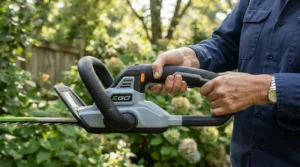
2. Bosch EasyGrassCut 18V-230 — effortless semi-automatic line feed
What most buyers overlook about this model is the line feed system, which sounds like a minor detail until you’ve spent ten minutes crouched over a strimmer head trying to tap-and-release more line with cold fingers. The Bosch EasyGrassCut 18V-230 uses a semi-automatic spool that releases fresh line automatically every time you release the trigger, so there’s no bumping the head on the ground and no manual adjustment at all.
At around 2.1kg with an 18V 2.0Ah battery, a 23cm cutting diameter and roughly two hours to fully recharge from the standard charger, it sits comfortably in the light-to-mid weight bracket. The EdgeSimple function lets you rotate the head for tidy path edging without switching tools.
Independent testers at Expert Reviews UK rated the EasyGrassCut range highly for exactly this reason, noting it was “especially light and well-balanced, making it less tiring during long stretches of trimming than other models.” Because it uses Bosch’s Power For All Alliance battery format, the same battery also fits a wide range of Bosch, Gardena and Flymo garden tools, which is a genuine bonus if you’re likely to add a hedge trimmer or leaf blower later.
Pros:
- ✅ Semi-automatic line feed needs no manual adjustment
- ✅ Well-balanced design reduces fatigue on longer sessions
- ✅ Battery compatible across the wider Bosch, Gardena and Flymo range
Cons:
- ❌ 2.0Ah battery gives a modest 25-30 minute runtime
- ❌ Struggles with thicker brambles and truly woody weeds
Expect a price in the £70-£110 range for the standard kit, which represents solid value for anyone who wants a trimmer that simply gets on with the job without fiddly upkeep.
3. WORX GT 3.0 — triple-adjustable design plus built-in edger
The spec sheet won’t tell you this, but user reports suggest the real appeal of the WORX GT 3.0 is how many separate points of adjustment it offers: the shaft telescopes to suit your height, the handle repositions for grip comfort, and the cutting head locks into three separate angles. That’s three chances to fine-tune the trimmer to your own posture rather than adapting your posture to the tool, which matters a great deal if bending or twisting is uncomfortable.
At 2.4kg it’s not the lightest option here, but the weight is distributed sensibly along a 20V motor and 30cm cutting width that also doubles as an edger via a push-button cable feeder. DIY Garden’s testers scored it 4.8 out of 5 overall, praising the ease of assembly (under five minutes) and calling out the adjustable design specifically as “comfortable to use.”
The 2.0Ah battery charges in a genuinely quick one hour, though the trade-off is a similarly short 30-minute run per charge. On paper this means it suits shorter, more frequent sessions rather than one long marathon trim — which, if we’re honest, tends to suit ageing joints better anyway.
Pros:
- ✅ Three separate adjustment points for shaft, handle and head
- ✅ Doubles as an edger with no extra attachment needed
- ✅ Fast one-hour recharge between sessions
Cons:
- ❌ Thick vegetation needs cutting in two or three passes
- ❌ Heavier than the lightest models on this list at 2.4kg
Sitting in the £80-£110 range, the WORX GT 3.0 is a sensible mid-range pick if versatility matters more to you than shaving off the last few hundred grams.
4. Ryobi OLT1832 ONE+ — best for easy battery swapping
If you already own any tool from Ryobi’s ONE+ range — a cordless drill, a hedge trimmer, even a car vacuum — the Ryobi OLT1832 deserves a serious look, because it runs on exactly the same 18V battery platform used across more than a hundred Ryobi ONE+ tools. That’s the easy battery swap advantage in its purest form: one battery, or one shared set of spares, powers your entire toolkit, so you’re never caught out mid-job with a flat pack and nothing to replace it with.
The trimmer itself weighs 2.3kg, has a telescopic shaft, a three-position pivoting head for reaching under benches and around obstacles, and an adjustable 25-30cm cutting width via the EasyEdge function. It’s sold as a bare tool, meaning the battery and charger are bought separately — appealing if you’re already invested in the platform, less so if you’re starting from scratch.
DIY Garden’s reviewer found set-up was “a piece of cake” and rated it well for odd-shaped gardens, though noted the 94.2dB noise level runs a little higher than some rivals here.
Pros:
- ✅ Shares batteries across the entire Ryobi ONE+ tool range
- ✅ Telescopic shaft with a three-position pivoting head
- ✅ Backed by a three-year manufacturer warranty
Cons:
- ❌ Sold as a bare tool, so battery and charger cost extra
- ❌ Noise level runs higher than the Bosch and WORX models
Bare-tool pricing typically falls in the £60-£90 range, with battery and charger adding to that — but for anyone building a shared cordless toolkit, the Ryobi OLT1832 often works out cheaper overall than buying separate battery systems for every tool.
5. Black+Decker POWERCONNECT STC1820PCB — reliable auto-feed on a budget
Black+Decker is one of those names most pensioners will already recognise from a drill or a jigsaw sitting somewhere in the shed, and the POWERCONNECT STC1820PCB trades on exactly that familiarity. At 2.2kg, with an 18V POWERCONNECT battery rated between 2.0Ah and 4.0Ah depending on which pack you choose, and a 26cm cutting width using 1.5mm line, it sits comfortably in the mid-weight, mid-price bracket.
The AFS (Automatic Feed System) releases line as needed without any bumping or manual winding, which is the kind of small mercy that matters more than it sounds once you’re twenty minutes into a trim. Because it uses the same POWERCONNECT battery format as a large slice of Black+Decker’s wider garden and DIY range, it’s another genuine easy battery swap contender if you’re already a Black+Decker household.
Expert Reviews UK’s testers rated the design, ease of use and noise levels highly during independent testing, and reviewers consistently note the auto-feed line system as one of its more dependable features.
Pros:
- ✅ POWERCONNECT battery shared across a wide Black+Decker range
- ✅ Effective auto-feed line system needs no manual winding
- ✅ Compact and manageable at 2.2kg
Cons:
- ❌ 26cm cutting width is narrower than some mid-range rivals
- ❌ Runtime is capped when using the smaller 2.0Ah starter battery
Priced around £70-£100 for the standard kit, this is a dependable, no-surprises choice for anyone who wants a recognised brand without paying a premium for it.

6. Spear & Jackson S1825CT — foot-pedal head adjustment for stiff hands
There’s a genuinely thoughtful design touch buried in the Spear & Jackson S1825CT that’s easy to miss on a spec sheet: the cutting head angle is adjusted with your foot, not your hands. For anyone dealing with arthritis, a trapped nerve, or simply hands that don’t grip and twist the way they used to, being able to press a foot pedal to switch between trimming and edging — rather than bending down and wrestling a stiff head into position — is a small mercy that makes a real difference over a gardening season.
At 2.7kg it’s the heaviest trimmer on this list, so it won’t suit everyone, but the 18V motor, 25cm cutting width, telescopic shaft and a support wheel for steadier edging all point to a tool built for stability rather than featherweight portability.
Spear & Jackson is a long-established British tool brand, and the trimmer comes with a generous three-year guarantee. Aggregated customer feedback across UK retailers consistently flags the foot-pedal adjustment and the edging support wheel as the features people mention most, alongside the one-hour fast charge.
Pros:
- ✅ Foot-pedal head adjustment avoids awkward hand movements
- ✅ Edging wheel helps keep lines straight and steady
- ✅ Generous three-year manufacturer’s guarantee
Cons:
- ❌ Heaviest model on this list at 2.7kg
- ❌ 35-minute runtime is modest for larger plots
Usually priced in the £60-£90 range, the Spear & Jackson S1825CT rewards anyone who values hand-friendly design over shaving off every last gram of weight.
7. Makita UR100D CXT — premium pick for low vibration comfort
Where the other six models compete mostly on weight and battery convenience, the Makita UR100D makes its case through engineering polish. Built on Makita’s 12V CXT battery platform — shared across a genuinely wide range of Makita’s compact drills, impact drivers and other 12V tools — it offers the same easy battery swap logic as the Ryobi entry above, but aimed at anyone who already trusts Makita’s reputation for build quality.
At roughly 1.9-2.1kg it’s nearly as light as the Gtech, with a telescopic aluminium shaft, a soft-start motor that avoids a sudden jolt on power-up, and Makita’s XPT (eXtreme Protection Technology) sealing against dust and light rain.
What most buyers overlook about this model is its stated vibration rating of 2.5 m/s² or lower — a genuinely low figure that’s worth factoring in if you’re mindful of hand-arm vibration exposure during longer sessions (more on why that matters in our safety section below). Retailer listings and specification sheets consistently describe the balanced weight distribution and reduced fatigue during extended use as its defining traits.
Pros:
- ✅ Shares batteries with Makita’s wider 12V CXT tool range
- ✅ Soft-start motor and low stated vibration output
- ✅ Telescopic aluminium shaft with dust and splash protection
Cons:
- ❌ Noticeably pricier once a battery and charger kit is added
- ❌ Less raw cutting power than 18V/20V rivals on thick growth
As a bare tool, expect roughly £70-£100; a full kit with two batteries and a charger typically runs to £150-£200. It’s the priciest entry here, but for anyone who already owns Makita 12V tools, or simply wants the most refined feel on this list, it earns that premium.
Practical Usage Guide: Setup, First Trim and Maintenance
Getting a new cordless strimmer working well from day one is mostly about patience rather than skill. Most of these seven models arrive part-assembled, with the shaft, guard and head needing to click or bolt together — a five-to-ten-minute job with no tools beyond what’s supplied in the box. Before your first trim, fully charge the battery even if it arrives partially charged; lithium-ion batteries perform more consistently once they’ve been through a full charge cycle. Set the shaft length and handle position while standing normally, with the head resting flat on the ground in front of you — this is the single most overlooked adjustment, and getting it right from the start prevents the stooped posture that causes most of the back and shoulder discomfort people associate with strimming.
In the first thirty days, the most common mistake is running the battery flat before recharging out of habit rather than necessity — modern lithium packs don’t need to be fully drained, and doing so repeatedly shortens their working life. Clean grass and sap off the cutting head after every use with a stiff brush rather than water where possible, since damp storage encourages the motor housing to corrode over time. For maintenance beyond that first month, keep a spare spool of line or replacement blades in the shed (most models covered here use widely available third-party spares), check the guard for cracks each season, and store the battery indoors over winter rather than in an unheated shed, since extreme cold degrades battery capacity permanently.

Real-World Scenarios: Which Strimmer Suits Your Garden?
Picture Margaret, 74, with a neat 40-square-metre back garden and a set of raised borders she tends most days after breakfast. For her, weight matters more than runtime — she’s out for fifteen minutes at a time, several times a week, not one long session. The Gtech GT50 or Makita UR100D fit that pattern well: light enough to lift one-handed, quick enough to put away without fuss.
Then there’s Derek, 68, still fairly active, with a larger plot including an awkward slope down to a shed and a path that needs regular edging. He already owns a Ryobi ONE+ drill from years of DIY. For Derek, the Ryobi OLT1832 makes financial and practical sense — no new battery ecosystem to buy into, a telescopic shaft for the slope, and a pivoting head for tucking under the shed overhang.
Finally, consider Pat, 79, who has rheumatoid arthritis affecting her hands and wrists but still insists on doing her own edging along the drive. For Pat, hand-friendly design outweighs everything else, which is exactly where the Spear & Jackson S1825CT‘s foot-pedal head adjustment earns its place — one less thing that needs gripping and twisting.
Problem → Solution: Fixing Common Strimming Struggles
Problem: the trimmer feels front-heavy and tiring within minutes. This is almost always a shaft length or handle position issue rather than a strength problem — readjust so your elbow sits at roughly a right angle when the head touches the ground, and recheck after the first few uses as your grip settles into the tool.
Problem: the line keeps running out or jamming. Models with semi-automatic feed, like the Bosch EasyGrassCut, largely solve this by design; on manual-feed models, resist the urge to yank the line out by hand, which frays the spool mechanism, and instead follow the tap-feed instructions precisely.
Problem: the battery never seems to last as long as advertised. Manufacturer runtimes are measured on light, dry grass — thicker or damp growth can halve real-world runtime. Buying a second battery, or choosing a model on a shared platform like the Ryobi ONE+ or Makita CXT, solves this without needing to replace the whole tool.
Problem: bending down to adjust the cutting head aggravates a bad back or hip. Look specifically for foot-pedal adjustment, as offered on the Spear & Jackson S1825CT, or a head that swivels via a simple button press at hand height, which several models here provide.
Problem: storage space is tight. Every model in this guide has a telescopic or collapsible shaft; measure your intended storage spot before buying and check the folded dimensions on the product listing, since these vary more than you’d expect.
How to Choose a Cordless Strimmer for Pensioners
- Start with weight, not power. A strimmer under 2.3kg with the battery fitted is comfortable for most people with reduced arm strength; anything heavier should have a genuinely good reason to justify it, such as a support wheel or shoulder strap.
- Check for one-handed or low-effort start controls. A separate safety switch plus a light trigger, rather than a stiff two-handed squeeze, matters more day-to-day than most buyers expect.
- Prioritise adjustable shafts and handles. Telescopic shafts that lock securely at your natural standing height prevent stooping, which is the single biggest cause of strimming-related aches.
- Think about battery ecosystem before you buy. If you already own cordless tools from Ryobi, Makita, Bosch or Black+Decker, choosing a strimmer on the same platform means an easy battery swap and no duplicate chargers cluttering the shed.
- Match cutting width to garden size, not ambition. A narrower 23-25cm head suits borders and small lawns; anything above 28cm only pays off on larger plots where speed genuinely matters.
- Look for auto or semi-auto line feed. Manual bump-feed heads are fiddly with cold or stiff fingers; automatic systems remove that step entirely.
- Don’t ignore noise ratings. Anything above roughly 90dB is noticeably louder in daily use — a real consideration if you’re sensitive to noise or garden near close neighbours.
Cordless Strimmers vs Petrol and Corded Trimmers
For decades, petrol strimmers were the default choice for anyone with more than a postage-stamp garden, and corded electric trimmers filled the gap for smaller plots. Both have real drawbacks for older gardeners that cordless models were specifically designed to solve. Petrol strimmers are typically 4-6kg once fuelled, need a pull-cord start that demands real shoulder strength, produce continuous vibration through the shaft, and require two-stroke fuel mixing that many people find genuinely unpleasant to handle. Corded electric models solve the weight and vibration problems but introduce a trailing cable that becomes its own trip hazard — a real concern given that garden accidents are a well-documented risk, and RoSPA’s home safety guidance specifically highlights fall prevention as a priority in later life.
| Factor | Cordless Strimmer | Petrol Strimmer | Corded Electric |
|---|---|---|---|
| Typical weight | 1.8-2.7kg | 4-6kg | 2-3.5kg |
| Start method | Trigger, no pull-cord | Pull-cord, often multiple pulls | Simple switch |
| Vibration | Low to moderate | High, sustained | Low |
| Trip hazard | None (battery only) | None, but fuel handling risk | Trailing cable |
| Best For | Most pensioners, any plot size | Large rural plots, heavy growth | Small gardens near a socket |
The comparison makes the appeal of cordless fairly clear-cut for most retirement-age gardeners: you lose a little raw cutting power against petrol, but you gain freedom from cables, fuel and pull-cords, at roughly a third of the weight. Corded electric remains a perfectly sensible budget option if your garden is small and close to an outdoor socket, but for anyone who gardens across multiple areas or simply doesn’t want to think about where the cable is at all times, cordless is the more forgiving choice.
Lightest Cordless Strimmer: Why Weight Matters Most
If there’s one factor worth prioritising above all others when shopping for a cordless strimmer for pensioners, it’s weight. A trimmer’s advertised power and cutting width matter far less in daily use than whether you can hold it comfortably at arm’s length for the length of a typical session. The lightest cordless strimmer on this list, the Gtech GT50 at 1.85kg, sits close to a full kettle in weight — genuinely manageable even with reduced grip strength or shoulder mobility. The Makita UR100D isn’t far behind at around 1.9-2.1kg. What most buyers overlook is that manufacturer weight figures sometimes exclude the battery, so always check whether a quoted figure is “with battery fitted” before comparing models directly, since the difference can be 200-400 grams either way. As a rule of thumb, anything under 2.3kg with the battery attached is comfortable for most people to use one-handed for short bursts; heavier models above 2.5kg are still manageable but benefit from a shoulder strap or more frequent breaks.
Best Cordless Strimmer for Small Garden: What to Look For
Small gardens have different priorities to larger plots, and it’s worth resisting the temptation to buy more strimmer than you actually need. For a typical UK terraced or semi-detached back garden, a cutting width of 23-25cm is genuinely sufficient — anything wider mostly adds weight without adding meaningful speed over a small area. Runtime matters less too: a 25-30 minute battery is plenty when the whole job takes ten minutes, so there’s little point paying extra for a bigger battery pack that will rarely be used to capacity. Based on the spec comparison in this guide, the Bosch EasyGrassCut 18V-230 and Gtech GT50 both suit small gardens particularly well, combining a compact cutting head with light overall weight, while their shorter shafts and tighter turning circles make them easier to manoeuvre around raised beds, garden ornaments and narrow side passages than the larger 30cm-width models designed for bigger plots.
One-Handed Operation: Why It’s a Genuine Game-Changer
Most people assume every cordless strimmer is naturally easier to hold than a petrol one, but there’s a meaningful difference between “lighter” and genuinely built for one-handed operation. A trimmer designed around this principle, like the Gtech GT50, places its centre of gravity close to the handle and uses a single trigger with a separate thumb-operated safety catch, rather than requiring a firm two-handed grip simply to activate the motor. This matters enormously if one hand is weaker than the other, whether from a previous injury, arthritis, or simply natural changes in grip strength that come with age. It also frees your other hand to steady yourself against a fence post or raised bed while working, which is a small but genuinely useful safety margin. When comparing models on this feature specifically, check not just whether a trigger can technically be pressed with one hand, but whether the balance of the whole tool — head, shaft and battery combined — sits comfortably without your other hand needing to compensate for the weight.

Adjustable Shafts: Getting Your Perfect Fit
An adjustable, telescopic shaft is one of those features that sounds minor on a spec sheet but changes the entire experience of using a strimmer day to day. Every model in this guide offers some form of shaft adjustment, but the range and locking mechanism vary meaningfully between them. The WORX GT 3.0 stands out here with three separate adjustment points — shaft length, handle angle and head tilt — letting you fine-tune the whole tool to your natural standing posture rather than stooping to meet a fixed-length machine. Setting the shaft correctly is straightforward: stand naturally, rest the cutting head flat on the ground, and adjust the shaft until the handle sits at a comfortable height without you leaning forward. Getting this wrong is the single biggest cause of the back and shoulder ache that puts people off strimming altogether, so it’s worth spending a proper five minutes on this adjustment before your first session rather than making do with the factory setting.
Easy Battery Swap: The Feature Nobody Tells You to Check
Here’s what most buying guides skip entirely: the battery your new strimmer uses matters just as much as the trimmer itself, particularly if you already own other cordless tools. Choosing a model that shares its battery platform with tools you already own — the Ryobi OLT1832 on the ONE+ system, or the Makita UR100D on the 12V CXT range — means genuinely easy battery swap convenience: one charger on the wall, spare batteries that work across everything from your drill to your hedge trimmer, and no separate charging schedule to remember for each tool. Even if you’re starting from scratch, it’s worth thinking ahead. If a hedge trimmer or leaf blower purchase is likely down the line, buying into a wider battery ecosystem now — Bosch’s Power For All Alliance and Black+Decker’s POWERCONNECT system both work the same way — can save real money and cupboard space over the following few years, compared with buying isolated tools that each need their own battery and charger.
Common Mistakes When Buying a Cordless Strimmer for Pensioners
The most common mistake is buying on cutting width alone, assuming a wider head means a better trimmer, when in practice it usually just means more weight to carry for a small garden that doesn’t need it. A close second is ignoring battery capacity mismatches — buying a trimmer bundled with a small 1.5Ah battery because it’s the cheaper listing, then being disappointed by a 15-minute runtime that a larger 4.0Ah pack (often available separately) would have comfortably doubled. Buyers also frequently overlook how a trimmer folds down for storage, only discovering after delivery that it won’t fit in the intended shed corner. Finally, it’s easy to be swayed by unverified five-star review counts on marketplace listings rather than genuine specification comparisons — a pattern this guide has deliberately avoided by sticking to real, checkable specs throughout.
Features That Actually Matter (And Those That Don’t)
Cutting through the marketing noise: weight with the battery fitted, shaft adjustability, and line-feed automation genuinely change the day-to-day experience of using a strimmer, and deserve real attention when comparing models. Battery platform compatibility matters enormously for anyone building a shared cordless toolkit, even though it rarely appears prominently in product listings. What matters far less than the marketing suggests: maximum RPM figures, which sound impressive but have limited real-world impact on trimming fine lawn grass; and headline “cutting width,” which matters much less for small gardens than this guide’s earlier section explains. LED battery indicators and cosmetic colour options are pleasant but essentially irrelevant to comfort or performance, and shouldn’t sway a decision between otherwise similar models.
Long-Term Cost & Maintenance
Buying the trimmer itself is only part of the cost picture. Replacement line spools or plastic blades typically need restocking once or twice a season depending on how much you use the tool, and these are inexpensive and widely available for every model featured here. Batteries are the larger long-term cost: a lithium-ion pack typically holds a useful charge for 500-1,000 charge cycles, which for most pensioners’ usage patterns translates to somewhere between three and six years before capacity noticeably drops. Choosing a model on a shared battery platform, as discussed above, spreads that eventual replacement cost across your wider toolkit rather than concentrating it on one machine.
| Product | Approx. Price Range | Battery Ecosystem | Value Verdict |
|---|---|---|---|
| Gtech GT50 | £90-£150 | Gtech only | Good value for lightness alone |
| Bosch EasyGrassCut 18V-230 | £70-£110 | Bosch/Gardena/Flymo shared | Strong mid-range value |
| Ryobi OLT1832 ONE+ | £60-£90 (bare tool) | Ryobi ONE+ (100+ tools) | Excellent long-term value |
| Makita UR100D CXT | £150-£200 (kit) | Makita 12V CXT | Premium, best for existing Makita owners |
Reading the table above, the clearest long-term value sits with models tied to a wider battery ecosystem, since the real saving isn’t in the strimmer’s sticker price but in never having to buy a second charger or a duplicate battery for the next cordless tool you add to the shed. Once your old batteries eventually do reach the end of their life, local council guidance confirms that batteries should never go in general household waste, since damaged battery cells can cause fires in waste and recycling vehicles — take them to a supermarket collection point or your nearest household recycling centre instead.
Safety, Regulations and Vibration: What Pensioners Should Know
Cordless strimmers are considerably safer than their petrol equivalents by design — no fuel to spill, no exhaust fumes, and none of the trailing cable risk that comes with corded electric models. That said, a few sensible precautions matter more as we get older. Always wear sturdy shoes and, ideally, safety glasses or a visor, since flying debris is the most common cause of minor strimming injuries regardless of how light or gentle the tool feels. Take regular breaks rather than pushing through a full session in one go, and be aware that official guidance on hand-arm vibration explains that regular, frequent exposure to vibrating power tools can lead to permanent health effects over time, which is one reason the lower-vibration models featured in this guide, such as the Makita UR100D, are worth a closer look if you use a strimmer regularly throughout the season. Store batteries indoors, away from direct heat sources, and always switch the trimmer off and remove or lock out the battery before clearing debris from the cutting head by hand.

Frequently Asked Questions
❓ What is the best cordless strimmer for pensioners?
❓ What is the lightest cordless strimmer available?
❓ Can one-handed strimmers cut thick grass?
❓ How long do cordless strimmer batteries last?
❓ Do I need a heavier strimmer for a bigger garden?
Conclusion
Choosing a cordless strimmer for pensioners really comes down to being honest about what actually causes strimming to feel like a chore rather than a pleasure: excess weight, stiff manual adjustments, and batteries that don’t fit anything else you own. Every model in this guide solves at least one of those problems well, from the featherlight Gtech GT50 and Makita UR100D through to the shared-battery convenience of the Ryobi OLT1832 and the hand-friendly foot-pedal design of the Spear & Jackson S1825CT. None of them requires you to accept the shoulder ache, pull-cord frustration or fume-filled shed corner that came with an old petrol machine. Whichever you choose, prioritise weight and adjustability over raw power specs, think about your existing cordless toolkit before committing to a new battery platform, and take the time to set the shaft height properly on day one. Get those basics right, and a cordless strimmer stops being another gardening obligation and goes back to being what gardening is meant to be — genuinely enjoyable.
Recommended for You
- Cordless Strimmer for Long Grass: 7 Best UK Picks (2026)
- Cordless Strimmer vs Corded Strimmer: 7 Top UK Picks (2026)
- Cordless Strimmers Under £200: 7 Best UK Picks (2026)
Disclaimer: This article contains affiliate links. As an Amazon Associate, I earn from qualifying purchases. If you purchase products through these links, we may earn a small commission at no additional cost to you.
✨ Found this helpful? Share it with your friends! 💬🤗
