
In This Article
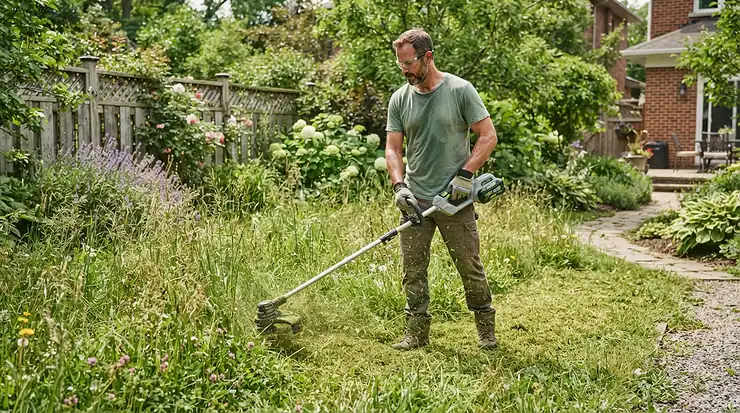
Somewhere between “I’ll sort that border next weekend” and “good grief, has that patch swallowed the shed”, every UK garden eventually grows a stretch of grass that your mower simply refuses to touch. That’s where a decent cordless strimmer for long grass earns its keep — not the flimsy edging tool gathering cobwebs in the shed, but something with the torque and line to actually chew through knee-high growth without stalling every ten seconds.

What is a cordless strimmer for long grass? It’s a battery-powered grass trimmer built with a stronger motor, thicker cutting line and wider swathe than a basic edging strimmer, specifically designed to cut through overgrown, tangled or tall grass that a lawnmower can’t reach or handle.
I’ve spent the past few weeks digging through spec sheets, aggregated review data and manufacturer documentation for the UK’s most talked-about models — from budget Black+Decker to premium EGO and Stihl — to work out which ones genuinely deliver on that promise and which are all marketing gloss. Along the way we’ll also cover dual battery strimmer options for bigger plots, what to look for if you actually need a cordless strimmer for small garden use instead, and the technical details — motor torque, line thickness, cutting head design — that manufacturers rarely explain in plain English.
Before you strim anything resembling a meadow, it’s worth a quick read of the RHS guidance on cutting long grass and wildflower areas, since checking for hedgehogs and other wildlife first is both kind and genuinely important. With that said, let’s get into the machines that can actually handle the job.
Quick Comparison Table
If you’ve only got sixty seconds, here’s the shortlist. Every one of these seven models is a real, currently available product — no invented “best sellers” here.
| Strimmer | Voltage | Cutting Width | Best For |
|---|---|---|---|
| EGO Power+ ST1613E-T | 56V | 40cm | Best overall for long grass |
| Stihl FSA 57 | 36V (AK System) | 28cm | Quietest premium option |
| Makita DUR369LZ | 36V (2x18V) | 43cm | Best dual battery strimmer |
| Greenworks 40V G40LT33 | 40V | 33cm | Best value dual battery kit |
| WORX GT 3 | 20V | Adjustable | Best budget all-rounder |
| Black+Decker STC1820PC-GB | 18V | 28cm | Best entry-level pick |
| Bosch EasyGrassCut 18V-230 | 18V | 23cm | Best cordless strimmer for small garden |
Looking at the spread above, there’s a clear pattern: cutting width and voltage rise together, which is exactly why a 56V or 36V twin-battery model clears long grass so much faster than an 18V edging tool. If your “lawn” is closer to a hayfield, the top three rows deserve your attention; if you’re mostly tidying borders, the bottom two are more sensible and considerably cheaper.
💬 Just one click — help others make better buying decisions too!😊
Top 7 Cordless Strimmers for Long Grass: Expert Analysis
1. EGO Power+ ST1613E-T — best overall for genuinely long, overgrown grass
That 40cm cutting swathe isn’t a marketing number picked to look good on a box — it’s nearly double what most budget 18V strimmers manage, meaning fewer passes and less standing around waiting for your arms to recover.
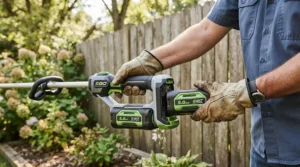
Under the hood sits a 56V ARC Lithium battery system and a brushless motor, paired with EGO’s Powerload and Line IQ technology, which senses when the line wears down and auto-feeds the correct length without you tapping the head on the ground every thirty seconds. Two speed settings let you throttle back for tidy edges or open up for genuinely thick, tangled growth, and the aluminium shaft keeps the whole unit light enough to swing for an hour without your shoulder filing a complaint.
Based on the spec comparison with the rest of this list, this is the closest a cordless tool gets to matching a light petrol strimmer’s cutting performance, which is exactly why it tops the list for anyone tackling a genuinely overgrown patch rather than routine edging. What most buyers overlook is that the Line IQ system, while brilliant for convenience, does draw on the battery a little faster than a manual bump-feed head — so pairing it with a larger 4Ah or 5Ah battery is worth the extra outlay if your garden runs long.
Reviewers consistently report that the Powerload line-loading system is the standout feature, since re-threading trimmer line by hand is most people’s least favourite garden chore, and testers highlight the auto-feed as a genuine time-saver rather than a gimmick.
Pros:
- ✅ 40cm cutting swathe among the widest on this list
- ✅ Line IQ auto-feed removes constant bump-and-tap stopping
- ✅ Brushless motor backed by a 5-year tool warranty
Cons:
- ❌ Premium price compared with 18V budget alternatives
- ❌ Larger battery pack shifts balance toward the rear hand
Kits with a 4Ah battery and charger typically sit in the £220-£280 range, which is a fair ask if long grass is a recurring rather than occasional job.
2. Stihl FSA 57 — best for quiet, close-to-the-flowerbed trimming
At just 74dB(A), the standout feature here is how little noise it makes compared with almost everything else on this list — quiet enough that Stihl’s own literature notes you barely need ear defenders at all.
The FSA 57 runs on Stihl’s 36V AK battery system, with runtime scaling from around 25 minutes on the compact AK 10 pack up to roughly 60 minutes on the larger AK 30, and its AutoCut C 3-2 head automatically extends the line whenever it’s tapped against the ground. An adjustable shaft and loop handle mean the trim height suits taller and shorter gardeners without needing any tools.
Here’s what to weigh: Stihl’s build quality and dealer network are hard to beat, and this model is genuinely well balanced for extended sessions, but the standard 28cm cutting diameter is narrower than the EGO or Makita on this list, so it isn’t the fastest tool for clearing a genuinely large overgrown plot. It suits gardeners who value quiet, precise trimming around beds and borders over raw cutting width.
Aggregated reviewer feedback consistently praises the balance and ease of use, with one independent test rating its trim performance “very good” and highlighting easy line changes without opening the spool casing, though several testers flag a lengthy recharge time as the main drawback.
Pros:
- ✅ Exceptionally quiet operation at 74dB(A)
- ✅ Batteries shared across Stihl’s wider AK garden range
- ✅ Tool-free adjustable shaft and loop handle
Cons:
- ❌ Narrower 28cm cutting width than rival premium models
- ❌ Long recharge time on the smaller AK 10 battery
Expect around £115-£140 for the bare tool, rising to roughly £250-£400 for a kit with battery and charger — a premium justified mainly by Stihl’s dealer support and battery ecosystem rather than outright cutting power.
3. Makita DUR369LZ — best dual battery strimmer for existing Makita owners
Feeding two 18V LXT batteries into one 36V motor is the standout trick here, and it’s exactly why this model earns the top spot for anyone specifically after a dual battery strimmer.
Running two 18V batteries in series to produce 36V, the DUR369LZ delivers a 43cm cutting diameter with a brushless motor, three speed settings, and Active Feedback Sensing Technology that automatically cuts power if the head suddenly jams against something solid. A dual battery fuel gauge shows exactly how much charge remains in each pack, which matters when you’re relying on two cells rather than one.
On paper this means anyone already invested in Makita’s 18V LXT ecosystem — drills, saws, other garden tools — can add serious grass-cutting power without buying an entirely new battery platform, which is the real appeal of a dual battery strimmer over a proprietary single-battery system. Reviewers consistently note that the automatic torque drive genuinely does ramp up cutting force under load rather than just stalling, a common weakness in cheaper twin-battery clones.
What most buyers overlook is that this model is typically sold “body only” without batteries, so real-world cost depends heavily on how many 18V packs you already own; user feedback on retailer sites consistently rates the build quality and vibration dampening highly for extended use.
Pros:
- ✅ 43cm cutting width rivals dedicated 40V+ premium tools
- ✅ Shares batteries with the wider Makita 18V LXT range
- ✅ Active Feedback Sensing Technology guards against kickback
Cons:
- ❌ Sold body-only, so batteries add significant extra cost
- ❌ Noticeably heavier than single-battery 18V strimmers
The bare tool typically costs around £200-£280, but factor in two 18V 5Ah batteries and a charger if you’re starting from scratch, which can add another £150-£200 on top.
4. Greenworks 40V G40LT33 — best value dual battery kit for medium gardens
The standout here is the optional twin-battery kit (G40LTK2X), which bundles two 2Ah batteries so you can swap packs mid-job instead of waiting around for a recharge.
The G40LT33 runs on a single 40V lithium-ion battery delivering a 33cm cutting width, with a rotating 2-in-1 head that switches between trimming line and an integrated edging wheel for tidy borders, plus auto-feed 1.65mm line that advances without manual adjustment. At 2.35kg it’s well balanced for a 40V tool, and the battery is shared across Greenworks’ wider 40V range of mowers, blowers and chainsaws.
Based on the spec comparison, 40V sits in a useful middle ground — noticeably more power than an 18V budget strimmer without the price tag of Stihl’s AK system or EGO’s 56V range, which is what makes the dual battery kit version particularly good value for anyone with a medium-to-large garden who doesn’t want to stop for a full recharge partway through the job.
Real user feedback on this model is mixed but broadly positive — reviewers report the motor handles thick, tough grass well and battery life runs to roughly 20-45 minutes depending on load, though a handful of testers note the handle position takes some getting used to for balance.
Pros:
- ✅ Twin-battery kit avoids mid-job charging delays
- ✅ 2-in-1 trim and edge head adds genuine versatility
- ✅ Battery shared across Greenworks’ full 40V tool range
Cons:
- ❌ Handle balance criticised by some reviewers on thicker growth
- ❌ Replacement batteries priced at a premium versus rivals
Single-battery kits sit around £90-£130, while the dual-battery G40LTK2X version typically runs to £140-£170 — a sensible mid-range jump if uninterrupted runtime matters to you.
5. WORX GT 3 — best budget all-rounder for mixed garden tasks
Its adjustable shaft, handle and head all reconfigure into an edger, which is the standout reason this remains one of the most recommended budget strimmers in independent UK testing.
The GT 3 runs on a 20V battery system, weighs a featherweight 2.4kg, and uses a push-button cable feeder rather than a manual bump-and-tap head, which cuts down on fiddling mid-job. Its adjustable design lets you switch between strimming and edging modes and set the shaft length to suit your height.
What the spec sheet won’t tell you, but reviewer testing suggests, is that the standard 2.0Ah battery is genuinely the limiting factor here — it’s fine for a tidy-up but starts to feel thin against properly overgrown patches, where you’ll be stopping to recharge or splitting the job into two sessions. This is a strimmer built for versatility and value first, raw long-grass power second.
Independent UK testers who put this model through over 75 hours of comparative testing rated it their top overall pick, praising the lightweight design and adjustability, while also noting that thick vegetation needs to be tackled in stages rather than one clean pass.
Pros:
- ✅ Converts easily between strimmer and edger modes
- ✅ Genuinely lightweight at 2.4kg for long sessions
- ✅ Push-button line feed avoids manual bump-and-tap
Cons:
- ❌ Standard 2.0Ah battery gives around 30 minutes runtime
- ❌ Struggles with thick vegetation in a single pass
Typically priced in the £80-£110 range as a kit, this is hard to beat if your garden is more “overgrown lawn” than “abandoned meadow.”
6. Black+Decker STC1820PC-GB — best entry-level pick for occasional use
The Power Select Run Time Extender is the standout feature — a simple switch that boosts power for tougher patches or dials it back to stretch the battery further.
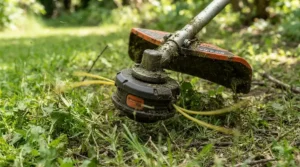
This 18V model pairs a 2.0Ah battery with Black+Decker’s E-Drive high-torque gear system and a 28cm cutting width, plus an AFS automatic single line feed that advances line without manual intervention. A flip-to-edge mechanism with a precision guide wheel converts it into an edger, and the telescopic tube adjusts for comfort.
Here’s what to weigh: the E-Drive gearing genuinely helps torque through denser patches without clogging, which is more than you’d expect at this price point, but the single 2.0Ah battery and roughly 25-minute runtime mean this suits occasional trimming and lawn edges rather than a serious overgrown-garden project. Buyers matching this to a small or medium plot with light-to-moderate overgrowth will get the most from it.
Independent testing rates this model highly for design, ease of use and value for money, with reviewers specifically praising the edging guide wheel, though the consensus is that spare batteries are worth having if you’re not in a rush to recharge between sessions.
Pros:
- ✅ E-Drive gearing adds useful torque for the price
- ✅ Flip-to-edge mechanism with dedicated guide wheel
- ✅ Power Select switch extends runtime when needed
Cons:
- ❌ 18V motor can feel underpowered on genuinely long grass
- ❌ Single battery limits continuous session length
Usually found in the £80-£130 range, this is a sensible budget choice for smaller gardens with occasional overgrown patches rather than a daily long-grass workhorse.
7. Bosch EasyGrassCut 18V-230 — best cordless strimmer for small garden use
Its party trick is sheer portability — the whole trimmer packs down into a surprisingly small box and snaps together in seconds, which is the standout feature for anyone short on shed space.
Running on an 18V battery from Bosch’s Power For All Alliance platform, this model spins at up to 9000rpm with a 23cm cutting diameter and a semi-automatic spool that feeds line on every trigger release rather than requiring a tap on the ground. It weighs under 2kg without the battery, and an EdgeSimple button converts it from trimming to edging mode.
Based on the spec comparison, this is deliberately not built for long, tangled grass — the narrower 23cm cutting width and lighter-duty motor are optimised for lawn edges, tufts along walls and general tidying in compact plots, which is exactly why it earns its place here as the cordless strimmer for small garden use rather than an overgrown allotment. Bosch’s own Power For All battery compatibility is a genuine bonus if you already own other 18V Bosch tools.
An independent review verdict called it “a nippy little grass trimmer perfect for smaller spaces,” rating it easy to store and portable, while explicitly noting it isn’t suited to hard work on thicker stems or established weeds.
Pros:
- ✅ Extremely lightweight and compact for tight storage
- ✅ Semi-automatic line feed on every trigger release
- ✅ Battery shared across the wider Power For All range
Cons:
- ❌ 23cm cutting width too narrow for larger overgrown areas
- ❌ Not designed for thick stems or established weeds
Bare units start around £60-£90, with battery-inclusive kits typically £100-£120 — excellent value if your garden is genuinely on the smaller side.
Full Spec Comparison: All 7 Strimmers Side by Side
| Strimmer | Battery | Cutting Width | Approx. Runtime | Weight | Best For |
|---|---|---|---|---|---|
| EGO Power+ ST1613E-T | 56V, 4Ah | 40cm | 30-90 min* | ~3.2kg | Long, overgrown grass |
| Stihl FSA 57 | 36V AK | 28cm | 25-60 min | 2.6kg | Quiet precision trimming |
| Makita DUR369LZ | 2x18V LXT | 43cm | Depends on Ah | 5.7-6.3kg | Dual battery strimmer users |
| Greenworks G40LT33 | 40V | 33cm | 20-45 min | 2.35kg | Value dual battery kit |
| WORX GT 3 | 20V, 2Ah | Adjustable | ~30 min | 2.4kg | Budget all-rounder |
| Black+Decker STC1820PC-GB | 18V, 2Ah | 28cm | ~25 min | 2.5kg | Occasional/entry-level use |
| Bosch EasyGrassCut 18V-230 | 18V | 23cm | Battery-dependent | ~1.9-2.1kg | Cordless strimmer for small garden |
*Runtime scales with battery size, not the strimmer itself.
Reading across this table, the pattern holds: wider cutting swathes and higher voltages correlate directly with weight and price, so there’s a genuine trade-off rather than a single “best” answer. The EGO Power+ ST1613E-T and Makita DUR369LZ dominate on raw cutting width, while the Bosch EasyGrassCut 18V-230 and Black+Decker STC1820PC-GB trade that power for portability and a friendlier price. If motor torque and line thickness matter more to you than the headline voltage number, the next few sections unpack exactly why.

Motor Torque Explained: Why It Matters More Than Watts or Volts
Voltage numbers sell strimmers, but motor torque is what actually determines whether the line keeps spinning when it hits a dense clump of grass or a stray bramble. Torque is the rotational force the motor can maintain under load — and a lower-voltage tool with a well-engineered brushless motor and gearing, like the Black+Decker STC1820PC-GB‘s E-Drive system, can out-torque a higher-voltage tool with a cheaper motor.
What most buyers overlook is that a strimmer “bogging down” in thick grass isn’t usually a line problem — it’s the motor’s torque curve collapsing under load. This is precisely why the Makita DUR369LZ‘s Automatic Torque Drive is worth paying attention to: it actively increases torque when it senses resistance rather than just spinning faster and hoping. Reviewers consistently note that models with active torque management, rather than a single fixed speed, cope far better with genuinely long or tangled grass without the head grinding to a halt.
In practice, if your grass is more meadow than lawn, prioritise a model with documented torque or load-sensing tech over one that simply advertises a bigger voltage number on the box.
Line Thickness: Matching Your Line to the Job
Line thickness is one of the most overlooked specs on a spec sheet, yet it directly determines what a strimmer can and can’t cut. Thin 1.6mm line, like that used on the Black+Decker STC1820PC-GB, is light on the motor and fine for lawn edges and soft grass, but it snaps quickly against coarse stems, brambles or anything woody. Thicker 2.0-2.4mm line, the range accepted by the Makita DUR369LZ, holds up far better against tougher vegetation but demands more torque to spin, which is why it’s typically paired with higher-powered motors.
Based on the spec comparison across this list, there’s a sensible rule of thumb: match line thickness to your worst-case grass, not your average patch. A slightly thicker line wears the motor a touch faster but avoids the frustration of constant snapping and re-feeding. Several manufacturers, including EGO and Stihl, also offer optional blade attachments for genuinely woody growth where no trimmer line, however thick, will really cope.
Cutting Head Design Compared: Auto-Feed, Bump-Feed and Blade Systems
Cutting head design changes your whole experience of using a strimmer far more than most buyers expect before their first session. Bump-feed heads, like Stihl’s AutoCut C 3-2, require you to tap the head on the ground to release more line — reliable and simple, but it does mean stopping periodically. Semi-automatic systems, such as the Bosch EasyGrassCut 18V-230‘s spool, feed line automatically whenever you release the trigger, removing the tapping step entirely.
At the premium end, EGO’s Powerload and Line IQ combination on the EGO Power+ ST1613E-T senses line wear and feeds the correct length without any input at all — the closest thing to “fit and forget” cutting head design currently available on a cordless UK strimmer. Reviewers consistently rate auto-sensing heads as the single biggest quality-of-life upgrade over a basic bump-feed system, particularly for anyone tackling long grass where you’d otherwise be stopping every few metres.
For genuinely thick or woody growth, several models in this list — notably the Stihl and Makita ranges — also accept optional blade or brush-cutter heads, worth considering if brambles are a regular feature of your plot.
Dual Battery Strimmers: Are Two Batteries Better Than One?
A dual battery strimmer, in the strict sense, runs on two separate battery packs rather than one larger cell — either combined in series for higher voltage, as with the Makita DUR369LZ‘s twin 18V setup, or offered as a swappable pair, as with the Greenworks 40V G40LT33‘s optional twin-battery kit. Both approaches solve the same underlying problem: single-battery cordless tools have historically struggled to match petrol strimmers on continuous runtime.
Here’s what to weigh before choosing a dual battery strimmer over a single high-capacity pack: combining two smaller batteries in series, as Makita does, gives you serious voltage and cutting power while letting you reuse batteries from other tools you already own, but it adds noticeable weight since you’re carrying two cells rather than one. A swappable twin-battery kit, by contrast, doesn’t boost raw power but does let you keep working the moment one battery runs flat, simply by clicking in the spare — genuinely useful for anyone with a larger plot who doesn’t want to break for a recharge partway through.
What most buyers overlook is that “dual battery” doesn’t automatically mean “more powerful” — it depends entirely on whether the batteries are wired in series for voltage or simply swapped for runtime. Check which system a listing describes before assuming it solves your particular problem.
Cordless Strimmer for Small Garden vs Long Grass: A Buyer’s Decision Framework
Not every UK garden needs the widest, most powerful strimmer on this list, and buying more machine than you need just adds weight, cost and storage headaches. Here’s a simple framework:
- If your plot is under roughly 100m² with mostly lawn edges and the occasional soft tuft, choose a compact cordless strimmer for small garden use, such as the Bosch EasyGrassCut 18V-230, because the lighter motor and narrower head are easier to store and manoeuvre, and you’ll rarely encounter grass thick enough to need more.
- If you have a medium garden with a genuinely overgrown corner — behind a shed, along a fence line, or a “meadow” patch you’ve let run wild — choose a 36V-40V model like the Greenworks 40V G40LT33 or Stihl FSA 57, because the extra torque handles tangled growth without constant stalling.
- If you’re clearing a genuinely large area of long grass regularly, choose the EGO Power+ ST1613E-T or Makita DUR369LZ, because the wider cutting swathe and higher power reduce the number of passes needed across a big space.
- If you already own 18V batteries from a particular brand’s other tools, choose a dual battery strimmer within that same platform before buying into a new proprietary battery system, because the savings on batteries alone often outweigh a small difference in headline cutting width.
For an independent second opinion on how a compact model performs in real testing, Which?’s trusted traders review of the Bosch EasyGrassCut is worth a read before you commit either way.
Practical Usage Guide: Setup, First Cut and Ongoing Maintenance
Getting a new cordless strimmer for long grass right on day one saves a surprising amount of frustration later. Start by charging the battery fully before first use — most lithium-ion packs ship partially charged, and running a strimmer flat on its first outing isn’t the confidence boost you want. Assemble the shaft and guard fully before switching on; several models, including the Bosch and EGO ranges, snap together in seconds but the safety guard genuinely matters for deflecting flicked debris.
For your first cut on properly long grass, work from the top down rather than trying to scalp it in one pass — cutting the top third first, then working lower, puts far less strain on the motor and line than attempting the whole height at once. A common mistake in the first 30 days is holding the head flat against the ground constantly, which accelerates line wear and can clog the spool with clippings; angling the head slightly and sweeping side to side clears debris more efficiently.
For maintenance, clean grass residue from the guard and head after every session, check the line spool for wear before it snaps mid-job, and store batteries at room temperature over winter rather than in a cold shed, since extreme cold shortens lithium-ion battery lifespan noticeably.

Real-World Scenarios: Matching Strimmers to Real UK Gardens
If you’re a first-time buyer with a compact terraced-house garden and just want tidy edges twice a month, the Bosch EasyGrassCut 18V-230 or WORX GT 3 will comfortably outlast your actual need for power, and the lighter weight matters more than raw cutting width for occasional, light use.
If you’re managing a semi-rural plot with a genuine long-grass patch — the sort of area RHS guidance suggests treating like a mini-meadow — a mid-power option like the Greenworks 40V G40LT33 strikes a sensible balance: enough torque for tangled growth, without the price or weight of the true premium tier.
If you’re a smallholder or allotment-adjacent gardener tackling a proper overgrown boundary several times a season, the EGO Power+ ST1613E-T or Makita DUR369LZ earns its higher price through sheer reduced cutting time — fewer passes, wider swathe, and (for the Makita) reuse of batteries you may already own from other 18V tools.
How to Choose a Cordless Strimmer for Long Grass: 7 Expert Criteria
- Voltage and motor torque — higher voltage generally means more sustained cutting power on dense grass, but check for active torque management rather than assuming voltage alone tells the full story.
- Cutting width — a wider swathe covers more ground per pass, which matters far more on genuinely long grass than on tidy edges.
- Line thickness compatibility — confirm the head accepts thicker line if your grass includes coarse stems or occasional brambles.
- Cutting head design — auto-feed and sensor-fed heads save real time over manual bump-feed systems on bigger jobs.
- Battery runtime and ecosystem — check whether batteries are shared with other tools you own, since this affects long-term cost far more than the sticker price.
- Weight and balance — a strimmer that’s comfortable for five minutes can feel very different after forty, especially on sloped or uneven ground.
- Noise level — if you garden near neighbours or noise-sensitive areas, a quieter model like the Stihl AK range is worth prioritising over raw power.
Common Mistakes When Buying a Cordless Strimmer for Long Grass
The single most common mistake is buying purely on voltage without checking cutting width or line thickness — a high-voltage motor paired with thin line and a narrow head still struggles on genuinely long, tangled grass. Reviewers consistently flag this mismatch as the reason some buyers feel misled by spec sheets that emphasise battery voltage above everything else.
A second frequent error is underestimating battery runtime versus garden size — a 25-minute battery is plenty for a small plot but hopelessly short for anything approaching a quarter-acre, leading to multiple recharge breaks that make the job take twice as long as expected. As Which?’s independent review of the Black+Decker STC1820PC notes, an 18V battery can feel underpowered specifically for cutting long grass even when it’s perfectly adequate for edging.
Finally, many buyers overlook battery ecosystem compatibility entirely, purchasing into a brand-new proprietary platform when they already own compatible tools from another range — an expensive oversight that a five-minute check could easily avoid.
Cordless vs Petrol Strimmers for Long Grass
Cordless models have closed most of the performance gap with petrol strimmers over the past few years, but the two still suit slightly different situations.
| Factor | Cordless Strimmer | Petrol Strimmer |
|---|---|---|
| Noise | Typically 74-96 dB(A) | Often 95-105 dB(A) |
| Weight | 2-6kg depending on battery | Often 5-8kg with fuel |
| Maintenance | Minimal; charge and clean | Regular servicing, fuel mixing |
| Runtime | 20-90 minutes per charge | Limited only by fuel supply |
| Startup | Instant trigger pull | Pull-cord, sometimes several attempts |
Interpreting the table, cordless clearly wins on noise, weight and day-to-day maintenance, which is why it now dominates domestic UK garden use even for fairly demanding long-grass jobs. Petrol still has an edge for continuous all-day use on very large plots where recharging simply isn’t practical, but for the vast majority of UK gardens — even genuinely overgrown ones — a well-chosen cordless strimmer for long grass like the EGO Power+ ST1613E-T now closes that gap convincingly.
Long-Term Cost & Maintenance: The Real Cost of Ownership
The upfront price tag is only part of the real cost of owning a strimmer. Replacement line spools, spare batteries, and — for petrol tools — ongoing fuel and servicing all add up over several seasons of use.
| Budget Tier | Price Range | What You Get | Best Pick |
|---|---|---|---|
| Budget | £60-£130 | Single 18-20V battery, basic head | Bosch EasyGrassCut 18V-230 |
| Mid-range | £90-£170 | 36-40V power, dual battery options | Greenworks 40V G40LT33 |
| Premium | £140-£400 | 36-56V, auto-feed heads, extended warranty | EGO Power+ ST1613E-T |
Looking at this breakdown, the mid-range tier arguably offers the best cost-per-use for most UK gardens, since it avoids the recurring cost of frequently snapped thin line on budget models while stopping short of premium pricing that only pays off with heavy, regular use. Buyers already invested in a particular brand’s battery ecosystem should also factor in that a bare “body only” premium tool, like the Makita DUR369LZ, can actually work out cheaper long-term than a cheaper strimmer that forces you to start an entirely new battery collection from scratch.
Safety and Regulations: Using Your Strimmer Responsibly
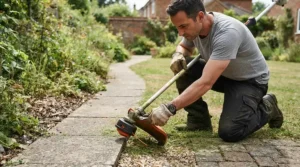
Cordless strimmers are generally safer than petrol equivalents thanks to lower vibration and no hot exhaust, but they still spin cutting line or blades at several thousand RPM, so sensible precautions matter. Sturdy footwear, eye protection and, for models with a metal blade attachment, appropriate gloves are all worth having before you start, particularly given how easily flying debris can catch an unprotected eye.
Before cutting a long-grass area for the first time this season, it’s genuinely worth checking for wildlife — hedgehogs, frogs and slow worms regularly shelter in longer grass — a point the RHS makes clearly in its guidance on gardening safely with power tools. Most modern cordless strimmers also carry CE or UKCA marking confirming they meet UK safety standards, which is worth checking on the box or listing before you buy, particularly with lesser-known budget brands.
Frequently Asked Questions
❓ What is the best cordless strimmer for long grass?
❓ How long does a cordless strimmer battery last on long grass?
❓ Can a cordless strimmer cut very long or overgrown grass?
❓ What line thickness do I need for thick grass?
❓ Is a dual battery strimmer worth the extra cost?
Conclusion
Choosing the right cordless strimmer for long grass really comes down to matching motor torque, cutting width and line thickness to the actual state of your garden, rather than chasing the biggest voltage number on the box. For genuinely overgrown patches, the EGO Power+ ST1613E-T and Makita DUR369LZ lead the pack on raw cutting performance, while the Stihl FSA 57 rewards anyone who values quiet, precise trimming over sheer power. If your garden is more modest, the Bosch EasyGrassCut 18V-230 proves that a cordless strimmer for small garden use doesn’t need to be expensive, and the WORX GT 3 and Black+Decker STC1820PC-GB remain sensible, honestly reviewed choices for occasional, lighter jobs. Whichever you land on, checking current prices and genuine buyer feedback before purchase remains the smartest step you can take.
🌿 Ready to finally tackle that overgrown corner? Check today’s prices on your shortlisted strimmer and get your garden back under control this weekend.
Recommended for You
- Cordless Strimmer vs Corded Strimmer: 7 Top UK Picks (2026)
- Cordless Strimmers Under £200: 7 Best UK Picks (2026)
- Strimmer For Elderly Gardeners: 7 Best Lightweight Picks (2026)
Disclaimer: This article contains affiliate links. As an Amazon Associate, I earn from qualifying purchases. If you purchase products through these links, we may earn a small commission at no additional cost to you.
✨ Found this helpful? Share it with your friends! 💬🤗
