
In This Article
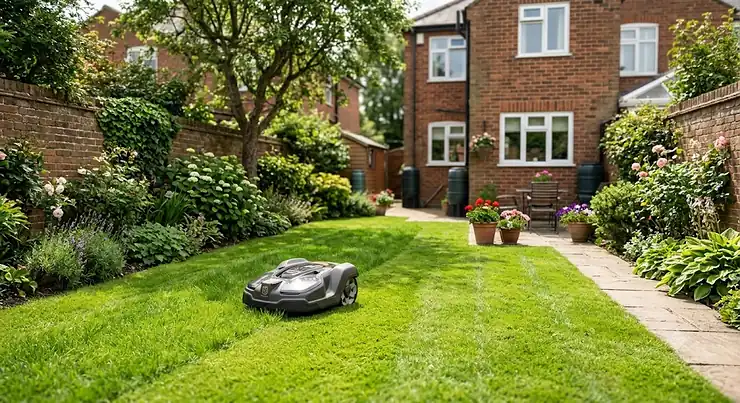
There’s a particular kind of Sunday dread that only a tangled reel of boundary wire can produce. You’re on your knees in the flower bed, wire cutters in one hand, a laminated instruction sheet flapping in the wind, wondering why a robot that’s supposed to save you time is currently costing you an entire weekend. A robot lawn mower no perimeter wire changes that equation completely: instead of burying cable, you walk (or let the mower drive) the boundary once, the software remembers it, and you’re mowing within the hour.
This shift matters more than it might sound. Wire-free navigation, whether it’s satellite-based RTK, onboard cameras, or LiDAR, has gone from a flaky early-adopter gimmick to a genuinely reliable category in the space of about three years. Reviewers at outlets like Trusted Reviews and Expert Reviews now rate several wire-free models above their wired stablemates, not despite skipping the cable, but because of it. Fewer buried faults, instant boundary changes when you move a flower bed, and setup measured in minutes rather than hours.
This guide walks through seven genuinely available wire-free robot mowers for UK gardens, from budget-conscious RTK models to premium all-wheel-drive machines built for slopes. We’ll cover GPS boundary mapping, RTK navigation, and virtual boundary systems in plain English, dig into a proper Husqvarna EPOS review, and give you a decision framework so you’re not just guessing which box to tick on Amazon. As with any category this fast-moving, treat every spec here as a snapshot; always check current pricing and availability before you buy.
Quick Comparison Table
| Mower | Navigation | Best For | Price Range |
|---|---|---|---|
| Segway Navimow i105E | RTK + Vision | Small, flat suburban lawns | £900–£950 range |
| eufy Robot Lawn Mower E15 | Pure Vision (RTK-free) | Buyers who want zero antenna fuss | £1,300–£1,500 range |
| Worx Landroid Vision M600 | Camera-only | Simplest possible setup | £1,250–£1,600 range |
| ECOVACS Goat A1600 LiDAR Pro | Dual-LiDAR + Vision | Shaded gardens, edge-trimming | around £1,300 |
| Segway Navimow i205 AWD | RTK + Vision, AWD | Budget slopes and uneven turf | under £700 |
| Mammotion Luba 2 AWD 1000 | RTK + Vision, AWD | Steep, complex, large gardens | £2,100–£2,200 range |
| Husqvarna Automower 305e Nera (EPOS) | EPOS satellite navigation | Premium build and edge-cutting | £1,900–£2,300 range |
Looking at the spread here, the pattern that jumps out is how much navigation technology now costs less than it used to: the Segway Navimow i205 AWD proves you can get genuine wire-free, slope-capable mowing for under £700, while the Mammotion Luba 2 AWD 1000 and Husqvarna Automower 305e Nera sit at the premium end because they’re solving harder problems (steep terrain, edge-perfect cutting) rather than just charging more for the same trick. Budget buyers with small, flat lawns are genuinely well served now; the extra spend only becomes worthwhile once your garden gets complicated.
💬 Just one click — help others make better buying decisions too!😊
Top 7 Robot Lawn Mowers Without a Perimeter Wire: Expert Analysis
Choosing which of these seven suits you comes down to garden shape, slope, and how much you value simplicity over raw capability. Here’s the honest breakdown of each, drawn from verified specs and aggregated reviewer and owner sentiment.
1. Segway Navimow i105E — best budget wire-free entry for small gardens
The standout here is price: independent reviewers note this was the model that finally brought RTK-based wire-free mowing down to a level ordinary UK households could justify. Trusted Reviews and Expert Reviews both tested the i105E and found setup took minutes rather than hours, with the mower using its EFLS 2.0 system (RTK GPS plus AI vision) to build a virtual boundary just by trundling around the lawn’s edge once. The i105E is rated for lawns up to roughly 500m², running around 60 minutes per charge from its 2.55Ah battery.
Based on the spec comparison with pricier RTK mowers, what you’re trading away at this price is raw stamina and slope handling, not core navigation accuracy — the centimetre-level positioning is the same technology used in Segway’s more expensive models. This makes it a sound pick for anyone with a flat-to-gently-sloped suburban plot who doesn’t want to overspend on capability they’ll never use. Reviewers consistently note the companion app is unusually intuitive for a first-generation wire-free product, and one BBC Gardeners’ World “Best Buy” award backs that up.
Aggregated owner sentiment on Amazon UK is strongly positive on ease of setup, with several buyers specifically praising the one-lap mapping process; the more critical reviews flag occasional GPS drift near buildings, which is a known limitation of RTK-only systems under obstruction.
Pros:
- ✅ Genuinely quick setup — minutes, not an afternoon of digging
- ✅ Centimetre-level RTK accuracy at a budget price point
- ✅ Praised, intuitive companion app for scheduling and mapping
Cons:
- ❌ Best suited to flat, open gardens rather than complex layouts
- ❌ Shorter runtime than pricier AWD alternatives
At around £900–£950, with UK street prices occasionally dipping lower during sales, the i105E represents excellent value if your lawn genuinely fits its 500m² sweet spot — check current price before buying, as retailer promotions shift often.
2. eufy Robot Lawn Mower E15 — best pure-vision mower with zero antenna hassle
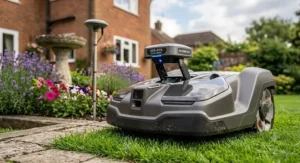
What most buyers overlook about camera-only mowers is that skipping RTK doesn’t just remove a wire — it removes an entire antenna, reference station, and signal-strength conversation altogether. The eufy E15 uses Eufy’s Vision FSD system: high-precision cameras plus onboard algorithms build a map of your lawn from grass-versus-not-grass recognition, rated for gardens up to around 800m² at an 18-degree maximum slope.
T3’s review highlighted the covered charging base as a genuine differentiator — most competitors leave the mower’s electronics exposed to summer sun and bird mess, while the E15’s roofed dock protects it, on top of its own IPX6 water resistance. Reviewers frame this as a small but telling sign of thoughtful engineering rather than corner-cutting. The trade-off, as with any vision-only system, is that mapping accuracy depends on good contrast between grass and borders; a lawn that blends messily into gravel or bare earth will confuse the algorithm more than it would an RTK-based rival.
Reviewers consistently report the setup process as the fastest in the category — no steering the mower around the boundary at all, since it learns the lawn shape through observation on its first run. Aggregated feedback flags Wi-Fi range in far corners of larger gardens as the most common real-world complaint, which is why eufy offers an optional 4G add-on.
Pros:
- ✅ No RTK antenna, reference station, or signal setup required
- ✅ Covered, weatherproofed charging station — a rare touch at this price
- ✅ Fastest, most hands-off first-time mapping in this comparison
Cons:
- ❌ Vision accuracy depends on clear grass-to-border contrast
- ❌ Wi-Fi range can be patchy in large or oddly shaped gardens without 4G
At around £1,300–£1,500, the E15 sits mid-pack on price but near the top for sheer setup simplicity — ideal for buyers who find the idea of an RTK antenna genuinely off-putting.
3. Worx Landroid Vision M600 — best plug-and-play mower for technophobes
The Worx Landroid Vision M600 takes “no wire” further than most: T3’s reviewer described it as usable straight out of the box without even opening the companion app, something no RTK-based rival can claim, since those still need at least a brief guided mapping walk. The M600 relies entirely on a front-mounted HD camera running semantic segmentation, treating the visible edge of the grass itself as the boundary rather than any surveyed line.
Here’s what to weigh before buying into that simplicity: because the AI is learning the lawn shape live rather than working from a pre-mapped virtual fence, early coverage can look semi-random, and reviewers note it typically takes a few sessions before mowing patterns tighten up. Once it does settle in, the trade-off pays off in flexibility — move a planter or add a new flower bed and the M600 adapts on its next run with no re-mapping required, unlike wire or even some RTK systems.
Aggregated customer sentiment is polarised in a predictable way: buyers with simple, regularly shaped lawns report near-total hands-off satisfaction, while those with complex, cluttered gardens see more missed patches during the settling-in period. The Landroid Vision range spans four sizes (250m² up to 1,300m²+), so matching the right model to your plot size matters more here than with most rivals.
Pros:
- ✅ Usable immediately with no boundary mapping walk required
- ✅ Adapts automatically when you change garden layout
- ✅ No GPS, RTK antenna, or signal dependency whatsoever
Cons:
- ❌ Coverage can look patchy for the first few mowing sessions
- ❌ Best suited to visually well-defined lawns rather than cluttered plots
Worx prices the Vision M600 in the £1,250–£1,600 range depending on retailer, with the smaller M600 sitting toward the lower end of that band.
4. ECOVACS Goat A1600 LiDAR Pro — best for shaded gardens and edge-perfect cutting
LiDAR solves a problem RTK genuinely struggles with: satellite signal loss under tree canopy or beside tall buildings. The ECOVACS Goat A1600 LiDAR Pro uses spinning laser sensors to build a real-time 3D map of the garden, and because that map doesn’t depend on satellite visibility, ECOVACS and reviewers both note it performs consistently in shaded corners where RTK mowers can stutter or pause.
The headline feature, though, is the built-in TruEdge trimmer — a small side-mounted cutting element that tackles the last few centimetres along paths and borders that a standard rotary blade always misses. Based on the spec comparison with the standard (non-Pro) Goat range, this is the meaningful upgrade: without it, owners typically still need a manual strimmer for finishing touches, which rather undercuts the “hands-off lawn care” promise.
Reviewers praise the mower’s ability to operate confidently at dusk or after dark, since LiDAR doesn’t rely on ambient light the way camera-only systems do — useful if you want mowing done outside daylight hours, though see our safety section below for why nighttime mowing needs a second thought regardless of navigation type. Aggregated owner sentiment flags the mower’s premium build and finish as a highlight, with the main criticism centring on the learning curve of ECOVACS’s app compared with simpler rivals.
Pros:
- ✅ LiDAR keeps working reliably under tree canopy and near buildings
- ✅ Built-in TruEdge trimmer cuts true right up to borders
- ✅ Doesn’t depend on daylight or strong satellite visibility
Cons:
- ❌ App and setup have a steeper learning curve than simpler rivals
- ❌ Premium pricing compared with vision-only alternatives of similar coverage
The A1600 LiDAR Pro launched at an RRP of around £1,300, positioning it as a genuine mid-premium choice rather than an entry-level one.
5. Segway Navimow i205 AWD — best budget pick for slopes and uneven turf
Most budget wire-free mowers assume a flat lawn; the Segway Navimow i205 AWD doesn’t. Its all-wheel-drive chassis is rated for slopes up to 45%, a figure that would normally only appear on mowers costing two or three times as much, and it manages this while staying, at the time of research, priced under £700 on Amazon UK — genuinely striking value on paper.
What most buyers overlook about “AWD” claims on cheaper mowers is that traction and slope-rating aren’t the same thing as build quality on rough ground; reviewers at TheRobotMower.co.uk noted that for just a modest premium over the standard i105E, the i205 AWD delivers “significantly better traction and reliability,” which is exactly the improvement UK gardens with their characteristic damp patches and uneven lawns actually need. It uses Segway’s EFLS RTK plus vision system and, notably, doesn’t require a separate RTK antenna installation in most setups — a genuine convenience over some rivals.
Aggregated review sentiment is consistently favourable on value, with the main caveat being that, like all budget-tier RTK mowers, performance near buildings or under dense trees can degrade compared with the LiDAR-based alternatives further up this list.
Pros:
- ✅ AWD slope handling up to 45% at a genuinely budget price
- ✅ No separate RTK antenna installation typically required
- ✅ Strong value verdict from independent UK reviewers
Cons:
- ❌ RTK accuracy can dip under heavy tree cover, as with any GPS-based system
- ❌ Smaller battery than premium AWD rivals limits runtime on larger plots
At under £700, this is arguably the best wire-free robot mower for anyone with a sloped but modest-sized UK garden who doesn’t want to stretch to four figures.

6. Mammotion Luba 2 AWD 1000 — best premium all-terrain mower for complex gardens
If your garden looks more like a hillside than a bowling green, the Mammotion Luba 2 AWD 1000 is built specifically for that scenario. TechRadar and T3 both singled out its slope capability — up to 45% sustained, with a maximum climb of 80% — as class-leading, achieved through genuine all-wheel drive rather than the single-driven-wheel setups still common elsewhere. It combines RTK-GNSS with an onboard camera, meaning the mower cross-checks satellite positioning against visual landmarks, a setup that pays off precisely in the tree-lined, uneven gardens where pure RTK struggles.
Here’s what the spec sheet won’t tell you outright, but reviewers note it clearly: setup, while wire-free, is more involved than the budget models on this list, since positioning the RTK reference station (or optional wall-mount) correctly takes some care to get a stable signal. Once running, though, owners and reviewers alike describe the actual cut quality and coverage as exceptional, helped by a wide 400mm cutting deck that clears large areas quickly.
Reviewers consistently flag this as a genuine step up in engineering rather than just a bigger battery — the Formula One comparison shows up in more than one review, which tells you something about how this mower is positioned. Aggregated owner sentiment is very positive on cutting performance and slope handling, with the main criticism being the fiddly initial placement of the RTK receiver.
Pros:
- ✅ Best-in-class slope handling — up to 80% maximum climb
- ✅ Combines RTK GNSS with camera-based cross-checking for reliability
- ✅ Wide 400mm cutting deck covers large lawns efficiently
Cons:
- ❌ Initial RTK receiver placement takes more care than plug-and-play rivals
- ❌ Premium pricing puts it out of reach for smaller, simpler gardens
Mammotion prices the Luba 2 AWD 1000 at around £2,100–£2,200 in the UK, with larger-coverage variants (3000 and 5000) priced higher again — a fair value verdict for anyone whose terrain genuinely justifies it.
7. Husqvarna Automower 305e Nera (EPOS) — best premium build quality and edge-cutting
No wire-free round-up would be complete without a proper Husqvarna EPOS review, and the Husqvarna Automower 305e Nera is the model that brought Husqvarna’s satellite navigation to a more attainable tier of its range. EPOS (Exact Positioning Operating System) combines GPS, GLONASS and Galileo signals with cloud-based correction, removing the need for a separate physical reference station that older Husqvarna satellite systems required — you map the boundary once through the Automower Connect app and the robot remembers it.
What sets this apart from every other mower here, according to Expert Reviews and The Ambient, is the EdgeCut system: a design that lets the cutting disc genuinely reach right to the lawn’s edge, drastically reducing (though reviewers note not eliminating) the need for a separate strimmer. Reviewers describe the build quality as noticeably above the rest of this list, which tracks with Husqvarna’s three-decade history in the category — the company built the first robot lawn mower back in the 1990s.
Based on the spec comparison, the catch is cost: reviewers note you can buy the standard wire-based 305e Nera and add the EPOS Plug-in later for £399, so there’s no saving by buying the satellite-ready bundle upfront, and either way this sits well above the Segway and eufy options on this list. Reviewers are consistent that the price is justified only if you value the build quality and edge-cutting specifically, or have a complex garden where mixing EPOS with a supplementary boundary wire genuinely helps — an option Husqvarna offers that most competitors don’t.
Pros:
- ✅ EdgeCut system genuinely reduces manual strimming at the borders
- ✅ Can combine EPOS satellite navigation with wire for complex layouts
- ✅ Outstanding build quality reviewers rate above every rival here
Cons:
- ❌ EPOS adds roughly £399 over the standard wire-only version
- ❌ Obstacle avoidance rated behind some cheaper camera-based rivals
Expect to pay in the £1,900–£2,300 range for the EPOS-equipped 305e Nera depending on retailer and current offers — genuinely premium money, but reviewers consistently rate it among the best all-round robot mowers regardless of navigation type.
Setting Up Your Wireless Robot Lawn Mower: A Practical First-Month Guide
Getting a wire-free mower running well involves more than switching it on. Most first-month problems reviewers document come down to mapping shortcuts, not hardware faults. Start by walking (or driving, on RTK models) the entire boundary slowly and deliberately, including any narrow corridors between beds — rushing this step is the single biggest cause of missed patches later. If your mower uses RTK, place the antenna or reference station somewhere with a clear view of open sky; tucking it under an eave or close to a wall is the most common cause of the GPS drift reviewers complain about.
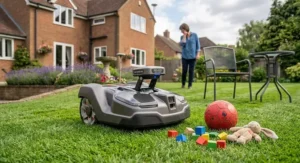
For the first week, mow on a manual or supervised schedule rather than full auto, so you can catch and correct any boundary errors before they become baked into the mower’s memory. Common early mistakes include mapping the lawn on a single dry, sunny day and then finding vision-based systems get confused by longer shadows later in the season, and forgetting to set exclusion zones around ponds, vegetable beds, or children’s play equipment before the first unsupervised run.
Once the map is solid, a simple maintenance routine keeps performance consistent: check blades every two to three weeks during peak growing season, clean the underside after wet cuts to stop grass clippings caking around the cutting disc, and update firmware promptly, since several models on this list (the Segway Navimow and Husqvarna Automower ranges especially) have had meaningful navigation improvements delivered via over-the-air updates rather than new hardware.
Real Gardens, Real Solutions: Matching a Wire-Free Mower to Your Lawn
Picture three very different UK gardens and how this list actually maps onto them. First, a young family in a new-build estate with a flat 400m² rear lawn, a trampoline, and two dogs: the Segway Navimow i105E or budget-friendly Segway Navimow i205 AWD suit this well, since the garden is simple enough that RTK’s occasional weak spots (shade, clutter) rarely come into play, and the lower price frees up budget for the safety extras discussed later.
Second, a retired couple with a mature, tree-lined 900m² garden on a gentle slope, several flower beds, and a greenhouse: this is precisely the scenario LiDAR and camera-vision systems were built for. The ECOVACS Goat A1600 LiDAR Pro copes with the shade under mature trees where pure RTK falters, and its edge trimmer means less manual tidying around those flower beds.
Third, a larger rural property with a genuinely steep 1,000m²-plus lawn, uneven ground, and no interest in fiddly setup compromises: this is where the Mammotion Luba 2 AWD 1000 or Husqvarna Automower 305e Nera earn their premium price tags — both are built for exactly this kind of demanding terrain, and trying to save money with a budget model here typically just means a mower that stalls on the slope or misses the awkward corners.
Buyer’s Decision Framework: Which Wire-Free Mower Type Suits You?
If your lawn is small, flat, and regularly shaped, choose a budget RTK+Vision model like the Segway Navimow i105E, because you’re not paying for capability you won’t use. If your priority is the absolute simplest possible setup and you’re not fussed about an antenna, choose a pure-vision mower like the eufy Robot Lawn Mower E15 or Worx Landroid Vision M600, because they remove the RTK conversation entirely. If your garden has mature trees, tall buildings, or heavy shade, choose a LiDAR-equipped model like the ECOVACS Goat A1600 LiDAR Pro, because satellite signal simply isn’t reliable enough there. If you’re dealing with genuine slopes above 30%, choose an AWD model — either the budget Segway Navimow i205 AWD or the premium Mammotion Luba 2 AWD 1000 — because traction, not navigation, becomes the limiting factor. And if edge-cutting quality and long-term build reliability matter more to you than upfront price, the Husqvarna Automower 305e Nera with EPOS is worth the premium.
✨ Don’t Miss These Exclusive Deals!
🔍 Take your wire-free lawn care to the next level with these carefully selected mowers. Click on any highlighted model to check current pricing and availability. These robots will help you create a beautifully kept lawn your whole family will love!
What Is a Robot Lawn Mower Without a Perimeter Wire?
A robot lawn mower without a perimeter wire is an autonomous mowing robot that defines its cutting area using satellite positioning (GPS/RTK), onboard cameras, or LiDAR, instead of a buried boundary cable. You set the mowing zone through a smartphone app rather than digging a physical wire into the ground, which typically cuts installation time from several hours down to about fifteen to thirty minutes.
Robot lawn mowers usually start at around £600 and climb well into the thousands depending on lawn size and navigation technology, according to Which?, with pricier models adding features like GPS tracking, weather sensing, and anti-theft alarms.
How to Choose a Robot Lawn Mower Without a Perimeter Wire
- Measure your lawn accurately first. Every model on this list has a maximum coverage rating; buying undersized means constant recharging gaps and uneven cuts.
- Assess your slope honestly. Anything consistently above 25–30% needs an AWD model, not a standard two-wheel-drive one.
- Check tree and building coverage. Heavy shade favours LiDAR or vision systems over pure RTK, which needs a clear view of the sky.
- Decide how much setup fuss you’ll tolerate. Pure-vision models need the least manual mapping; RTK models need careful antenna placement.
- Factor in obstacles and complexity. Narrow side-passages, ponds, and multiple zones favour mowers with strong multi-zone management in the app.
- Set a realistic total budget, including any optional extras like wall-mounted antenna kits, spare blades, or extended warranties.
- Read aggregated owner reviews, not just marketing copy, since real-world complaints (Wi-Fi range, app quirks) rarely show up in spec sheets.
GPS vs RTK vs Vision: Understanding Boundary Mapping Technology
These three approaches to GPS boundary mapping solve the same problem in different ways. Standard GPS alone is only accurate to a few metres — nowhere near precise enough to hold a lawn edge — which is why every serious wire-free mower on this list uses something more refined. RTK navigation corrects for that imprecision using a fixed reference station that constantly compares its own known position against incoming satellite signals, then relays that correction to the mower in real time, achieving the centimetre-level accuracy you’ll see quoted throughout this guide. Camera-based vision systems take a completely different approach: they don’t use satellites at all, instead recognising the visual edge between lawn and border and building a map from what the mower physically observes, which is why they remain reliable under tree canopy where RTK can lose its fix. LiDAR sits somewhere in between, scanning the physical environment with lasers to build a 3D map independent of both satellite visibility and ambient light.
Virtual Boundary Systems Explained
A virtual boundary system is simply the software layer that replaces the old buried cable: once your chosen navigation technology (RTK, vision, or LiDAR) has located the mower precisely enough, the app lets you draw or record a boundary line that exists only in software. Move a flower bed or extend the patio, and you edit the virtual line in the app in seconds — no digging required, which is the single biggest practical advantage this entire category holds over wired mowers.
Husqvarna EPOS Review: Is the Premium Worth It?
EPOS deserves its own section because it’s genuinely different from the RTK systems used by most rivals on this list. Rather than relying purely on a locally-installed reference station, Husqvarna’s EPOS combines GPS, GLONASS, and Galileo satellite constellations with cloud-based correction data, which the company says delivers accuracy in the region of two to three centimetres. Reviewers at Notebookcheck confirmed UK pricing for the flagship NERA range sits well above this list’s mid-tier options, reflecting Husqvarna’s positioning as the premium end of wire-free mowing.
The honest verdict from independent testers is that EPOS earns its premium primarily through two things: the EdgeCut border-cutting mechanism, and the flexibility to combine satellite navigation with a supplementary boundary wire in especially complex gardens — an option no other brand on this list currently offers. What EPOS doesn’t obviously win on, according to The Ambient’s testing, is obstacle avoidance, which trails some cheaper camera-based rivals. If your garden is straightforward, cheaper wire-free options on this list will get you 90% of the practical benefit for a fraction of the outlay; EPOS earns its keep specifically on build quality, edge-cutting, and configuration flexibility for difficult plots.
Features That Actually Matter (And Those That Don’t)
Reviewers across this category consistently rate a handful of features as genuinely important: reliable multi-zone management (for gardens split by paths or driveways), rain sensors that pause mowing during wet weather to protect the grass and the blades, and firmware-over-the-air updates, which have meaningfully improved navigation on several models here without any hardware changes. Anti-theft GPS tracking also earns its place, given robot mowers left outside overnight are an obvious target.
What gets less genuine value than the marketing suggests: headline-grabbing top speeds (grass cutting rarely benefits from raw pace, and faster mowers often sacrifice cut quality), voice-assistant integrations that most owners try once and never use again, and elaborate app gamification features. What most buyers overlook is that the boring stuff — battery capacity relative to lawn size, and how the mower behaves specifically in your garden’s weakest signal spot — determines day-to-day satisfaction far more than any flashy feature list.
Common Mistakes When Buying a Wire-Free Robot Mower
The most frequent error reviewers and owners report is buying strictly to current lawn size rather than any planned extensions — if you’re likely to expand the garden, size up rather than buying to the exact current footprint. A close second is underestimating slope: many buyers assume “handles slopes” on a spec sheet means their specific incline, when the tested figure is usually a maximum under ideal, dry conditions rather than a guarantee for every part of every lawn. Third, skipping the trial period on RTK positioning — running the mower supervised for the first week catches boundary errors while they’re still easy to fix, rather than after the mower has already carved a bald patch into next door’s flower bed. Finally, many buyers overlook ongoing costs (replacement blades, occasional servicing) when comparing sticker prices, which can meaningfully shift the value comparison between models.
Wire-Free vs Wired Robot Mowers: Which Wins for UK Gardens?
| Factor | Wire-Free (RTK/Vision/LiDAR) | Wired (Perimeter Cable) |
|---|---|---|
| Installation time | 15–30 minutes | 1–3 hours or more |
| Boundary changes | Instant, via app | Requires digging up and repositioning cable |
| Reliability in poor weather | Generally consistent | Extremely reliable, unaffected by satellites |
| Typical price premium | £500–£1,500 higher | Lower upfront cost |
| Best for | Changeable, complex, or larger gardens | Simple, fixed, small-to-medium lawns |
The practical takeaway from this comparison is that wired mowers still make sense for straightforward, unchanging gardens where the lower upfront cost matters more than convenience — Which? notes robot mowers generally cost considerably more than push or cordless alternatives regardless of navigation type. Wire-free genuinely earns its premium once your garden layout changes often, has complex zones, or sits somewhere a buried cable would be impractical to install, such as over patios or gravel paths.
💬 Just one click — help others make better buying decisions too!😊
Long-Term Cost & Maintenance: Total Cost of Ownership
Sticker price is only part of the story. Blades on every model here need replacing every few months during peak season — typically a modest, ongoing cost rather than a major one — and batteries, like all lithium-ion packs, gradually lose capacity over several years of daily charge cycles. RTK-based mowers carry an additional consideration: reference stations and antennas are largely maintenance-free once correctly sited, but a damaged antenna cable (from strimming too close, for example) is a repair cost wired mowers simply don’t have.
Where wire-free models can claw back value over time is flexibility: since boundary changes cost nothing beyond a few taps in an app, gardens that get renovated, extended, or reshaped avoid the labour cost of relaying cable that a wired mower would demand. Weighed against a typical UK lawn-care service, even premium wire-free models like the Mammotion Luba 2 AWD 1000 or Husqvarna Automower 305e Nera can work out reasonable over a five-year span for larger or more complex gardens, though budget models like the Segway Navimow i105E will always win on raw payback speed for smaller plots.
Safety, Regulations and Compliance for Robot Mowers in the UK
Robot mowers are generally safe when used sensibly, but there’s one specific UK safety issue worth taking seriously: wildlife. Research led by the University of Oxford found that robotic mowers can injure hedgehogs, which typically freeze and curl into a ball rather than flee when threatened, making them easy for sensor-based obstacle detection to miss entirely. The study’s authors are working towards a standardised hedgehog-safety certification for the category.
Until that labelling exists, the practical advice is straightforward: run your mower during daylight hours rather than overnight, when hedgehogs and other garden wildlife are most active, and visually check the lawn for animals before starting an unsupervised cycle. It’s also worth checking your mower for basic safety features — lift and tilt sensors that stop the blades instantly, and a physical emergency-stop button — all of which are standard across the models featured in this guide. From a compliance standpoint, all mowers sold in the UK must carry UKCA or CE marking confirming they meet relevant electrical and mechanical safety standards, so it’s worth confirming this is present before buying from any less familiar retailer.
FAQ
❓ Do robot lawn mowers need a perimeter wire?
❓ How accurate is RTK navigation for lawn boundaries?
❓ Can a wire-free robot mower work under trees?
❓ Are wire-free robot mowers safe for pets and hedgehogs?
❓ How long does a wire-free robot mower last?
Conclusion
The perimeter wire was never really the point of a robot lawn mower — it was just the technology available to get one working. Now that RTK, vision, and LiDAR systems have matured into genuinely reliable alternatives, the real decision has shifted to something more useful: matching your specific garden’s shape, slope, and shade to the navigation technology best suited to it, rather than accepting whatever a buried cable could handle.
For flat, modest gardens, the Segway Navimow i105E and Segway Navimow i205 AWD prove wire-free no longer means expensive. For anyone who wants the absolute simplest setup, the eufy Robot Lawn Mower E15 and Worx Landroid Vision M600 remove the RTK conversation entirely. Shaded or tree-lined gardens are best served by the ECOVACS Goat A1600 LiDAR Pro, while genuinely demanding terrain justifies the premium of the Mammotion Luba 2 AWD 1000 or the Husqvarna Automower 305e Nera with EPOS. Whichever you choose, always check current pricing before buying, since this category moves fast and today’s best deal can shift within weeks.
✨ Ready to reclaim your weekends? Compare today’s prices on any of these seven wire-free mowers and find the one built for your garden. ✨
Recommended for You
- Robot Lawn Mower for Large Garden: 7 Top Picks (2026)
- 7 Best Robot Lawn Mower Under £500 Picks for 2026 (UK)
- Robot Lawn Mower: 7 Brilliant UK Picks for 2026
Disclaimer: This article contains affiliate links. As an Amazon Associate, I earn from qualifying purchases. If you purchase products through these links, we may earn a small commission at no additional cost to you.
✨ Found this helpful? Share it with your friends! 💬🤗
