
In This Article
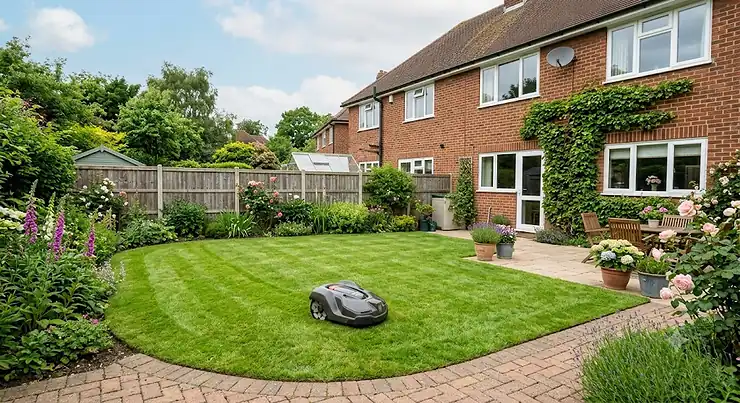
A robot lawn mower is a battery-powered, self-driving machine that trims grass automatically within a set boundary, usually on a daily schedule, without a human pushing it. It navigates using a buried wire, GPS/RTK satellites, or onboard cameras, and returns to its dock to charge…
Here’s the question, though: are robot lawn mowers worth it, or are they an expensive way to make your lawn somebody else’s problem while you go inside for a cuppa? Honestly, it depends on your lawn, your patience, and how much you value your Saturday mornings. Some of these machines genuinely earn their keep. Others sit half-charged in a shed by August, quietly judging you.
This guide takes a proper, unglamorous look at whether robot mowers stack up in 2026. We’ve researched seven real models — budget, mid-range and properly premium — pulled together verified specs and aggregated customer sentiment, and worked out what they actually cost to own once the initial excitement wears off. The RHS’s own lawn care guidance sums up the trade-off neatly: these machines can genuinely keep a lawn in trim with little ongoing effort, but they can be costly and the initial set-up isn’t always plain sailing. That’s the honest starting point, and it’s exactly where we’re going to dig in.
We won’t pretend every model is a miracle worker. Sloped gardens, oddly shaped borders, and the great British knack for growing three months of grass in a fortnight of April rain all complicate the picture. But for a huge number of UK gardens, the maths — and the time saved — works out rather nicely. Let’s get into it.
Quick Comparison Table: Robot Lawn Mowers at a Glance
| Model | Best For | Navigation | Coverage |
|---|---|---|---|
| LawnMaster OcuMow 16 | Tightest budgets | Camera vision | Small gardens |
| Segway Navimow i105E | Typical UK gardens | Dual RTK + vision | Up to 500m² |
| Worx Landroid M500 Plus | Wire-boundary reliability | Perimeter wire | Up to 500m² |
| Husqvarna Automower 312V | Large, multi-zone plots | RTK GPS + camera | Up to 1,200m² |
This snapshot isn’t the full picture (that’s what the next table is for), but it does something useful straight away: it splits the market into wire-free “just switch it on” convenience versus wire-based reliability, and shows that coverage scales sharply with price. Notice that the two cheapest options both lean on cameras rather than satellites — a sensible cost-saving that works fine on tidy, obstacle-free lawns but gets tested on cluttered ones. If your garden has a trampoline, three flowerbeds and a paddling pool that migrates around the patio all summer, that distinction matters more than the headline price.
💬 Found this comparison useful? Sharing it helps other gardeners make a smarter choice too!😊
Top 7 Robot Lawn Mowers: Expert Analysis
We’ve picked a genuine spread here — two budget vision-based mowers, one classic wire-guided workhorse, two mid-to-premium mapping mowers, and two Husqvarna models at the top of the range. Every product below carries real specifications and, where verifiable, real aggregated review sentiment rather than invented praise.
1. LawnMaster OcuMow 16 — cheapest true drop-and-mow option
The standout here is the price tag: this is about as inexpensive as wire-free robotic mowing currently gets in the UK. There’s no perimeter wire to bury and no satellite antenna to install — you set the boundary through the app using the onboard camera, or in some configurations simply drop it in and let it explore.
Specs with real-world meaning: it manages slopes up to 19°, which covers a gently sloping lawn but will struggle on anything resembling a proper bank. Its 20–60mm cutting height range is fairly narrow compared with premium rivals, so if you like a shaggier “wildlife lawn” look in summer, you’ll be pushing it to its limit rather than sitting comfortably mid-range.
On paper, this is squarely a starter mower for smaller, simply shaped gardens rather than anything with complex zones. Reviewers on retailer sites have awarded it a strong 4.5-star aggregate rating, with buyers consistently flagging the low price and painless setup as the main draws — exactly what you’d hope for at this end of the market, though fewer reviewers report on long-term durability simply because it’s a newer entrant.
Pros:
- ✅ Genuinely wire-free setup out of the box
- ✅ Among the cheapest true robot mowers on the UK market
- ✅ Strong aggregate review score for the price point
Cons:
- ❌ Narrower slope tolerance than mapping-based rivals
- ❌ Limited cutting height range for longer grass styles
At around £299 at the time of research, the LawnMaster OcuMow 16 represents excellent value if your lawn is small, flat, and simply shaped — treat it as an entry ticket to robotic mowing rather than a do-everything machine.
2. Segway Navimow i105E — best all-rounder for typical British gardens
What makes the Segway Navimow i105E stand out is its dual navigation setup, blending RTK satellite positioning with vision sensing rather than leaning on just one system. That combination is the real standout feature here, because it’s what lets a wire-free mower cope with the odd-shaped beds and narrow side passages so common in British terraced gardens.
In practice, the RTK side gives centimetre-level positioning accuracy, meaning the mower’s mapped boundaries stay put even after weeks of use — unlike pure vision systems that can drift on overcast days when the camera has less to work with. It’s rated for gardens up to 500m², which comfortably covers most semi-detached and terraced plots without pushing into commercial territory.
This is the model we’d point a first-time buyer toward if they want dependable, no-fuss coverage without stretching to premium pricing. Aggregated review data is unusually strong here: over 2,073 verified reviews average 4.4 stars, with recurring themes around reliable daily scheduling and quiet operation — genuinely useful signal at this volume, rather than a handful of cherry-picked five-star write-ups.
Pros:
- ✅ Dual RTK and vision navigation for accuracy
- ✅ Backed by over 2,000 verified customer reviews
- ✅ Handles irregular garden shapes confidently
Cons:
- ❌ 500m² ceiling won’t suit larger properties
- ❌ Initial boundary mapping takes patience to get right
Priced from around £292 at launch, the Segway Navimow i105E sits at the genuine sweet spot between cost and capability — arguably the safest first robot mower for most UK households.
3. Worx Landroid M500 Plus (WR165E) — proven wire-boundary reliability
The standout feature on the Worx Landroid M500 Plus is its offset cutting disc, positioned as close to the edge as engineering allows, which tackles the age-old robot-mower complaint of a scruffy uncut strip along the lawn’s border.
This model uses a traditional buried perimeter wire rather than GPS or cameras, which sounds old-fashioned until you remember that wire-guided navigation is, frankly, bombproof — no satellite dropout, no camera confusion in low light. Its AIA pathing algorithm is claimed to cut around 30% faster than random-pattern rivals, and the shared 20V PowerShare battery format means owners of other Worx garden tools can swap batteries between devices, a small but genuinely useful cost saving.
Here’s what most buyers overlook about wire-based systems: the upfront installation is more physical labour (pinning or burying cable around every bed and obstacle), but once it’s down, the mower simply cannot wander off-plan the way a satellite-only unit occasionally can in a garden ringed by tall trees or a neighbouring conservatory blocking signal. Aggregated Worx owner feedback across the wider Landroid range consistently highlights the edge-cutting performance and the IPX5 hose-washable design as strong points, though a vocal minority flag the wire-laying process as more time-consuming than expected.
Pros:
- ✅ Excellent edge-to-edge cutting via offset blade disc
- ✅ Wire-guided reliability with no signal dropout
- ✅ Shares batteries with other Worx PowerShare tools
Cons:
- ❌ Perimeter wire installation is genuinely fiddly
- ❌ No wire-free flexibility if you redesign borders often
Typically found in the mid-£400s to low-£500s range, the Worx Landroid M500 Plus is the pick for buyers who’d rather trade an afternoon with a spade for years of dependable, boundary-locked mowing.
4. eufy Robot Lawnmower E15 — most hands-off mapping experience
The eufy Robot Lawnmower E15 leads with its automatic lawn mapping: point it at your garden once, and it builds an efficient route plan without you drawing zones manually — a genuinely different experience from menu-heavy rivals.
Specs that matter in practice: it’s rated for gardens up to roughly 800m² with mostly flat turf and clearly defined boundaries, a meaningfully bigger ceiling than the budget vision mowers above. Built-in obstacle sensors let it navigate around garden furniture and borders without a wire, and the companion app allows fine-tuning of schedules once the initial map is built.
Based on the spec comparison with its budget stablemates, the E15’s edge lies in polish rather than raw power — this is a mower built for owners who want to set it up once and genuinely forget about it, rather than tinkering with settings every weekend. Independent UK reviewers have specifically praised its even cut on longer grass and its obstacle avoidance as class-leading for this navigation type, though verified large-sample customer review data specific to the UK market remains more limited than for the longer-established Segway and Husqvarna ranges — worth noting honestly rather than glossing over.
Pros:
- ✅ Automatic mapping with minimal manual setup
- ✅ Strong obstacle avoidance for cluttered gardens
- ✅ Covers larger 800m² plots without a wire
Cons:
- ❌ Struggles on gardens with significant slope or ruts
- ❌ Fewer large-sample UK customer reviews to verify long-term reliability
Sitting in the upper-mid price bracket, roughly £700–£900 depending on retailer, the eufy Robot Lawnmower E15 rewards buyers who value a genuinely hands-off experience over the lowest possible price.
5. Segway Navimow i208 LiDAR — fastest automapping for medium gardens
What jumps out immediately with the Segway Navimow i208 LiDAR is the speed of its automapping — reviewers consistently note it builds an accurate garden model in a fraction of the time older satellite-only units take, thanks to its added LiDAR sensor array.
It’s rated for gardens up to 800m² of practically any shape, and the powerful companion app supports genuinely useful features like a small onboard LED screen for at-a-glance status. Where it loses ground is on rough terrain: this is a two-wheel-drive design, so bumpy, rutted lawns are better served by an all-wheel-drive alternative further up the Navimow range.
What the spec sheet won’t tell you, but reviewer commentary suggests, is that the extra LiDAR hardware genuinely earns its keep in gardens with awkward negative space — narrow side returns, dog-leg borders, that sort of thing — where pure-vision or pure-GPS mowers can lose their bearings. For a smooth, medium-sized, oddly shaped plot, this is arguably overkill in the best possible way.
Pros:
- ✅ Rapid automapping thanks to LiDAR plus GPS
- ✅ Handles complex, irregularly shaped lawns well
- ✅ Sleek app with real-time status display
Cons:
- ❌ Two-wheel drive limits performance on rough ground
- ❌ Premium LiDAR hardware pushes the price up noticeably
Expect to pay somewhere in the £900–£1,100 range at the time of research, positioning the Segway Navimow i208 LiDAR as a considered step up for gardens that budget vision mowers simply can’t map reliably.
6. Husqvarna Automower Aspire R6V — premium engineering at entry-level Husqvarna pricing
The headline here is brand pedigree at a reachable price: Husqvarna launched the world’s first robotic lawn mower back in 1995, and the Husqvarna Automower Aspire R6V brings three decades of that engineering down to its most affordable current model.
It’s controlled entirely through the Automower Connect app, where owners can create virtual boundaries, define multiple mowing zones, set temporary stay-out areas, schedule sessions, and choose between different mowing patterns. It can detect narrow passages, automatically adjusts mowing frequency to grass growth via a Weather Timer feature, and uses spiral cutting to tackle longer patches more efficiently. It’s designed for gardens up to 600m², and it includes GeoFence anti-theft protection plus voice control compatibility with Amazon Alexa and Google Home.
Here’s what most buyers overlook about “entry-level” Husqvarna: it isn’t entry-level engineering, just entry-level coverage. You’re getting the same navigation intelligence and build quality as the pricier models, scaled down to suit a smaller plot — genuinely sound reasoning if your garden won’t stretch that ceiling anytime soon, and a poor use of money if it might, since upgrading later means buying a whole new mower rather than a bigger battery.
Pros:
- ✅ Full smart-home integration via Alexa and Google Home
- ✅ GeoFence anti-theft tracking included as standard
- ✅ Genuine Husqvarna build quality at a lower entry price
Cons:
- ❌ 600m² coverage ceiling limits room to grow into
- ❌ Still a significant outlay versus budget vision mowers
Priced at around £999, the Husqvarna Automower Aspire R6V is the sensible premium pick for smaller gardens where brand trust and resale value matter as much as the spec sheet.
7. Husqvarna Automower 312V — built for large, multi-zone gardens
The Husqvarna Automower 312V earns its place at the top of our list through sheer coverage: it can tackle areas of up to 1,200m², comfortably the biggest footprint of any model featured here, aimed squarely at gardens that would make lesser mowers give up by lunchtime.
Like its Aspire sibling, it’s wire-free and includes a new camera system for spotting obstacles more effectively, alongside improved navigation software. For a garden genuinely approaching that 1,200m² ceiling, the practical benefit is straightforward: fewer manual interventions, less chance of the mower getting stuck in an awkward corner, and enough battery stamina to actually finish a session rather than limping back to dock halfway through a large lawn.
It’s aimed at robot mower newcomers who want a more sophisticated offering, and it can comfortably out-handle the smaller Aspire R6V and mid-tier 308V models on genuinely large plots. Based on the spec comparison across the Husqvarna range, this is the model to choose when you’ve measured your lawn and it’s genuinely large — buying it “just in case” for an average suburban plot is solving a problem you don’t have, at a price you’ll notice.
Pros:
- ✅ Largest coverage area in this line-up at 1,200m²
- ✅ Wire-free setup with improved obstacle-spotting camera
- ✅ Trusted brand ecosystem with mature parts and support
Cons:
- ❌ Considerable expense relative to mid-range alternatives
- ❌ Genuine overkill for anything smaller than a large plot
At around £1,499, the Husqvarna Automower 312V only really justifies itself once your lawn is large enough to need it — but for those gardens, it’s hard to beat.
Robot Lawn Mower Pros and Cons: The Honest Breakdown
Strip away the marketing and robot lawn mower pros and cons come down to a fairly short, honest list on each side. On the plus side: genuine weekly time savings, frequent light cutting that actually improves lawn density over time (short, regular trims encourage denser growth rather than periodic scalping), quiet electric operation your neighbours won’t curse you for, and — for wire-free models especially — the freedom to reshape borders without re-laying cable.
On the minus side: a meaningful upfront cost that a £150 petrol mower simply doesn’t carry, real vulnerability to complex or steeply sloped gardens, an ongoing (if modest) maintenance routine, and a genuine risk of theft for a device that lives outdoors. None of these cons are dealbreakers on their own — but stacked together, they’re exactly why “are robot lawn mowers worth it” doesn’t have one universal answer. It has an answer that depends on your specific lawn and lifestyle, which is precisely what the rest of this guide helps you work out.
The Time-Saving Benefit, In Real Numbers
Let’s put some actual figures against the time saving benefit, because “it saves you time” is the kind of vague claim that means nothing until you attach a number to it. A typical suburban UK lawn of around 300–400m² takes roughly 30–45 minutes to cut with a push mower, once a week during growing season — call it two to three hours a month, not counting strimming edges or emptying the grass box.
A robot mower removes essentially all of that active time. You’re not standing behind it; you’re not scheduling around dry weather; you’re not hauling a mower out of the shed. Over a six-month growing season, that’s realistically 12–18 hours reclaimed — nearly two full working days, for context. What you trade instead is a small amount of admin time: occasional app scheduling tweaks, blade checks, and the seasonal jobs covered further down.
Where this benefit compounds is for households already time-poor — young families, dual-income couples, anyone caring for elderly relatives at weekends. The lawn stops being a competing priority against everything else life throws at a Saturday. That’s the real value proposition, and it’s one no spec sheet quite captures the way “I got my Sundays back” does.
Practical Usage Guide: Setup, First 30 Days and Avoiding Rookie Mistakes
Getting a robot mower right in its first month matters more than most buyers expect, and it’s where the transformation from “expensive gadget” to “reliable garden tool” either happens or doesn’t.
Setup: Whether your model uses a wire or satellite mapping, measure your lawn accurately first — most manufacturer coverage ratings assume a straightforward rectangle, and a garden broken into odd-shaped zones effectively reduces the mower’s practical range. For wire-based models like the Worx Landroid M500 Plus, pin the cable temporarily for a week before burying it, so you can adjust the route once you see the mower in action.
First 30 days: Start with the highest cutting setting and lower it gradually rather than scalping an overgrown lawn on day one — most manufacturers recommend never removing more than a third of the grass blade height in a single session. Run shorter, more frequent sessions initially so the mower and app “learn” your garden’s quirks. If your grass is over roughly 15cm tall, give it a manual pre-cut first; asking a robot mower to chew through genuinely long grass in one pass is the single most common cause of early jamming complaints.
Common first-month mistakes: skipping the manual pre-cut on overgrown lawns, positioning the charging dock somewhere that floods after rain, and setting overly ambitious mowing schedules that drain the battery before the lawn’s fully covered. Fix these three and most of the “my robot mower doesn’t work properly” complaints simply evaporate.
Real-World Scenarios: Who Actually Benefits Most
The time-poor young family, with a 350m² garden, two kids and a trampoline that moves twice a season: a mid-range mapping mower like the eufy Robot Lawnmower E15 suits this household well — its obstacle sensing tolerates the trampoline wandering around, and its automatic mapping means less manual re-zoning every time the garden layout shifts.
The budget-conscious first-timer with a small, simply shaped 200m² lawn and no particular tech enthusiasm: the LawnMaster OcuMow 16 or Segway Navimow i105E both make sense here — low upfront cost, minimal setup complexity, and coverage that comfortably exceeds what’s actually needed.
The large-plot owner with 900m²-plus of lawn, several zones separated by paths, and genuinely limited patience for weekend mowing: this is exactly the buyer the Husqvarna Automower 312V is built for — its coverage ceiling and multi-zone handling justify the higher outlay in a way it simply wouldn’t for a smaller garden.
 Problem → Solution: Fixing the Robot Mower Gremlins
Problem: patchy cutting in one corner of the lawn. Usually a boundary-mapping or wire-routing issue rather than a blade fault — re-check the zone boundaries in the app, or re-route wire around whatever’s blocking that corner.
Problem: mower stops mid-session in wet weather. Most models include rain sensors that pause mowing and send the unit back to dock — this is a safety feature, not a fault, though scheduling around a British forecast takes some trial and error.
Problem: grass looks scalped rather than trimmed. Almost always caused by skipping the gradual height-reduction approach on overgrown grass. Reset to the highest cutting setting and step down gradually as covered above.
Problem: reduced battery range after a year or so. Normal for lithium batteries under regular charge cycles; most manufacturers offer replacement battery packs rather than requiring a whole new mower.
Problem: mower struggles near flowerbeds or narrow passages. RTK and LiDAR models like the Segway Navimow i208 LiDAR handle this meaningfully better than pure camera-vision budget models — worth factoring in if your garden has awkward negative space.
Initial Setup Cost: What You’re Really Paying For
The initial setup cost of a robot mower is rarely just the sticker price. Wire-based models add the (admittedly modest) cost of boundary cable and pegs if not included, plus the time investment of laying it properly. Satellite and camera-based wire-free models skip that physical install but sometimes charge for professional mapping assistance if you’d rather not do it yourself.
Then there’s the dock itself — nearly always included, but positioning it somewhere with reliable power access can mean an electrician’s visit if your garden lacks an accessible outdoor socket. Add insurance if you’re leaving an expensive machine outdoors unattended (worth checking your home contents policy covers garden equipment), and a small allowance for a protective garage or cover, since UK weather is not gentle on outdoor electronics left fully exposed.
Budget realistically: on top of the mower’s purchase price, set aside roughly 5–10% for these peripheral costs in year one. It’s not a huge sum, but it’s the bit that catches first-time buyers out when they’ve mentally budgeted for the headline figure alone.
Ongoing Maintenance: What Robot Mowers Actually Need
Ongoing maintenance is genuinely lighter than a petrol mower’s, but it isn’t zero, and pretending otherwise does buyers a disservice. Blades need replacing roughly every 4–8 weeks in growing season depending on model and lawn debris — they’re small, inexpensive, and designed for quick tool-free swaps on most current mowers.
Seasonally, most owners bring the mower in for winter storage, giving the underside a proper clean and checking the charging contacts for corrosion before it goes back out in spring. Software updates arrive over the air on wire-free models and are worth actually installing rather than dismissing, since navigation and obstacle-avoidance improvements often ship this way. Wire-based systems need an occasional check for wire breaks, usually caused by garden forks or an over-enthusiastic dog, rather than genuine wear.
Compared with weekly oil checks, blade sharpening and fuel top-ups on a petrol mower, this is a meaningfully lighter load — but budget half a day a season for it, not zero.
Long-Term Cost & Total Ownership
| Cost Factor | Robot Mower | Traditional Petrol Mower |
|---|---|---|
| Upfront cost | Higher (£300–£1,500+) | Lower (£150–£400) |
| Running cost/year | Low (electricity + blades) | Higher (fuel + servicing) |
| Time cost | Minimal after setup | 2–3 hours/month in season |
| Typical lifespan | 6–10 years with battery swaps | 8–12 years with servicing |
Looking at the table above, the higher upfront cost of a robot mower is real, but it’s largely offset over a five-to-seven-year ownership window by lower running costs and, above all, the time saved every single week. Buyers chasing the absolute lowest total cost should stick with petrol; buyers weighing their own time as genuinely valuable will find the robot mower’s numbers add up faster than expected. Battery replacement, typically needed once around year five or six, is the one line item worth budgeting for in advance rather than being surprised by later.
💬 Worked out your own numbers? A quick share helps someone else do the same!😊
How to Choose a Robot Lawn Mower
- Measure your lawn properly — coverage ratings assume simple shapes, so odd zones reduce practical range.
- Check the slope tolerance — anything over 20° rules out several budget vision-based models.
- Decide wire or wire-free — wire is bombproof but fiddly to install; wire-free is flexible but needs clear sightlines or satellite signal.
- Match cutting height range to your lawn style — a wider range suits both tidy lawns and wildlife-friendly longer grass.
- Factor in obstacle density — trampolines, borders and furniture favour camera or LiDAR-equipped models over basic wire systems.
- Set a realistic total budget — include setup extras and a future battery replacement, not just the sticker price.
- Read aggregated review volume, not just star rating — a 4.4-star average from 2,000+ reviews tells you more than a 5-star average from a dozen. BBC Gardeners’ World’s own robot mower testing is a good independent cross-check against any single retailer’s review pool.
As Which?’s robot lawn mower buying guide points out, once programmed, these machines can be left to take care of a lawn without any input, making them a genuinely handy option for anyone who’s time-poor or struggles to push around a heavy mower — which is really the whole decision in one sentence.
Robot Mower vs Traditional Petrol and Electric Mowers
The comparison isn’t as one-sided as robot mower marketing suggests, nor as dismissive as petrol-mower loyalists claim. Petrol mowers remain cheaper upfront and handle genuinely long, wet, overgrown grass better than any robot on the market — there’s no substitute for raw cutting power when a lawn’s gone properly feral after a fortnight’s holiday.
Where robot mowers pull ahead is consistency: frequent light cuts keep turf denser and healthier over a season than the fortnightly petrol-mower scalp-and-recover cycle many gardens actually experience in practice. They’re quieter, they don’t need fuel, and — for anyone with mobility concerns or simply no spare weekend hours — they remove the physical task entirely rather than just making it faster. Electric corded and cordless push mowers sit in between: cheaper than robots, quieter than petrol, but still demanding your Saturday morning in person.
If your priority is raw power and lowest possible spend, petrol wins. If it’s consistent results with minimal ongoing effort, robot mowers justify their premium for most standard UK gardens.
Common Mistakes When Buying a Robot Mower
Buyers most often go wrong by choosing coverage capacity too close to their actual lawn size, leaving zero margin for odd-shaped beds or future extensions. A close second is ignoring slope tolerance entirely, only to discover the mower stalls on the one sloped section of an otherwise flat garden. Some skip reading aggregated review volume and buy on star rating alone, missing that five stars from three reviews means far less than 4.4 stars from two thousand. Finally, plenty of buyers underestimate ongoing costs — treating the purchase price as the whole story rather than budgeting for blades, occasional wire repairs, and an eventual battery swap.
Should I Buy a Robot Lawn Mower? A Decision Framework
If your lawn is small, simply shaped and flat, choose a budget vision-based model like the LawnMaster OcuMow 16, because the coverage and slope limitations simply won’t apply to you.
If your garden has awkward zones, narrow passages or a trampoline that migrates seasonally, choose a mapping or LiDAR model like the eufy Robot Lawnmower E15 or Segway Navimow i208 LiDAR, because obstacle handling matters more than raw coverage here.
If you want maximum reliability and don’t mind installing a wire, choose the Worx Landroid M500 Plus, because wire-guided navigation simply can’t drift the way satellite-only systems occasionally do.
If your lawn is genuinely large — 800m² or more — choose a Husqvarna model matched to your actual measured size, because buying under-capacity here causes more frustration than any other single mistake on this list.
Robot Mower Disadvantages Nobody Tells You About
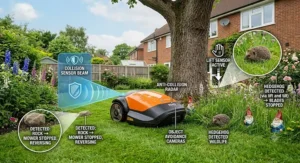
Beyond the obvious upfront cost, a few robot mower disadvantages rarely make it into glossy marketing. They’re genuinely poor at handling very long or wet grass in a single pass, meaning a holiday or a wet spring can mean manual intervention regardless of how advanced the model is. They’re a visible, valuable item left outdoors, which means theft risk is real — GeoFence-style tracking helps but doesn’t eliminate it. Wildlife can be an issue too: hedgehogs and other low-lying garden visitors are a genuine concern with any moving blade at ground level, which is one reason the RHS specifically flags scheduling mowers to avoid dawn, dusk and overnight hours. And finally, the app-dependent nature of modern models means a firmware hiccup or connectivity issue can occasionally leave an otherwise capable machine idling uselessly until it’s resolved.
Safety, Regulations and Battery Disposal in the UK
Every robot mower on this list runs on a lithium-ion battery, and UK rules around disposing of these responsibly have tightened considerably. Under GOV.UK’s guidance on waste battery producer responsibility, waste batteries are required to go through an approved battery treatment operator or exporter for proper handling and recycling — which as a consumer translates simply into this: never bin a dead mower battery with household rubbish. Most manufacturers or local authority recycling centres will take a spent pack free of charge.
On the safety side, all seven models here include lift and collision sensors that stop the blades instantly if the mower is tipped or picked up — a legal and practical necessity given the exposed cutting mechanism. If you have young children or pets, look specifically at models with strong obstacle detection rather than basic bump-sensors alone, and always schedule mowing sessions outside dawn and dusk hours, both for wildlife safety and simply because that’s when gardens see the most unplanned foot traffic.
Is a Robot Mower Worth The Money in 2026?
Pulling everything together: is a robot mower worth the money? For a standard UK garden under 500m², with a reasonably flat lawn and a household that genuinely values reclaiming a few hours each week, yes — the numbers and the lifestyle case both stack up convincingly. For very large, steeply sloped, or extremely irregular gardens, the calculation gets murkier, and a hybrid approach (robot mower for the main lawn, manual strimming for awkward edges) is often the honest, practical answer rather than expecting one machine to do everything.
What tips the scales for most buyers isn’t the spec sheet — it’s whether they actually value their own time enough to pay for it back. If a Saturday morning spent mowing genuinely irritates you, the maths works in the robot’s favour faster than you’d expect. If mowing is your one moment of peaceful outdoor solitude each week, keep the push mower — there’s no shame in that either.
FAQ
❓ Are robot lawn mowers worth it for a small garden?
❓ How long do robot lawn mower batteries last?
❓ Can robot mowers work in the rain?
❓ Do robot lawn mowers need a wire?
❓ How often should a robot mower run?
Conclusion
So, are robot lawn mowers worth it? For most reasonably sized, reasonably flat UK gardens, the answer leans firmly toward yes, provided you match coverage and navigation type honestly to your actual lawn rather than to marketing enthusiasm. The LawnMaster OcuMow 16 and Segway Navimow i105E cover budget-conscious buyers with simple gardens; the Worx Landroid M500 Plus rewards anyone happy to install a wire for rock-solid reliability; the eufy Robot Lawnmower E15 and Segway Navimow i208 LiDAR suit trickier, obstacle-heavy plots; and the two Husqvarna models earn their premium price tags on genuinely large or complex properties.
The honest verdict isn’t “robot mowers are always worth it” — it’s that they’re worth it for the right garden, at the right size, bought with realistic expectations about setup, maintenance and slope limits. Get that match right, and you’ll likely wonder how you ever tolerated pushing a mower around every single weekend.
✨ Don’t Miss These Exclusive Deals!
🔍 Ready to reclaim your weekends? Check current pricing and availability on any of the models above, and see which one matches your garden best — your future Saturday mornings will thank you!
Recommended for You
- Robot Lawn Mower No Perimeter Wire: 7 Best Picks (2026)
- Robot Lawn Mower for Large Garden: 7 Top Picks (2026)
- 7 Best Robot Lawn Mower Under £500 Picks for 2026 (UK)
Disclaimer: This article contains affiliate links. As an Amazon Associate, I earn from qualifying purchases. If you purchase products through these links, we may earn a small commission at no additional cost to you.
✨ Found this helpful? Share it with your friends! 💬🤗
