
In This Article
There’s a very specific kind of dread that sets in when you look out at a lawn that’s gone feral over a fortnight of rain. The edges have vanished. The bit round the shed looks like a nature documentary. And somewhere in the shed itself sits a decision you’ve been putting off: cordless vs petrol strimmer, and which one actually deserves a spot on your wall of garden tools.

A strimmer, for anyone who’s never owned one, is a handheld power tool that spins a nylon line (or occasionally a small blade) at high speed to slice through grass and weeds that a mower can’t reach — fence lines, tree bases, awkward corners. Some run on rechargeable batteries, others on a small two-stroke petrol engine, and the gap between the two has narrowed a lot faster than most people realise. This guide pits real, current UK models against each other — budget, mid-range and premium, cordless and petrol — so you can work out which one actually suits your garden rather than which one has the flashiest advert.
We’ve dug into genuine specifications, aggregated review sentiment, running costs and noise data (not just marketing copy) to build something you can actually use to decide. If you want a fuller technical rundown of how these tools evolved and what’s what, the Wikipedia entry on string trimmers is a solid primer before we get into specifics.
Quick Comparison Table
Before the deep dive, here’s the shape of the market at a glance. Weights, runtimes and noise figures are drawn from manufacturer data and independent testing; treat the numbers as representative rather than gospel, since your own grass, technique and battery age will nudge them around.
| Product | Power Type | Weight | Runtime / Fuel Use | Noise Level | Price Range | Best For |
|---|---|---|---|---|---|---|
| WORX GT 3.0 | Cordless (20V) | 2.4 kg | Up to ~20 min per battery (2 included) | ~80 dB | Under £120 | Small lawns, quick jobs |
| Ryobi OLT1832 ONE+ | Cordless (18V) | 2.3 kg | Up to ~50 min (5.0Ah battery) | ~94 dB | £65-£90 (bare tool) | Existing Ryobi ONE+ owners |
| Hyundai HYBC5200X | Petrol (52cc) | 9.1 kg | Runs on fuel tank, refuel in seconds | ~95-107 dB | £130-£170 | Overgrown, bramble-heavy plots |
| Bosch EasyGrassCut 18V-26 | Cordless (18V) | 2.2 kg | Roughly 30-35 min | ~83 dB | £90-£120 | Mid-size gardens, tidy edges |
| Husqvarna 129R | Petrol (27.6cc) | 5.4 kg | Roughly 0.5 l/hour fuel burn | ~93 dB | £220-£300 | Reliability-focused all-rounders |
| EGO Power+ ST1511E | Cordless (56V) | ~4.1 kg | Around 45-60 min | ~85 dB | £250-£360 | Petrol-level power without fumes |
| Stihl FS 56 C-E | Petrol (27.2cc) | ~5.2 kg | Roughly 0.51 l/hour fuel burn | ~93-108 dB | £300-£370 | Daily professional-grade use |
Look closely and a pattern emerges: cordless models cluster at the light, quiet end of the table, while petrol machines dominate the “runs all day, cuts anything” end — but the gap closes fast once you get to 56V systems like the EGO Power+ ST1511E. Weight and noise track fairly predictably with power type, but runtime is the wildcard, since it depends entirely on battery capacity rather than the trimmer itself. Anyone comparing on price alone should note that the cheapest cordless options and the cheapest petrol option land in a similar bracket — it’s the ongoing costs, covered further down, where the real gap opens up.
💬 Found this comparison useful? A quick share helps other gardeners find it too!😊
Top 7 Cordless and Petrol Strimmers: Expert Analysis
We’ve picked seven real, currently available UK models spanning budget to premium, covering both power types fairly. Each one gets a genuine look at what the spec sheet means in practice, not just a list of numbers.
1. WORX GT 3.0 — best 2-in-1 trimmer and edger for small lawns
The standout here isn’t the cutting power, it’s the fact this thing quietly turns into a wheeled edger in about ten seconds flat. That’s a genuinely useful trick for anyone with a lawn small enough that buying a separate edging tool feels like overkill.
Running on a 20V system with two 2.0Ah batteries included, the WORX GT 3.0 manages a 30cm cutting width and a telescopic shaft that adjusts to your height rather than forcing you to hunch. In practice, expect around 20 minutes of continuous trimming per battery — since you get two, you can swap mid-job rather than waiting three hours for a recharge, though that does mean planning your session around the swap.
Based on the spec comparison with rivals in this price band, this is squarely a small-garden tool: light at 2.4kg, easy for anyone to lift one-handed, but not built for thick brambles or a jungle-scale plot. Reviewers consistently note the CommandFeed line system as a genuine time-saver versus fiddly bump-feed heads on cheaper trimmers, though several mention that properly thick vegetation needs cutting in stages rather than one clean sweep.
Pros:
- ✅ Converts to a wheeled edger in seconds
- ✅ Two batteries included for uninterrupted swaps
- ✅ Telescopic shaft suits varied user heights
Cons:
- ❌ Runtime per battery is short for larger plots
- ❌ Struggles with dense, overgrown vegetation
At around £100-£120 for a kit with two batteries, the WORX GT 3.0 represents solid value for anyone whose garden could be tidied in fifteen minutes flat.
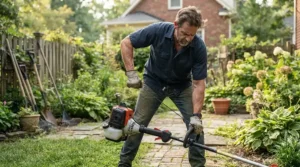
2. Ryobi OLT1832 ONE+ — best battery ecosystem for existing Ryobi owners
What most buyers overlook about this model is that its real value isn’t the trimmer at all — it’s the battery you probably already own. If you’ve got a Ryobi ONE+ drill, blower or mower kicking around, this bare tool slots straight into that same 18V system.
The adjustable 25-30cm cutting width lets you choose between speed and reach depending on the job, and the all-metal boom is a genuine step up in durability terms versus the plastic shafts found on some rivals at this price. Paired with a 5.0Ah battery (sold separately if you don’t already own one), Ryobi quotes up to 50 minutes of trimming, which comfortably outlasts most of the cordless competition in this guide.
Here’s what to weigh: at 2.3kg it’s easy enough to handle for extended sessions, and aggregated review sentiment is largely positive on the auto-feed spool, though a handful of owners note the noise output — around 94dB at the source — is noticeably louder than you’d expect from a battery tool this size.
Pros:
- ✅ Compatible with the wider Ryobi ONE+ battery range
- ✅ Durable all-metal boom construction
- ✅ Adjustable cutting width for flexibility
Cons:
- ❌ Sold as a bare tool — battery adds to the cost
- ❌ Louder than most cordless rivals at this size
Priced around £65-£90 for the bare unit, this is the strongest value pick specifically for households already invested in the Ryobi ecosystem.
3. Hyundai HYBC5200X — best budget petrol brushcutter for overgrown patches
The standout feature is right there in the name: this is a brushcutter as much as a strimmer, meaning it ships with both a nylon line head and a metal blade attachment for genuinely tough growth.
A 52cc 2-stroke Euro-V engine gives the Hyundai HYBC5200X noticeably more raw torque than the smaller-displacement petrol units further up the market, and a cutting width stretching to 45cm means fewer passes across a large area. On paper, this means it’s the tool to reach for when a garden has been neglected for a season rather than a fortnight — brambles, thistles and woody stems that would stall a lighter cordless trimmer in seconds.
What the spec sheet won’t tell you, but reviewers consistently note, is that the weight — 9.1kg — becomes genuinely tiring across long sessions without the included double shoulder harness properly adjusted first. It’s also worth being upfront that as a budget petrol option, fit and finish trail the premium petrol brands covered later in this guide, though the core cutting performance holds up well for the price.
Pros:
- ✅ Dual cutting heads for grass and heavy brush
- ✅ Genuinely powerful 52cc engine for the price
- ✅ Wide 45cm cutting width covers ground fast
Cons:
- ❌ Heavy at 9.1kg for extended use
- ❌ Build quality noticeably below premium petrol brands
Typically priced in the £130-£170 range, this is the budget entry point for anyone facing serious overgrowth rather than routine maintenance.
4. Bosch EasyGrassCut 18V-26 — best build quality for mid-size gardens
The standout advantage is restraint, oddly enough — Bosch has resisted piling on gimmicks and instead focused on a trimmer that just feels solidly made, which shows up repeatedly in review sentiment around long-term reliability.
An 18V, 2.5Ah battery drives a 26cm cutting width, landing this squarely as a single-speed, no-fuss tool. Based on the spec comparison with the WORX and Ryobi models above, the 26cm width is narrower, meaning more passes for the same area, but the trade-off is a notably light 2.2kg build that’s easy to manoeuvre around borders and ornamental beds without arm fatigue setting in.
Reviewers consistently report that this is one of the quieter cordless options on test, sitting around 83dB, and several highlight the German build quality as a reason they’d buy Bosch again despite the narrower cut. What most buyers overlook is that the single-speed motor, while limiting for versatility, actually simplifies operation for anyone who just wants to press a trigger and go without fiddling with settings.
Pros:
- ✅ Genuinely solid, reliable build quality
- ✅ Lightweight at 2.2kg for easy handling
- ✅ Quieter than most cordless rivals
Cons:
- ❌ Narrower 26cm cutting width means more passes
- ❌ Single speed limits flexibility for tougher growth
At around £90-£120 including battery and charger, this sits as the mid-range cordless pick for gardens with borders and beds rather than open expanses.
5. Husqvarna 129R — best easy-start petrol for reliability seekers
The standout here is Husqvarna’s Smart Start system, which genuinely does remove most of the effort from the age-old petrol-strimmer gripe: yanking a stubborn pull-cord repeatedly on a cold morning.
A 27.6cc engine delivering 0.85kW gives the Husqvarna 129R enough grunt for edging and clearing dense grass without tipping into brushcutter territory the way the Hyundai does, and the 43cm cutting width covers a decent swathe per pass. Based on the spec comparison, this sits as a genuine middle ground — more refined than budget petrol, less specialist than the professional-grade Stihl further down this list.
The curved shaft and loop handle noticeably reduce fatigue over long sessions compared with straight-shaft budget alternatives, and reviewers consistently flag the air purge function as making restarts after breaks far less frustrating than expected. On the downside, at 5.4kg it’s heavier than any cordless option here, and as with all 2-stroke engines, fuel needs pre-mixing with oil, which adds a small but real maintenance step most cordless owners never think about.
Pros:
- ✅ Smart Start system genuinely eases ignition
- ✅ Ergonomic curved shaft reduces fatigue
- ✅ Strong mid-range cutting width and power
Cons:
- ❌ Heavier than any cordless model on this list
- ❌ Requires 2-stroke fuel mixing and maintenance
Priced around £220-£300, this is the pick for anyone who wants petrol reliability without the fuss of a fully professional-grade machine.

6. EGO Power+ ST1511E — best premium cordless for petrol-like power
The standout feature is the 56V battery platform itself, which genuinely closes the power gap that’s kept petrol strimmers relevant for so long — this isn’t a scaled-up 18V tool, it’s a different class of cordless machine entirely.
A brushless motor and 38cm cutting width put the EGO Power+ ST1511E ahead of every other cordless model in this guide on raw cutting capability, and the Powerload system — thread the line, press a button, done — removes one of the more fiddly chores that plagues cheaper trimmers. Based on the spec comparison, EGO’s claim that 56V delivers roughly 40% more power than comparable 36V systems tracks with the real-world cutting performance reviewers describe, particularly against thicker weed growth that would bog down a WORX or Bosch model.
Here’s what to weigh: the included 2.5Ah battery and charger push this into premium pricing territory, but the five-year tool warranty is unusually generous and reviewers consistently mention the low vibration and near-silent running as standout advantages over petrol alternatives at a similar performance level. It’s genuinely one of the few cordless tools here that could replace a petrol machine for most homeowners rather than just the smallest gardens.
Pros:
- ✅ Power output rivals genuine petrol trimmers
- ✅ Powerload line-feed system saves real time
- ✅ Five-year manufacturer warranty
Cons:
- ❌ Premium price compared to entry cordless models
- ❌ Battery and charger add significant extra cost
Typically £250-£360 depending on kit configuration, this is the pick for anyone who wants petrol-equivalent performance without ever mixing fuel again.
7. Stihl FS 56 C-E — best professional-grade petrol for daily use
The standout advantage is STIHL’s 2-MIX engine technology, which reviewers and independent tests consistently point to as delivering noticeably better fuel efficiency and lower emissions than comparable 2-stroke units from rival brands.
A 27.2cc engine producing 0.8kW gives the Stihl FS 56 C-E performance broadly comparable to the Husqvarna above, but the ErgoStart system — reducing the resistance on the pull-cord — genuinely makes starting less of a workout, something reviewers repeatedly single out as a meaningful quality-of-life improvement over cheaper petrol rivals. The bike-style handle and included harness promote a natural, sweeping mowing action that’s particularly suited to larger lawns worked methodically rather than in short bursts.
What the spec sheet won’t tell you, but user reports suggest, is that build quality and parts availability from an established dealer network make this a strong long-term ownership proposition even though the initial outlay is the highest of any product in this guide. On paper this means you’re paying for durability and serviceability as much as raw cutting power — the AutoCut mowing head and transparent fuel tanks are small design touches that add up over years of regular use rather than delivering an obvious wow factor on day one.
Pros:
- ✅ ErgoStart makes ignition noticeably easier
- ✅ Efficient 2-MIX engine with lower emissions
- ✅ Strong dealer network for parts and servicing
Cons:
- ❌ Highest price point of any model in this guide
- ❌ Requires ongoing fuel and 2-stroke oil purchases
Sitting around £300-£370, this is the professional-grade pick for anyone who strims regularly enough that reliability and running costs matter more than upfront price.
Practical Usage Guide: Getting the Most From Your Strimmer
Buying the right machine is only half the job — using it properly is what actually determines whether your lawn looks professionally finished or faintly chewed. For any cordless model, charge the battery fully before first use and let it complete one full discharge cycle to help the battery management system calibrate accurately; skipping this step is a common reason new owners report shorter-than-expected runtimes in their first fortnight. Petrol owners should mix fuel at the exact ratio specified in the manual — usually 40:1 or 50:1 — since guessing tends to either starve the engine or gunk up the spark plug within weeks.
Technique matters more than most people expect. Tilt the head slightly and work in a sweeping motion from left to right rather than plunging straight down into thick grass, which both models in this guide’s petrol category handle better than cordless ones simply due to sustained torque. Keep the line at a consistent length using the auto-feed or bump-feed system rather than manually pulling excessive slack, since over-long line increases drag and drains cordless batteries noticeably faster.
Maintenance in the first month sets the tone for the tool’s whole life. Clean grass build-up from the cutting head after every session — it’s a thirty-second job that prevents the motor overheating on cordless models or the air filter clogging on petrol ones. Common mistakes in this early period include storing a petrol strimmer with fuel still in the tank (it degrades and gums the carburettor) and leaving cordless batteries on charge indefinitely rather than removing them once full, which shortens battery lifespan over time.
Real-World Scenarios: Who Should Buy Which Trimmer
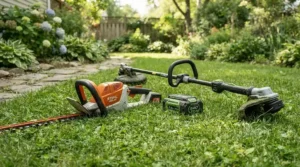
Picture three fairly ordinary UK households, each with a different answer to the cordless vs petrol strimmer question. First, a first-time homeowner with a modest 40 square metre garden and a weekend habit of pottering rather than serious grafting — for them, something like the WORX GT 3.0 or Bosch EasyGrassCut 18V-26 makes obvious sense: light, quiet enough not to annoy neighbours on a Sunday morning, and more than capable of a fifteen-minute tidy-up.
Second, a semi-rural family with half an acre, a paddock boundary and brambles that seem to regrow overnight — here the calculus shifts firmly toward petrol. The Hyundai HYBC5200X or Husqvarna 129R simply outwork any battery-powered rival on sustained, heavy-duty clearing, and the ability to just keep refuelling rather than waiting on a charger matters when there’s genuinely a lot of ground to cover in one go.
Third, someone renovating a long-neglected garden who wants petrol-level cutting power but lives somewhere noise genuinely matters — a terrace with close neighbours, say. This is precisely the buyer the EGO Power+ ST1511E was built for: enough torque to handle overgrowth, without the fumes or the early-morning engine noise that would otherwise generate a complaint over the garden fence.
How to Choose Between a Cordless and Petrol Strimmer
Working through the decision methodically beats guessing based on whichever product has the best-looking box. Here’s the process worth following:
- Measure your garden honestly. Anything under roughly 150 square metres with light-to-moderate growth rarely justifies petrol; the extra power goes largely unused.
- Audit existing tool batteries. If you already own cordless tools from WORX, Ryobi, Bosch or EGO, buying into that same platform saves real money on future purchases.
- Be honest about vegetation density. Brambles, thick weeds and long-neglected borders favour petrol’s sustained torque over a battery’s shorter burst of power.
- Weigh noise tolerance and timing. Early-morning or evening strimming near neighbours strongly favours cordless, given the dramatically lower decibel output.
- Factor in storage and maintenance appetite. Petrol needs fuel mixing, air filter cleaning and occasional spark plug changes; cordless needs a charged battery and little else.
- Set a realistic budget for the whole system, not just the trimmer — spare batteries or fuel and 2-stroke oil both add up over a season.
- Consider frequency of use. Weekly maintenance favours whichever tool is quickest to grab and start; occasional heavy jobs favour petrol’s raw capability.
Runtime vs Power Trade-Off: What You’re Really Choosing Between
This is the crux of the whole cordless vs petrol strimmer debate, and it’s worth being precise about what runtime vs power trade-off actually means in practice rather than treating it as an abstract spec-sheet number. A petrol engine delivers consistent, undiminishing torque for as long as there’s fuel in the tank — the Stihl FS 56 C-E cuts exactly as hard in minute forty as it did in minute one. A battery, by contrast, delivers peak power early and gradually tapers as the cell depletes, meaning the last few minutes of any cordless session are noticeably weaker than the first few.
Based on the spec comparison across this guide, entry-level 18-20V cordless models like the WORX GT 3.0 and Ryobi OLT1832 ONE+ trade the most power for portability — fine for fine grass, underpowered for anything woody. Step up to 56V systems like the EGO Power+ ST1511E and that trade-off largely disappears; you’re paying a premium price specifically to buy back the power that smaller batteries sacrifice. What most buyers overlook is that runtime figures on packaging assume light, dry grass — thick or wet vegetation draws more current and can cut quoted runtime by a third or more, a pattern reviewers across multiple brands report consistently.
Fuel Costs vs Charging Costs: The Real Numbers
Fuel costs are where the cordless vs petrol strimmer argument gets genuinely financial rather than theoretical. UK unleaded has fluctuated significantly through 2026 — RAC Fuel Watch data has tracked prices moving from lows near 132p a litre earlier in the year to well above 150p during periods of market volatility — and a petrol strimmer’s small two-stroke engine, while frugal per hour, still needs regular top-ups plus the added cost of 2-stroke oil for the fuel mix.
Charging a cordless battery, by contrast, costs pennies. A typical 2.5Ah lithium-ion pack draws a small fraction of a kWh per full charge, meaning even with UK electricity prices where they currently sit, a season’s worth of strimming on a model like the Bosch EasyGrassCut 18V-26 costs a fraction of the equivalent fuel spend on the Hyundai HYBC5200X. Here’s what to weigh: petrol strimmers also carry ongoing costs cordless owners never see — air filters, spark plugs, carburettor cleaning — while cordless owners eventually face a battery replacement, typically after several hundred charge cycles, which is a real but comparatively rare expense.
| Cost Factor | Cordless | Petrol |
|---|---|---|
| Per-session running cost | Pennies (electricity) | £1-£3 (fuel + oil mix) |
| Annual servicing | Minimal | Air filter, spark plug, carb care |
| Major replacement cost | Battery pack (every few years) | Engine rebuild (rare, but costly if neglected) |
| Best For | Light, regular use | Heavy, sustained use |
Looking at the numbers above, a household strimming weekly through a UK growing season will typically spend noticeably less over five years on a cordless system, even accounting for one battery replacement, than on petrol and its recurring fuel and servicing costs. Heavy users clearing genuinely large areas may still find petrol’s per-litre efficiency wins out, since it avoids buying multiple expensive battery packs to match a full day’s runtime.
Noise Levels: What the Decibel Numbers Actually Mean
Noise levels are the most physically noticeable difference between the two categories, and the decibel scale is logarithmic, so the gap feels far bigger in practice than the raw numbers suggest — a jump from 80dB to 95dB isn’t “a bit louder,” it’s roughly perceived as several times louder to the human ear. Cordless models in this guide, like the Bosch EasyGrassCut 18V-26 at around 83dB, sit closer to a vacuum cleaner, while petrol machines including the Stihl FS 56 C-E can reach sound power levels above 100dB at the engine itself.
For context on why this matters beyond simple annoyance, the HSE’s Control of Noise at Work Regulations set a lower exposure action value of 80dB(A), above which employers must assess risk to hearing — while this legislation covers workplaces rather than domestic gardens, it’s a useful benchmark for understanding that regular exposure to a petrol strimmer’s output isn’t purely a neighbourly courtesy issue, it’s genuinely worth wearing ear defenders for extended sessions. Reviewers consistently note that cordless trimmers are quiet enough for early weekend mornings without complaint, while petrol models are generally best reserved for more sociable hours.
Cordless Strimmer vs Petrol Strimmer: The Full Comparison
Stripped of marketing language, this comes down to a handful of genuine trade-offs rather than one category being objectively “better.” Cordless strimmers win decisively on noise, weight, instant start-up and running costs for light-to-moderate use — there’s no warm-up, no fumes, and no trip to the petrol station. Petrol strimmers win just as decisively on sustained power, unlimited runtime (refuel and keep going), and raw capability against thick, established growth that would bog a battery motor down.
| Factor | Cordless Strimmer | Petrol Strimmer |
|---|---|---|
| Startup | Instant, press trigger | Pull-cord, choke, warm-up |
| Runtime | Fixed by battery, tapers near end | Unlimited (refuel as needed) |
| Weight | Generally lighter | Generally heavier |
| Maintenance | Minimal | Regular (filters, plugs, fuel mix) |
| Best For | Small-to-mid gardens, quiet hours | Large plots, heavy vegetation |
Interpreting the table above, the honest advice is that most UK domestic gardens are genuinely better served by cordless — the EGO Power+ ST1511E in particular narrows the power gap to the point where petrol’s advantages become marginal for anyone without a genuinely large plot. Where petrol still earns its keep is at the extremes: properties with paddocks, allotments, or seasonal overgrowth clearance where sustained cutting time simply outweighs the convenience of silence.
Common Mistakes When Buying a Strimmer
Even careful buyers fall into a handful of predictable traps. The first is buying based purely on voltage or cc figures without checking actual cutting width and battery capacity — an 18V trimmer with a large battery can outperform a 20V model with a small one, so the number on the box tells you less than it appears to. The second is underestimating garden size, leading buyers to purchase an entry-level cordless model for a plot that genuinely needs the sustained power of petrol or a premium 56V system.
A third common mistake is ignoring ongoing costs at the point of purchase — a cheap petrol strimmer that needs frequent servicing can end up costing more over three years than a pricier cordless alternative. Fourth, several reviewers across the products in this guide note that buyers regularly skip reading noise ratings, only to discover their new petrol trimmer isn’t appropriate for early-morning use in a terraced street. Finally, many buyers overlook spare parts availability — established brands like Stihl and Husqvarna have extensive dealer networks for replacement heads and lines, while some budget imports can be genuinely difficult to source parts for after the first year.

Frequently Asked Questions
❓ Is a cordless strimmer as powerful as a petrol strimmer?
❓ How long does a cordless strimmer battery last per charge?
❓ Do petrol strimmers need special fuel?
❓ Are cordless strimmers quieter than petrol ones?
❓ What size garden needs a petrol strimmer instead of cordless?
Conclusion
There’s no single correct answer to cordless vs petrol strimmer — only the correct answer for your specific garden, your neighbours, and how much fuss you’re willing to tolerate in exchange for raw cutting power. For the vast majority of UK gardens, something like the Bosch EasyGrassCut 18V-26 or the genuinely impressive EGO Power+ ST1511E will handle the job quietly, cheaply, and without a single trip to a petrol station.
Where a garden genuinely earns the petrol label — paddocks, allotments, seasons of neglected growth — machines like the Husqvarna 129R and Stihl FS 56 C-E justify their higher price and extra maintenance with sustained power that no battery pack can currently match hour for hour. Budget-conscious buyers facing serious overgrowth shouldn’t overlook the Hyundai HYBC5200X either, which delivers genuine brushcutter capability without the premium petrol price tag.
Whichever direction you land on, the research above should mean you’re buying based on your actual garden rather than whichever trimmer happened to be on the shelf. Check current prices and availability before deciding, since stock and deals shift regularly across UK retailers.
✨ Ready to reclaim your garden? Compare today’s prices on any of these seven picks and get strimming this weekend! 🌿✂️
Recommended for You
- Strimmers Under £100: 7 Best Picks for UK Gardens in 2026
- Self-Propelled vs Push Lawn Mower: 7 Top Picks for 2026
- Self-Propelled Lawn Mower for Slopes: 7 Best Picks for 2026 (UK)
Disclaimer: This article contains affiliate links. As an Amazon Associate, I earn from qualifying purchases. If you purchase products through these links, we may earn a small commission at no additional cost to you.
✨ Found this helpful? Share it with your friends! 💬🤗
