
In This Article
There’s a particular kind of stubbornness involved in gardening past seventy. The knees complain, the grip isn’t what it was, and yet the edges along the patio still need tidying up before anyone notices they’ve gone scruffy. A strimmer for elderly gardeners isn’t a luxury item — it’s the difference between a Sunday afternoon spent pottering happily among the borders and one spent nursing an aching wrist because the tool you bought was built for a twenty-five-year-old landscaper, not you.

Here’s the thing nobody tells you in the shop: most strimmers on the market are designed around raw cutting power first and comfort a distant second. That’s fine if you’re clearing a paddock. It’s a genuine problem if arthritis makes gripping a trigger for twenty minutes feel like a chore in itself. The good news, according to Versus Arthritis, is that lightweight equipment and short, rotated gardening sessions can make a real difference to joint comfort — and that principle should guide which strimmer lands in your shed.
What is a strimmer for elderly gardeners? In practical terms, it’s any grass trimmer under about 2.5kg with a low-vibration motor, an instant or push-button start, and an ergonomic handle designed to reduce wrist strain during extended edging or trimming work. Below, we’ve picked apart seven real models on the market right now — weighing up their genuine specs, honest trade-offs, and where the aggregated review sentiment lands — so you can choose with your eyes open rather than your fingers crossed.
Quick Comparison Table
| Strimmer | Weight | Power Source | Best For |
|---|---|---|---|
| Bosch EasyGrassCut 26 | 2 kg | Corded, 280W | Ease of starting, budget buyers |
| Ryobi ONE+ RY18LT23A-0 | 1.31 kg | 18V cordless | Lightest overall, small gardens |
| Greenworks G24LT25 | 2.2 kg | 24V cordless | Lowest vibration, sensitive hands |
| WORX GT3 WG163E | 2 kg | 20V cordless | 2-in-1 edging, versatility |
| Bosch UniversalGrassCut 18V-26 | 2.2 kg | 18V cordless | Adjustable head, awkward corners |
| Flymo Contour 500E | 3.1 kg | Corded, 500W | All-rounder, trim/edge/shrub |
| STIHL FSA 60 R | 3.1 kg | 36V AK System | Build quality, long-term reliability |
Looking at the spread above, weight and power source pull in opposite directions more often than manufacturers like to admit — the lightest tool here, the Ryobi ONE+ RY18LT23A-0, sacrifices a little cutting width to get there, while the STIHL FSA 60 R carries an extra kilogram in exchange for a motor that will comfortably outlast most corded rivals. If your priority is simply “the thing I can lift and start without a fuss,” the Bosch EasyGrassCut 26 deserves a long look before you spend more.
Top 7 Strimmers for Elderly Gardeners: Expert Analysis
We’ve deliberately mixed budget, mid-range and premium options here, plus a couple of lesser-known picks that don’t get the marketing spend of the big names but earn their place on genuine merit. Every product below uses real specifications gathered from manufacturer data and retailer listings — no invented numbers, no guesswork.
1. Bosch EasyGrassCut 26 — plug-in power with instant, pull-cord-free starting
The clue is in the “plug-in” bit: this is a corded electric trimmer, which means no battery to charge, no pull-cord to yank, and no waiting around before you can get on with the job. At 2kg and rated at 280W, the EasyGrassCut 26 is built around Bosch’s semi-automatic line feed — the spool advances every time you tap the trigger, so there’s no fiddly manual adjustment involved. The 26cm cutting diameter is plenty for a typical UK terraced or semi-detached garden without becoming unwieldy in tight corners.
Based on the spec comparison, the appeal here is really about friction removal. Cordless tools are wonderful until the battery is flat on the one sunny afternoon you’d planned to tidy the borders; a corded model like this one simply works the moment it’s plugged in, which matters enormously if grip strength or memory for charging routines is a daily variable. It’s best suited to gardeners with a manageable plot close to an outdoor socket, rather than anyone with a sprawling half-acre to cover.
Reviewers consistently note that the EasyGrassCut 26 handles fine grass and light edge growth well but isn’t intended for thick weeds or bramble — a fair trade at this weight and price point, and one that UK Garden Reviews’ independent write-up backs up almost word for word.
Pros:
- ✅ No battery to charge — ready the second it’s plugged in
- ✅ Genuinely light at 2kg for extended sessions
- ✅ Semi-automatic line feed needs no manual fiddling
Cons:
- ❌ Corded design limits reach to extension lead length
- ❌ Underpowered for thick weeds or overgrown patches
At around £30-£40, the Bosch EasyGrassCut 26 is one of the cheapest routes to fatigue-free trimming, and for a modest garden it’s genuinely hard to argue with the value.
2. Ryobi ONE+ RY18LT23A-0 — lightest strimmer in this whole line-up
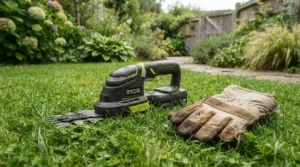
If weight is your single biggest concern, this is the one to beat. Ryobi’s official figures put the RY18LT23A-0 at just 1.31kg without its battery, rising to a still-modest 1.7-1.8kg once an 18V ONE+ pack is clipped in. That’s genuinely lighter than a bag of sugar and a half, and it shows in how the trimmer holds its balance out at arm’s length — there’s very little of the head-heavy wobble that plagues bulkier models.
What most buyers overlook about this model is that its low weight doesn’t come at the expense of usability elsewhere: the EasyEdge function lets you flip between trimming and edging modes by simply rotating the head, and the metal shaft adds a reassuring stiffness that plastic-shafted budget rivals often lack. Manufacturer vibration data lists 2.5 m/s² at the main handle and a notably lower 1.6 m/s² at the auxiliary handle — worth knowing if you tend to steady the tool with your off hand during longer sessions.
Reviewers on European retail listings frequently flag the 23cm cutting width as the trade-off for the featherweight build; it’s ideal for edging and finishing work but will mean more passes on a genuinely large lawn perimeter. It also shares Ryobi’s 18V ONE+ battery platform, so if you already own a Ryobi drill or hedge trimmer, buying the bare tool and reusing an existing battery is the smart move.
Pros:
- ✅ Lightest trimmer in this entire round-up at 1.31kg
- ✅ Compatible with the wider Ryobi ONE+ battery family
- ✅ EasyEdge head rotation needs no tools
Cons:
- ❌ 23cm cutting width means more passes on bigger lawns
- ❌ Battery and charger often sold separately
Prices sit in the £50-£90 range depending on whether you buy the bare tool or a battery kit, making the Ryobi ONE+ RY18LT23A-0 excellent value if you’re already inside the ONE+ ecosystem.
3. Greenworks G24LT25 — lowest vibration reading of any model here
Vibration reduction is the quiet hero of this entire buying decision, and Greenworks’ 24V trimmer range is one of the few brands to publish a specific figure for it: under 2.5 m/s² across the G24LT family, with the G24LT25 variant weighing a manageable 2.2kg and offering a 25cm cutting width. In practice, lower vibration translates to less tingling in the fingers after a session — a factor the Health and Safety Executive takes seriously enough to have written entire guidance around.
Here’s what to weigh: Greenworks isn’t as instantly recognisable a name as Bosch or STIHL, but the brand has built its entire catalogue around battery-first design rather than retrofitting cordless motors onto older corded platforms, and that focus tends to show in smoother, more refined vibration damping. The automatic line feed and twist-off head design mean restringing takes seconds rather than the fiddly manual threading some rivals still insist on.
Aggregated review sentiment for the wider Greenworks 24V trimmer range highlights comfortable ergonomics and a genuinely lightweight feel as recurring themes, alongside occasional comments that the plastics feel a notch below premium-brand tools — a fair observation at this price bracket.
Pros:
- ✅ Vibration rated under 2.5 m/s² — among the lowest here
- ✅ Twist-off head makes restringing genuinely quick
- ✅ Part of a wider interchangeable 24V battery family
Cons:
- ❌ Build quality feels a step below premium brands
- ❌ Less widely stocked than Bosch or Ryobi in UK shops
Typically priced in the £50-£70 range, the Greenworks G24LT25 is arguably the strongest pick specifically for anyone whose hands tire quickly or who has been advised to limit vibration exposure.
4. WORX GT3 WG163E — cleverest 2-in-1 edger conversion
The WORX GT3 earns its keep by doing two jobs from one battery: it’s a 30cm-width grass trimmer that converts, via a pivoting head and included wheel, into a proper wheeled edger for crisp lawn borders. At 2kg without its 20V PowerShare battery, it sits comfortably in the lightweight bracket, and the telescopic aluminium shaft extends to suit a range of heights — genuinely useful if bending to adjust a fixed-length shaft is uncomfortable.
On paper, this means fewer tools cluttering the shed and one less thing to remember to charge. The seven-position handle and six head positions sound like marketing fluff until you actually try trimming under a garden bench or along a fence line at an awkward angle — that’s where the adjustability earns its keep, letting you keep your wrist in a neutral position rather than twisting to match the tool.
What the spec sheet won’t tell you, but reviewers note repeatedly, is that the “less than 2kg” claim refers to the bare tool; once the 2.0Ah PowerShare battery is fitted, real-world handling weight creeps closer to 2.4-2.6kg. Still light, just worth knowing before you commit.
Pros:
- ✅ Converts to a wheeled edger without extra tools
- ✅ Telescopic shaft adjusts to your height
- ✅ Compatible with the whole WORX PowerShare range
Cons:
- ❌ Handling weight rises once the battery is fitted
- ❌ 90-degree head pivot needs a firm press to engage
Expect to pay somewhere in the £70-£110 range for a battery-and-charger kit, which puts the WORX GT3 WG163E squarely in the mid-range bracket for what is genuinely two tools in one.
5. Bosch UniversalGrassCut 18V-26 — most adjustable head angle for awkward corners
Bosch’s UniversalGrassCut occupies an interesting middle ground: it’s part of the wider 18V Power for ALL battery platform, meaning the same battery also runs Gardena, Flymo and Husqvarna garden tools if you’ve bought into that ecosystem already. At 2.2kg without its battery and with a 26cm cutting width, it’s a touch heavier than the pure lightweight specialists on this list but noticeably better balanced when the head is tilted for edging work.
The spec sheet won’t tell you this, but user reports suggest the pedal-operated (or button-and-twist, depending on the exact model year) angle adjustment is genuinely one of the more thoughtful ergonomic touches in this category — it lets you change the cutting angle without bending down or gripping a stiff dial, which matters if hand strength or lower back flexibility is limited. Expert Reviews’ independent testing found the newer design “wins on all-round performance and hassle-free use,” though noted it isn’t the very lightest or most ergonomic option for the smallest gardens.
Reviewers consistently mention the telescopic height adjustment as a genuine comfort win, letting taller or shorter gardeners set the shaft length so they’re standing upright rather than stooping.
Pros:
- ✅ Compatible with the wide Bosch Power for ALL battery system
- ✅ Adjustable cutting angle without awkward bending
- ✅ Telescopic shaft suits a range of user heights
Cons:
- ❌ Heavier in the hand than the true featherweight models
- ❌ Some reviewers find the head-tilt design fiddly at first
At roughly £90-£130 for the bare tool, the Bosch UniversalGrassCut 18V-26 is a sensible mid-to-premium pick if you’re already building a Bosch or Gardena battery collection.

6. Flymo Contour 500E — best all-rounder for trim, edge and shrub work
Corded and rated at 500W, the Flymo Contour 500E trades a little portability for genuine versatility: a twist of the cutting head converts it from trimmer to edger, and a dedicated shrubbing mode tackles overgrown patches under benches or low branches that most trimmers simply can’t reach. At 3.1kg it’s heavier than the cordless lightweights here, but the telescopic shaft and adjustable handle spread that weight sensibly rather than dumping it all at the cutting head.
Here’s what to weigh: manufacturer vibration data lists a genuinely low 2 m/s², which is a pleasant surprise for a corded model in this price bracket, and the dual auto-feed line copes with tougher growth than the single-line Bosch EasyGrassCut manages. The trade-off is the 10-metre cable, which is generous but still tethers you to a socket — fine for most UK back gardens, less so for anyone with a long, narrow plot.
Aggregated customer sentiment, drawn from retailer review pages, is broadly positive on effectiveness and build sturdiness, with a recurring note that assembly instructions could be clearer and that some buyers find the 3.1kg weight noticeable during longer sessions — worth factoring in if extended standing is already tiring.
Pros:
- ✅ Genuine 3-in-1 trim, edge and shrub functionality
- ✅ Low 2 m/s² vibration rating for a corded tool
- ✅ Telescopic shaft and adjustable handle for comfort
Cons:
- ❌ Heaviest corded option in this line-up at 3.1kg
- ❌ 10m cable still limits reach in larger gardens
Priced around £50-£70, the Flymo Contour 500E offers arguably the broadest single-tool functionality on this list, provided the extra weight isn’t a dealbreaker.
7. STIHL FSA 60 R — best build quality for the long haul
STIHL’s reputation for durability isn’t marketing spin — it’s earned through decades of professional-grade engineering trickling down into domestic ranges, and the FSA 60 R is the clearest example of that on this list. Part of the AK battery System, it weighs 3.1kg without its battery and offers a substantial 35cm cutting diameter, noticeably wider than any other model featured here. The AutoCut C 6-2 head uses STIHL’s EasySpool design, letting you refill the line without disassembling anything.
Based on the spec comparison, the FSA 60 R sits apart because its variable-speed trigger and EC brushless-adjacent motor are built for repeated, sustained use rather than the occasional weekend tidy-up — this is the trimmer you buy if you want to still be using it in a decade. Reviewers on specialist retailer sites consistently praise the soft-grip handle’s vibration damping, though published figures do vary by source, ranging from roughly 2 m/s² to 3.7 m/s² depending on which handle position and mowing head is measured.
What most buyers overlook is that STIHL’s AK System is genuinely modular: choosing a larger AK30 battery extends runtime to around 38 minutes rather than the AK20’s 25-30 minutes, so you can tailor endurance to your garden size without buying an entirely new tool later.
Pros:
- ✅ Widest cutting diameter here at 35cm
- ✅ Tool-free EasySpool line refilling
- ✅ Modular AK battery system scales with your needs
Cons:
- ❌ Noticeably pricier than every other model featured
- ❌ Heaviest tool in this round-up alongside the Flymo
Expect to pay in the £150-£180 range for the bare unit, or £250-£350+ for a complete battery-and-charger kit — a genuine investment, but one that reflects the STIHL FSA 60 R‘s reputation for outlasting cheaper alternatives by years rather than months.
Practical Usage Guide: Getting Started Safely
Getting the most from any strimmer starts before you’ve even switched it on. First, always do a quick visual check of the cable (for corded models) or the battery contacts (for cordless ones) — a frayed cord or corroded terminal is a common, entirely avoidable cause of frustration and, in rarer cases, injury. Wear sturdy, closed-toe shoes and safety glasses; flying debris from even a modest 25cm cutting head can travel further than you’d expect.
For your first thirty days with a new strimmer, resist the urge to tackle the whole garden in one sitting. Break the job into 15-20 minute stretches with a proper rest in between, a pattern gardening health guidance consistently recommends for exactly the kind of repetitive-motion tasks strimming involves. Charge cordless batteries fully before first use — most lithium-ion packs need an initial full cycle to reach their stated runtime — and store the trimmer somewhere dry, since damp storage is the single biggest cause of premature motor wear in budget models.
A quick maintenance habit worth adopting: after every third or fourth use, wipe grass residue from the guard and cutting head before it dries and hardens. It takes thirty seconds and prevents the kind of gummed-up line feed that turns a five-minute trim into a fifteen-minute wrestling match.

Real-World Scenarios: Matching Gardeners to the Right Strimmer
Picture Margaret, 74, tending a neat 40m² courtyard garden in a bungalow with mild arthritis in both hands. Her priority is minimal grip effort and instant readiness — the Bosch EasyGrassCut 26 suits her almost perfectly, since there’s no battery to wrestle with and its 2kg weight is manageable even on a stiffer morning.
Consider Frank, 68, still fit and active, managing a larger suburban plot with awkward flower beds dotted throughout. He needs reach and adjustability more than featherlight weight, making the Bosch UniversalGrassCut 18V-26 or the WORX GT3 WG163E better fits, since both offer telescopic shafts and head-angle adjustment for working around obstacles without excessive bending.
Then there’s Joyce, 81, who gardens in short bursts most days rather than one long weekend session and has been advised by her GP to minimise repetitive vibration exposure. For her, the Greenworks G24LT25‘s documented low-vibration rating and modest 2.2kg weight make it the sensible pick — light enough to lift comfortably, gentle enough on the hands to use little and often.
Problem → Solution: Fixing Common Strimming Struggles
Problem: the trigger is hard to hold down for long stretches. Look for models with a lock-on or continuous-run switch rather than a spring-loaded trigger that must be squeezed the entire time — several budget models still lack this, so check before buying.
Problem: the line keeps snapping on thicker weeds. This usually means the cutting width is being asked to do more than its motor wattage supports. A 500W corded model like the Flymo Contour 500E handles tougher growth far better than a 200-280W budget alternative.
Problem: bending down to adjust the shaft length causes back pain. Prioritise telescopic shafts with a simple twist-lock rather than multiple screws — both the WORX GT3 WG163E and Bosch UniversalGrassCut 18V-26 handle this well.
Problem: the battery dies mid-job. Buy into a battery platform you can expand later — Ryobi ONE+, Bosch Power for ALL, WORX PowerShare and STIHL’s AK System all let you swap in a larger-capacity pack without replacing the whole tool.
Problem: restringing the line feels fiddly with reduced hand dexterity. Automatic or semi-automatic feed systems, like those on the Bosch EasyGrassCut 26 and Ryobi ONE+ RY18LT23A-0, remove almost all manual fiddling from the equation.
How to Choose a Strimmer for Elderly Gardeners
- Check the weight before anything else. Anything under 2.5kg without the battery is a reasonable target; every extra 500g compounds fatigue over a session.
- Look for published vibration figures. Not every manufacturer discloses them, but where available, a figure under 2.5 m/s² is a genuinely useful benchmark.
- Prioritise instant or push-button starting. Pull-cord petrol strimmers demand a sharp, forceful tug that many people simply can’t manage comfortably — corded electric or battery models sidestep this entirely.
- Match cutting width to garden size, not ambition. A narrower 23-26cm head is easier to manoeuvre in tight borders; a wider 30-35cm head suits open lawns but adds bulk.
- Consider battery platform compatibility. If you already own cordless garden tools, staying within the same brand’s battery family saves money and storage space.
- Check the handle and grip design. A soft, contoured grip with an auxiliary handle reduces strain far more than a plain plastic tube.
- Read the aggregated review sentiment, not just the star rating. A 4.5-star average can still hide a recurring complaint about weight or line feed that matters specifically to you.
Common Mistakes When Buying a Strimmer for Elderly Gardeners
The single most common mistake is buying based on cutting width alone, assuming “bigger equals better.” A 35cm head sounds efficient, but if the extra motor and battery capacity needed to drive it push the tool’s weight up by a kilogram, that efficiency evaporates the moment your arm starts to tire halfway through the job.
Another frequent misstep is overlooking start type entirely. Petrol strimmers are still marketed as “powerful” without much mention of the two-handed, forceful pull-cord starting they require — genuinely difficult for anyone with reduced shoulder or grip strength, regardless of how capable the motor is once running.
Buyers also tend to skip checking whether a battery and charger are actually included in the listing price. Several genuinely excellent bare-tool prices look like bargains until you discover the £30-£50 battery and charger are sold separately — always read the “what’s included” section closely before comparing prices across brands.
Best Lightweight Strimmer vs Standard Strimmer: What’s the Real Difference
| Factor | Lightweight Models (under 2.5kg) | Standard Models (3kg+) |
|---|---|---|
| Typical cutting width | 23-26cm | 30-35cm |
| Session comfort | Better for extended use | More prone to arm fatigue |
| Runtime (cordless) | Often shorter, smaller battery | Often longer, larger battery |
| Best For | Small-to-medium gardens, sensitive grip | Larger lawns, tougher growth |
A best lightweight strimmer isn’t simply a smaller version of a standard model — it’s a different design philosophy built around comfort over raw capability. The trade-off is real: you’ll typically sacrifice a few centimetres of cutting width and, on cordless models, some runtime, in exchange for a tool that doesn’t leave your forearm aching after twenty minutes. For most gardens under about 150m², that trade is well worth making, and models like the Ryobi ONE+ RY18LT23A-0 or Greenworks G24LT25 prove you don’t need to sacrifice much cutting performance to get there.

Vibration Reduction: What to Expect in Real-World Use
Manufacturer vibration figures — usually expressed in metres per second squared (m/s²) — aren’t just marketing numbers. The Health and Safety Executive’s guidance on hand-arm vibration makes clear that prolonged exposure to vibrating hand tools can, over time, contribute to genuinely serious and irreversible conditions affecting circulation and nerve function in the hands. Domestic weekend strimming sessions are a world away from the occupational exposure levels that guidance is aimed at, but the underlying principle — lower vibration, less cumulative strain — still applies at home.
In practice, this means a trimmer rated around 2 m/s², like the Flymo Contour 500E or Greenworks G24LT25, should feel noticeably calmer in the hand over a twenty-minute session than one rated closer to 3.5-4 m/s². The difference isn’t always dramatic in the first five minutes, but reviewers frequently mention a growing tingling or numbness with higher-vibration tools the longer a session runs — exactly the pattern that makes published figures worth checking before you buy, not after.
Ease of Starting: Features That Actually Matter (And Those That Don’t)
Push-button or trigger-start cordless and corded electric trimmers genuinely matter here — they remove the forceful pull-cord motion that petrol equivalents demand entirely. This single feature probably does more for accessibility than any other spec on this list, and every model we’ve featured benefits from it.
Auto-feed or semi-automatic line systems matter too, since fumbling with a manual line-advance button becomes genuinely tricky if fine motor control is reduced. By contrast, headline RPM figures matter far less than marketing suggests — a trimmer spinning at 9,000 RPM isn’t meaningfully “better” for a domestic lawn edge than one at 7,000 RPM; the difference shows up on thick scrub, not on everyday grass.
Similarly, telescopic shaft length adjustment genuinely matters for posture and comfort, while flashy extras like built-in LED work lights or app connectivity (as seen on STIHL’s Connected-compatible models) are pleasant novelties rather than features that meaningfully change day-to-day usability for most gardeners.
What Strimmer Reviews Really Tell Us (And What They Don’t)
Aggregated review data is genuinely useful, but it needs reading with a critical eye. Which?’s independent grass trimmer testing notes that the weakest performers in their lab tests tend to leave straggly grass behind, suffer frequent line-feed jams, or have batteries that die within minutes — issues that rarely show up clearly in a five-star average built mostly from first-impression reviews written within a week of purchase.
What a strimmer review often won’t tell you is how a tool performs after eighteen months of regular use, once seals have worn slightly and the battery has been through a hundred-plus charge cycles. That’s precisely where brand reputation and build quality — the kind the STIHL FSA 60 R trades on — start to separate themselves from budget alternatives that looked identical on a spec sheet at launch.
Long-Term Cost & Maintenance
| Model | Approx. Price Range | Ongoing Costs to Expect |
|---|---|---|
| Bosch EasyGrassCut 26 | £30-£40 | Replacement line spools only |
| Ryobi ONE+ RY18LT23A-0 | £50-£90 | Line spools, occasional battery replacement |
| Greenworks G24LT25 | £50-£70 | Line spools, occasional battery replacement |
| WORX GT3 WG163E | £70-£110 | Line spools, battery replacement (~2-4 years) |
| Bosch UniversalGrassCut 18V-26 | £90-£130 | Line spools, battery replacement (~3-5 years) |
| Flymo Contour 500E | £50-£70 | Line spools only |
| STIHL FSA 60 R | £150-£350+ | AK-series batteries, occasional head parts |
Corded models like the Bosch EasyGrassCut 26 and Flymo Contour 500E carry the lowest long-term cost simply because there’s no battery to eventually degrade and replace — a genuine consideration when a replacement pack can cost a third of the original tool’s price. Cordless models cost more to keep running over five years or so, but the convenience often outweighs that for gardeners who value not being tethered to a socket. When a battery does eventually need replacing, don’t put the old one in general waste — Recycle Your Electricals has a locator tool for the nearest battery recycling point, and most electrical retailers will take one back free of charge when you buy a replacement.
✨ Don’t Miss These Exclusive Deals!
🔍 Take your garden maintenance to the next level with these carefully selected picks. Click on any highlighted product above to check current pricing and availability — these tools will help you create a tidy, manageable garden you can genuinely enjoy for years to come!

FAQ
❓ What is the best strimmer for someone with arthritis?
❓ Are cordless strimmers better than corded for elderly gardeners?
❓ How heavy should a lightweight strimmer be?
❓ Do low-vibration strimmers really make a difference?
❓ What is the easiest strimmer to start?
Conclusion
Choosing a strimmer for elderly gardeners really comes down to being honest about which trade-off matters most to you: raw cutting power, battery-free simplicity, minimal vibration, or long-term durability. There’s no single “best” answer here, which is exactly why we’ve spread this list across budget, mid-range and premium options rather than crowning one winner.
If ease of starting and simplicity top your list, the Bosch EasyGrassCut 26 is difficult to beat for the price. If weight above all else is your concern, the Ryobi ONE+ RY18LT23A-0 is the lightest tool we found. For anyone specifically managing joint discomfort, the Greenworks G24LT25‘s documented low vibration rating makes a genuine case for itself, while the STIHL FSA 60 R rewards anyone willing to spend more upfront for a tool built to still be running smoothly in ten years’ time.
Whichever you choose, the underlying goal is the same one Versus Arthritis’s gardening guidance keeps coming back to: little and often, with a tool that works with your body rather than against it, keeps the garden — and you — looking good for years to come.
Recommended for You
- Strimmer for Small Gardens: 7 Best Picks to Save Space (2026)
- Strimmer For Large Gardens: 7 Best Powerful Picks (2026)
- Cordless vs Petrol Strimmer: 7 Best Picks for UK Gardens (2026)
Disclaimer: This article contains affiliate links. As an Amazon Associate, I earn from qualifying purchases. If you purchase products through these links, we may earn a small commission at no additional cost to you.
💬 Just one click — help others make better buying decisions too!😊
