
In This Article
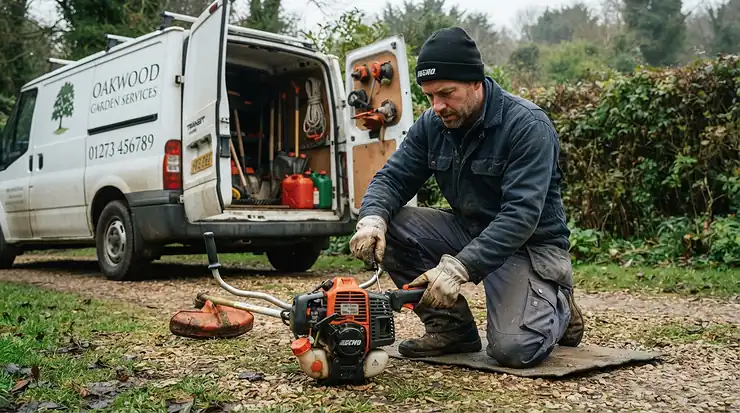
Buy a cheap strimmer for professional grounds work and you’ll learn its limits the hard way — usually on a Tuesday afternoon, three gardens into a six-garden round, when the pull cord starts fighting back. A petrol strimmer for professional use isn’t just a bigger engine bolted to a familiar shape; it’s a different category of tool, built around daily starts, dense vegetation, and the kind of vibration exposure the Health and Safety Executive has spent decades studying in tradespeople’s hands. What is a petrol strimmer for professional use? In short, it’s a commercial-grade brushcutter or strimmer engineered for full daily duty cycles — heavier-duty gearboxes, professional harness systems, and engines rated for hours of continuous work rather than the odd weekend tidy-up.
This guide skips the marketing gloss and gets into what actually separates a tool that survives a season of contract grounds maintenance from one that doesn’t. We’ve pulled together seven genuinely available machines spanning budget, mid-range, and premium territory, with honest analysis of real specifications and aggregated review sentiment rather than invented testimonials. You’ll find a proper breakdown of 4-stroke vs 2-stroke petrol strimmer engines, a look at what “commercial-grade build” is supposed to mean versus what it often means in practice, and a frank look at maintenance costs most listings conveniently skip. Whether you’re a sole trader eyeing something sensible under £200 or a contractor ready to invest in a machine built for a genuine daily duty cycle, there’s something here worth reading before you spend a penny.
Quick Comparison Table
| Product | Engine Type | Weight | Price Range | Best For |
|---|---|---|---|---|
| Husqvarna 545RX | 45.7cc 2-stroke | 8.9kg | Around £900-£1,050 | Full-time commercial contractors |
| STIHL FS 460 C-EM | 45.6cc 2-stroke | 8.5kg | Around £1,000-£1,150 | Forestry and clearing saw work |
| Honda UMK435UE | 4-stroke | ~9kg | £550-£750 range | No-mix daily professional use |
| STIHL FS 94 RC-E | 2-stroke, 2-MIX | ~7kg | £450-£600 range | Mid-tier professional grounds care |
| Makita EM2651UH | 4-stroke | ~7.5kg | £400-£550 range | Noise-sensitive residential contracts |
| Mountfield MB33D | 2-stroke | ~7kg | Under £280 | Semi-commercial and part-time trade use |
| Cobra BC260C | 26cc 2-stroke | 5kg | Under £200 | Sole traders starting out on a budget |
Looking across this table, the split between engine type and duty-cycle rating is the real story: the two 4-stroke machines here, the Honda UMK435UE and Makita EM2651UH, trade a little peak power for lower running costs and none of the fuel-mixing hassle that trips up busy schedules. Meanwhile, the Husqvarna 545RX and STIHL FS 460 C-EM justify their price tags with genuine commercial-grade componentry rather than just bigger cc numbers. If your daily duty cycle rarely exceeds a couple of hours, the Cobra BC260C or Mountfield MB33D may do the job perfectly well without the premium spend.
Found a favourite already? A quick click on any highlighted pick below takes you straight to check current pricing — no obligation, just information.
Top 7 Petrol Strimmers for Professional Use: Expert Analysis
1. Husqvarna 545RX — the daily-duty commercial benchmark
The standout here is the Balance X harness, which genuinely changes how an 8.9kg machine feels after four straight hours of cutting. The 45.7cc X-Torq engine is tuned for a wide torque band rather than just peak rpm, which in practice means it holds cutting speed through thick nettle and bramble instead of bogging down and needing a re-rev, something the smaller 26-31cc machines in this guide simply can’t replicate. Husqvarna’s Smart Start system cuts starter cord resistance by roughly 40%, a detail that matters enormously if you’re pulling a cord fifteen times a day across multiple job sites rather than once a weekend.
This is squarely a machine for contractors and grounds professionals managing acreage, reedbed, or verge clearance as a full-time job, not an occasional-use garden tool — the Trio-Balance harness and combi-guard system (switching between line head and 3-tooth blade without tool changes) are built around that use case specifically. Aggregated user feedback consistently highlights the reliability of the gearbox under sustained heavy-end work, with one commercial user reporting several hectares of reedbed and fen cut annually without major issues, though a handful of reviewers note minor ergonomic tweaks they’d still like to see.
Pros:
- ✅ Smart Start cuts pull-cord resistance by around 40%
- ✅ X-Torq engine holds torque through dense vegetation
- ✅ Balance X harness distributes load for full-day comfort
Cons:
- ❌ Premium price puts it beyond casual or occasional users
- ❌ Replacement blades and heads add to ongoing running costs
Expect to pay in the region of £900-£1,050 at the time of research, and given the daily-duty engineering on offer, that price holds up well against a season of contract work — check current price before committing, as availability and promotions shift.
2. STIHL FS 460 C-EM — best for forestry-grade clearing
What sets this apart on the spec sheet is the M-Tronic electronic engine management system, which automatically compensates for fuel quality, altitude, and air filter cleanliness — a genuinely useful feature if your contracts take you across varied terrain and fuel sources. The 45.6cc 2-MIX engine with stratified charge technology reduces unburned fuel loss during the charge cycle, translating to roughly 20% lower fuel consumption than a comparable standard 2-stroke, which adds up meaningfully across a full season of daily use.
This is the pick for anyone whose “strimming” work regularly tips into small-tree and sapling clearance — the optional chisel-tooth blade and saw-rated shaft make it as much a light clearing saw as a strimmer, ideal for forestry thinning, orchard maintenance, or overgrown boundary work where a standard trimmer head would struggle. Reviewers who’ve run it professionally consistently praise the raw power-to-weight ratio and the ErgoStart system, though several mention that STIHL’s proprietary head-change kits are a genuine ongoing expense worth budgeting for.
Pros:
- ✅ M-Tronic auto-adjusts for fuel, altitude and filter condition
- ✅ Forestry-rated for saplings, not just grass and scrub
- ✅ ErgoStart nearly halves the effort needed to start it
Cons:
- ❌ One of the loudest machines here at 101dB(A)
- ❌ Attachment and head-change kits cost extra on top
At around £1,000-£1,150 depending on shaft length and retailer, this sits at the premium end — genuinely justified only if forestry-grade clearing is a regular part of your working week.
3. Honda UMK435UE — best 4-stroke for zero fuel-mixing hassle
The headline feature is straightforward: this is a genuine 4-stroke engine, which means no measuring, no mixing bottle, and no risk of running the wrong ratio on a rushed morning. Comparative reviews consistently flag it as having the largest engine displacement in its class of 4-stroke professional strimmers, which shows up directly in cutting power on tougher grass and light scrub that would make a smaller 4-stroke labour.
For grounds professionals managing smallholdings, estate boundaries, or acres of challenging terrain, the appeal isn’t subtle — you refuel with plain unleaded and a separate oil top-up, exactly like a car, removing one of the most common sources of engine damage in petrol tool ownership (running a 2-stroke on the wrong mix, or worse, on straight petrol). Reviewers who’ve switched from 2-stroke machines report the reduced smoke and smell as a genuine quality-of-life improvement, particularly working close to clients’ homes, though the trade-off is a noticeably heavier unit than the lightest 2-strokes here.
Pros:
- ✅ Zero fuel mixing — just petrol and a separate oil check
- ✅ Largest engine among the 4-stroke options in this guide
- ✅ Cleaner running with far less smoke and smell on the job
Cons:
- ❌ Heavier than comparable 2-stroke brushcutters
- ❌ Requires periodic oil changes like a small car engine
Typically retailing in the £550-£750 range, it sits mid-to-upper table — a sound investment if fuel-mixing errors have ever cost you an engine before.
4. STIHL FS 94 RC-E — best mid-tier professional 2-stroke
The 2-MIX engine technology is the standout feature here, cutting fuel consumption and exhaust emissions compared with older conventional 2-stroke designs while still delivering the punch professionals expect from a STIHL brushcutter. ECOSPEED technology automatically drops engine speed when the cutting attachment isn’t under load, which in daily use translates to less wasted fuel during the inevitable stopping and starting of a real working day.
This model suits professionals whose work sits between light domestic jobs and heavy forestry clearance — think regular verge maintenance, allotment contracts, or medium-sized commercial grounds rounds where full 45cc-class power would be overkill but a budget 26cc unit would burn out fast. Aggregated feedback on the 2-MIX platform generally praises reliability and STIHL’s dealer network for parts and servicing, though buying exclusively through approved dealers does mean less scope for price comparison than with widely-stocked brands.
Pros:
- ✅ 2-MIX engine cuts fuel use and emissions versus older 2-strokes
- ✅ ECOSPEED reduces engine speed automatically when idling
- ✅ Loop-handle variant suits tight, overgrown working areas
Cons:
- ❌ Noticeably less powerful than the 460-series for heavy brush
- ❌ Dealer-only purchasing limits how much you can shop around
Expect a price in the £450-£600 range — a genuine sweet spot for professionals who need dealer-backed reliability without paying forestry-grade prices.
5. Makita EM2651UH — best for noise-sensitive residential contracts
The defining feature is the 4-stroke engine’s noticeably lower noise output compared with 2-stroke rivals — a real consideration when your working day starts early in residential streets or close to neighbours who’d rather not hear a 2-stroke scream at 7am. Like the Honda, this model requires no fuel mixing, refuelling with straight unleaded and topping up engine oil separately, which simplifies logistics for contractors running multiple machines across a fleet.
This is the pick for professionals whose contracts lean domestic and semi-commercial rather than heavy agricultural clearance — residential gardening rounds, small estate maintenance, or any work where a quieter machine genuinely changes client relationships and scheduling flexibility. The bike-handle design and balanced weight distribution earn consistent praise in aggregated reviews for reducing fatigue over long sessions, though the smaller engine size means it isn’t the machine to reach for on dense, overgrown bramble.
Pros:
- ✅ 4-stroke design runs markedly quieter than 2-stroke rivals
- ✅ No fuel mixing simplifies refuelling across a fleet
- ✅ Bike handle balances weight well over long sessions
Cons:
- ❌ Smaller engine limits performance on dense scrub
- ❌ Parts network is smaller than Honda’s or STIHL’s
Pricing typically falls in the £400-£550 range, positioning it as excellent value for noise-conscious professional work rather than heavy-duty clearance.
6. Mountfield MB33D — best mid-range value pick
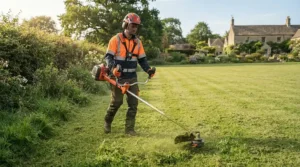
What earns this a spot is a genuinely strong reputation for reliability at a price point well below the premium commercial-grade machines in this guide — comparative reviews repeatedly single it out as a mid-range champion rather than just a budget compromise. The engine and weight balance are tuned for extended sessions without the premium harness systems found on the Husqvarna or STIHL professional lines.
This suits semi-commercial users and part-time tradespeople — someone running a small landscaping side-business, a groundsman covering a modest estate, or a professional gardener whose round doesn’t yet justify a £1,000 machine. Wide stockist availability means parts and servicing are straightforward to source, which matters more than buyers often realise when a machine breaks down mid-contract. Aggregated review sentiment consistently praises the reliability-to-price ratio, though it isn’t rated or built for full commercial-grade daily duty cycles the way the premium picks above are.
Pros:
- ✅ Strong reliability reputation at a genuinely mid-range price
- ✅ Balances power and weight well for extended sessions
- ✅ Widely stocked, making parts and servicing straightforward
Cons:
- ❌ Not built for full-time heavy commercial duty cycles
- ❌ Still requires correct 2-stroke fuel-mixing ratios
At under £280 in most cases, this is a genuinely sensible middle ground — check current price, as it fluctuates by retailer and season.
7. Cobra BC260C — best petrol strimmer under £200
The standout feature is simply the price-to-capability ratio: a genuine 26cc 2-stroke brushcutter, complete with a tap ‘n go nylon head and a metal tri-blade for tougher growth, all comfortably under the £200 mark. At just 5kg, it’s the lightest machine in this entire guide, which matters enormously for anyone starting out and unsure how many hours a day they’ll actually be running it.
This is the honest entry point for a sole trader testing whether professional-grade strimming work suits them before committing to a £900 machine, or for anyone whose “professional use” is genuinely light — a handful of gardens a week rather than a five-day commercial round. Aggregated customer feedback generally reflects satisfaction with ease of starting and straightforward operation, though — and this needs saying plainly — it isn’t built to the same commercial-grade gearbox or harness specification as the premium picks above, so treat it as a stepping stone rather than a long-term daily-duty solution.
Pros:
- ✅ Genuinely under £200 — a real budget entry point
- ✅ Lightest machine in this guide at just 5kg
- ✅ Tap ‘n go head plus tri-blade covers grass and light scrub
Cons:
- ❌ 26cc engine struggles with dense, established bramble
- ❌ Single shoulder harness offers less support over full days
At £140-£180 in most retailers, this is the strimmer to start with — just budget mentally for an upgrade once your daily duty cycle grows.
Practical Usage Guide: Setup, Break-In and the First 30 Days
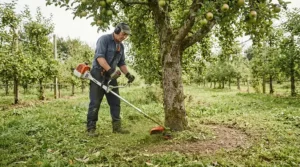
Getting a new petrol strimmer for professional use right in its first month prevents most of the early failures that flood aggregated review sections. Start with correct break-in: most 2-stroke engines need a richer fuel mix and reduced throttle for the first tank or two — running full throttle from hour one is a common cause of premature piston wear that manufacturers rarely make obvious in the manual. Check the gearbox grease level before first use; many commercial-grade machines ship with minimal factory grease, and topping it up properly now saves a gearbox rebuild later.
Establish a maintenance rhythm from day one rather than waiting for something to go wrong: clean the air filter after every few hours of dense-vegetation work, check the spark plug gap monthly, and inspect the harness stitching weekly if you’re on a genuine daily duty cycle. A common first-30-days mistake is over-tightening the cutting head, which strips threads faster than the cutting work itself ever would. Keep a simple fuel-mixing log if you’re running a 2-stroke — inconsistent ratios are one of the most preventable causes of early engine failure, and it takes seconds to jot down each mix.
Real-World Scenarios: Which Professional Needs Which Strimmer
The sole trader on a tight budget. Someone testing the waters with a new landscaping round, doing perhaps eight to ten gardens a week, doesn’t need a £1,000 machine yet. The Cobra BC260C makes sense here — genuinely under £200, light enough to manage fatigue while building stamina for the job, and a sensible way to validate demand before reinvesting profits into commercial-grade equipment.
The full-time grounds contractor. Someone managing multiple large sites, verges, or acreage five days a week has a genuine daily duty cycle that will expose any weakness in a budget machine within weeks. The Husqvarna 545RX or STIHL FS 460 C-EM are built for exactly this — harness systems designed for eight-hour days, gearboxes rated for continuous heavy use, and the fuel efficiency to matter across a full season’s running costs.
The residential specialist working close to clients. Someone whose contracts are mostly domestic gardens, often working early mornings near occupied houses, benefits most from the quieter 4-stroke options. Both the Makita EM2651UH and Honda UMK435UE suit this profile — lower noise, no fuel-mixing mess to explain to curious clients, and professional-grade reliability without forestry-level power that isn’t needed on a suburban lawn edge.
Buyer’s Decision Framework
If your work involves dense bramble, forestry clearance, or acreage measured in hectares, choose a 45cc-plus commercial-grade machine like the Husqvarna 545RX or STIHL FS 460 C-EM, because anything smaller will shorten its own lifespan under that load. If your daily duty cycle rarely exceeds two or three hours and involves mostly grass and light scrub, a mid-range 2-stroke such as the Mountfield MB33D balances cost and capability sensibly. If fuel-mixing errors or noise complaints have caused problems before, prioritise a 4-stroke model — the Honda UMK435UE or Makita EM2651UH — even at a moderate price premium. And if you’re not yet certain professional strimming work is sustainable for your business, start with the Cobra BC260C under £200 and reinvest once demand is proven.
How to Choose a Petrol Strimmer for Professional Use
Choosing the right machine comes down to matching engine class, build quality, and running costs to your actual daily workload rather than chasing the biggest cc number available.
- Match engine size to vegetation type. Grass and light scrub rarely need more than 30cc; dense bramble, reedbed, or sapling clearance justifies 45cc-plus commercial-grade engines.
- Weigh 4-stroke against 2-stroke honestly. If daily fuel-mixing errors or noise complaints are a real risk, a 4-stroke earns its higher upfront cost quickly.
- Check the harness, not just the engine. A machine used for a genuine daily duty cycle lives or dies on harness comfort — Balance X and Trio-Balance systems exist for a reason.
- Budget for consumables from day one. Cutting line, blades, and gearbox grease are ongoing maintenance costs that a headline price never includes.
- Confirm parts and servicing availability locally. A machine that’s cheap to buy but expensive to get serviced quickly erodes any initial saving.
- Read aggregated review sentiment, not star ratings alone. Look specifically for comments about reliability after 100+ hours, not just first-impressions praise.
- Decide your actual duty cycle honestly. Overbuying for occasional use wastes capital; underbuying for full-time work wastes far more in downtime and repairs.
Petrol vs Cordless/Electric: Benefits for Professional Use
| Factor | Petrol Strimmer | Cordless/Electric | Best For |
|---|---|---|---|
| Runtime | Unlimited with refuelling | Limited by battery/cable | Full-day contractors need petrol |
| Power on dense growth | High, consistent | Drops under heavy load | Bramble/scrub clearance favours petrol |
| Noise | Higher, especially 2-stroke | Significantly quieter | Residential early starts favour electric |
| Running cost per hour | Fuel plus 2-stroke oil | Electricity, cheaper per hour | High-volume daily use favours petrol long-term |
The table above makes the trade-off plain: petrol wins decisively on raw duty cycle and cutting power through anything genuinely tough, which is exactly why full-time contractors overwhelmingly still choose it over cordless alternatives. Cordless models are catching up on power, but battery runtime still can’t match a five-minute refuel followed by another hour of unrestricted work. For noise-sensitive residential rounds specifically, though, the calculation shifts — which is partly why 4-stroke petrol options exist as a middle ground.
4-Stroke vs 2-Stroke Petrol Strimmer: Which Wins for Daily Professional Work?
This is genuinely one of the most consequential decisions in this entire buying guide, and it deserves more than a single line in a spec sheet. A 2-stroke engine mixes oil directly into the fuel, burning both together — this keeps the engine lighter and typically more powerful for its size, which is why most of the heavy-duty commercial-grade machines in this guide, including the Husqvarna 545RX and STIHL FS 460 C-EM, still run 2-stroke platforms. The trade-off is fuel-mixing discipline: get the ratio wrong consistently and you shorten engine life dramatically, something aggregated forum and review sentiment flags repeatedly as a preventable cause of premature failure.
A 4-stroke petrol strimmer, like the Honda UMK435UE or Makita EM2651UH, separates fuel and oil entirely — you fill the tank with straight unleaded and check engine oil separately, much like a car. In practice, this eliminates an entire category of user error, reduces smoke and smell noticeably, and typically runs quieter, which matters enormously for residential-facing professional work. What the spec sheet won’t tell you, but reviewers consistently note, is that 4-stroke units tend to run slightly heavier for equivalent displacement, and servicing involves genuine oil changes rather than just fuel-filter checks.
For heavy commercial clearance where raw power-to-weight matters most, 2-stroke still dominates the premium end of this market. For daily professional use where reliability, noise, and simplicity matter more than absolute peak power, 4-stroke increasingly makes the stronger business case — and the gap is narrowing every model generation.
Commercial-Grade Build: Features That Actually Matter (And Those That Don’t)
“Commercial-grade” gets printed on packaging more loosely than it should, so it’s worth separating genuine build indicators from marketing language. A real commercial-grade build means a full-crank engine rather than a half-crank (single-bearing) design — full-crank engines, as used across professional Husqvarna and STIHL lines, deliver lower vibration and meaningfully longer service life, which directly affects both comfort and the noise and vibration exposure limits that apply to anyone using this equipment regularly for work. A heat-treated steel gearbox, rather than a plastic-reinforced one, is another genuine indicator — it’s the single component most likely to fail first under a genuine daily duty cycle.
What matters less than marketing suggests: cosmetic details like buttons, decals, and colour-matched trim don’t affect longevity at all, despite often being used to justify a price premium. Similarly, headline cc figures alone are a weak indicator of quality — a well-engineered 33cc engine with proper heat treatment can outlast a poorly finished 45cc unit. What most buyers overlook entirely is harness quality: a Balance X or Trio-Balance system genuinely reduces musculoskeletal strain over an eight-hour day in a way no engine spec can compensate for, yet it’s rarely mentioned until three paragraphs deep in most listings.

Best Petrol Strimmer Under £200: What You Gain and What You Sacrifice
It’s entirely possible to buy a usable, professional-adjacent petrol strimmer under £200 — the Cobra BC260C proves that convincingly. What you gain at this price point is a genuine entry into paid strimming work without the capital risk of a £900 commitment, a lightweight build that’s forgiving for someone still building physical stamina for the job, and enough cutting capability for grass, weeds, and light scrub across a modest weekly round.
What you sacrifice, and it’s worth being honest about this rather than glossing over it, is the commercial-grade gearbox and harness engineering found on the premium machines in this guide. A sub-£200 strimmer will typically not survive a genuine full-time daily duty cycle across hectares of dense growth — the gearbox simply isn’t built for that load profile, and aggregated review sentiment on budget machines consistently reflects shorter working lifespans under heavy use compared with the premium tier. The honest advice: treat a sub-£200 petrol strimmer as a legitimate starting point for light-to-moderate professional work, not a permanent substitute for commercial-grade equipment once your workload genuinely justifies the upgrade.
Daily Duty Cycle: What to Expect From Real-World Performance
Specification sheets rarely translate cleanly into a working day, so here’s what an honest daily duty cycle actually looks like across this guide’s tiers. A budget machine like the Cobra BC260C is realistically comfortable for two to three hours of intermittent use — a handful of garden edges and light trimming — before fatigue and heat become genuine factors, both for the operator and the engine. A mid-range machine like the Mountfield MB33D extends that comfortably to four or five hours across a working morning, provided breaks are built in roughly every ninety minutes, in line with general hand-arm vibration exposure guidance for powered hand tools.
The premium commercial-grade machines change the equation entirely. The Husqvarna 545RX and STIHL FS 460 C-EM are engineered around genuine eight-hour daily duty cycles — harnesses designed for full-shift wear, gearboxes rated for continuous operation, and engines tuned to hold power output without excessive heat build-up over sustained use. What most buyers underestimate is how much this changes the maths on productivity: a contractor covering more ground per hour, with less fatigue-driven slowdown by mid-afternoon, often recovers the price difference within a single busy season.
Long-Term Cost & Maintenance: What Maintenance Costs Really Look Like
The headline price is only the opening figure in petrol strimmer ownership, and maintenance costs deserve honest treatment here rather than being buried in small print. Across a typical working season, expect to budget for cutting line (replaced regularly on any machine used commercially), air filters, spark plugs roughly every 100-150 hours, and gearbox grease top-ups. For 2-stroke machines, factor in 2-stroke oil as an ongoing consumable cost that 4-stroke owners simply don’t have, though 4-stroke machines add their own periodic engine oil changes in return.
Commercial-grade machines like the Husqvarna 545RX and STIHL FS 460 C-EM carry higher parts costs individually — a proprietary head-change kit or replacement harness can run into three figures — but their heat-treated gearboxes and full-crank engines typically mean fewer catastrophic failures across a multi-year lifespan. Budget machines like the Cobra BC260C cost less per replacement part but tend to need gearbox or clutch replacement sooner under sustained heavy use, which can eat into the initial price saving faster than expected. The genuinely useful long-term cost calculation isn’t purchase price alone — it’s purchase price plus realistic annual maintenance costs, divided by expected working lifespan at your actual duty cycle.
Safety, Regulations and Compliance for Professional Strimmer Use
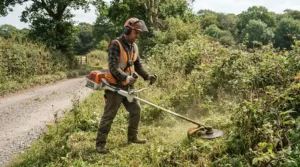
Operating a petrol strimmer for professional use in the UK carries real regulatory obligations, particularly if you employ others or operate as a contractor. The Control of Noise at Work Regulations 2005 set an 85dB(A) daily exposure action value at which employers must provide hearing protection, and several machines in this guide — notably the STIHL FS 460 C-EM at 101dB(A) — sit comfortably above that threshold during normal operation, making ear defenders a non-negotiable rather than optional extra. Hand-arm vibration is an equally serious consideration: the Control of Vibration at Work Regulations 2005 require employers to assess and manage vibration exposure, with regular timed breaks between tanks of fuel widely recommended as a practical control measure.
Beyond noise and vibration, standard PPE for professional strimmer use includes eye protection or a full-face visor (kite-marked for impact resistance), sturdy trousers or leg guards, and steel-toe-capped boots — thrown debris from a metal blade travels further and faster than most people expect. If you’re managing staff or subcontractors, documenting a proper risk assessment isn’t bureaucratic box-ticking; it’s a legal requirement, and HSE guidance provides templates specifically covering vibration and noise exposure for exactly this kind of equipment.

Frequently Asked Questions
❓ What cc is best for a professional petrol strimmer?
❓ Is 4-stroke or 2-stroke better for professional strimmer use?
❓ How much does a professional petrol strimmer cost in the UK?
❓ Do you need a licence to use a petrol strimmer professionally?
❓ How often should a professional petrol strimmer be serviced?
Conclusion
Choosing a petrol strimmer for professional use ultimately comes down to matching real workload against genuine build quality rather than chasing the highest cc figure or the lowest price tag in isolation. If your daily duty cycle involves genuine full-time commercial work, the Husqvarna 545RX and STIHL FS 460 C-EM earn their premium pricing through commercial-grade gearboxes and harness systems engineered for exactly that punishment. If fuel-mixing mistakes or noise complaints have caused problems, the Honda UMK435UE and Makita EM2651UH offer a genuinely compelling 4-stroke alternative. For everyone else — the mid-range professional, the residential specialist, or the sole trader just starting out — the Mountfield MB33D and Cobra BC260C prove that sensible, honest capability doesn’t require an eye-watering budget.
Whatever you choose, factor in realistic maintenance costs from the outset, respect the noise and vibration regulations that apply to professional use, and buy for the duty cycle you actually have rather than the one you imagine you might grow into. A well-matched machine, properly maintained, will outlast almost any spec-sheet comparison in the long run.
✨ Ready to gear up for the season ahead? Browse today’s best petrol strimmer deals and pick the one that matches your real working day! 🌿🔧
Frequently Asked Questions
❓ What cc is best for a professional petrol strimmer?
❓ Is 4-stroke or 2-stroke better for professional strimmer use?
❓ How much does a professional petrol strimmer cost in the UK?
❓ Do you need a licence to use a petrol strimmer professionally?
❓ How often should a professional petrol strimmer be serviced?
Recommended for You
- Petrol Strimmer For Thick Grass: 7 Beastly Picks For 2026
- 7 Best Petrol Strimmers For Large Gardens (UK Guide 2026)
- Petrol Strimmers Under £300: 7 Best Picks for UK Gardens (2026)
Disclaimer: This article contains affiliate links. As an Amazon Associate, I earn from qualifying purchases. If you purchase products through these links, we may earn a small commission at no additional cost to you.
✨ Found this helpful? Share it with your friends! 💬🤗
