

In This Article
A brush cutter for smallholdings is a shoulder-harnessed, engine-driven cutting machine built to clear what a mower can’t. That means rough paddock grass, nettles, brambles, docks and woody regrowth, along fence lines, ditches and field margins. Most buyers choose a petrol model for its sustained power and freedom from battery limits.

Here’s the problem. Most buying guides assume you’re tidying a suburban lawn. Yours is a different job: an acre or five of uneven ground, a boundary that fights back every summer, and a long list of chores that all need doing before the light goes. Pick the wrong machine and you’ll spend your Saturdays fighting it instead of the brambles.
This guide covers seven real petrol machines from budget to premium. It also covers the things spec sheets skip: how a harness changes your back by lunchtime, why paddock maintenance is a calendar rather than a one-off, and how to plan boundary clearance so you aren’t re-cutting the same hawthorn every year. There’s a legal angle too. Under the Weeds Act 1959, occupiers can be required to stop injurious weeds such as ragwort from spreading. If you graze horses, sheep or cattle, that matters.
Every product opinion below is analysis based on published specifications and retailer information, not claimed hands-on testing. Where I couldn’t verify a pool of independent customer reviews, I say so rather than invent one. Prices are ranges only, because they move constantly.
Quick Comparison: Brush Cutter for Smallholdings at a Glance
| Model | Engine | Handle Type | Cutting Tools | Indicative Price Range | Best For |
|---|---|---|---|---|---|
| Trueshopping 43cc | 43cc 2-stroke | Loop-style | Line head + blade | Budget (under £200) | Tight budgets and awkward corners |
| ParkerBrand 52cc | 52cc 2-stroke | Bike/loop | Bump-feed line head | Budget (under £250) | Raw power for the money |
| Husqvarna 129R | 27.5cc 2-stroke, 0.85kW | Bull handle | Line/blade options | Mid-range (£250-£400) | Mixed light-to-medium clearing |
| STIHL FS 56 C-E | 27cc 2-stroke | Loop handle | AutoCut line head | Mid-range (£300-£450) | Frequent, lighter paddock work |
| Honda UMK 435 UE | 35cc 4-stroke (GX35T) | Bike handle | Tap-and-go head, blade option | Premium (£600-£750) | Long-term ownership, plain petrol |
| STIHL FS 131 | 36.3cc 4-MIX, 1.4kW | Bike handle | Metal blade + AutoCut | Premium (£700-£900) | Serious boundary clearance |
| McCulloch Trimmac | 25cc 2-stroke | Loop handle | Bump-feed line only | Budget (under £150) | Edges, yards and light trimming |
Look at the table as a ladder of intent. The ParkerBrand 52cc gives the most raw displacement for the least money, but it is a line-head machine on paper, so thick woody stems are not its home turf. The STIHL FS 131 and Honda UMK 435 UE cost several times more because they’re built for longevity and comfort over years of heavy use. The McCulloch Trimmac is the odd one out. It’s included because many smallholders need a light secondary tool for edges, not a brush cutter in the blade-wielding sense.
💬 Just one click — help others make better buying decisions too!😊
Top 7 Brush Cutter for Smallholdings: Expert Analysis
1. Trueshopping 43cc — budget machine with a blade included
Few budget machines offer both a bump-feed head and a metal blade, and this one does. That versatility is the headline. A 43cc 2-stroke engine puts it comfortably above the 25-30cc class, so brambles and tall docks are realistic targets.
Displacement matters because brush cutting is about torque under load. A 43cc engine bogs down less when the blade bites into thick stems than a 25cc unit. One roundup of petrol strimmers singled it out as the best budget pick and one of the better machines for narrow spots. On paper it suits a smallholder with a modest field and an even more modest budget.
Reviewer-style sentiment I could find leans positive on value. Expect the usual budget-tier caveats: more vibration, fiddlier starting and a thinner support network than the big dealer brands. I couldn’t verify a large pool of independent reviews for this exact listing, so treat that as a cautious summary.
Pros:
- ✅ Line head and metal blade both included
- ✅ 43cc engine handles brambles and docks
- ✅ Handy for narrow, awkward corners
Cons:
- ❌ Budget-tier vibration and fit-and-finish
- ❌ Limited dealer and spares support
Price range: under £200 at the time of research. It’s strong value if you accept the trade-offs. Check current price before buying.

2. ParkerBrand 52cc — most engine for the money
Fifty-two cubic centimetres is a lot of engine in a budget package, and a roundup of petrol strimmers noted it carries almost 10cc more than the next-biggest machine on its list. That’s why it earned the “heavy duty” label. More displacement usually means more torque for dense nettles and thick grass.
The catch is the cutting head. The same review noted it has a bump-feed head but no blade head, which makes sense for its intended work but limits it against woody growth. If your boundary clearance involves blackthorn or sapling regrowth, this isn’t the right tool. If you face acres of rank paddock grass and docks, it could be exactly right.
Weight is the other consideration. Bigger engines generally mean more mass, and harness comfort becomes more important, so budget for a decent double harness. Review sentiment for machines in this tier typically splits between delighted-for-the-price and frustrated-by-reliability. I couldn’t verify enough independent reviews for this exact model to be more specific.
Pros:
- ✅ Large 52cc engine for tough grass
- ✅ Low entry price for the power
- ✅ Suits big, open paddock areas
Cons:
- ❌ Line head only, so unsuited to woody stems
- ❌ Heavier feel; needs a good harness
Price range: under £250. It’s good value for rough grass, but not for woody clearing.
3. Husqvarna 129R — dependable all-rounder with bull handle
The Husqvarna 129R pairs a 27.5cc 2-stroke engine and 0.85kW output with a bull handle. In practice, that handle gives you two-handed control that feels natural when you’re swinging the head along a fence line. It’s a light-to-medium machine.
What does 0.85kW mean in the field? It’s enough for long grass, nettles and light scrub, but not for sustained work on thick brambles all day. The sweet spot is the smallholder who clears a little most weeks rather than a lot twice a year. The brand also brings a wide UK dealer network, so spares and servicing are rarely an issue. That’s a real advantage when a carburettor needs attention in the middle of June.
Retailers often bundle a small bottle of 2-stroke oil, which is a nice touch for first-time buyers learning the fuel mix. Reviewers of this class of machine commonly praise starting reliability and balance. I couldn’t verify individual reviews for this precise model.
Pros:
- ✅ Bull handle gives confident two-handed control
- ✅ Wide UK dealer and spares network
- ✅ Light enough for regular use
Cons:
- ❌ 0.85kW limits thick bramble work
- ❌ Needs 2-stroke fuel mixing
Price range: roughly £250-£400. It’s a sensible mid-range buy for lighter paddock maintenance.
4. STIHL FS 56 C-E — lightweight for frequent paddock work
The STIHL FS 56 C-E is a roughly 27cc, lightweight petrol brush cutter with an auto cut line head, according to a World of Power listing. Its loop handle suits manoeuvring around posts, troughs and gateways, where a big bike-handle machine gets clumsy.
Here’s what the spec sheet won’t tell you: a lighter machine is used more often. If grass grows weekly in summer, a 5kg-class machine that doesn’t punish your shoulders will do more actual cutting than a heavier one you dread picking up. That’s the logic behind this model for smallholders with a few acres and a high-frequency routine.
It is not the tool for sustained heavy clearing. Think of it as the scalpel next to the STIHL FS 131‘s machete. Owner sentiment for STIHL’s lighter machines generally centres on easy starting and refined engineering. I couldn’t verify reviews of this exact variant, so take that as brand-level observation.
Pros:
- ✅ Light and well suited to regular, frequent use
- ✅ Loop handle for gates, posts and troughs
- ✅ Backed by a strong dealer network
Cons:
- ❌ Line head focus limits woody growth work
- ❌ Higher price than similar-sized budget rivals
Price range: around £300-£450. It’s reasonable value if lightness and dealer backup matter to you.
5. Honda UMK 435 UE — plain petrol, built to last
The Honda UMK 435 UE is the odd one in this group: a 35cc 4-stroke GX35T engine that runs on plain petrol, with oil in a separate sump. No fuel mixing. For anyone who has ever mis-measured 2-stroke oil in a hurry, that alone is a selling point.
Retailer information lists a dry weight of about 7.6kg, which is heavy compared with the STIHL FS 131 at 5.8kg. A bike handle and a good harness help, but this isn’t the machine for people who value lightness above all. What you get in return is a 360-degree-capable engine that works at any angle (useful on banks and ditches), a semi-automatic tap-and-go head, and optional blades. One retailer lists a five-year warranty, which is unusually generous in this category. Check the terms for your own purchase.
Reviewers of Honda’s small 4-stroke engines commonly cite smooth, quiet running and low emissions. I couldn’t verify reviews specific to the UMK 435 UE itself, so I’m describing the engine’s general reputation, not a verified verdict.
Pros:
- ✅ Runs on plain petrol, with no fuel mixing
- ✅ Works at steep angles on banks and ditches
- ✅ Long warranty offered by some retailers
Cons:
- ❌ Heavier than comparable 2-stroke and 4-MIX machines
- ❌ Premium price for a 35cc engine
Price range: around £600-£750. It’s a long-term investment that pays back if you hate mixing fuel.
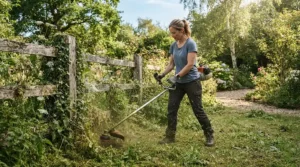
6. STIHL FS 131 — the serious boundary clearance tool
This is the heavyweight of the group. The STIHL FS 131 uses a 36.3cc 4-MIX engine producing 1.4kW, weighs 5.8kg, and comes with a metal grass blade, an AutoCut head and an ADVANCE Universal double shoulder harness. Retailer listings state a 420mm cutting diameter and a 0.71-litre fuel tank.
The 4-MIX engine runs on a fuel-oil mixture like a 2-stroke but delivers faster acceleration and better fuel efficiency, and it is lower in noise and emissions. The power-to-weight ratio is the real story. At 5.8kg versus the Honda UMK 435 UE‘s 7.6kg, you’re carrying roughly 1.8kg less for 0.4kW more power. Over a six-hour day, that gap is tangible.
Retailer-published figures show vibration values of 3.4 to 4.9 m/s² at the handle depending on the cutting tool. For anyone working long hours, that’s relevant; more on that in the harness comfort and safety sections. Sound power is listed at 109 dB(A), so hearing protection isn’t optional. I couldn’t verify a pool of independent reviews, but the professional positioning and published specifications make it the obvious choice for demanding boundary clearance.
Pros:
- ✅ 1.4kW engine for brambles and saplings
- ✅ 5.8kg weight with a proper double harness
- ✅ Metal blade and line head both supplied
Cons:
- ❌ Highest price in this group
- ❌ Overkill for small paddocks
Price range: roughly £700-£900. It’s expensive, but it’s the best value over a decade of heavy use.
7. McCulloch Trimmac — light secondary tool for edges
Be honest with yourself about what you need. The McCulloch Trimmac is a 25cc, 3.9kg trimmer with a bump-feed head and no blade attachment, according to a petrol strimmer roundup. That means it is a petrol strimmer, not a bladed brush cutter. It earns its place here because many smallholdings need a nimble secondary tool for yard edges, around water troughs, and under electric fencing.
Think of it as the supporting act. Pair it with a primary machine like the Husqvarna 129R or STIHL FS 131, and you avoid dragging a big machine around for five-minute jobs. At 3.9kg it’s genuinely light, and the 25cc engine is enough for grass and soft weeds.
Don’t expect it to touch brambles or woody regrowth. I couldn’t verify sufficient independent customer reviews for this specific model, so my advice rests on specifications and roundup commentary.
Pros:
- ✅ Very light at 3.9kg
- ✅ Easy to use around posts and troughs
- ✅ Low price for a petrol machine
Cons:
- ❌ Line head only, with no blade option
- ❌ Not suited to woody boundary growth
Price range: under £150. It’s a good value secondary tool, but not a primary brush cutter.
How to Choose a Brush Cutter for Smallholdings
- Match engine size to your worst vegetation. Under 30cc suits grass and nettles. Between 30 and 40cc handles brambles and light scrub. Anything bigger is for dense, woody growth or large open areas.
- Decide on blade versus line. A metal blade slices woody stems; a line head is safer around stones and fences. Machines supplying both, like the Trueshopping 43cc and STIHL FS 131, give you flexibility.
- Weigh weight against power. Heavier machines are more tiring. The Honda UMK 435 UE is roughly 1.8kg heavier than the STIHL FS 131, which matters over a full day.
- Pick the handle for the job. Bike handles give a smooth sweeping action in open ground. Loop handles win in tight spaces. Bull handles split the difference.
- Check the harness. A padded double shoulder harness transfers weight to your hips and spreads load across both shoulders. It’s not an accessory; it’s part of the machine.
- Think about fuel logistics. Plain petrol (Honda) versus mixed fuel (2-stroke and 4-MIX) affects what you carry to remote fields.
- Consider after-sales support. A slightly cheaper machine without local servicing can cost far more in downtime.
Each criterion points back to the same truth: a brush cutter for smallholdings is chosen by workload, not by brand prestige.

Petrol Brush Cutter vs Battery vs Flail Mower
A petrol brush cutter isn’t the only way to clear land. Here’s how the main alternatives stack up for a typical smallholding.
| Option | Run Time | Power on Thick Growth | Running Cost | Best For |
|---|---|---|---|---|
| Petrol brush cutter (e.g. STIHL FS 131) | Unlimited with spare fuel | Very high | Fuel, oil, servicing | Remote fields and heavy clearing |
| Battery brush cutter | Limited by battery | Moderate | Low per hour, high battery replacement | Small plots near a power point |
| Tractor-mounted flail mower | Unlimited | Very high | Tractor fuel and wear | Large, open, flat paddocks |
| Line-only petrol trimmer (e.g. McCulloch Trimmac) | Unlimited with spare fuel | Low | Low | Edges and light weeds |
The table shows why petrol keeps winning on smallholdings. Battery tools are quieter and simpler, but run time and field distance from the charger are real constraints once you’re beyond the yard. Flail mowers are far faster on open ground, yet they can’t reach ditches, steep banks or fence lines. A petrol brush cutter fills that gap, so even holdings with a tractor often keep one for the places the tractor can’t go.
If your land is all flat, open paddock and you own a tractor, a flail may be the more efficient primary tool. For anything with hedges, banks, ditches or posts, the petrol brush cutter remains the realistic answer.
Harness Comfort: Why It Matters More Than Horsepower
Harness comfort decides how long you can work, and therefore how much you actually clear. A brush cutter swings a long shaft with an engine at one end, and without a good harness all that leverage lands on your shoulders and lower back.
What to look for. A double shoulder harness spreads weight across both sides, with padding where it crosses the collarbone and a waist belt that moves load onto your hips. The STIHL FS 131 ships with an ADVANCE Universal double harness. The Honda UMK 435 UE listings mention a practical harness as well. On heavier machines in particular, this is not optional.
Set-up matters. Adjust the hook point so the machine hangs with the cutting head just above the ground, level with your hips. If you’re reaching forward or bending, the harness is set wrong. A well-balanced machine should almost float.
Breaks and vibration. Vibration builds up quietly. The HSE explains that hand-arm vibration from brush cutters and chainsaws can damage the hands over time, and notes there’s no personal protective equipment proven to reduce that risk. It does recommend staying warm. Use gloves, layered clothing and regular breaks, especially in cold, damp weather.
The legal duties are aimed at employers, but your hands don’t care about your employment status. If you do a lot of boundary clearance, choose a machine with lower published vibration values, keep the blade sharp and the machine serviced, and avoid long unbroken sessions.
Paddock Maintenance: A Practical Season-by-Season Plan
Paddock maintenance is a calendar, not a one-off job. A brush cutter for smallholdings earns its keep when it’s used at the right moment.
Spring (March to May). Clear last year’s dead growth and tackle early nettles before they seed. Check fence lines for fallen branches. Light machines like the STIHL FS 56 C-E or Husqvarna 129R excel at this early, frequent work.
Early summer (June to July). Target docks and thistles before they flower and seed. Under the Weeds Act, common ragwort, curled dock, broad-leaved dock, spear thistle and creeping thistle are all listed as injurious weeds, so timing here helps with compliance as well as grazing quality. If you cut ragwort, remove the cut material from grazing areas, because wilted plants remain toxic and can become more palatable to stock.
Late summer (August to September). Cut back rank grass in resting paddocks and clear the base of hedgerows where bramble regrowth is strongest. This is the STIHL FS 131 or Honda UMK 435 UE season.
Autumn and winter. Service the machine, drain or stabilise fuel, sharpen blades and replace worn line. A tidy machine in October is a reliable machine in April.
A simple rule: cut little and often rather than rarely and drastically. Rank, tangled growth wears out engines, blunts blades and exhausts operators.
Boundary Clearance: Hedges, Fence Lines and Ditches
Boundary clearance is where a brush cutter for smallholdings differs most from a lawn trimmer. You’re working beside stock fencing, around wire, stones and posts, often on sloping ground.
Blade or line? Use a line head near fences and stones to avoid kickback and blade damage. Switch to a metal blade for brambles and saplings in open stretches. The STIHL FS 131 and Trueshopping 43cc both supply blades; the ParkerBrand 52cc and McCulloch Trimmac are line-only.
Protect the fence. Hitting a wire with a metal blade is a quick way to ruin it and risk injury. Approach posts with line, and clear the base of the fence in a controlled manner.
Banks and ditches. The Honda UMK 435 UE‘s ability to run at steep angles is genuinely useful here. A 2-stroke on a steep bank can starve of fuel, while a design built to run at any angle keeps working.
Mind the wildlife. Hedges and field margins are habitat. Nesting birds are protected, and the general season of concern is spring through late summer. Check current guidance before major cutting. Leave some margins uncut where you can; it’s good for wildlife and saves effort.
Always wear the right kit. Eye and face protection, hearing defenders, sturdy boots, long trousers and gloves are the minimum. With 109 dB(A) sound power quoted for the STIHL FS 131, hearing protection is not a suggestion.
Case Studies: Three Smallholdings, Three Machines
Profile 1: The weekend hobbyist (2 acres, two ponies, tight budget). Grass grows fast, but nothing thicker than docks and nettles. The Husqvarna 129R or STIHL FS 56 C-E covers this comfortably. Add a cheap McCulloch Trimmac for edges only if the budget allows. Total outlay stays moderate, and the machines are light enough for 45-minute sessions.
Profile 2: The working sheep keeper (12 acres, long boundaries, bramble-infested hedges). This profile cuts for hours, often in awkward terrain. The STIHL FS 131 is the logical choice: more power, a proper double harness and a blade for woody regrowth. The higher price is spread across a decade of heavy use.
Profile 3: The hates-fuel-mixing smallholder (6 acres, steep banks, rarely used machine). If you only use the machine now and then and fear stale mixed fuel, the Honda UMK 435 UE is appealing. Plain petrol and a separate oil sump mean fewer mistakes, and the angle-tolerant engine suits banks. Accept the extra weight in exchange for simplicity.
The pattern: match the machine to your frequency of use, terrain and tolerance for maintenance, not to a brand name.

Problem → Solution Guide for Brush Cutter Owners
Problem 1: The engine won’t start after winter. Stale fuel is the usual culprit. Drain the tank at season’s end, or use fresh fuel and the correct mix ratio in spring. Check the spark plug and air filter.
Problem 2: Line keeps snapping or won’t feed. Use the correct line diameter for your head and keep the spool tidy. Cutting against stones or fencing wears line quickly, which is a good reason to carry spare spools.
Problem 3: Back and shoulder ache after an hour. Adjust the harness hook point, use the waist belt, and consider a lighter machine. A heavier unit like the Honda UMK 435 UE demands better set-up discipline.
Problem 4: Brambles wrap around the head. Cut from the top down in layers rather than attacking the base. A blade slices more cleanly than line on woody stems.
Problem 5: Docks and ragwort keep returning. Cutting alone rarely kills perennial weeds. The Welsh Government’s guidance notes that injurious weeds can harm grazing animals and spread to neighbouring land, and that a code of practice on ragwort offers advice to landowners. Combine cutting with timely follow-up and, where appropriate, other control methods.
Common Mistakes When Buying a Brush Cutter for Smallholdings
Buying on engine size alone. A big engine with no blade option (like the line-only ParkerBrand 52cc) can disappoint if your main job is woody clearing.
Ignoring weight. A 7.6kg machine is fine for a short job but tiring all day. Compare with the 5.8kg STIHL FS 131 before you commit.
Skipping the harness. Using a single-strap or no harness on a heavy machine is a recipe for sore shoulders and poor control.
Underestimating servicing. A £150 machine with no local dealer can become a £150 paperweight. Support counts.
Buying a trimmer when you need a brush cutter. The McCulloch Trimmac is lovely for what it is, but it’s a line trimmer. Check whether a blade can be fitted before buying.
Forgetting protective equipment. Eye, ear, foot and leg protection should be in the budget from day one.
Long-Term Cost & Maintenance
The sticker price is only part of the story. Over five to ten years, fuel, servicing, spare parts and your time all count.
| Model | Upfront Cost Tier | Fuel Logistics | Servicing Support | Best For |
|---|---|---|---|---|
| Trueshopping 43cc | Low | Mixed fuel | Limited | Short-term, budget-first buyers |
| ParkerBrand 52cc | Low | Mixed fuel | Limited | Rough grass on a tight budget |
| Husqvarna 129R | Mid | Mixed fuel | Wide dealer network | Balanced mid-range ownership |
| STIHL FS 56 C-E | Mid | Mixed fuel | Wide dealer network | Frequent light use |
| Honda UMK 435 UE | High | Plain petrol plus oil | Strong, long warranty offered | Hassle-free long-term ownership |
| STIHL FS 131 | High | Mixed fuel (4-MIX) | Wide dealer network | Heavy, regular clearing |
Cost-per-use favours the premium end if you use the machine often. A £750 machine used 60 times a year for ten years works out at roughly £1.25 per use before fuel, while a £150 machine that dies after three seasons costs about £0.83 per use but leaves you buying twice. If you use it only a handful of times a year, the budget machines make more sense.
Maintenance routines are simple but non-negotiable: clean or replace the air filter, check the spark plug, sharpen or replace blades, grease the gearhead per the manual and use fresh fuel. A machine looked after properly outlives one that isn’t, whatever the badge says.
Safety, Regulations and Legal Duties
Brush cutters are among the more hazardous hand-held tools on a smallholding. The main risks are flying debris, blade contact, noise and vibration.
Vibration. HSE guidance explains that hand-arm vibration at work is controlled under the Control of Vibration at Work Regulations 2005, aimed at employers, and sets exposure action and limit values. Simple tracking tools use a points system, where around 100 points marks the action level and 400 the limit. Even if you’re not legally covered, the principle is sound: limit continuous use, keep machines maintained, and watch for tingling or numbness.
Noise. Machines like the STIHL FS 131 list a sound power of 109 dB(A). Wear hearing protection whenever the engine runs.
Weeds and land duties. The Weeds Act applies to occupiers. If you graze animals or neighbour grazing land, controlling ragwort and other injurious weeds isn’t just good husbandry; it can be a legal expectation.
Fuel safety. Store fuel in approved containers away from ignition sources, refuel only with the engine cool, and never smoke nearby.
CE and UKCA marking. Machinery sold in Great Britain should carry appropriate conformity marking, so check this on any import or marketplace purchase.

FAQ
❓ What size petrol brush cutter do I need for a smallholding?
❓ Is a 4-stroke brush cutter better than a 2-stroke?
❓ Can I use a metal blade near fences and stock netting?
❓ How long does a petrol brush cutter last?
❓ Do I really need a harness for a brush cutter for smallholdings?
Conclusion
The best brush cutter for smallholdings is the one that fits your land, your frequency of use and your body. If you maintain a couple of acres and cut little and often, the Husqvarna 129R or STIHL FS 56 C-E offers a sensible balance. If you’re on a tight budget and tackling rough grass, the Trueshopping 43cc and ParkerBrand 52cc deliver power cheaply, with the trade-offs already described. If you hate fuel mixing and work on steep banks, the Honda UMK 435 UE deserves a look. For serious, regular boundary clearance, the STIHL FS 131 is the strongest all-round performer here. The McCulloch Trimmac rounds out a kit as a light edging tool.
Whichever you choose, budget for a good harness, proper protective equipment and a servicing routine. A petrol brush cutter is only as good as the habits around it, and paddock maintenance works best as a steady rhythm rather than a seasonal panic.
✨ Ready to reclaim your boundaries?
🔍 Compare the models above, click through to check current pricing and availability, and choose the machine that suits your land. A tidy, safe smallholding starts with the right tool in your hands!
Recommended for You
- Brush Cutter vs Strimmer: 7 Best Picks For UK Gardens (2026)
- Brush Cutters Under £250: 7 Best Picks For UK Gardens (2026)
- Petrol Strimmer For Professional Use: 7 Tested Picks (2026)
Disclaimer: This article contains affiliate links. As an Amazon Associate, I earn from qualifying purchases. If you purchase products through these links, we may earn a small commission at no additional cost to you.
✨ Found this helpful? Share it with your friends! 💬🤗
