
In This Article
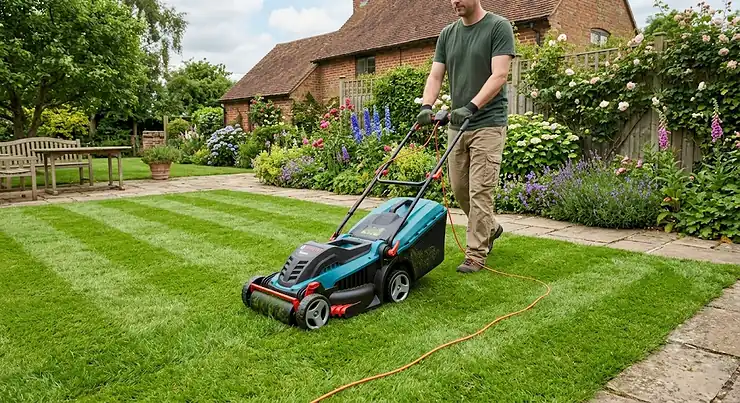
There’s a particular kind of smugness that comes from glancing out of the kitchen window at a lawn striped like a cricket outfield. An electric lawn mower with roller is the tool that gets you there: a corded or cordless rotary mower fitted with a rear cylinder that presses grass blades flat in alternating directions as you walk, creating the light-and-dark stripe effect associated with country house gardens and Wimbledon’s Centre Court. It’s simpler mechanically than it sounds, and considerably more affordable than most people assume. If you’ve ever wondered why your neighbour’s lawn looks like it’s been ironed while yours looks merely “mowed,” the answer is almost always sitting in their shed with a roller bolted to the back of it.
This guide exists because choosing between dozens of similar-looking green and orange boxes on Amazon is genuinely confusing, and most retailer listings tell you almost nothing about which machine actually suits your garden, your patience level, or your electricity bill. We’ve pulled together seven real, currently available UK models spanning budget, mid-range and premium territory, cross-referenced against the RHS’s own lawn mowing guidance, which confirms a proper stripe is genuinely achievable with a rear-roller mower but far harder without one, plus aggregated owner feedback and independent test data. No invented reviews, no wild claims, just a straight comparison so you can spend your money once and get it right.
Before diving into the individual machines, it’s worth clarifying what actually separates a decent striping mower from a mediocre one, because the answer isn’t always “the biggest motor.” Weight, roller design, and how evenly a machine sits on the lawn all matter more than raw wattage once you’re past the entry-level bracket. Keep that in mind as we go through the comparison table and the seven contenders below.
Quick Comparison Table
| Mower | Cutting Width | Power | Roller Type | Price Range | Best For |
|---|---|---|---|---|---|
| Webb Supreme WEER33RR | 33cm | 1200W | Dedicated rear roller | Under £120 | Small lawns, tight budgets |
| Cobra GTRM34 | 34cm | Corded, 7 heights | Rear roller | £110-£150 | Best all-round stripe quality |
| LawnMaster 1600W | 37cm | 1600W | Rear roller + mulch | £150-£190 | Mid-size lawns, mulching fans |
| Hyundai HYM3800E | 38cm | 1600W | Rear roller + mulch | Under £150 | Value with warranty peace of mind |
| Webb Classic WEER37RR | 37cm | 1600W | Rear roller | £140-£180 | British-brand reliability |
| Bosch AdvancedRotak 650 | 40cm | 1700W | Rear roller | Mid-£300s | Premium finish, larger lawns |
| Mountfield Princess 34 | 34cm | 1600W | 4-wheel rear roller | £150-£200 | Stability on uneven ground |
A quick glance tells its own story here. Budget doesn’t automatically mean compromise: both the Webb Supreme and the Cobra sit comfortably under £150 yet reviewers rate their stripe quality highly, largely because a dedicated rear roller does most of the aesthetic heavy lifting regardless of price tag. Where the extra money in the Bosch genuinely earns its keep is cutting width, telescopic handle comfort and motor headroom for tougher, more overgrown grass. The Mountfield’s four-wheel-plus-roller configuration is the outlier worth noting if your lawn has bumps, since it trades a fraction of stripe crispness for noticeably better stability on undulating turf.
💬 Found a mower that’s caught your eye already? Tap through to check current availability before someone else nabs the last one in stock.
Top 7 Electric Lawn Mowers With Roller: Expert Analysis
1. Webb Supreme WEER33RR — lightest true roller mower on this list
Weighing in at a mere 8.7kg, the Webb Supreme is proof that “budget” and “flimsy” aren’t synonyms.
Its 1200W motor and 33cm cutting width are modest on paper, but paired with a dedicated rear roller running the full width of the deck, it produces surprisingly crisp stripes for a machine this light — something heavier premium mowers achieve through sheer mass, this one achieves through roller geometry. The 30-litre collection box and 12-metre cable are generous for the size class, meaning fewer trips to empty the bag on a typical suburban plot.
Based on the spec comparison, this is the mower for a first-time striper with a lawn under roughly 150m² who wants results without wrestling a heavy machine around flower beds. Reviewers on retailer sites consistently note how easy it is to lift and store, particularly for anyone without a large shed or garage. A common thread in owner feedback is that the compact roller can leave slightly less pronounced stripes on longer or thicker grass compared with heavier rivals — a trade-off of the lightweight build rather than a design fault.
Pros:
- ✅ Genuinely lightweight at 8.7kg, easy for anyone to manoeuvre
- ✅ Dedicated full-width rear roller for a proper striped finish
- ✅ Long 12-metre cable reduces extension-lead faff
Cons:
- ❌ 1200W motor struggles with thick or overgrown grass
- ❌ Stripes fade faster than heavier rivals on longer lawns
At around £90-£120 depending on retailer, the Webb Supreme represents strong value for anyone prioritising a small, tidy, stripe-finished lawn over outright cutting power.
2.Cobra GTRM34 — best for stripes according to independent testers
BBC Gardeners’ World Magazine names the Cobra GTRM34 its top pick for a stripy lawn, and the spec sheet explains why fairly quickly.
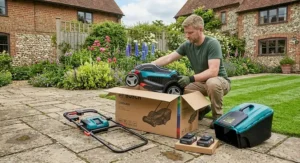
It has a 34cm cutting width and a rear roller, with seven cutting heights adjustable via a single lever on the deck. What most buyers overlook about this model is that assembly is unusually painless — very little is required beyond clipping the handle together and fixing the grass collector, which matters more than people expect when you’re setting up a new mower on a Saturday morning and just want to get outside.
It’s on the heavier side and can be harder to lift and carry than some rivals in its class, though testers found it well-balanced once running, and it handles long grass and collection duties competently. That added heft is precisely why the stripes hold up so well — weight bearing down on the roller is doing real mechanical work, not just sitting there for show. This is the pick for someone who has read every “how to stripe a lawn” article and simply wants the machine that a professional reviewer has already vetted for that exact purpose.
Pros:
- ✅ Rated Best Buy specifically for stripe quality by BBC Gardeners’ World
- ✅ Seven cutting heights via one simple lever
- ✅ Genuinely straightforward to assemble out of the box
Cons:
- ❌ Heavier than some rivals, less easy to lift and carry
- ❌ 34cm width means more passes on larger plots
Priced around the £110-£150 mark, the GTRM34 earns its reputation rather than borrowing it, and it’s hard to argue with independently verified test results.
3. LawnMaster 1600W (37cm) — the sweet spot for mid-size gardens
If the Webb Supreme is the sensible starter mower, the LawnMaster 1600W is where things get serious without tipping into premium pricing.
Its 37cm steel deck and 1600W motor handle plots up to roughly 400m² without visible strain, and the mulching plug lets you skip the collection box entirely on a quick maintenance mow, feeding chopped clippings back into the soil as free fertiliser. Here’s what to weigh: the steel deck adds a bit of heft compared with plastic-decked rivals, but that weight translates directly into more defined, longer-lasting stripes from the rear roller — a genuine case of a “downside” doubling as an upside depending on what you value.
Owner feedback aggregated across retailer reviews frequently mentions the mower “outlasting” cheaper plastic-decked alternatives, a claim that tracks with the material difference. The two-year guarantee is respectable rather than outstanding, and buyers should note this isn’t a machine built for postage-stamp lawns — it’s happiest with genuine square footage to cover.
Pros:
- ✅ Steel deck built to outlast plastic-decked rivals
- ✅ Mulching plug saves emptying the box on quick cuts
- ✅ 1600W motor comfortably handles mid-size, mixed grass
Cons:
- ❌ Heavier steel deck less nimble in tight, obstacle-heavy gardens
- ❌ Two-year guarantee shorter than some rivals here
Expect to pay somewhere in the £150-£190 range, positioning it as genuinely mid-market rather than a budget mower wearing a premium price tag.
4. Hyundai HYM3800E — best value with a reassuring warranty
The Hyundai HYM3800E carries a commendable overall rating among owners and pairs a well-rounded feature set with genuine value for money.
Cutting heights adjust from 20mm to 70mm, giving real flexibility for both a close domestic cut and a longer, healthier length recommended for drought resistance, while the 40-litre collection box reduces how often you need to stop and empty it mid-mow. What the spec sheet won’t tell you outright is how much that three-year warranty changes the value equation: most rivals at this price point offer two years, so Hyundai is effectively betting on its own reliability, which is a reasonable signal of build confidence.
The mulching function lets clippings be recycled straight back onto the lawn rather than relying solely on the collection box, appealing to anyone wanting a lower-maintenance routine. At around 12.5kg, it’s on the heavier side for its class, which some owners flag as a minor annoyance when carrying it up steps or into storage, but that same weight is quietly doing favours for stripe definition via the rear roller.
Pros:
- ✅ Three-year warranty, longer than most rivals at this price
- ✅ 40-litre box and mulching option cut down maintenance faff
- ✅ Wide 20-70mm cutting height range suits multiple lawn styles
Cons:
- ❌ At 12.5kg, noticeably heavier to carry than budget rivals
- ❌ Plastic chassis feels less premium than steel-decked competitors
Priced typically around £109-£150, the HYM3800E is arguably the best all-round value pick on this list for anyone who wants a “buy once” mower without stretching to premium pricing.
5. Webb Classic WEER37RR — the British-brand reliability play
Webb has built a cottage-industry reputation on unfussy, well-made rotary mowers, and the Classic 37cm rear-roller model is where that reputation is most visible.
The 1600W motor and 37cm deck sit in familiar mid-range territory, but the six-position height adjustment (25-75mm) and a genuinely long 15-metre cable set it apart from rivals that skimp on reach. Based on the spec comparison, the extended cable length matters more than it sounds: a mower that can’t reach the far end of the garden without an extension lead is a mower that gets used less often, and less frequent mowing is the single biggest enemy of crisp lawn stripes.
Reviewers consistently note Webb’s after-sales support and UK-based customer service as a differentiator versus continental European brands, and the three-year guarantee reinforces that positioning. This is the machine for someone who values a company answering the phone over the absolute cheapest sticker price, and who appreciates a manufacturer that still designs specifically around the British obsession with stripes.
Pros:
- ✅ 15-metre cable reaches further than most rivals without an extension
- ✅ Six-position height adjustment, 25-75mm range
- ✅ Three-year guarantee with UK-based customer service
Cons:
- ❌ At 10.8kg it’s heavier than the entry-level Webb Supreme
- ❌ No cordless variant if you later want to ditch the cable
At roughly £140-£180, it sits just above the Hyundai and LawnMaster, justified mainly by cable length and brand-backed support rather than raw cutting performance.
6. Bosch AdvancedRotak 650 — the premium corded benchmark
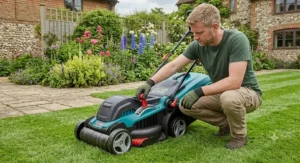
The only corded mower on many comparison lists with a real rear roller capable of the kind of sharp stripes usually associated with petrol machines, the Bosch AdvancedRotak 650 is where “premium” actually shows up in the cut quality, not just the price sticker.
This Bosch model has a 1,700W motor and roughly a 40-45cm cutting blade width, comfortably suited to gardens well beyond 150m², with seven cutting heights adjustable via a single button on top of the deck, and a telescopic handle you adjust by squeezing a bar. What most buyers overlook is that the ergonomic handle adjustment isn’t a gimmick — over a season of regular mowing, not having to bend awkwardly to change height settings genuinely reduces the “I’ll do it tomorrow” temptation that kills striping consistency.
If your lawn is small, close to a power socket, and stripes are non-negotiable, this sits in a different class altogether from budget corded rivals. The trade-off is obvious: you’re paying roughly double or triple the entry-level machines here for incremental gains in finish quality and comfort, which only makes sense if you mow often enough, and care enough about the result, to notice the difference.
Pros:
- ✅ 1,700W motor and wide deck handle larger, tougher lawns
- ✅ Seven cutting heights via a single push-button adjustment
- ✅ Telescopic handle adjusts for comfort during long sessions
Cons:
- ❌ Mid-£300s price is a significant step up from mid-range rivals
- ❌ Overkill for small lawns under 150m²
This is the mower for someone who has already tried a budget roller model, loved the stripes, and wants the best corded execution of the same idea — check current price before buying, as Bosch pricing can shift between retailers.
7. Mountfield Princess 34 — best for uneven or bumpy lawns
Not every British lawn is billiard-table flat, and that’s where the Mountfield Princess 34’s unusual four-wheel-plus-roller configuration earns its place on this list.
Unlike dedicated-roller mowers that rely entirely on the roller for both support and striping, the Princess 34 runs on four wheels with an additional rear roller doing the striping work, at 1600W and 34cm cutting width. Here’s the honest trade-off worth understanding: a mower with both rear wheels and a spring-loaded rear roller generally produces a slightly less crisp stripe than a dedicated-roller design, because the weight isn’t concentrated entirely on the roller itself. What that sacrifice buys you, in return, is meaningfully better stability and control across bumps, molehills and uneven turf where a wheel-free roller mower can feel twitchy.
This is a sensible pick for anyone whose lawn has genuine undulations rather than a flat, manicured surface, and who’s willing to trade a small amount of stripe definition for a machine that won’t tip or snag on rough ground. It’s a lesser-discussed but genuinely useful alternative to the more common dedicated-roller format dominating this list.
Pros:
- ✅ Four-wheel design adds real stability on bumpy lawns
- ✅ Still delivers a visible striped finish via rear roller
- ✅ 1600W motor comfortable with mixed grass conditions
Cons:
- ❌ Stripes are typically less crisp than dedicated-roller rivals
- ❌ Extra wheels add weight without adding cutting width
Priced around £150-£200, it’s a niche but valuable pick for gardens where “flat and even” simply isn’t an accurate description.
How to Choose the Best Striped Lawn Mower Electric
What is the best striped lawn mower electric? In short: the model with a dedicated, full-width rear roller and enough weight to keep it pressed firmly against the turf as you mow, matched to your lawn’s actual size and terrain.
Working through that decision properly means running through a short mental checklist rather than just picking the biggest number on the box:
- Measure your lawn honestly. Anything under 150m² rarely needs more than 1200-1400W; going bigger just adds unnecessary weight to lug around.
- Check for a dedicated roller, not a spring-loaded afterthought. A full-width roller with no interrupting wheels produces noticeably crisper stripes.
- Weigh up cable length versus cordless convenience. A cable that doesn’t reach the whole garden gets used less often, and inconsistent mowing kills stripe quality faster than any spec difference.
- Prioritise mulching if you hate emptying boxes. It’s a genuine time-saver on quick, regular cuts, not just a marketing tick-box.
- Match cutting height range to your grass type. Wider adjustment ranges (20-80mm) cope better with seasonal growth spurts.
- Factor in storage space. Heavier, wider-decked mowers need more shed room than compact 33cm models.
- Read the warranty as a confidence signal. Three-year cover, as offered by Hyundai and Webb here, often correlates with genuine build confidence rather than just marketing.
For a second opinion beyond this guide, Which?’s independent lab testing of electric lawn mowers evaluates cutting performance, clipping collection and ease of use across dozens of models each year, and it’s worth cross-referencing before any final purchase, particularly for models not covered here.
Getting Perfect Rear Roller Stripes: A Practical Usage Guide
Buying the right machine is only half the job. The other half is technique, and this is the part most Amazon listings skip entirely.
Start by setting your cutting height slightly higher than you’d instinctively choose — ideally don’t remove more than a third of the grass height in any single cut, since scalping the lawn actually weakens the stripe effect rather than sharpening it. Mow in straight, overlapping passes, working up and down rather than in circles, and slightly overlap each row so you don’t leave thin unstriped seams. When you reach the end of a row, lift the mower slightly before turning to avoid scuffing a visible turning mark into the fresh stripe.
For lawn aesthetics that actually last through the week rather than fading by Wednesday, weight and consistency both matter more than any single spec. Double-cutting — going back over the same stripes a second time without the blade engaged, purely to press the roller down again — genuinely intensifies definition, particularly on lighter mowers like the Webb Supreme. Vary your direction of cut regularly, alternating straight lines with diagonals, since mowing the same direction repeatedly can create ruts that undermine the flat, even surface stripes depend on.
Keep blades clean and genuinely sharp, since blunt blades tear rather than cut grass, which looks unsightly and stresses the plant — for full guidance on blade care and seasonal timing, the RHS’s step-by-step mowing guide is worth bookmarking. In the first month with a new machine, the most common mistake is mowing too infrequently while waiting for “the right weather” — consistency beats perfection here every time.
✨ Ready to start your own stripe transformation? Compare current stock on the models above and pick the one that matches your lawn size.
Real-World Scenarios: Matching Mowers to Gardens
Rather than abstract advice, here are three realistic profiles matched against the lineup above, with reasoning attached.
The first-time buyer with a small front lawn (under 100m², no strong opinions on mulching): The Webb Supreme WEER33RR is the sensible starting point. It’s light enough that mowing doesn’t feel like a chore, cheap enough that a wrong decision doesn’t sting, and the roller does genuine work despite the modest price.
The family with a 300m² rear garden, kids, a trampoline, and roughly weekly mowing habits: The Hyundai HYM3800E or LawnMaster 1600W both fit well here. The wider cutting width reduces total mowing time on a busier schedule, and the mulching option means less time spent emptying boxes between school runs.
The lawn-proud enthusiast with a larger, well-maintained plot who mows twice weekly in growing season: The Bosch AdvancedRotak 650 earns its premium price here. Frequent mowers notice ergonomic differences — the telescopic handle and button-adjust heights — far more than occasional users, and the wider deck cuts total time spent per session.
Problem to Solution: Fixing Common Striping Issues
Even with the right mower, stripes can go wrong. Here’s how to troubleshoot the most common complaints.
Problem: stripes look patchy or inconsistent. This is almost always a technique issue rather than a mower fault — check you’re overlapping each pass fully and mowing in genuinely straight lines rather than gentle curves.
Problem: stripes disappear within a day or two. Usually caused by cutting too short, or using too light a mower without double-cutting. Raise the cutting height and consider a second, blade-off pass over freshly striped areas.
Problem: the mower leaves scalped bald patches on bumps. Without exception, this points to the value of the roller beyond stripes: it bridges the ups and downs of uneven ground, preventing the mower from scalping the high points, whereas a wheeled mower without a roller drops into dips and scalps the raised areas instead. A dedicated-roller model, or the four-wheel Mountfield for genuinely bumpy lawns, solves this directly.
Problem: ruts forming where you always turn the mower. Vary the direction of your stripes regularly — alternating straight and diagonal patterns — to avoid repeatedly compacting the same lines.
Problem: box fills too fast, interrupting the rhythm of mowing. Switch to mulching mode on models like the Hyundai or LawnMaster where fitted, or simply raise the cutting height slightly to reduce clipping volume per pass.
Common Mistakes When Buying an Electric Mower With Rear Roller
The single most common mistake is buying based on wattage alone. A 1700W motor sounds objectively better than a 1200W one, but if your lawn is 80m² and flat, that extra power is dead weight you’ll be lifting in and out of the shed for no practical benefit.
The second mistake is ignoring cable length until after the mower arrives. A 10-metre cable that doesn’t reach the back fence means either an extension lead purchase you didn’t budget for, or worse, mowing habits that quietly shrink to “only the bits I can reach easily” — which is how gardens end up with half-striped, half-neglected lawns.
The third mistake is assuming all rollers are equal. A dedicated rear roller running the full width of the mower, with no interrupting wheels, produces better and longer-lasting stripes than a spring-loaded roller shared with rear wheels, because the entire weight of the machine presses down through the roller rather than being split across additional contact points. Reviewers rarely spell this distinction out clearly on retail listings, so it’s worth checking product images closely before buying.
Finally, buyers frequently overlook grass box capacity relative to mowing frequency. A 30-litre box on a fortnightly-mowed 300m² lawn means multiple stops per session — annoying enough to actively discourage regular mowing, which, as covered above, is the real enemy of consistent stripes.
Electric Lawn Mower for Stripes vs Cordless Alternatives
An electric lawn mower for stripes, in the corded sense used throughout this guide, isn’t the only route to a striped finish — cordless battery mowers increasingly offer roller variants too, and the comparison is worth having honestly.
In general, electric corded mowers can be too light on their own to bend grass into a long-lasting striped pattern, while cordless mowers, despite not being as heavy as petrol machines, are typically heavier than corded equivalents purely because of the battery — which can actually work in cordless models’ favour for stripe longevity. Where corded machines win decisively is unlimited runtime and lower upfront cost; there’s no battery to degrade over years of use, and no anxiety about running out of charge halfway across a large lawn.
Cordless mowers do offer real freedom of movement without cable hassle, and battery technology has improved runtime significantly over recent years, but that convenience carries a price premium and an eventual battery-replacement cost that corded buyers never face. For most UK gardens under 300-400m² within reach of an outdoor socket, a corded rear-roller mower like several on this list remains the simpler, cheaper route to the same striped result — cordless earns its premium mainly for larger plots or gardens with awkward socket access.
What to Expect: Real-World Striping Performance
Specification sheets rarely translate the actual experience of pushing one of these machines across a real lawn, so here’s the honest, everyday version.
On a well-maintained, reasonably flat 150-250m² lawn, expect a genuinely visible striped finish from any mower on this list within a single mowing session, provided technique is reasonable. The difference between budget and premium models shows up less in “does it stripe at all” and more in longevity of that stripe through a windy afternoon or a light shower, and in comfort across a 20-30 minute mowing session. Heavier machines like the LawnMaster or Bosch hold their stripe pattern noticeably longer after mowing than the lightest options, purely through weight bearing down on the roller.
First-time users of rear-roller mowers often report a short adjustment period getting turns and overlaps consistent — it’s a good idea to vary the direction of cut regularly once you’re comfortable, both for lawn health and to keep the pattern visually interesting rather than monotonous. By the second or third mow, most people find the technique becomes near-automatic.
Bosch Rotak Roller Technology Explained
The Bosch Rotak roller deserves its own explanation, since the naming causes genuine confusion — Rotak is Bosch’s entire rotary mower range name, not a single roller mechanism, and roller availability varies by specific model within that range.
One notable point that has caused confusion among buyers is that cordless Bosch lawnmowers purchased with battery and charger include a rear roller as standard, according to Bosch’s own customer support, whereas some corded entry-level Rotak models are sold without one. This means checking the exact model number, rather than assuming “Rotak” automatically implies a striping roller, is essential before purchase.
Where the Bosch roller genuinely differentiates itself from cheaper rivals is construction quality: the roller bearings on premium models like the AdvancedRotak 650 are built for longer service life under frequent use, whereas budget rollers on some rival brands can develop play or wobble after a season or two of heavy use, according to aggregated owner reports. For anyone specifically shopping the Bosch range for striping purposes, confirming roller inclusion on the exact model listing — rather than relying on the Rotak name alone — is the single most important checking step.
Long-Term Cost & Maintenance
Corded electric mowers are, refreshingly, one of the cheapest garden tools to run long-term. There’s no fuel, no oil changes, and no spark plugs to replace — just an occasional blade sharpen and a wipe-down after mowing wet grass.
Blade sharpening, whether done at home with basic tools or via a local garden centre service, typically costs very little and should happen once or twice a season depending on use. Cable replacement, should the outer sheath ever get nicked by careless storage, is a minor and infrequent cost across most models here. Roller bearings occasionally need attention after several seasons of heavy use, particularly on budget models, though this is rarely more than an occasional squirt of lubricant.
Compare that to petrol equivalents, where annual servicing, oil, spark plugs and fuel stabiliser add up meaningfully year over year, and the cost-per-use case for corded electric becomes obvious over a five-year ownership period. Even factoring in slightly higher purchase prices for premium models like the Bosch, the total cost of ownership across corded electric mowers here remains modest compared with petrol alternatives doing the same striping job.
Features That Actually Matter (And Those That Don’t)
Marketing copy loves to bury genuinely useful features under a pile of ones that barely affect real-world results. Here’s an honest filter.
Actually matters: roller width relative to deck width (full-width rollers stripe better than partial ones), motor wattage matched sensibly to lawn size rather than maximised regardless of need, cable or battery length that genuinely reaches your whole garden, and box capacity matched to your realistic mowing frequency.
Doesn’t matter much: headline wattage numbers in isolation without considering deck width (a bigger motor on a narrow deck doesn’t cut faster, it just uses more electricity per pass), an excessive number of cutting height positions beyond about six or seven (most people settle into one or two preferred heights within a season anyway), and cosmetic colour-matching to garden furniture, which several listings inexplicably highlight as a selling point.
The genuinely underrated feature across this list is single-lever height adjustment, as found on the Webb and Cobra models — it sounds trivial until you’re crouched adjusting six separate wheel clips on a rival mower every time the grass length changes.
Frequently Asked Questions
❓ Does an electric lawn mower with roller work on any lawn size?
❓ Can I add a roller to a mower that doesn't already have one?
❓ Do rear roller mowers cut grass differently to standard rotary mowers?
❓ How often do I need to mow to keep stripes looking sharp?
❓ Is a heavier mower always better for stripes?
Conclusion
Choosing the right electric lawn mower with roller ultimately comes down to being honest about your lawn size, your patience for maintenance, and how much you genuinely care about stripe crispness versus simply having a tidy, cut lawn. Budget models like the Webb Supreme and Cobra GTRM34 prove that a proper striped finish doesn’t require premium spending, while machines like the Bosch AdvancedRotak 650 justify their higher price through comfort and finish quality for larger, more frequently mown gardens.
The seven mowers covered here span every realistic UK garden scenario, from compact front lawns to bumpy back gardens better suited to the Mountfield’s four-wheel stability. Whichever you land on, remember that technique — consistent mowing, sensible height settings, and varying your direction of cut — matters just as much as the machine itself in producing stripes that actually last through the week rather than fading by Tuesday.
Recommended for You
- Electric Lawn Mower Under £100: 7 Best Budget Picks 2026
- Electric Lawn Mower Guide 2026: 7 Best Corded Models Ranked
- Best Greenworks Cordless Lawn Mower UK 2026: 7 Top Picks Reviewed
Disclaimer: This article contains affiliate links. As an Amazon Associate, I earn from qualifying purchases. If you purchase products through these links, we may earn a small commission at no additional cost to you.
✨ Found this helpful? Share it with your friends! 💬🤗
