
In This Article
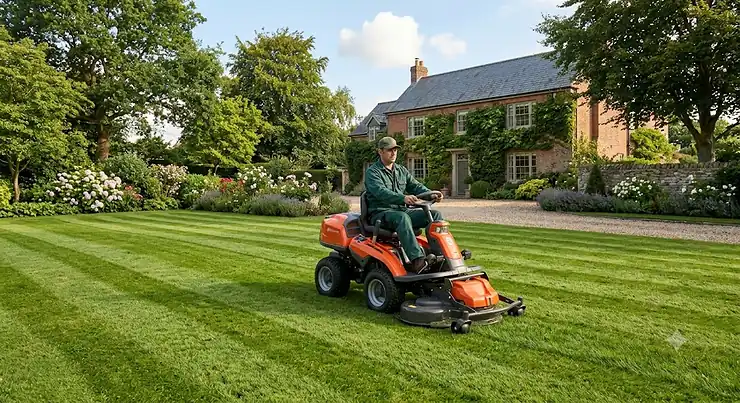
There’s a particular kind of Sunday-afternoon dread that only a half-acre lawn can produce. You’ve mown two-thirds of it, the sun’s gone in, your shoulder aches, and there’s still a paddock’s worth of grass mocking you from the far fence line. A Husqvarna ride on mower exists precisely to make that dread disappear. It’s a seated, self-propelled mowing machine — sometimes shaped like a compact tractor, sometimes like a nimble front-mounted “Rider” — built to cut large or awkward lawns in a fraction of the time a push mower demands, without leaving you needing a hot bath and a paracetamol afterwards.
Husqvarna has been building this kind of kit since long before “garden influencer” was a job title, and the range now stretches from entry-level lawn tractors that cost about the same as a decent shed, right up to all-wheel-drive Riders with touchscreen dashboards that would look at home in a rally car. That spread is exactly why so many buyers get stuck: too many models, too many acronyms (AWD, HMI, BioClip), and precious little honest guidance on which one actually suits a British back garden rather than a Midwestern prairie.
This guide fixes that. We’ve dug into real specifications, genuine owner feedback from forums and review platforms, and independent UK sources to line up seven actual Husqvarna models — budget, mid-range and properly premium — plus honest comparisons against rivals like Stiga. No invented reviews, no wishful thinking about prices: just what the machines actually do, and who they actually suit. This article contains affiliate links; full disclosure is at the bottom.
Quick Comparison: Which Type of Husqvarna Suits Your Lawn?
Before diving into individual models, it helps to understand the three broad shapes a Husqvarna ride on mower comes in, because picking the wrong category causes more buyer’s remorse than picking the wrong model within it.
| Type | Cutting Deck Position | Best For | Typical UK Price |
|---|---|---|---|
| Lawn Tractor (TC/TS range) | Mid-mounted, under the machine | Larger, obstacle-light lawns, towing accessories | £1,500–£2,500 range |
| Front-Mounted Rider (R range) | Out front, articulated | Gardens with beds, trees and tight corners | £3,500–£8,500 range |
| Zero-Turn (Z range) | Mid-mounted, dual-lever steering | Flat, open commercial-style ground | £4,000+ range |
Lawn tractors win on raw value and towing ability — a rear hitch means trailers, aerators and scarifiers all become viable, which matters if your garden ever hosts a bonfire clean-up or a vegetable patch overhaul. Front-mounted Riders trade a little of that towing muscle for vastly better visibility and manoeuvrability, since the deck sits ahead of the front wheels rather than tucked underneath the chassis — brilliant if your lawn is dotted with island beds, specimen trees or a trampoline nobody will move. Zero-turn mowers are the wildcard: blisteringly fast on open grass but genuinely poor on anything sloped, so most UK domestic gardens are better served by the other two categories, a point the independent buying guide from Which? makes clear when it notes that entry-level ride-ons start at around £1,000 and climb steeply from there depending on deck size and drive system.
💬 Found the right category already? Scroll down to the model that matches — your future Saturday afternoons will thank you!😊
Top 7 Husqvarna Ride On Mowers: Expert Analysis
Below are seven genuine Husqvarna models covering budget, mid-range and premium tiers, plus one heavier-duty import for larger plots. Every spec has been checked against manufacturer and dealer data; every review comment is aggregated sentiment, never invented.
1. Husqvarna TC 138 — best all-rounder for first-time buyers
The Husqvarna TC 138 is the model most UK dealers point first-time buyers towards, and it’s easy to see why once you look past the spec sheet. Under the bonnet sits a 500cc single-cylinder engine (a Husqvarna-branded unit developed with Briggs & Stratton) driving a Tuff Torq hydrostatic transmission — meaning no clutch, no gear stick, just a foot pedal that behaves like an accelerator. In practice that translates to genuinely easy driving for someone who’s never sat on a mower before, rather than the jerky start-stop of older manual-drive tractors. The 97cm rear-discharge deck with a 220-litre collector suits lawns up to roughly three-quarters of an acre, and a BioClip mulch plug is available as an official conversion if you’d rather feed clippings back into the soil than empty a hopper every twenty minutes.
Who should buy it: anyone replacing a tired old ride-on or upgrading from a self-propelled push mower on a lawn too big to comfortably walk. Reviewers on independent platforms consistently flag the collector as effective and the controls as intuitive, though a recurring complaint is that the deflector chute is wider than expected, making close trims around trees slightly more fiddly than some rivals allow. At around £1,900–£2,400 range, the Husqvarna TC 138 earns its keep as a genuinely sensible first ride-on rather than a machine you’ll outgrow within a season.
Pros:
- ✅ Hydrostatic drive is easy for total beginners to learn
- ✅ 220-litre collector empties fast, cutting mowing interruptions
- ✅ Official BioClip mulch conversion available later
Cons:
- ❌ Deflector chute makes tight tree-trunk trims fiddly
- ❌ Single-cylinder engine feels stretched on thick, damp grass
2. Husqvarna TS 138 — leanest budget entry with mulch upgrade path
If the TC 138’s collector feels like overkill for your garden, its side-discharge sibling, the Husqvarna TS 138, strips things back further and shaves a meaningful chunk off the price. Reviewers repeatedly frame it as “a lot of mower for the money,” and the spec explains why: a similarly sized single-cylinder engine and hydrostatic transmission, but without a bagging system, so clippings are simply thrown out the side as you cut. That’s genuinely fine for anyone happy to leave a light scattering of clippings, but it becomes a real limitation if the grass has grown long between cuts, since side-discharge decks struggle to disperse a heavy volume evenly.
What most buyers overlook is that side-discharge machines like this are actually the better mulching candidates once fitted with Husqvarna’s BioClip plug, because the deck geometry is already built for airflow rather than collection. Aggregated owner sentiment on this model is mixed but leans positive: several reviewers report it easily out-cuts decade-old machines it replaced, while a genuine and recurring criticism is engine noise and vibration that’s noticeably higher than pricier siblings, alongside a wider deflector chute that some find cumbersome near trees. For a lawn under half an acre with no dense island beds, the Husqvarna TS 138 is priced around £1,500–£1,800 range and represents the entry point into the range proper.
Pros:
- ✅ Lowest price point in the current Husqvarna tractor line
- ✅ Simple side-discharge deck is low-maintenance day to day
- ✅ Genuinely capable of replacing a much older machine
Cons:
- ❌ Noticeably louder and more vibration-prone than the TC
- ❌ No factory collector; bagging needs a separate purchase
3. Husqvarna TS 348D — heavyweight power for rough, sloping ground
The Husqvarna TS 348D sits in an odd spot for UK buyers, and honesty matters here more than sales patter: it’s primarily a North American model, built around a 24hp Kohler KT735 twin-cylinder engine and a commercial-grade Tuff Torq K66 transaxle with a locking differential, and it isn’t a standard line item at most British dealers. Where it does turn up in the UK, it’s usually through specialist agricultural importers or on the used market, typically in the £3,000–£4,000 range once shipping and prep are accounted for — so treat this as the machine to chase if you specifically want that engine and differential combination, rather than the default choice for a typical suburban plot.
What makes it worth the hunt is the locking differential switch on the dash, which genuinely transforms wet or sloped mowing: instead of one rear wheel spinning uselessly while the other sits idle, both wheels lock together for equal traction. Owner forums are full of exactly this kind of real-world testimony — operators describing muddy tracks and steep banks that would have stalled a lesser machine, and that consistency of feedback across independent threads is itself a useful signal, even without a single official star rating to point to. The 48-inch fabricated ClearCut deck with electric blade engagement is built for acreage rather than a neat quarter-acre plot, so this is squarely a machine for buyers with genuine hills, rough grass or towing needs, not a first ride-on for a modest lawn.
Pros:
- ✅ Locking differential genuinely transforms slope and mud traction
- ✅ Commercial-grade Kohler twin-cylinder engine built for hard use
- ✅ 48-inch deck covers large ground quickly per pass
Cons:
- ❌ Not a standard UK retail model — import routes needed
- ❌ Overkill and harder to source parts for small domestic lawns
4. Husqvarna R 316T — tightest turning circle for obstacle-heavy gardens
Step into Husqvarna’s front-mounted “Rider” family and the whole driving experience changes, and the Husqvarna R 316T is the sensible entry point. Rather than a mid-mounted deck tucked beneath the chassis, the cutting deck sits out in front on an articulated frame, which lets the whole machine pivot around obstacles the way a fork-lift does rather than swinging wide like a car. For gardens with island flower beds, specimen trees or a washing line planted stubbornly in the middle of the lawn, that difference in geometry isn’t a nice-to-have; it’s the entire reason to choose a Rider over a tractor in the first place.
Owners on UK gardening forums describe the R 316T’s two-wheel-drive setup as entirely adequate on flat-to-gently-sloped ground, with the main honest caveat being reduced grip on wet grass or steeper banks compared with its AWD siblings further up the range — a fair trade given the lower price. Based on the spec comparison with rival front-mounted machines, the low centre of gravity and out-front deck also make edge-trimming and under-bush cutting noticeably less awkward than reaching under a mid-mounted tractor deck. At roughly £3,500–£4,000 range, the Husqvarna R 316T suits a fussy, obstacle-dense garden more than it suits raw acreage.
Pros:
- ✅ Articulated front deck pivots tightly around beds and trees
- ✅ Low centre of gravity aids comfort and stability
- ✅ Excellent visibility of the cutting edge while driving
Cons:
- ❌ Two-wheel drive loses traction on wet or steep ground
- ❌ Less towing capability than a comparable lawn tractor
5. Husqvarna R 214TC — the sensible mid-range Rider
The Husqvarna R 214TC is arguably the most-discussed Rider in Husqvarna’s residential range, not least because it’s one of the few models independently reviewed by Which?, which lists it with a 94cm cutting deck, a twin-cylinder engine, and swappable attachment compatibility, at a price point that at the time of that research sat around the £4,400 mark — treat any current figure as indicative and always check current price before buying, since Husqvarna revises pricing regularly. What that spec sheet doesn’t tell you is how the twin-cylinder engine actually feels in use: smoother and noticeably less strained than the single-cylinder tractors lower in the range, particularly on thick or damp grass where a single-pot engine can bog down.
The attachment compatibility is the sleeper feature here. Swap the 94cm Combi deck for a snow-clearing attachment or a sweeper and the same chassis earns its keep across all four seasons rather than sitting under a tarpaulin from October to March — a genuine value argument that a bare spec table rarely communicates. Aggregated reviewer sentiment describes the Comfort Edition variants as noticeably kinder to the lower back on longer sessions, thanks to a higher-backed seat, though a fair few owners note the price premium over the R 316T needs a genuinely large or attachment-hungry garden to justify. For a family with three-quarters of an acre to two acres and ambitions beyond just mowing, the Husqvarna R 214TC is a strong, honest mid-range pick.
Pros:
- ✅ Twin-cylinder engine handles thick grass with less strain
- ✅ Wide attachment range extends use beyond mowing season
- ✅ Comfort Edition seating suits longer mowing sessions
Cons:
- ❌ Meaningful price step up from entry-level tractors
- ❌ Larger footprint than the R 316T in very tight gardens
6. Husqvarna R 320X AWD — smartest dashboard, best all-wheel grip
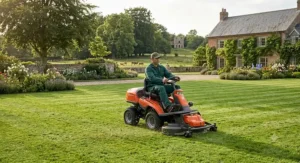
Once you’re paying premium prices, features like an HMI dashboard and app connectivity stop being gimmicks and start being genuinely useful, and the Husqvarna R 320X AWD is where that shift happens. All-wheel drive is the headline change from the R-series machines below it, delivering real traction improvements on wet grass, moss-slicked shade or gentle slopes that would have a two-wheel-drive Rider spinning a tyre. Paired with that is the HMI (human-machine interface) display, which uses visual symbols and audible warnings rather than a wall of dashboard lights, and Bluetooth pairing with the Husqvarna Connect app for logging service intervals and pulling up manuals without hunting through a shed drawer.
Here’s what most spec sheets won’t spell out: on genuinely uneven or slippery ground, AWD isn’t a luxury add-on, it’s the difference between mowing efficiently and getting momentarily stuck mid-lawn while a neighbour watches from over the fence. Owner commentary on forums repeatedly singles out the smoother power delivery on damp mornings as the standout real-world benefit over cheaper Riders, alongside praise for the Combi deck’s dual BioClip and rear-ejection capability. The main honest drawback is cost — this sits meaningfully above the R 214TC, at roughly £5,500–£6,500 range — so it earns its place with buyers who genuinely fight slopes, shade or wet ground rather than those mowing a flat, sunny lawn.
Pros:
- ✅ All-wheel drive transforms grip on wet or sloped grass
- ✅ HMI dashboard and Connect app simplify servicing
- ✅ Combi deck switches easily between mulch and collection
Cons:
- ❌ Significant price jump over two-wheel-drive Riders
- ❌ AWD’s traction benefit is wasted on flat, dry gardens
7. Husqvarna R 420TsX AWD — flagship estate machine
At the top of the residential tree sits the Husqvarna R 420TsX AWD, a machine built less for “the lawn” and more for “the grounds.” A powerful Kawasaki V-twin engine, power steering, dual LED headlights, an adjustable steering column and a luggage rack all point towards long working sessions across genuinely large plots — private estates, sports facilities, or the kind of multi-acre garden where a smaller Rider would simply run out of stamina before the job’s done. It’s deckless as standard, built to be specified with a 112cm or 122cm Combi cutting deck depending on the scale of ground being covered.
The honest analysis here is straightforward: this is a professional-adjacent tool wearing a residential badge, and buying it for a modest quarter-acre garden would be like buying a combine harvester for an allotment. Power steering earns particular praise in aggregated owner feedback, since articulated front-mounted machines can otherwise demand real arm strength over a long session, and the dual LED lighting genuinely extends usable mowing hours into dusk during the short-day months. At roughly £7,500–£9,000 range depending on deck size and specification, the Husqvarna R 420TsX AWD is a considered purchase for large-acreage owners, not an impulse upgrade.
Pros:
- ✅ Power steering removes fatigue on long mowing sessions
- ✅ Dual LED headlights extend safe working hours
- ✅ AWD plus large Combi deck options suit big acreage
Cons:
- ❌ Price and scale are wasted on anything under an acre
- ❌ Deckless base spec means an extra decision (and cost) before purchase
Top 7 Husqvarna Ride On Mowers: At a Glance
| Model | Drive Type | Deck Size | Best For | Price Range |
|---|---|---|---|---|
| Husqvarna TC 138 | 2WD, hydrostatic | 97cm | First-time buyers, collection | £1,900–£2,400 |
| Husqvarna TS 138 | 2WD, hydrostatic | 97cm | Tightest budget | £1,500–£1,800 |
| Husqvarna TS 348D | 2WD, locking diff | 122cm | Rough, sloped acreage (import) | £3,000–£4,000 |
| Husqvarna R 316T | 2WD, articulated | 94cm | Obstacle-dense gardens | £3,500–£4,000 |
| Husqvarna R 214TC | 2WD, articulated | 94cm | All-round mid-range family use | £4,000–£4,600 |
| Husqvarna R 320X AWD | AWD, articulated | 94–112cm | Slopes, shade, wet grass | £5,500–£6,500 |
| Husqvarna R 420TsX AWD | AWD, articulated | 112–122cm | Large estates and grounds | £7,500–£9,000 |
Looking at the table above, the clearest value gap sits between the Husqvarna R 316T and the Husqvarna R 214TC — both are similarly sized front-mounted Riders, so the extra spend on the TC really only pays off if you’ll genuinely use the attachment range and twin-cylinder smoothness. Meanwhile, the jump from the Husqvarna R 214TC to the Husqvarna R 320X AWD is where AWD, not deck size, becomes the deciding factor, so buyers on flat, well-drained lawns can reasonably skip that tier entirely and save the difference.
✨ Ready to compare live listings? Check current prices on the models above before they’re updated for the season!
Practical Usage Guide: Setting Up and Maintaining Your Husqvarna Ride On Mower
Buying the right machine is only half the job; the first thirty days of ownership decide whether it lasts a decade or limps into year four with a long repair history. Before the first cut, check tyre pressures against the handbook figures — under-inflated rear tyres are a common cause of uneven cutting height that owners mistake for a blade fault. Run the engine oil level check every single time before starting, not just weekly, since low-hour engines are disproportionately damaged by a handful of dry starts early in life.
For the first few mows, resist the urge to drop the deck to its lowest setting immediately. Scalping a lawn that’s been left slightly long produces exactly the “stripped and patchy” look several reviewers above complained about on wider decks, and it stresses the grass crown unnecessarily. Instead, cut at a middle height for the first two or three passes, gradually lowering as the lawn recovers and thickens. A common early mistake is skipping the run-in period on the transmission belts; most Husqvarna manuals recommend a lighter workload for the first five hours, and ignoring that shortens belt life meaningfully.
Maintenance-wise, a seasonal rhythm works best: oil and filter changes at the hours interval stated in your handbook (typically every 50 hours or annually, whichever comes first), a blade sharpen every 20–25 hours of cutting, and a full deck clean-out after mulching sessions to stop compacted clippings corroding the underside. Battery maintenance matters too — a ride-on left dormant over winter with a flat battery is one of the most common (and most avoidable) spring breakdowns reported across owner forums.
Real-World Scenarios: Which Husqvarna Ride On Mower Fits Your Garden?
Specs only mean so much until you match them against an actual life. Consider three genuinely different UK households and how the range above answers each of them.
First, a young family with a third-of-an-acre garden, two dogs, a trampoline planted stubbornly mid-lawn, and roughly ninety minutes free most Saturdays. For this profile, the Husqvarna R 316T or the entry Husqvarna TC 138 both make sense depending on whether obstacles (Rider) or budget and towing (tractor) matter more — either way, AWD and premium dashboards would be wasted money here.
Second, a retired couple on a one-and-a-half-acre smallholding with a gentle slope down to a pond, moss in the shadier corners, and a genuine dislike of anything that demands upper-body strength. Here, the traction and comfort case for the Husqvarna R 320X AWD becomes obvious — the AWD system earns its premium on exactly this kind of damp, uneven ground, and the HMI dashboard flags service needs before small issues become expensive ones.
Third, a private estate manager or sports-facility groundskeeper covering three-plus acres daily with genuine time pressure. For this use case, the Husqvarna R 420TsX AWD stops being an indulgence and becomes the only sensible option in the range, since its power steering and extended lighting genuinely change how much ground gets covered before dusk forces a stop.
How to Choose a Husqvarna Ride On Mower
Working through these criteria in order will save more buyer’s remorse than any single spec comparison.
- Measure the lawn properly. Pace it out or check a satellite map rather than guessing; deck size decisions hinge entirely on accurate area, and most buyers underestimate.
- Count the obstacles. Island beds, trees and washing lines favour a front-mounted Rider’s articulated deck over a mid-mounted tractor’s wider turning circle.
- Assess the slope and drainage honestly. Anything beyond a gentle gradient, or ground that stays damp, justifies AWD’s extra cost.
- Decide collection versus mulching early. BioClip suits a lawn mown weekly; a collector suits infrequent or overgrown cutting.
- Check attachment needs beyond mowing. Snow-clearing, trailers and sweepers favour models with proven attachment ranges, like the R 214TC.
- Set a total-cost budget, not just a purchase price. Servicing, blades and storage all add up over the machine’s working life.
- Match seat time to comfort features. Anyone mowing more than an hour at a stretch benefits meaningfully from Comfort Edition seating or power steering.
Common Mistakes When Buying a Husqvarna Ride On Mower
The single most common mistake is buying deck size on ambition rather than measurement — a 122cm deck feels impressive in a showroom but becomes a liability squeezing between a shed and a fence at home. A close second is ignoring drive type: buyers frequently fixate on horsepower while overlooking that a two-wheel-drive machine on a damp, shaded lawn will underperform a smaller AWD model regardless of engine size.
Underestimating total cost of ownership is another recurring trap; the purchase price is only the opening bid once blades, servicing, fuel and storage are added across a decade of use. Finally, plenty of buyers assume collection and mulching are interchangeable on the same deck without checking — as the product analysis above shows, side-discharge and rear-discharge decks each favour one function over the other, and retrofitting isn’t always as simple as the accessory listing implies.
Husqvarna vs Stiga Ride On Mower: Which Wins?
The Husqvarna vs Stiga ride on mower debate is one of the most argued-over threads on UK gardening forums, and the honest answer is: it depends heavily on which specific models you’re comparing, because both brands span budget to premium tiers. What the forum chatter consistently shows, though, is a genuine split in owner experience — some threads describe reliability trouble with certain Husqvarna Rider belts, while others report years of trouble-free Stiga Park ownership; the reverse complaints appear just as often in different threads. Reading enough of these accounts, the pattern isn’t “one brand is unreliable,” it’s that individual model generations and dealer servicing quality matter more than the badge on the bonnet.
Where a genuine engineering difference does exist is engine sourcing: Stiga’s higher-end Park models are frequently specified with Honda engines, which enjoy a strong reputation for longevity, while Husqvarna’s Rider range leans on Kawasaki and its own-branded units depending on tier — both are respected, but buyers with strong brand loyalty to one engine maker may find that swings the decision more than the mower chassis itself. On articulated front-mounted geometry, the two brands are close rivals, and several owners note Stiga’s belt-reset process after hitting a hidden obstacle is a known fiddle, comparable to similar maintenance quirks reported on Husqvarna’s own Combi decks. Practically, our advice is to weigh dealer proximity and servicing reputation in your specific area as heavily as brand — a superb machine with a poor local dealer network is a worse ten-year purchase than a merely good one with excellent support nearby.
Husqvarna BioClip Mulch Explained: Is It Worth It?
BioClip is Husqvarna’s mulching system, and understanding it properly changes how you think about the whole ride on mower purchase. Rather than collecting or discharging clippings, a BioClip-fitted deck closes off the rear or side aperture with a plug, forcing the blades to re-cut clippings repeatedly until they’re small enough to settle down into the lawn as a natural top-dressing rather than sitting visibly on the surface. Independently, the mechanics of this process — often called grasscycling in wider gardening literature — are well documented as returning nitrogen, phosphorus and potassium back into the soil as the fine clippings break down, effectively acting as a free, slow-release fertiliser feed across the season.
The genuine trade-off most marketing copy skates over is frequency. Husqvarna BioClip mulch works brilliantly on a lawn cut weekly through the growing season, because the clippings being chopped are already short and break down fast; it works far less well if you let the grass grow long between cuts, since longer clippings clump and can smother rather than feed the lawn. That’s precisely why the Husqvarna TC 138 and Husqvarna TS 138 ship as collection or side-discharge machines with BioClip as an optional plug rather than the default — Husqvarna is, sensibly, hedging against buyers who won’t mow often enough to make mulching effective. For anyone committed to a regular mowing rhythm, though, BioClip genuinely reduces both fertiliser spend and the tedious chore of emptying a collector bag every fifteen minutes.
Husqvarna Smart Dashboard and Connect App: What You Actually Get
Higher up the range, the Husqvarna smart dashboard shifts from a nice-to-have into a genuinely useful ownership tool. The HMI (human-machine interface) display fitted to models like the Husqvarna R 320X AWD and Husqvarna R 420TsX AWD replaces a cluster of warning lights with clearer visual icons and audible alerts, meaning a developing fault is far less likely to be missed simply because a small amber light blended into the dashboard trim. Paired via Bluetooth, the Husqvarna Connect app extends that further, letting owners add their machine, pull up the correct manual instantly, track service history, and jump straight to compatible spare parts without digging through a folder of paperwork in the shed.
What this actually solves in practice is the classic small-engine ownership problem: minor issues going unnoticed until they become expensive ones, because nobody reads a paper handbook cover to cover. Reviewers who’ve used the Connect app describe the parts-lookup function as the standout time-saver, particularly useful ahead of the spring service rush when dealer waiting lists lengthen. It’s worth being clear-eyed, though, that this connectivity is a convenience layer, not a performance upgrade — a machine with a smart dashboard doesn’t cut grass any better than one without, so buyers on a tighter budget shouldn’t feel short-changed skipping it in favour of the mechanical fundamentals covered earlier in this guide.
Benefits vs Traditional Alternatives
| Factor | Ride On Mower | Push/Self-Propelled Mower | Robotic Mower |
|---|---|---|---|
| Time per acre | 30–60 minutes | 3–5 hours | Continuous, unattended |
| Physical effort | Low (seated) | High | Minimal |
| Upfront cost | £1,500–£9,000+ range | Under £500 typically | £600–£3,000+ range |
| Handles slopes/rough ground | Good to excellent (AWD models) | Moderate | Limited on steep or uneven ground |
| Attachment versatility | Wide (tractors especially) | None | None |
The table makes an obvious but important point: a ride on mower’s real advantage over a push mower isn’t cutting quality, it’s time and physical effort reclaimed, which matters enormously once a lawn exceeds roughly a third of an acre. Robotic mowers compete hardest on convenience for smaller, simpler lawns, but they generally can’t match a Rider or tractor’s attachment versatility, and most struggle on genuinely steep or obstacle-dense ground — which is exactly where models like the Husqvarna R 320X AWD earn their keep instead.
Long-Term Cost and Maintenance: The Real Cost of Ownership
The sticker price is only the opening chapter. Fuel, oil, blade sharpening, belts and periodic servicing all accumulate, and total cost of ownership diverges sharply by tier. Budget tractors like the Husqvarna TS 138 carry the lowest purchase price but often the highest relative running cost per hour, since single-cylinder engines and simpler decks tend to need blade sharpening and belt attention more frequently under sustained use. Premium AWD Riders like the Husqvarna R 420TsX AWD cost far more upfront but typically spread that cost across more working hours and a longer usable lifespan, particularly for owners covering serious acreage where a cheaper machine would be worked harder and wear faster.
| Ownership Factor | Budget Tractor Tier | Mid-Range Rider Tier | Premium AWD Tier |
|---|---|---|---|
| Annual servicing | £80–£120 | £120–£180 | £180–£280 |
| Blade sharpening/replacement | 2–3× per season | 2× per season | 1–2× per season (wider decks) |
| Expected working life | 6–10 years | 8–12 years | 10–15+ years |
| Best For | Light, occasional use | Regular family mowing | Heavy, frequent, large-acreage use |
Looking at the figures above, the sensible read isn’t “premium is always cheaper long-term” — it’s that cost per hour of actual use is the number that matters, and a premium Rider bought for a lawn too small to need it will simply be an expensive way to cut grass, however smoothly it does so.
Safety, Regulations and Compliance for UK Buyers
Ride-on mowers are genuinely capable of causing serious injury if used carelessly, and this isn’t scaremongering — the Health and Safety Executive has prosecuted grounds maintenance operators after fatal incidents involving ride-on machinery, with rollover protection and proper risk assessment on slopes and near water repeatedly identified as the critical safety factors. For domestic buyers, the practical takeaways are straightforward: never mow across a slope rather than up and down it, keep children and pets well clear of the working area since rear visibility on any ride-on is limited, and never disable an interlock or operator-presence switch even when it feels like a minor inconvenience mid-task.
Before every session, a quick check of tyre condition, blade engagement switches, brakes and any fitted rollover structure takes under two minutes and meaningfully reduces risk. UK buyers should also confirm CE or UKCA marking is present on any machine bought new, confirming it meets the relevant UK and EU safety standards for garden machinery, and should keep the original handbook accessible, since manufacturer-specific slope limits and PPE recommendations vary by model and deck size.
Frequently Asked Questions
❓ How much does a Husqvarna ride on mower cost in the UK?
❓ Is a Husqvarna or Stiga ride on mower better?
❓ What is Husqvarna BioClip mulching?
❓ Which Husqvarna ride on mower is best for a small garden with obstacles?
❓ Do Husqvarna ride on mowers have a smart dashboard or app?
Conclusion
There’s no single best Husqvarna ride on across this whole range — there’s only the best one for your specific lawn, slope and patience level. Budget-conscious first-timers with modest, obstacle-light gardens are well served by the Husqvarna TC 138 or Husqvarna TS 138; anyone wrestling with island beds and specimen trees should look at the articulated Riders, starting with the Husqvarna R 316T; and owners facing genuine slopes, shade or serious acreage should seriously weigh the AWD premium of the Husqvarna R 320X AWD or the flagship Husqvarna R 420TsX AWD. The often-imported Husqvarna TS 348D remains a niche but genuinely capable option for buyers chasing that specific Kohler engine and locking differential combination.
Whichever tier fits, the decision framework above — lawn size, obstacles, slope, mulch versus collection, and total cost of ownership — will steer you towards the model that actually earns its keep rather than the one with the flashiest spec sheet. Buy on your garden’s real conditions, not on ambition, and a Husqvarna ride on mower should comfortably outlast a decade of Saturday afternoons.
🌿 Ready to Reclaim Your Weekends?
Browse current listings for the models covered above and check today’s price and availability before making your final call — the right machine is out there waiting to turn mowing day from a chore into forty-five minutes of peace and quiet.
Recommended for You
- Ride On Mower vs Zero Turn Mower: 7 Real Picks Compared (2026)
- Ride On Lawn Mower for 1 Acre: 7 Best Picks Tested for 2026
- Ride On Lawn Mower 2026: 7 Best Models Compared & Rated
Disclaimer: This article contains affiliate links. As an Amazon Associate, I earn from qualifying purchases. If you purchase products through these links, we may earn a small commission at no additional cost to you.
✨ Found this helpful? Share it with your friends! 💬🤗
