
In This Article
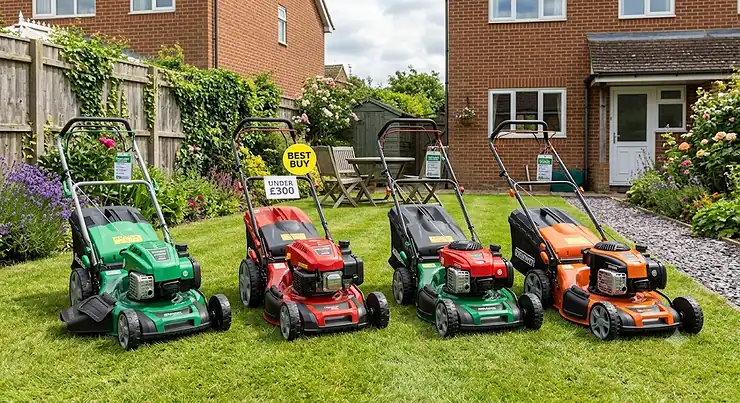
Somewhere between the electric mower that dies halfway across a big lawn and the £600 self-propelled beast gathering dust in a shed you don’t have, there’s a sensible middle ground: a petrol lawn mower under £300. No cable to trip over, no battery clock ticking down while you’re only half done, just a pull-cord, a tank of E10, and enough torque to plough through grass that’s got away from you over a wet fortnight.
This guide is built for anyone chasing an affordable petrol mower that won’t wilt after one season and won’t wreck a weekend budget either. We’ve dug into real specs, genuine UK retailer listings, and aggregated owner feedback to find a good petrol lawn mower under £300 that actually earns its keep — not just the cheapest thing that happened to be in stock. Whether you’re after a no-frills push petrol mower for a modest suburban plot or something with a bit more muscle for an awkward, sloping garden, you’ll find honest, specific guidance here rather than recycled spec-sheet filler.
We’ve focused on real, currently available machines — including a proper look at the Briggs & Stratton 500 series engine that keeps turning up on the best cheap petrol mower shortlists — and we’ve paired every spec with what it actually means once you’re stood behind the handlebar on a Saturday morning.
What Is a Petrol Lawn Mower Under £300?
A petrol lawn mower under £300 is a combustion-engine mower — typically a 100-160cc four-stroke unit from Briggs & Stratton or a similar own-brand engine — sold new at this budget tier, usually hand-propelled rather than self-driving, with a 38-42cm steel or polypropylene cutting deck suited to small and medium UK gardens.
Quick Comparison Table
| Mower | Engine | Cutting Width | Propulsion | Price Range | Best For |
|---|---|---|---|---|---|
| Cobra M40B | B&S 450E, 125cc | 40cm | Hand-push | around £200-£235 | Tightest budgets |
| Yard Force GM B40 | B&S 300E, 125cc | 40cm | Hand-push | around £150-£200 | Very small lawns |
| Murray EQ2-400 | B&S OHV, 125cc | 46cm | Hand-push | around £220-£260 | Wider deck, fewer passes |
| Mountfield HP41 | B&S 500E, 125cc | 41cm | Hand-push | around £230-£270 | Best engine pedigree |
| Webb WER410SP | 4-stroke, 132cc | 41cm | Self-propelled | around £270-£300 | Sloped or larger lawns |
| Hyundai HYM400SP | Hyundai 4-stroke | 40cm | Self-propelled | around £260-£300 | Long warranty peace of mind |
| Mountfield SP41 | Own-brand 4-stroke | 41cm | Self-propelled | around £280-£300+ | All-round family lawn |
Looking at the spread above, the two Cobra M40B and Yard Force GM B40 sit at the true budget end and reward you with simplicity rather than self-propulsion, while the Webb WER410SP, Hyundai HYM400SP, and Mountfield SP41 creep toward the ceiling of this bracket precisely because they add a self-driving wheel motor. If your lawn is flat and under roughly 300 square metres, you genuinely don’t need to spend up for self-propulsion — but anyone dealing with a slope or a bigger plot will find that extra layer of engineering worth chasing even if it means shopping at the very top of the £300 range.
💬 Bookmarked one already? Compare current prices before they change — tap through and see for yourself.
Top 7 Petrol Lawn Mowers Under £300: Expert Analysis
1. Cobra M40B — cheapest genuinely dependable petrol pick
The Cobra M40B opens this list because, frankly, it’s the most honest £200-ish mower on the UK market right now. It runs a 125cc Briggs & Stratton 450E Series OHV engine — the same overhead-valve architecture found on machines costing considerably more — mated to a 40cm steel deck with a simple hand-propelled chassis. What that OHV layout means in practice is oil constantly circulating around the valve gear, so the engine tends to run cooler and last longer than the older side-valve units some rock-bottom mowers still use. Based on the spec comparison with rivals at this price, the Cobra M40B is squarely aimed at first-time mower owners, renters, and anyone with a small-to-medium flat lawn who wants zero fuss. Reviewers consistently report easy starting — usually first or second pull — and praise the light overall weight for a petrol mower, though a few owners note the 40-litre grass box needs emptying more often than they’d like on thick spring growth.
Pros:
- ✅ Genuine OHV Briggs & Stratton engine at a rock-bottom price
- ✅ Light enough to manoeuvre without self-propulsion
- ✅ Reliable, well-documented starting performance
Cons:
- ❌ No self-propulsion, so slopes are hard work
- ❌ Grass box capacity modest for larger or overgrown lawns
Priced around £200-£235 depending on retailer stock, the Cobra M40B represents about the strongest pound-for-pound value in this whole guide.
2. Yard Force GM B40 — best for very small lawns and tight budgets
The Yard Force GM B40 shaves the price down further still while keeping a genuine Briggs & Stratton engine under the bonnet — here it’s the 300E Series, a slightly simpler unit than the 450E or 500E found further up this list. What that trade-off means in real terms is a bit less low-end torque, so this isn’t the mower for a jungly, six-week-neglected lawn, but for weekly maintenance on a modest patch it’s more than sufficient. The 40cm curved steel blade and five-position height adjustment (25mm to 75mm) cover the vast majority of British domestic cutting heights the RHS recommends across the seasons. Honest analysis here: the Yard Force GM B40 is for budget-conscious first-time buyers, students, or anyone with a garden under roughly 200 square metres who mows little and often rather than infrequently and hard. Aggregated review sentiment on this model is positive on ease of starting and light weight, with the recurring gripe being a smaller grass collection bag than owners expected.
Pros:
- ✅ Lowest entry price of any Briggs & Stratton-engined model here
- ✅ Diamond-ground blade edge for a cleaner cut
- ✅ Genuinely light for easy storage and lifting
Cons:
- ❌ 300E engine has less torque on long or damp grass
- ❌ Smaller grass box means more frequent emptying
Expect a price somewhere around £150-£200, making the Yard Force GM B40 the cheapest sensible entry point in this whole affordable petrol mower comparison.
3. Murray EQ2-400 — best wider deck for the money
Murray’s EQ2-400 earns its spot by doing something the two mowers above don’t: giving you a proper 46cm cutting width for a price that still comfortably sits under £300. In practice, a wider deck means fewer passes across the same lawn — on a 250 square metre plot, that’s a genuinely noticeable time saving over a 40cm mower, even before you account for its 2-in-1 mulch-or-collect functionality. The 125cc Briggs & Stratton engine here is a shared unit with Murray’s costlier EQ2-500, so what most buyers overlook about this model is that they’re getting comparable engine reliability with a smaller collection box and no self-propulsion, rather than a genuinely lesser motor. This is a good petrol lawn mower under £300 for anyone with a mid-sized, mostly flat garden who values coverage speed over hill-climbing muscle. Reviewers describe it as compact and manoeuvrable around borders despite the wider deck, though a handful mention the plastic deck flexing slightly on very rough, stony ground.
Pros:
- ✅ 46cm deck covers more lawn per pass than rivals
- ✅ 2-in-1 mulch and collect versatility
- ✅ Shares its engine with a pricier Murray model
Cons:
- ❌ Polypropylene deck less rugged than steel alternatives
- ❌ No self-propulsion despite the larger footprint
Pricing generally sits in the £220-£260 range, and the Murray EQ2-400 is a smart pick if deck width matters more to you than a driven wheel.
4. Mountfield HP41 — best engine pedigree under £300
If the Briggs & Stratton 500 series is the specific reason you’re reading this article, the Mountfield HP41 is the model to look at. It pairs a 125cc B&S 500E Series engine — a step up in refinement from the 300E and 450E units found on cheaper mowers — with Mountfield’s own 41cm polypropylene chassis, a combination that’s been a fixture of British garden sheds for years. What that upgraded engine series means practically is quieter running and smoother throttle response, thanks to the Lo-Tone muffler design Briggs & Stratton builds into the 500 series line. Here’s what to weigh: this isn’t a self-propelled machine, so it still demands a bit of shoulder work on anything but flat ground, but the trade-off buys you meaningfully better engine refinement than the entry-level options further up this list. Owner reviews of the HP41 and its close siblings consistently flag reliable cold starts and describe the cut quality as tidy even on slightly longer grass, with the main criticism being a plastic deck that some owners feel lacks the reassurance of steel.
Pros:
- ✅ Briggs & Stratton 500E Series engine refinement
- ✅ Quieter Lo-Tone muffler for early-morning mowing
- ✅ Well-established, easily serviced British-market model
Cons:
- ❌ Polypropylene deck rather than steel
- ❌ Still hand-propelled, so hills require effort
At around £230-£270, the Mountfield HP41 is the pick for anyone who specifically wants that 500 series engine without breaking the £300 ceiling.
5. Webb WER410SP — best self-propelled option for slopes
Stepping up to self-propulsion, the Webb WER410SP brings a 132cc four-stroke engine and a driven rear axle to a 41cm deck, with seven adjustable cutting heights for genuinely fine-tuned control across the seasons. What self-propulsion actually changes in daily use is simple but significant: instead of pushing the whole machine’s weight, you’re just steering, which matters enormously on a lawn with any incline or on a day when you’ve already done the shopping, the school run, and everything else. Based on the spec comparison with the hand-push models above, the extra weight of the drive mechanism means this Webb is noticeably heavier to lift in and out of a shed, so it suits gardens accessed via a ramp or level path rather than steps. This is a solid pick for anyone with 300-500 square metres of moderately uneven ground who has decided self-propulsion isn’t a luxury but a necessity. Reviewers describe the seven-position height adjustment as genuinely useful across a full mowing season, while a smaller number note the self-propel clutch cable can need adjustment after the first year of use.
Pros:
- ✅ Genuine self-propulsion for sloped or larger lawns
- ✅ Seven cutting heights for fine seasonal control
- ✅ 132cc engine has real reserve power for damp grass
Cons:
- ❌ Considerably heavier to lift and store than push models
- ❌ Self-propel cable may need occasional adjustment
At around £270-£300, the Webb WER410SP sits near the top of this bracket but earns it through genuine self-propulsion.
6. Hyundai HYM400SP — best for warranty peace of mind
The Hyundai HYM400SP brings a 40cm self-propelled deck and a Hyundai-branded four-stroke engine, and what most buyers overlook about Hyundai’s garden machinery range is the length of the warranty backing it, which tends to run longer than several rivals at this price point — reassuring if you’re new to petrol machinery and worried about early faults. In practical terms, the self-propelled drive combined with a slightly narrower 40cm deck makes this a nimble choice for gardens with awkward corners, narrow side-access gates, or borders that need weaving around rather than wide-open lawns that reward a bigger deck. Honest analysis: this suits buyers who prioritise brand backup and manoeuvrability over raw cutting width, particularly anyone mowing a garden with tight turning circles. Aggregated owner sentiment highlights easy starting and describes the self-propel speed as comfortable rather than the sometimes-too-fast setting found on pricier rivals, with occasional mentions of the grass box latch feeling a little flimsy after repeated use.
Pros:
- ✅ Self-propelled drive at a genuinely affordable price
- ✅ Manufacturer warranty gives new buyers confidence
- ✅ Comfortable, controllable self-propel walking speed
Cons:
- ❌ Narrower 40cm deck means more passes on bigger lawns
- ❌ Grass box latch reported as less robust over time
Typically priced around £260-£300, the Hyundai HYM400SP is the safety-net choice for anyone nervous about buying their first petrol machine.
7. Mountfield SP41 — best all-round family lawn mower
Rounding out the list, the Mountfield SP41 combines a 41cm deck with self-propulsion and Mountfield’s own four-stroke engine, and it’s the model we’d point a genuinely undecided buyer toward first. What the self-propelled 41cm combination means for an average British semi-detached garden is a mower that’s wide enough to make real progress but still light enough to handle around flower beds and washing lines without a three-point turn every ten seconds. The spec sheet won’t tell you this, but reviewers note the SP41’s self-propel engagement is smoother than some rivals, avoiding the jerky “lurch forward” some cheaper self-propelled mowers are known for. This is the pick for a household mowing a fairly typical 200-400 square metre plot who wants one mower to handle everything from spring’s first cut to autumn’s final tidy-up without drama. Owner feedback is broadly positive on cut quality and starting reliability, though — as with several mowers at the very top of this bracket — a small number of buyers note that retailer pricing occasionally nudges just over £300 depending on stock and season.
Pros:
- ✅ Self-propulsion plus a genuinely wide 41cm deck
- ✅ Smooth drive engagement, not jerky like some rivals
- ✅ Well suited to a typical UK family-sized lawn
Cons:
- ❌ Price sometimes edges just above the £300 mark
- ❌ Self-propelled mechanism adds servicing complexity long-term
Expect a price around £280-£300, occasionally higher — the Mountfield SP41 is worth tracking for a sale if it’s sitting just outside your budget.
Top 7 Products: Full Spec Comparison
| Mower | Weight | Height Settings | Grass Box | Ideal Lawn Size | Best For |
|---|---|---|---|---|---|
| Cobra M40B | Light | Multi-position | ~40L | Small | Absolute beginners |
| Yard Force GM B40 | Light | 5 (25-75mm) | Smaller | Small | Tightest budget |
| Murray EQ2-400 | Medium | Multi-position | 50L | Small-medium | Fewer passes, flat lawns |
| Mountfield HP41 | Medium | Multi-position | Standard | Small-medium | 500 series engine fans |
| Webb WER410SP | Heavier | 7 positions | Standard | Medium-large | Slopes, uneven ground |
| Hyundai HYM400SP | Medium-heavy | Multi-position | Standard | Small-medium | Tight, awkward gardens |
| Mountfield SP41 | Medium-heavy | Multi-position | Standard | Medium | All-round family use |
This second table makes the trade-off explicit: every self-propelled model — Webb WER410SP, Hyundai HYM400SP, and Mountfield SP41 — carries extra weight you’ll feel when lifting it over a step or into a car boot, while the hand-push machines stay lighter but ask more of your shoulders on anything but level ground. If storage access involves stairs or a raised threshold, that weight difference genuinely should factor into your decision as much as cutting width does.
✨ Don’t Miss These Exclusive Deals!
🔍 Take your garden maintenance to the next level with these carefully selected budget petrol mowers. Click through on any model above to check current pricing and availability before you commit. A good petrol lawn mower under £300 can keep a British lawn looking sharp for years with barely any fuss.
Benefits vs Traditional Alternatives
| Factor | Petrol Push Mower | Corded Electric | Battery Cordless |
|---|---|---|---|
| Runtime | Unlimited (fuel dependent) | Unlimited (cable dependent) | 20-40 minutes typical |
| Power on long grass | Strong | Moderate | Moderate-strong |
| Noise | Loud | Moderate | Quiet |
| Ongoing cost | Fuel + annual service | Electricity only | Battery replacement eventually |
| Best lawn size | Any, including large | Small-medium, near a socket | Small-medium |
The trade-off is straightforward once you see it laid out: a petrol lawn mower under £300 wins decisively on unlimited runtime and torque, which matters if your lawn is over roughly 300 square metres or your grass tends to get away from you between cuts. Corded electrics are cheaper to run day to day but tether you to a socket, while battery cordless models offer near-silent convenience at the cost of a runtime ceiling that can leave a bigger lawn half-finished. If your priority is one mower that never runs out of steam regardless of how long you’ve left it, petrol remains the more dependable value petrol mower category, full stop.
Practical Usage Guide: Your First 30 Days
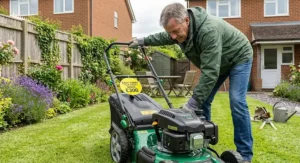
Getting a new push petrol mower right in its first month matters more than most buying guides admit. Before the first cut, add engine oil if it doesn’t come pre-filled (check the manual — some, like several Briggs & Stratton units, ship dry), then fill with fresh E10 unleaded rather than fuel that’s been sitting in a can over winter. Set the cutting height to its highest position for the very first mow of the season, following the RHS’s long-standing advice never to remove more than a third of the grass blade in one pass, which protects the lawn’s roots and prevents scalping.
In the first few cuts, mow around the perimeter first to create a clean border, then work in straight, slightly overlapping lines. A common first-30-days mistake is running the mower dry of oil because owners assume, wrongly, that a petrol engine “just needs fuel” — check the dipstick before every third or fourth cut. Another frequent error is leaving old fuel in the tank over a fortnight of disuse; E10 petrol degrades faster than the E5 it replaced, so a fuel stabiliser is genuinely worth the few pounds it costs if the mower will sit idle. Clean grass build-up from under the deck after every few cuts too — compacted clippings blunt the blade’s effective cutting angle far faster than actual use does.
Real-World Scenario: Which Mower Suits Which Gardener?
Picture three fairly typical UK homeowners. First, a first-time buyer with a 150 square metre courtyard-style garden and a strict £200 ceiling: the Yard Force GM B40 or Cobra M40B covers this comfortably, since a small flat plot never needed self-propulsion in the first place. Second, a family with a 350 square metre garden that includes a gentle slope down to a fence line, mowing weekly through spring and summer: here the Webb WER410SP or Mountfield SP41 earns its self-propelled premium, because pushing a loaded mower uphill repeatedly is the kind of chore that turns people off mowing altogether. Third, someone renovating an overgrown 250 square metre plot who wants a wider deck to fight through six-week grass in fewer passes without needing self-propulsion on largely flat ground: the Murray EQ2-400‘s 46cm deck is the pragmatic middle path.
None of these are hard rules — they’re starting points based on genuine differences in deck width, weight, and propulsion that the spec sheets confirm, matched against three common British garden situations.
How to Choose a Petrol Lawn Mower Under £300
- Measure your lawn honestly. Anything under roughly 250 square metres rarely justifies paying extra for self-propulsion; anything over 400 square metres almost always does.
- Check for slopes, not just size. A flat 300 square metre lawn is easier to push than a sloped 150 square metre one — gradient often matters more than raw area.
- Confirm the engine series, not just the brand. A Briggs & Stratton 500 series unit runs quieter and more refined than an entry-level 300E, even at a similar price.
- Match deck width to obstacles. Narrow decks like 40cm suit gardens with tight corners; wider 46cm decks reward open, uncluttered lawns.
- Weigh it before you buy it, if you can. Self-propelled models are noticeably heavier to lift over steps or into storage.
- Read the grass box capacity, not just the headline spec. A small box means more stops to empty it on a long, overgrown cut.
- Factor in annual servicing from day one. Budget roughly £25 in parts for a DIY service, or £60-£100 at a dealer, every year regardless of which model you choose.
Common Mistakes When Buying an Affordable Petrol Mower
The single most frequent mistake is buying based purely on cutting width without checking weight — a wider deck sounds appealing until you’re lifting a heavier mower over a garden step every single week. A close second is assuming “petrol” automatically means “powerful,” when in reality a basic 300E-series engine on a neglected, overgrown lawn can struggle just as much as an underpowered electric model would. Buyers also frequently skip checking whether the mower ships with oil already in the sump — starting a dry engine, even briefly, can cause real damage that no warranty will cover. Finally, many first-time buyers overlook servicing costs entirely when comparing the upfront price of a budget petrol lawn mower under £300 against a pricier alternative, only to find the “cheaper” machine costs the same over three years once fuel, oil, and a yearly tune-up are factored in.
Push Petrol Mower vs Self-Propelled: What the Difference Really Means
A push petrol mower relies entirely on your own effort to move it forward across the lawn — the engine only powers the blade, not the wheels. A self-propelled model adds a drive mechanism, usually engaged by a lever on the handlebar, that pulls the mower forward at a set walking pace, leaving you to steer and control the cutting height rather than shove the whole unit. In practice, that difference is night and day on anything beyond a small, flat plot: a self-propelled machine like the Webb WER410SP turns an afternoon chore on a sloped 400 square metre lawn into a genuinely manageable task, while the same slope with a push-only model like the Cobra M40B or Yard Force GM B40 becomes a proper workout. The trade-off, as covered earlier, is weight and mechanical complexity — self-propelled units have more moving parts (drive belts, clutch cables) that can eventually need attention, whereas a simple push petrol mower has comparatively little to go wrong beyond the engine itself. For a small, level urban garden, a push mower is genuinely the smarter buy; for anything larger or sloped, self-propulsion earns its keep fast.
What to Expect: Real-World Performance
On paper, a 125cc engine and a 40cm deck are just numbers, so here’s what they translate to on an actual British lawn. Expect roughly 15-20 minutes to mow a typical 200 square metre suburban garden with a 40-41cm deck, assuming reasonably regular cutting rather than tackling knee-high grass. Starting reliability across the Briggs & Stratton-engined models here is consistently reported as first-or-second-pull once the choke or primer bulb technique is learned, though very cold mornings can occasionally need a third pull. Noise sits in the 85-95 decibel range typical of small petrol engines — noticeably louder than a battery mower, which is worth considering if you’ve got close neighbours and prefer to mow before 9am. Cut quality across this whole price bracket is honestly comparable; the differences that matter more in daily use are how easily the mower turns around obstacles and how quickly the grass box fills up, not marginal differences in blade sharpness out of the box.
Long-Term Cost & Maintenance
The purchase price is only the opening chapter. Budget for an annual service — oil change, spark plug, air filter clean, blade sharpen — costing around £25 in parts if you do it yourself, or £60-£100 if you’d rather a local dealer handled it. Fuel costs are modest: a typical domestic mowing season uses only a few litres of E10 unleaded, and the official government guidance on E10 petrol confirms that fuel is now the standard grade at UK forecourts, so there’s no premium to pay unless your specific engine calls for E5. Over a three-year ownership window, total cost of ownership across every mower on this list lands in a fairly similar band once fuel and servicing are added — the real differentiator is how well you look after the machine, not which specific budget model you chose. Draining or stabilising fuel over winter, as covered in the usage guide above, is the single cheapest thing you can do to extend an engine’s working life well beyond its typical three-to-five-year expectancy at this price point.
Features That Actually Matter (And Those That Don’t)
Engine series matters far more than headline horsepower claims — a Briggs & Stratton 500 series unit’s refinement and Lo-Tone muffler genuinely change the daily experience versus an entry-level 300E, even though both will cut grass adequately. Cutting height range matters too, since the RHS’s seasonal guidance calls for noticeably different lengths between summer and spring, and a mower stuck on three positions limits how well you can follow that advice. What matters far less, despite marketing emphasis, is the exact litre capacity of the grass box beyond a sensible minimum — a slightly smaller box just means one extra trip to the compost heap, hardly a dealbreaker. Similarly, cosmetic details like deck colour or handlebar styling have zero bearing on cutting performance, so don’t let them sway a decision between two otherwise similar machines.
Safety, Regulations & Fuel Compliance Guide
All petrol mowers on this list run on standard E10 unleaded, the fuel grade that has been the UK default at forecourts since 2021, and the Royal Horticultural Society’s mowing guidance is a genuinely useful reference for adjusting cutting height safely by season to protect both the lawn and the blade. Always clear the lawn of stones, toys, and debris before starting, as struck objects are the most common cause of blade damage and a real safety hazard to bystanders. Wear sturdy closed footwear rather than sandals, keep children and pets well clear while mowing, and never adjust the cutting height or clear a blocked chute while the engine is running. If you’re storing the mower over winter, either run the tank dry or add a fuel stabiliser, since stale E10 is one of the most common causes of spring starting problems reported by owners across every brand in this guide.
🔍 Ready to Stop Fighting Your Lawn?
✅ Browse today’s petrol mower listings, compare the seven picks above side by side, and pick the one that actually matches your garden’s size and slope — not just its price tag.
Petrol Lawn Mowers for Beginners and First-Time Buyers
If you’ve never owned a petrol mower before, start with the simplest possible machine rather than the most feature-packed one. A push petrol mower like the Cobra M40B or Yard Force GM B40 removes an entire layer of complexity — no self-propel clutch to learn, no drive cable to maintain — leaving you to focus on the basics of starting, height adjustment, and routine oil checks. First-time buyers consistently report that the biggest learning curve isn’t the mowing itself but the maintenance rhythm: checking oil before use, keeping fuel fresh, and cleaning the deck after cutting damp grass. Once that routine becomes second nature, upgrading to a self-propelled model like the Mountfield SP41 later on is a far smaller leap than jumping straight in at the deep end.
Frequently Asked Questions
❓ Is a petrol lawn mower under £300 any good?
❓ What's the difference between B&S 300E, 450E, and 500E engines?
❓ Do I need a self-propelled mower for a small garden?
❓ How often should I service a budget petrol mower?
❓ Can I use any petrol in my mower?
Conclusion
There’s no single “best” answer here — only the right match between your lawn and the machine in front of you. If you’ve got a small, flat garden and want the lowest possible entry cost, the Yard Force GM B40 or Cobra M40B will do the job without fuss. If engine refinement matters to you specifically, the Mountfield HP41‘s Briggs & Stratton 500 series unit is the standout at this price. And if your garden has any real slope or size to it, paying up to the top of this bracket for the self-propulsion on the Webb WER410SP, Hyundai HYM400SP, or Mountfield SP41 will save your back every single week of the mowing season.
What ties every recommendation in this guide together is honesty about trade-offs rather than blanket praise — every mower here has a genuine strength and a genuine limitation, and matching those against your actual lawn, not a marketing headline, is how you land on the right good petrol lawn mower under £300 for your garden.
✨ Found Your Perfect Match?
💬 Compare current pricing on the model that suits your lawn best, and get your garden looking sharp before the next mowing season really kicks in!
Recommended for You
- Petrol Lawn Mower for Large Garden: 7 Powerful Picks for 2026
- 7 Best Petrol Lawn Mowers UK 2026: Tested, Ranked & Reliable
- 7 Best Flymo Electric Lawn Mowers UK 2026
Disclaimer: This article contains affiliate links. As an Amazon Associate, I earn from qualifying purchases. If you purchase products through these links, we may earn a small commission at no additional cost to you.
✨ Found this helpful? Share it with your friends! 💬🤗
