
In This Article
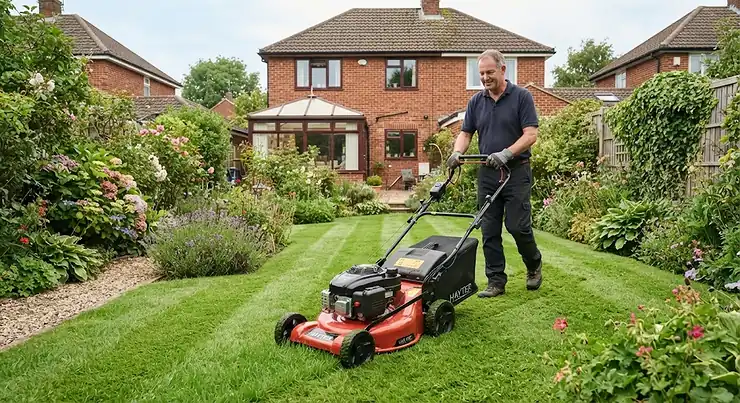
There’s a very particular kind of exhaustion that comes from wrestling a heavy push mower up a sloped lawn on a warm Saturday morning, and if you’ve felt it, you already know why you’re here. A self-propelled petrol lawn mower does the walking for you — the wheels drive themselves, so you’re steering rather than shoving. That single mechanical difference is the reason so many UK gardeners with anything bigger than a pocket-handkerchief lawn eventually make the switch.
So, what is a self-propelled petrol lawn mower? It’s a rotary mower with a petrol engine that powers both the cutting blade and the drive wheels, propelling the machine forward (or on some models, at a speed you control) so you don’t have to push against its own weight. As Wikipedia’s overview of lawn mower design explains, this self-contained petrol power source remains the most common way walk-behind mowers are driven today. It differs from a “push” petrol mower, which relies entirely on your muscle power to move.
This guide is built for a British garden and a British budget. We’ve researched seven genuine, currently available models spanning budget, mid-range and premium territory — Mountfield, Webb, Hyundai, Cobra, STIHL and Honda all make an appearance — and we’ve dug into real specs, aggregated owner-review sentiment, and honest trade-offs rather than marketing fluff. Whether you’re after the best petrol self drive mower for a modest suburban plot or a serious machine for a third-of-an-acre paddock-adjacent lawn, you’ll find a genuine option below, along with the reasoning to back it.
Quick Comparison Table
Before the deep dives, here’s the shortest possible version of this guide.
| Category | Model | Best For |
|---|---|---|
| Best Overall Value | Mountfield SP46 | Small-to-medium lawns on a tight budget |
| Lightest & Most Compact | Webb WER410SP Classic | Small, sloped or obstacle-heavy gardens |
| Most Versatile | Hyundai HYM460SP | Gardeners who want mulch, collect and discharge in one |
| Best for Lawn Stripes | Cobra RM40SPB | Traditionalists chasing that striped-lawn look |
| Best Mid-Range Engine | Cobra MX46SPB | Buyers who want variable-speed drive without Honda pricing |
| Widest Cut for the Price | STIHL RM 253 T | Medium-to-large lawns where speed of cut matters |
| Best Premium/Buy-Once | Honda HRX 476 VY | Larger gardens and buyers who want a 15-20 year mower |
A pattern jumps out immediately: price tracks fairly closely with drive sophistication and engine pedigree, not just cutting width. The Mountfield SP46 and Webb WER410SP Classic both use fixed single-speed drive, which keeps costs down but means you’re walking at the mower’s pace rather than yours. Step up to the Cobra MX46SPB or Honda HRX 476 VY and you get variable-speed drive that adjusts to your natural walking pace — genuinely useful if your lawn has tight corners or you mow with family members of different heights and strides. None of this means the budget options are bad; it means they’re built for a specific kind of garden, and knowing which garden you have is half the buying decision.
💬 Just one click — help others make better buying decisions too!😊
Top 7 Self-Propelled Petrol Lawn Mowers: Expert Analysis
We’ve picked these seven to cover realistic UK garden sizes, budgets and priorities — not just the models with the biggest marketing spend. Each one is a genuine, currently sold product; nothing here is invented.
1. Mountfield SP46 — best budget self-propelled all-rounder
The Mountfield SP46 earns its “budget hero” reputation by doing the fundamentals well and skipping the extras that push the price up. Its 46cm steel deck and rear-wheel self-propelled drive mean you get proper coverage without proper effort.
Under the bonnet sits a Stiga ST 140 OHV engine at 139cc, producing 2.2kW at 2900rpm — enough grunt for typical UK lawns up to around 800m² without bogging down in reasonably long grass. Six cutting heights between 22mm and 65mm, adjusted via a single central lever, cover everything from a tight spring cut to a shaggier midsummer trim, and the 60-litre canvas collector means fewer trips to the compost heap than smaller bags allow.
Based on the spec comparison with rivals at this price point, the SP46’s real selling point isn’t outright power, it’s the five-year extendable warranty (provided you service annually with an authorised dealer) — a level of after-sales confidence that’s rare below £400. This is the mower for a first-time self-propelled buyer who wants dependability over bells and whistles.
Reviewers consistently report smooth starting via the recoil pull and reliable everyday performance; one retailer’s own service notes flag occasional drive-belt slipping once the engine has warmed up on some units, which is worth knowing rather than discovering mid-mow.
Pros:
- ✅ Five-year extendable warranty with annual servicing
- ✅ Trusted UK brand with wide dealer/spares network
- ✅ Simple single-lever height adjustment across six positions
Cons:
- ❌ Single-speed drive only — no pace adjustment
- ❌ Occasional drive-slip reported once engine is warm
Typically priced in the £330-£380 range, the SP46 represents honest value: you’re paying for reliability and warranty backing rather than premium features, and for most modest UK gardens, that’s exactly the right trade-off.
2. Webb WER410SP Classic — lightest choice for small sloped plots
The Webb WER410SP Classic stands out for one number: 26kg. That’s genuinely light for a self-propelled petrol mower, and it matters more than spec sheets let on once you’re lifting the thing over a step or manoeuvring it out of a tight shed.
Its Webb DVO130 engine displaces 132cc — smaller than most rivals here — but that’s a deliberate trade-off for a compact 41cm cutting width aimed squarely at smaller gardens with awkward corners, flower beds and the odd ornamental tree to dodge. Seven cutting heights from 25mm to 75mm and a generous 45-litre mesh collector round out a genuinely thoughtful small-garden package.
What most buyers overlook about this model is that narrower decks aren’t automatically worse; on a small, fiddly lawn a 46cm or 51cm deck can be a liability, catching on obstacles a slimmer machine glides past. Reviewers who’ve tested it note it navigates paths, statues and flower beds with more ease than wider machines, which is precisely the audience Webb is chasing.
A British-designed brand with a long domestic-market history, Webb doesn’t attract the review volume of Hyundai or Mountfield, but the aggregated sentiment from those who have used it is consistently positive on manoeuvrability and starting reliability.
Pros:
- ✅ Genuinely lightweight at 26kg for easier handling
- ✅ Compact 41cm deck ideal for tight, obstacle-heavy gardens
- ✅ Seven cutting heights for fine control
Cons:
- ❌ Narrower cut means more passes on bigger lawns
- ❌ Single-speed drive with no mulching function included
Expect to pay in the region of £270-£320, making this one of the most affordable genuinely self-propelled options here — a smart pick if your garden is small but slopes just enough to make pushing a chore.
3. Hyundai HYM460SP — most flexible 4-in-1 cutting
If versatility is your priority, the Hyundai HYM460SP covers more bases than almost anything else at this price. Mulch, collect, rear-discharge or side-discharge — the choice is yours, and that flexibility alone justifies its huge popularity among UK buyers.
The Hyundai IC140V engine is a 139cc, 4-stroke, low-emission OHV unit delivering roughly 3.7hp, paired with rear-wheel self-propelled drive and a 46cm steel deck. Six cutting heights spanning 25mm to 75mm are set via a single central lever, and the 70-litre grass bag is noticeably larger than most rivals here — practically a full skip’s worth more capacity than the Webb, in relative terms.
Here’s what the spec sheet won’t tell you, but real buyers do: the 4-in-1 versatility genuinely gets used. Households that mulch in dry spells and collect after wet ones report actually switching modes through the season, rather than setting it once and forgetting the other options exist.
Aggregated reviewer sentiment is strongly positive on ease of assembly and starting, with multiple owners describing the mower as “up and running in ten minutes” straight out of the box — a meaningful point of friction removed for anyone dreading a fiddly first setup.
Pros:
- ✅ True 4-in-1 mulch, collect, rear and side discharge
- ✅ Large 70-litre grass bag reduces emptying trips
- ✅ Three-year platinum warranty with strong UK spares backup
Cons:
- ❌ Base SP model has recoil start only (electric costs more)
- ❌ Single-speed rear-wheel drive, no pace adjustment
Around £300-£370 depending on retailer, the HYM460SP is arguably the best value-for-features self-propelled petrol mower on the UK market right now, and it’s easy to see why it appears on so many “best of” shortlists.
4. Cobra RM40SPB — classic striped finish on a budget
For gardeners who care as much about how the lawn looks afterwards as how easy it was to cut, the Cobra RM40SPB brings a genuine rear roller to a genuinely affordable price point — a combination that’s surprisingly hard to find elsewhere.
Power comes from a Briggs & Stratton 450E series engine at 125cc, a smaller displacement than some rivals but one from arguably the most globally proven small-engine manufacturer in the business. The 40cm steel deck and full-width rear roller work together to produce that classic striped-lawn finish, while six cutting heights from 17mm to 75mm, set by a single counter-balanced lever, offer real precision.
Based on the spec comparison, the rear roller does double duty beyond stripes: it physically supports the mower when the front wheels run along a border, letting you cut right up to the edge of flower beds without the front end dipping in. That’s a practical, everyday benefit that spec sheets rarely emphasise but owners quickly come to appreciate.
Reviewers consistently praise the Briggs & Stratton engine’s reliability, and one long-term owner review specifically noted efficient performance carried over from previous non-roller Cobra models, suggesting brand consistency across the range.
Pros:
- ✅ Full-width rear roller for genuine lawn stripes
- ✅ Reliable Briggs & Stratton 450E engine
- ✅ Roller supports mower for clean edge-cutting
Cons:
- ❌ Narrower 40cm cut needs more passes on larger lawns
- ❌ Single-speed drive, no variable pace control
Typically found around £370-£410, the RM40SPB sits just above pure budget territory but delivers a feature — the striped finish — that would otherwise mean paying considerably more for a premium rear-roller machine.
5. Cobra MX46SPB — best mid-range engine and drive
The Cobra MX46SPB occupies what one independent UK review rightly calls “the rational middle ground” — a proper step up in engine pedigree and drive sophistication without tipping into Honda-level pricing.
Its Briggs & Stratton 500E Series engine (140cc, single-cylinder OHV four-stroke) includes ReadyStart technology, meaning no priming bulb and no choke lever to fiddle with before every mow. Crucially, this is one of the more affordable models here with genuine variable-speed drive, letting you match the mower’s pace to your own rather than being towed along at a fixed rate — a meaningful comfort upgrade on gardens with tight corners or mixed terrain.
What most buyers overlook when comparing this to the cheaper Mountfield SP46 is that the £120-ish premium buys two separate upgrades at once: a more globally proven engine platform, and variable-speed drive rather than single-speed. On paper this means less compromise for a modest extra outlay, which is precisely why independent reviewers position it as the sensible mid-tier pick rather than an indulgence.
Aggregated review sentiment flags one genuine caveat worth knowing: like most modern small petrol engines, it’s sensitive to E10 fuel left sitting in the tank, with owners advised to use a stabiliser or an alkylate fuel like Aspen 4T if the mower sits idle over winter — a detail we cover further in our fuel storage section below.
Pros:
- ✅ Proven Briggs & Stratton 500E ReadyStart engine
- ✅ Genuine variable-speed drive for pace control
- ✅ 4-in-1 cutting flexibility without major compromise
Cons:
- ❌ E10 fuel degrades in the tank within roughly 30 days
- ❌ Around £120 pricier than the equivalent single-speed Mountfield
Generally priced around £430-£470, the MX46SPB is the mower we’d point most buyers toward if their budget stretches just past entry-level and they specifically want variable drive speed without a four-figure spend.

6. STIHL RM 253 T — widest cut for the money
The STIHL RM 253 T wins on raw coverage: a 51cm cutting width is genuinely wide for this price bracket, meaning fewer passes and a faster finish on medium-to-large lawns compared with the 40-46cm decks common at similar prices.
Powered by a Stihl EVC 205/EVC 200 series engine around 127-139cc depending on production run, with single-speed self-propelled rear-wheel drive, the RM 253 T pairs its wide deck with a 55-litre grass box featuring a fill-level indicator — useful shorthand so you’re not guessing when to empty it. Seven cutting heights from 20mm to 100mm on some listings (25-75mm on others, so do check the specific listing) give unusually generous range at both ends.
Here’s where honest analysis matters more than marketing copy: at least one detailed independent owner review raises a fair question about whether the EVC 200/205 engine, originally specified for a smaller push-model sibling, is genuinely proportionate to this wider, heavier, self-propelled deck — particularly on slopes or larger lawns. That’s not a dealbreaker, but it’s the kind of nuance worth weighing before you commit, especially if your lawn has real inclines.
Reviewer sentiment is otherwise strongly positive on ease of starting (STIHL’s ReadyStart pull system) and straightforward height adjustment, with several buyers specifically praising delivery speed and price versus buying direct from STIHL.
Pros:
- ✅ Wide 51cm cut reduces the number of passes needed
- ✅ 55-litre grass box with fill-level indicator
- ✅ ReadyStart pull-cord starting, no priming needed
Cons:
- ❌ Some owner concern the engine is under-specified for the deck size
- ❌ Lightweight steel deck reported by one reviewer as feeling “tinny”
Prices for the RM 253 T generally fall in the £430-£520 range depending on retailer promotions, making it a strong pick specifically for buyers who value covering ground quickly over outright climbing power.
7. Honda HRX 476 VY — buy-it-once premium choice
At the top of this list, the Honda HRX 476 VY isn’t for every garden or every budget, but for larger UK lawns and buyers who want to stop shopping for mowers altogether, it’s hard to beat on paper.
Its Honda GCVx170 engine (167cc, OHC 4-stroke, Euro 5-compliant) drives a genuine Variable Select Drive system — a dial on the control bar lets you set and hold a constant walking pace, smoother and more precise than the lever-based variable systems on cheaper mowers. The 47cm Polystrong deck is both lighter and tougher than the steel decks used lower down this list, and Honda’s Versamow system lets you mulch, collect, discharge, or mulch-and-collect simultaneously, without needing a separate mulch plug at all.
Based on the spec comparison against everything else on this list, the standout feature is Roto-Stop — Honda’s version of a blade brake clutch that lets you stop the blades while the engine keeps running, so crossing a gravel path or emptying the grass bag doesn’t mean a full engine restart each time. That’s the kind of convenience that sounds minor until you’ve used it, at which point it’s genuinely hard to go back.
Reviewer sentiment, including thousands of collected ratings on major retailer review platforms, consistently praises smoothness, cut quality and reliability, with Honda’s engineering reputation for small-engine longevity a recurring theme across owner feedback.
Pros:
- ✅ True Variable Select Drive for a constant, chosen pace
- ✅ Roto-Stop blade brake clutch for safer, faster stop-starts
- ✅ Versamow mulch/collect flexibility without a mulch plug
Cons:
- ❌ Significantly pricier than every other model on this list
- ❌ Heavier and bulkier to store than budget alternatives
Expect to pay somewhere in the £950-£1,150 range depending on retailer offers, against a recommended retail price nearer £1,385 — a genuine premium, but one that buys a 47cm variable-speed mower engineered to outlast several cheaper machines bought in succession.
Getting the Most From Your Self-Propelled Petrol Mower
Buying the right mower is only half the job — using and maintaining it properly is what determines whether it’s still cutting cleanly in year eight or limping along by year three.
Before first use, always check the oil level (most self-propelled petrol mowers ship without oil pre-filled, and running one dry for even a few minutes can seize the engine) and use fresh fuel rather than anything that’s been sitting in a can since last autumn. In the first 30 days, the most common mistake isn’t mechanical, it’s habitual: mowing too low, too often. Cutting more than a third of the grass blade in one pass stresses the lawn and can clog the deck on any of the seven models above.
A simple maintenance rhythm keeps things running: clean the underside of the deck after every few cuts to stop grass build-up affecting airflow and cut quality, check and sharpen the blade roughly every 20-25 hours of use, and change the oil at the intervals your manual specifies — typically once per season for light domestic use. Self-propelled drive cables and belts (on models like the Mountfield SP46 or Cobra RM40SPB) benefit from an occasional check for fraying, since a slipping drive is one of the more commonly reported issues across this category.
Winter storage matters more than most owners realise. Either run the tank dry before storing or add a fuel stabiliser — E10 petrol, now the UK standard, degrades faster in stored small engines than the older E5 grade did, and can gum up carburettors over a few months of inactivity.
Real-World Scenarios: Which Self-Propelled Mower Suits You?
Specs only tell half the story. Here’s how the seven models above map onto genuine UK household situations.
If you’re a first-time buyer with a modest 400-600m² suburban garden and a fixed budget, the Mountfield SP46 or Hyundai HYM460SP make the most sense — both offer proven reliability and manageable running costs without asking you to pay for features you won’t use. If your plot is small but genuinely awkward, with raised beds, a shed, and a slope toward the back fence, the Webb WER410SP Classic‘s low weight will save your back far more than a wider deck would save you time.
For a family with a slightly larger lawn where different household members take turns mowing — say, a teenager who walks briskly and a grandparent who prefers a gentler pace — variable-speed drive stops being a luxury and becomes genuinely practical; the Cobra MX46SPB delivers that without premium pricing. And for anyone who’s just moved to a property with 1,000m²-plus of grass, inherited from previous owners who clearly gave up on the edges, the STIHL RM 253 T‘s wider deck will noticeably cut mowing time compared with a 40-46cm machine.
Finally, if you’re the sort of gardener who takes genuine pride in stripes down the lawn on a Sunday afternoon, the Cobra RM40SPB delivers that look affordably, while the Honda HRX 476 VY is the one to choose if you’ve decided, sensibly, that buying one excellent mower now is cheaper than replacing a mediocre one twice.
Common Self-Propelled Mower Problems, Solved
Even a well-chosen mower runs into snags. Here are the five most common, with practical fixes.
Problem: the mower won’t start after winter storage. This is almost always stale E10 fuel gumming up the carburettor. Drain old fuel, refill with fresh petrol (ideally with stabiliser added), and try again before assuming a mechanical fault.
Problem: the self-propelled drive feels weak or slips. Check the drive cable tension first — this is a five-minute adjustment on most models, including the Mountfield SP46, and is the single most commonly reported “fault” that turns out not to be one.
Problem: uneven cutting or scalped patches. Usually a blade that’s gone blunt or bent slightly from hitting a stone. A £15-£20 replacement or sharpening job on any of the seven mowers above will typically restore an even finish.
Problem: the grass bag isn’t filling properly. This is often simply the wrong cutting height for current grass length — mowing wet or overly long grass overwhelms most collectors regardless of brand, including the larger 70-litre bag on the Hyundai HYM460SP.
Problem: excessive vibration or noise. Check the blade is properly balanced and securely tightened; an unbalanced blade is both a comfort problem and, over time, a bearing-wear problem.
How to Choose a Self-Propelled Petrol Lawn Mower
Cutting through the spec sheets, here’s the reasoning that actually matters when picking a self-propelled petrol lawn mower for a UK garden. For independent, lab-tested scoring alongside this guide’s real-world research, Which?’s petrol lawn mower reviews are a genuinely useful second opinion before you commit:
- Measure your lawn first. Anything under roughly 400m² rarely needs more than a 41-46cm deck; go wider only if you’re covering 800m²-plus regularly.
- Decide if you need variable-speed drive. Single-speed machines like the Mountfield SP46 are cheaper and fine for flat, simple lawns; variable-speed models like the Cobra MX46SPB suit sloped or irregularly shaped gardens.
- Check engine provenance, not just cc. A well-regarded Briggs & Stratton or Honda engine at a lower displacement often outperforms a lesser-known engine at a higher one.
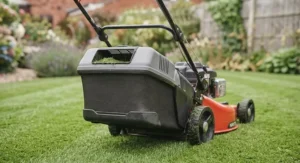
- Weigh grass bag capacity against your lawn size. A 45-litre bag on a small garden is plenty; a 1,000m² lawn will make you grateful for the 70-litre bag on the Hyundai HYM460SP.
- Consider storage space and weight. If you’re lifting the mower over a step regularly, the 26kg Webb WER410SP Classic will be noticeably easier to live with than a 32kg-plus machine.
- Factor in warranty and servicing network. A five-year warranty is only valuable if there’s an accessible authorised dealer nearby to keep it valid.
- Set a realistic total budget, not just a purchase price. Fuel, oil, an annual service and eventual blade replacement add roughly £40-£80 a year across the ownership life of any petrol mower.
Self-Propelled Petrol vs Cordless: Which Wins for UK Gardens?
The self-propelled petrol vs cordless debate has genuinely shifted in the last few years, and pretending otherwise does readers a disservice.
Cordless self-propelled mowers have become excellent for smaller lawns — quieter, lighter to start, and free from fuel storage headaches. But petrol still wins decisively once you’re regularly cutting anything past roughly 500-600m², cutting damp or overgrown grass, or mowing multiple times a week through a full summer. A cordless mower’s battery simply can’t match a full petrol tank’s runtime, and battery packs remain a genuine ongoing cost as they degrade.
| Factor | Self-Propelled Petrol | Cordless Self-Propelled |
|---|---|---|
| Best Lawn Size | 500m²+ | Under 500m² |
| Runtime | Full tank, refuel in seconds | Limited by battery, recharge required |
| Wet/Long Grass Performance | Generally stronger | Can struggle, reduces battery life faster |
| Upfront Cost | Often lower for equivalent power | Often higher including battery |
| Ongoing Cost | Fuel, oil, servicing | Eventual battery replacement |
| Noise | Louder | Quieter |
Reading the comparison above, petrol clearly retains the edge for larger or tougher UK lawns, while cordless increasingly makes sense for compact, tidy gardens where noise and simplicity matter more than raw endurance. Neither is objectively “better” — it depends entirely on square metreage and grass conditions, which is exactly why we’ve focused this guide specifically on petrol rather than pretending one technology suits every garden.
✨ Ready to Stop Pushing and Start Propelling?
🔍 Take your lawn from “adequate” to genuinely admired with one of the seven self-propelled petrol mowers above. Click through to check current pricing and availability, and give your Saturday mornings back to you.
OHV Self-Propelled Engine Technology Explained
Every mower on this list uses what’s known as an OHV self-propelled engine — and understanding what that actually means helps explain why some models cost more than others despite similar cutting widths.
OHV stands for overhead valve: the intake and exhaust valves sit above the combustion chamber rather than beside it, as in older, cheaper “L-head” or flathead designs. According to Wikipedia’s technical breakdown of overhead valve engines, this layout allows more direct, efficient airflow into and out of the cylinder, which in practice means better fuel economy, smoother running and less vibration transmitted through the handlebar into your hands during a long mowing session.
What most buyers overlook is that OHV isn’t a premium feature exclusive to expensive mowers, it’s now the standard across virtually every self-propelled petrol lawn mower sold in the UK, from the entry-level Webb WER410SP Classic right up to the Honda HRX 476 VY. The real differentiator between models isn’t whether the engine is OHV, but which manufacturer built it and how it’s tuned. Briggs & Stratton, Honda, and Stiga-built OHV units all appear across this list, and reviewers consistently rate Briggs & Stratton and Honda slightly ahead on long-term reliability and parts availability, which is reflected in the modest price premium those engines command.
Blade Brake Clutch and Variable Drive Speed: Features That Actually Matter
Two features separate genuinely useful upgrades from marketing dressing: a BBC blade brake clutch and variable drive speed. Both are worth understanding before you pay extra for them.
A blade brake clutch lets you stop the cutting blade while keeping the engine running, rather than having to switch the whole mower off and restart it every time you cross a path, pause to move a toy, or empty the grass bag. Honda brands its version Roto-Stop on the Honda HRX 476 VY, but the underlying mechanism is the same principle found on any BBC-equipped mower: a genuine time-and-hassle saver rather than a gimmick, particularly on gardens interrupted by paths or patios.
Variable drive speed, meanwhile, is exactly what it sounds like — the ability to set the self-propelled walking pace to suit you, rather than being towed along at one fixed rate. On the Cobra MX46SPB and Honda HRX 476 VY, this is controlled via a lever or dial and makes a genuine difference on lawns with tight turns, since you can slow down for corners and speed up on the straights. By contrast, single-speed models like the Mountfield SP46, Webb WER410SP Classic, Cobra RM40SPB and STIHL RM 253 T move at one fixed pace regardless of terrain — perfectly fine on a flat, open lawn, but occasionally frustrating on anything more complex.
Here’s the honest verdict: neither feature is essential for a straightforward, roughly rectangular lawn. Both start earning their keep the moment your garden has real corners, slopes, or interruptions to navigate.
Common Mistakes When Buying a Self-Propelled Petrol Mower
Even careful buyers fall into a handful of predictable traps.
The most frequent mistake is buying too much mower for the garden — a 51cm deck on a fiddly 300m² plot with three flower beds and a washing line post will spend more time being wrestled around obstacles than actually cutting grass efficiently. The inverse mistake is just as common: buying a narrow 40cm single-speed budget mower for an 1,100m² lawn and then resenting every single mow because of how long it takes.
A second common error is ignoring warranty terms until something goes wrong. Several manufacturers, including Mountfield and STIHL, extend their warranty from two years to five, but only if the mower is serviced annually by an authorised dealer — skip that service once, and the extended cover typically lapses.
Finally, many buyers underestimate fuel storage requirements. E10 petrol, now the UK’s standard unleaded grade according to government guidance, degrades notably faster in stored small engines than the older E5 fuel, and skipping a stabiliser over winter is one of the most common — and entirely avoidable — causes of spring starting problems across every brand on this list.
Long-Term Cost & Maintenance
The purchase price is only the opening chapter of mower ownership. Realistic annual running costs for any self-propelled petrol mower on this list typically include: fuel (roughly £15-£25 a season for average domestic use), an annual service if you want to preserve extended warranty terms (£40-£70 through an authorised dealer, less if you’re comfortable doing it yourself), occasional blade sharpening or replacement (£15-£25), and periodic air filter or spark plug replacement (£5-£15 combined).
| Cost Factor | Budget Models (SP46, WER410SP) | Mid-Range (HYM460SP, RM40SPB, MX46SPB) | Premium (RM 253 T, HRX 476 VY) |
|---|---|---|---|
| Typical Annual Fuel & Consumables | £20-£35 | £25-£40 | £30-£50 |
| Authorised Servicing (if required for warranty) | £40-£60 | £50-£70 | £60-£90 |
| Expected Lifespan (with servicing) | 6-10 years | 8-12 years | 15-20 years |
Looking at the table above, the Honda HRX 476 VY‘s higher running and servicing costs are meaningfully offset by an expected lifespan roughly double that of the budget picks, which means the true cost-per-year gap between premium and budget mowers is smaller than the upfront price difference suggests. For a household mowing weekly across a long UK growing season, that longer service life genuinely matters when you calculate total cost of ownership rather than sticker price alone.
Top Petrol Self-Propelled Mowers for Different Lawn Sizes
If you’re searching specifically for the best petrol self drive mower matched to your exact lawn size, here’s the shortcut version of everything above, distilled by square metreage.
For gardens under 400m², prioritise weight and manoeuvrability over cutting width — the Webb WER410SP Classic is the standout here. Between 400m² and 800m², the Mountfield SP46 and Hyundai HYM460SP both handle the job comfortably, with the Hyundai edging ahead if you want cutting-mode flexibility. From 800m² to around 1,200m², the wider-decked STIHL RM 253 T starts paying for itself in reduced mowing time, while the Cobra MX46SPB‘s variable-speed drive earns its keep if that space includes awkward corners. Beyond 1,200m², or for anyone who genuinely wants their next mower to be their last, the Honda HRX 476 VY is the one worth the premium.
Safety and Regulations: Mowing Responsibly in the UK
Petrol lawn mowers are powerful garden machinery, and treating them with appropriate respect matters for you, your family, and your neighbours.
Always disengage the blade (via a blade brake clutch where fitted, such as on the Honda HRX 476 VY) or switch the engine off entirely before clearing blockages, adjusting cutting height near the deck, or crossing gravel or paved areas — reaching under a running mower deck for any reason is one of the most preventable causes of serious injury with this kind of equipment. Keep children and pets well clear of the mowing area entirely rather than assuming they’ll stay at a safe distance on their own.
Store fuel in an approved container away from direct sunlight and any ignition source, and always refuel with the engine switched off and cool — never while it’s still running or hot from recent use. Steep slopes deserve particular caution: mow across a slope rather than straight up and down wherever the gradient allows, since this significantly reduces the risk of the mower — or you — losing footing and tipping.
Most UK councils don’t restrict daytime petrol mower use directly, but noise nuisance rules under the Environmental Protection Act mean it’s good practice, and simply good neighbourliness, to avoid mowing early mornings, late evenings, or Sundays where local custom leans quieter.

Frequently Asked Questions
❓ How long does a self-propelled petrol lawn mower last?
❓ Is a self-propelled petrol mower better than a push mower for a sloped lawn?
❓ What size lawn needs a self-propelled petrol mower rather than cordless?
❓ Can I use E10 petrol in my self-propelled lawn mower?
❓ Do self-propelled petrol mowers need an annual service?
Conclusion
Choosing between these seven mowers ultimately comes down to an honest audit of your own garden rather than chasing the biggest spec sheet. Small, awkward or sloped gardens are genuinely better served by something light and manoeuvrable like the Webb WER410SP Classic than by a wide-decked machine that fights every corner. Mid-sized, fairly straightforward lawns are exactly where the Mountfield SP46 and Hyundai HYM460SP shine, delivering dependable results without asking you to pay for drive sophistication you won’t use.
If your lawn has real slopes, tight turns, or multiple family members with different walking paces, the variable-speed drive on the Cobra MX46SPB stops being a luxury and starts being genuinely practical. Larger plots reward the wider cut of the STIHL RM 253 T, while anyone serious about a striped, traditional finish should look hardest at the Cobra RM40SPB. And for bigger gardens, or simply buyers who’ve decided that paying once properly beats paying twice cheaply, the Honda HRX 476 VY remains the standout premium choice, built to outlast several budget mowers bought in succession.
Whichever you choose, the fundamentals matter more than the marketing: match the deck width and drive type to your actual lawn, respect the annual servicing that protects your warranty, and store fuel properly over winter. Get those three things right, and any of the seven mowers above should reward you with years of straightforward, largely effortless mowing.
🚴♂️ Don’t Miss These Exclusive Deals!
🔍 Ready to get your lawn looking its best this season? Click on any of the seven mowers above to check current pricing and availability, and find the self-propelled petrol lawn mower that fits your garden perfectly.
Recommended for You
- Self-Propelled Lawn Mower: 7 Best Picks (2026 Guide)
- Push Mower vs Electric Mower: 7 Best Picks for UK Gardens (2026)
- Push Lawn Mower Guide: 7 Best Manual Models
Disclaimer: This article contains affiliate links. As an Amazon Associate, I earn from qualifying purchases. If you purchase products through these links, we may earn a small commission at no additional cost to you.
✨ Found this helpful? Share it with your friends! 💬🤗
