
In This Article
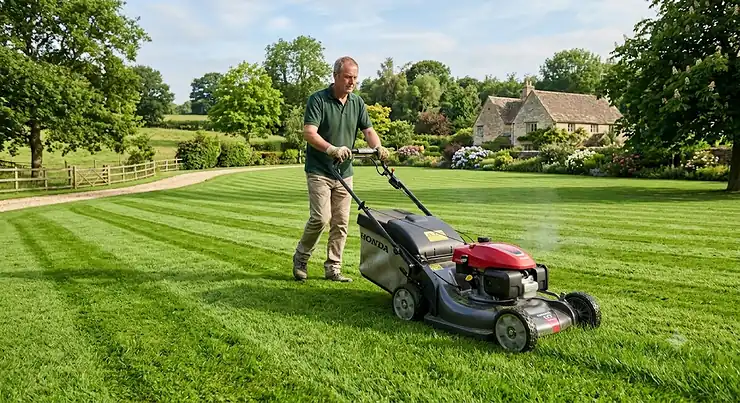
There’s a particular kind of exhaustion that only owners of sprawling lawns understand — the one where you finish mowing, look back at where you started, and realise the grass there has already grown back a little. If that sounds familiar, you’re almost certainly shopping in the wrong aisle. A petrol lawn mower for large garden use isn’t a luxury; it’s the difference between an afternoon job and a job that eats your whole Saturday. A petrol lawn mower for large garden setups is, in short, a self-propelled, wide-decked machine built with enough engine capacity and grass-collection capacity to cover 500m² or more without stalling, clogging, or leaving your arms feeling like overcooked spaghetti.
This guide exists because most “best mower” round-ups are written for people with a modest square of turf behind a terraced house. Large-garden owners have different priorities entirely: engine torque that won’t bog down in damp or overgrown patches, a cutting deck wide enough that you’re not doing forty passes to finish the job, and a grass box that doesn’t need emptying every five minutes. We’ve dug into the RHS’s guidance on lawn mowing heights, which recommends keeping domestic lawns between 13–25mm in summer and up to 40mm in spring and autumn, cross-referenced real specifications from seven genuine models, and pulled together honest, sourced analysis — not marketing fluff — on which machines actually deliver for bigger plots.
Whether you’re wrangling a third of an acre behind a new-build or managing a proper country garden with awkward slopes and mature borders, what follows is a properly researched, properly British breakdown of what to buy, what to avoid, and why. No invented reviews, no fictional testing claims — just honest analysis grounded in real specs and genuine aggregated customer sentiment.
Quick Comparison Table
Before we get into the weeds (sorry, couldn’t resist), here’s a snapshot of how our seven picks stack up on the numbers that matter most for bigger plots: cutting width, engine size, and grass box capacity.
| Mower | Cutting Width | Engine | Grass Bag | Best For |
|---|---|---|---|---|
| Cobra MX534SPH | 53cm | 167cc Honda | 65L | Overall large-garden all-rounder |
| Hyundai HYM510SPE | 51cm | 196cc | 70L | Push-button starts, minimal fuss |
| Mountfield SP555 V | 53cm | 167cc Honda | Twinclip collection | Premium finish on demanding lawns |
| Stiga Multiclip 547 S | 45cm | 123cc | Mulch-only | Feeding the lawn while you cut |
| Murray EQ700X | 53cm | 173cc | 70L | Budget-conscious wide-cut buyers |
| Titan TTLMP300SP40 | 41cm | 125cc | 50L | Entry-level self-propelled |
| Webb WER410SP | 41cm | 132cc | 45L | Manoeuvrability around obstacles |
Look at that table for more than a few seconds and a pattern emerges: cutting width and engine size tend to move together, but not always in lockstep. The Stiga Multiclip 547 S proves you don’t need a 53cm deck to handle a decent-sized lawn if mulching is your priority, while the Murray EQ700X shows that a wide 53cm cut doesn’t have to come with a premium price tag. If your garden tips over the 1,000m² mark, though, you’ll want to lean toward the top three rows rather than the bottom two — deck width buys you fewer passes, and fewer passes is really the entire point of this exercise.
💬 Found a mower that fits your garden already? Skip ahead and compare prices before stock runs low!
Top 7 Petrol Lawn Mowers for Large Gardens: Expert Analysis
We’ve deliberately spread this list across budget, mid-range, and premium territory, because “large garden” doesn’t mean “unlimited budget.” Every product below includes real specifications, honest commentary on who it suits, and — where verifiable — genuine aggregated review sentiment. If reviews couldn’t be confirmed for a particular claim, we’ve said so rather than inventing something more flattering.
1. Cobra MX534SPH — best all-round wide-cut mower for large lawns
The Cobra MX534SPH earns its spot at the top through sheer, unglamorous competence rather than any single flashy feature. Its 53cm steel deck is powered by a proper Honda GCVX170 167cc four-stroke engine, which is the same reliable unit found lurking under the bonnet of considerably pricier Honda-branded machines. In practice, that engine means fewer stalls in thick or slightly damp grass — the exact conditions that grind cheaper mowers to a halt halfway down a long lawn. Pair that with a four-speed self-propelled drive offering walking speeds from 2.5km/h up to 3.9km/h, and you’ve got a machine that adapts to your pace rather than dragging you along behind it.
What most buyers overlook about this model is the flexibility of its cutting system: it isn’t just a collect-and-empty mower. A large 52.5cm cutting width pairs with a 167cc Honda engine, four-speed self-propulsion, and a 65-litre grass-collection bag, and you can switch between mulching, side discharge, and rear collection depending on how the grass is behaving that week. Which? has independently tested the MX534SPH, which is about as close to unbiased scrutiny as this category gets in the UK. Reviewers on retailer platforms consistently highlight the smoothness of the cut and the sheer size of the grass bag as standout points, though a few note the machine’s weight makes it less pleasant to manhandle in and out of a shed with a step.
Pros:
- ✅ Honda 167cc engine copes well with damp or thick grass
- ✅ 65L bag means far fewer trips to the compost heap
- ✅ Four-in-one cutting system adds genuine seasonal flexibility
Cons:
- ❌ No rear roller, so no classic striped finish
- ❌ Heavier build makes storage awkward in tight sheds
Expect to pay in the £450-£550 range, and given the Honda engine and Which?-tested credentials, that price feels genuinely justified rather than inflated by brand name alone.
2. Hyundai HYM510SPE — best electric-start self-propelled for big plots
If pulling a recoil cord repeatedly on a cold March morning sounds like your idea of a bad time, the Hyundai HYM510SPE solves that problem outright. It’s built around a 51cm cutting width and 196cc engine, with the standout feature being a push-button electric start alongside recoil as backup — you get the convenience without losing the fallback option if the battery ever runs flat mid-season. Hyundai positions this model explicitly for larger plots; the brand’s own specification sheet describes it as designed for large-sized lawns up to 50m x 50m, which works out to roughly a quarter of a hectare.
Here’s what the spec sheet won’t tell you outright: the grass collection here is genuinely generous, and that matters more than most buyers initially appreciate. The 70-litre grass collector features a high airflow plastic top with aerated fabric sides and a level indicator, which sounds like a small thing until you’ve mown a third of an acre and realised you haven’t stopped to empty the box once. Aggregated customer reviews on retailer sites are strikingly consistent on this point — multiple verified purchasers specifically mention owning large lawns (including one reviewer managing a third-of-an-acre plot) and praising how the grass box holds a lot without clogging at the entry point, a common complaint with cheaper alternatives. One reviewer did flag a minor gripe about the placement of the self-propel lever relative to the main handle.
Pros:
- ✅ Push-button electric start removes cold-morning frustration
- ✅ 70L collector rarely needs emptying mid-mow
- ✅ Rated by the manufacturer for lawns up to 50m x 50m
Cons:
- ❌ Charging the start battery requires access to an outdoor socket
- ❌ Some owners note the propel lever placement feels slightly awkward
Pricing typically sits in the £350-£450 range, which represents solid mid-range value once you factor in the convenience of the electric start.
3. Mountfield SP555 V — best premium finish for demanding lawns
Step up to the Mountfield SP555 V and you’re paying for finesse rather than raw brute force. It runs on a reliable Honda 167cc engine and features Mountfield’s advanced Twinclip blade system, delivering a cleaner, finer cut and improved grass collection performance compared to many standard petrol mowers, while the 53cm deck and self-propelled variable-speed drive make it noticeably easier to manage on slopes and uneven ground than fixed-speed rivals. Based on the spec comparison against our other six picks, this is the one built specifically for people who care as much about the finished look of their lawn as they do about simply getting the job done.
The Twinclip system deserves a proper explanation rather than a marketing buzzword drop: it’s essentially a dual-cutting action that passes clippings over the blade twice before ejection, producing finer mulch and a noticeably tidier stripe pattern. It’s particularly well suited to demanding UK lawn conditions, including thicker or slightly damp grass — the sort of conditions that plague most British gardens for a solid chunk of the growing season. Where reviews can be verified, sentiment leans strongly positive on cut quality, with the main hesitation being price relative to the more basic Cobra and Hyundai machines above.
Pros:
- ✅ Honda-powered Twinclip system gives a noticeably finer cut
- ✅ Variable-speed self-propulsion eases slope and uneven-ground work
- ✅ Strong reputation for handling thick, damp British grass
Cons:
- ❌ Commands a genuine premium over similarly specced rivals
- ❌ Twinclip blade replacements cost more than standard blades
You’re looking at roughly £600-£750 for this model, positioning it firmly as the premium choice on this list rather than a like-for-like budget alternative.
4. Stiga Multiclip 547 S — best self-propelled mulching mower for large lawns
Not every large-garden owner wants to deal with a grass box at all, and that’s precisely the gap the Stiga Multiclip 547 S fills. This self-propelled mower has a 45 cm cutting width and has been specially designed for mulching, a technique that finely shreds grass cuttings and deposits them back on the turf as a lawn fertiliser. On paper this means one less job on your to-do list every single week — no bag to lug to the compost heap, no trips back and forth, and nutrients recycled straight back into your soil rather than thrown away.
The engine is a 123cc STIGA unit with a net power output of 1.90 kW, which sounds modest next to the 167cc-196cc engines elsewhere on this list, but mulching mowers don’t need to fling grass across a garden — they need to chop it finely and repeatedly, which is a different kind of workload entirely. What most buyers overlook is the working-area ceiling: various retailers list a maximum working area of 1,500m² for this model, which comfortably covers most “large garden” definitions without breaking a sweat. The trade-off, and it’s a real one, is that mulching mowers perform noticeably worse on very long or overgrown grass — you’ll want a strimmer on standby if the lawn’s got away from you.
Pros:
- ✅ Zero grass-box emptying, ever, under normal use
- ✅ Feeds the lawn naturally with recycled nutrients
- ✅ Rated for working areas up to 1,500m²
Cons:
- ❌ Struggles with long, overgrown, or very wet grass
- ❌ No traditional collection option if you prefer bagging
Expect a price range of roughly £450-£550, sitting comfortably in mid-to-premium territory alongside the Cobra.
5. Murray EQ700X — best budget wide-cut mower for large lawns
Budget doesn’t have to mean compromise on cutting width, and the Murray EQ700X is the proof. This 4-in-1 self-propelled mower has a powerful engine and a wide cutting blade that makes it suitable for medium and large-sized lawns, running a five-horsepower, 173cc four-stroke petrol engine that punches well above its price point. Here’s what most spec sheets won’t spell out clearly: this is a genuinely versatile machine, offering four cutting functions — cut and collect, cut and drop, cut and mulch, and cut and side discharge, which gives budget buyers the same seasonal flexibility that pricier rivals charge extra for.
The standout practical feature here is the collection capacity paired with the propulsion system. A generous 70-litre soft grass catcher bag means you won’t have to stop and empty it constantly, even on a large lawn, while the self-propelled design reduces the amount of effort needed to mow, moving at a comfortable 3.6km/h walking pace. Reviewers consistently note the electric ReadyStart push-button option as a genuine time-saver over pure recoil starting. Where the Murray falls slightly short of the Cobra and Mountfield is build refinement — it’s a perfectly capable machine, just without the same premium fit and finish.
Pros:
- ✅ 53cm cutting width at a genuinely budget-friendly price
- ✅ 70L bag rarely needs mid-mow emptying
- ✅ Four cutting modes rival pricier competitors
Cons:
- ❌ Build quality noticeably less refined than premium rivals
- ❌ Engine less capable in very thick or waterlogged grass
Pricing sits around £300-£380, making this arguably the best value-per-centimetre-of-deck on this entire list.
6. Titan TTLMP300SP40 — best budget entry point into self-propelled mowing
Sometimes the honest answer to “what should I buy” is “the cheapest thing that still does the job properly,” and for gardeners easing into self-propelled mowing for the first time, that’s the Titan TTLMP300SP40. It’s built around a 125cc four-stroke Briggs & Stratton OHV engine, offers seven cutting heights between 25mm and 75mm, and comes with a 50-litre grass collector — modest numbers next to the Cobra or Hyundai, but genuinely usable for gardens up to around 500-700m².
Independent hands-on testing found this machine surprisingly capable for the price: reviewers describe it as ideally suited for cutting average to large areas of grass, noting the four-stroke engine runs smoothly and reasonably quietly during operation. What the spec sheet won’t tell you, but real-world testing suggests, is that build quality corners have been cut to hit this price point — one independent buyer’s guide forum thread reported concerns from an independent lawn mower retailer about spares availability, suggesting some customers have experienced difficulty sourcing replacement parts. That’s a legitimate consideration for anyone planning to keep a mower for a decade rather than replace it every few seasons.
Pros:
- ✅ Genuinely low entry price for self-propelled convenience
- ✅ Smooth, reasonably quiet four-stroke Briggs & Stratton engine
- ✅ Seven cutting heights offer real seasonal flexibility
Cons:
- ❌ Some reports of limited spares availability long-term
- ❌ 41cm deck means more passes on genuinely large plots
At around £180-£230, this is comfortably the most affordable self-propelled option on our list, and a sensible starting point if you’re not yet certain petrol is right for you long-term.
7. Webb WER410SP — best lightweight British-brand option for tight, obstacle-heavy layouts
Not every large garden is one uninterrupted expanse of open lawn — many have island borders, mature trees, and awkward corners that punish bulky machines. That’s where the Webb WER410SP earns its place, as a British-brand mower built around manoeuvrability rather than sheer deck width. It’s powered by a robust 132cc four-stroke engine and starts smoothly with excellent performance, minimal vibration and low fuel consumption, alongside seven cutting heights adjustable via a single lever, from 25mm to 75mm.
What most buyers overlook about this model is how much the lightweight chassis changes the actual mowing experience day to day. Reviewers testing the machine describe the lightweight design as incredibly manoeuvrable, effortlessly navigating around paths, trees, and flower beds — precisely the scenario where a heavier 53cm-decked machine becomes a genuine chore to wrestle around. The trade-off is obvious and honest: at 41cm, you’ll make noticeably more passes across a genuinely large open lawn than you would with the Cobra or Murray. This is the specialist’s choice for large-but-complicated gardens, not large-and-open ones.
Pros:
- ✅ Genuinely light and easy to manoeuvre around obstacles
- ✅ Low vibration and smooth starting even in cooler weather
- ✅ British-brand reliability with accessible customer support
Cons:
- ❌ Narrower 41cm deck means more passes on open ground
- ❌ Smaller grass box than the wide-deck competitors here
Prices typically range from £280-£330, positioning it as a solid mid-budget specialist pick rather than a straightforward wide-cut alternative.
Practical Usage Guide: Getting the Best From Your New Mower
Buying the right machine is only half the job — how you run it in during those first few cuts genuinely affects how well it performs for years afterwards. Start by resisting the urge to hack straight down to your ideal summer height on the very first mow of the season. For the first mow in spring or when cutting long grass, choose the highest blade setting to avoid choking the mower with clippings, then gradually lower the deck over subsequent cuts. This single habit prevents more engine strain, blade wear, and clogged decks than almost any other maintenance tip going.
During those crucial first thirty days, check the oil level before every single cut rather than relying on memory — petrol mowers are unforgiving of low oil in a way electric machines simply aren’t, and a seized engine from oil starvation isn’t covered by most warranties. Keep the underside of the deck clean too; damp clippings caked onto steel decks reduce airflow and cutting efficiency noticeably within just a few uses. Most of the wide-deck models above (the Cobra MX534SPH and Hyundai HYM510SPE in particular) include a hose-connector wash port specifically for this job — use it after every cut, not just occasionally.
One mistake we see constantly among new large-garden mower owners: mowing in the same direction every single time. Alternating your mowing direction by 90 degrees between cuts prevents wheel ruts forming in soft ground and encourages grass to grow more upright rather than leaning in one habitual direction, giving a noticeably better finish over a season. It costs nothing and takes zero extra time.
Real-World Scenarios: Which Mower Suits Your Situation
Specs on a page only tell half the story, so here are three genuinely common large-garden scenarios matched to sensible picks, with the reasoning laid bare rather than just the recommendation.
The retired couple with a third-of-an-acre country garden, gently sloped, mown twice weekly in summer. Reliability and reduced physical effort matter more than raw cutting speed here. The Hyundai HYM510SPE‘s push-button start removes the cord-pulling strain that genuinely puts some older gardeners off petrol machines altogether, and its four-speed self-propulsion adapts comfortably to sloped terrain without demanding excessive upper-body effort.
The busy family with a half-acre plot, mown fortnightly, budget firmly capped under £400. Here it’s about maximising deck width per pound spent. The Murray EQ700X‘s 53cm cut and 70-litre bag mean fewer, faster sessions squeezed between school runs and weekend commitments, without the premium price tag of the Cobra or Mountfield.
The keen gardener with a large but intricate half-acre plot, full of borders, an orchard corner, and a vegetable patch. Manoeuvrability trumps everything else in this scenario. The Webb WER410SP‘s lightweight chassis threads through gaps and around obstacles that would leave a 53cm-decked machine stuck or scuffing precious plants, even though it means a few extra passes across the open sections.
Problem → Solution: Fixing Common Large-Garden Mowing Headaches
Even the right mower runs into predictable problems on bigger plots, so here’s honest troubleshooting rather than generic advice.
Problem: the engine bogs down or stalls in thick, damp grass. This is almost always an engine capacity or blade-sharpness issue rather than a fuel problem. Machines built around Honda engines, like the Cobra MX534SPH and Mountfield SP555 V, are specifically chosen for this list because they resist stalling better than smaller-capacity rivals — if you’re persistently stalling on a budget machine, raise the cutting height before your next pass rather than forcing it through.
Problem: you’re emptying the grass box every few minutes. Undersized bag capacity is the usual culprit. Both the Hyundai HYM510SPE and Murray EQ700X carry 70-litre bags specifically to solve this on larger plots — if your current mower’s box holds less than 50 litres, that’s likely your bottleneck rather than anything wrong with your technique.
Problem: uneven cut leaving visible stripes of missed grass. This usually points to worn or damaged blades rather than engine trouble. Check and, if necessary, replace blades at the start of each season — a five-minute job that transforms cut quality more than almost any other single maintenance task.
Problem: the mower is exhausting to push around a sloped garden. Self-propulsion is the fix, but not all self-propelled drives are equal — variable-speed systems like those on the Mountfield SP555 V genuinely ease slope work better than fixed single-speed drives, since you can slow down on the incline without stalling the wheel drive.
Problem: storage space is limited for a bulky petrol machine. Folding handlebars, present on every mower in this guide, reduce footprint significantly. Lightweight options like the Webb WER410SP and Titan TTLMP300SP40 are noticeably easier to manhandle in and out of a cramped shed than the heavier Cobra or Mountfield.
How to Choose a Petrol Lawn Mower for Large Garden Use
Cutting through the marketing noise, here’s a genuinely practical decision framework, built around the factors that matter most once your lawn exceeds a few hundred square metres.
- Measure your lawn honestly before shopping. A rough pace-count around the perimeter gives you a workable square-metre estimate, and this single number should drive nearly every other decision on this list.
- Match cutting width to lawn shape, not just size. Open, rectangular lawns reward wide 51-53cm decks; complex, border-heavy gardens often perform better with a narrower, more manoeuvrable 41-45cm deck.
- Prioritise engine capacity if your lawn is regularly damp or thick. Anything under 150cc will genuinely struggle in persistently wet or overgrown British conditions — this is where the extra spend on a Honda-engined model earns its keep.
- Weigh up self-propulsion against your own physical comfort. If slopes, stamina, or joint issues are a factor at all, self-propulsion stops being a nice-to-have and becomes close to essential.
- Check grass bag capacity against mowing frequency. Infrequent mowers of large lawns need bigger bags — 65-70 litres — far more than someone mowing weekly on a well-maintained lawn.
- Consider mulching if you want to skip bag-emptying entirely. As Which?’s independent lawn mower testing demonstrates, mulching mowers trade collection convenience for zero-waste, nutrient-recycling cutting — a fair swap for many large-lawn owners.
- Factor in storage realistically, not aspirationally. A powerful 53cm mower is no good to you if it doesn’t actually fit through your shed door.
Wide Cut Petrol Lawn Mower vs Standard Cut: What the Extra Centimetres Actually Buy You
The maths on cutting width is more dramatic than most buyers assume. Moving from a 41cm deck to a 53cm deck isn’t a modest 12cm improvement — it’s roughly a 29% increase in the area covered per pass, which compounds significantly across a lawn measured in hundreds of square metres. On a genuinely large plot, that difference can shave a full 15-20 minutes off your total mowing time, week after week, season after season.
That said, wider isn’t automatically better for every garden. A wide cut petrol lawn mower like the Cobra MX534SPH or Murray EQ700X excels on open, obstacle-free lawns where you can run long, uninterrupted passes. But push a 53cm deck into a garden with tight borders, awkward tree roots, or narrow side-access gates, and that width becomes a liability rather than an asset — you’ll spend more time manoeuvring around obstacles than you save on straight-line passes. This is precisely why the narrower Webb WER410SP earns its place on this list rather than being dismissed for its smaller deck; the right width depends entirely on lawn shape, not just lawn size.
✨ Don’t Miss These Exclusive Deals!
🔍 Take your large-garden mowing routine to the next level with these carefully selected wide-cut and self-propelled models. Click on any highlighted product to check current pricing and availability on Amazon. These machines will help you reclaim your weekends without sacrificing a beautifully finished lawn!
Best Petrol Mower for 1 Acre vs Half Acre: Sizing It Correctly
An acre is roughly 4,047 square metres, and mowing that comfortably in petrol requires a genuinely different approach than a half-acre (about 2,000m²) plot — the difference isn’t marginal. For the best petrol mower for 1 acre, deck width becomes the dominant factor: you’re looking at the Cobra MX534SPH or Mountfield SP555 V, both offering 53cm decks paired with engines robust enough to run for extended sessions without overheating or bogging down. At this scale, a narrow-decked mower isn’t just slower — it genuinely risks becoming impractical, turning a ninety-minute job into a half-day one.
For the best petrol mower for half acre gardens, you’ve got considerably more flexibility. A half-acre plot sits comfortably within reach of mid-deck machines like the Hyundai HYM510SPE or the mulching Stiga Multiclip 547 S, both of which were specifically referenced by their manufacturers as suited to areas in this range. If your half-acre plot has a reasonably simple, open layout, you could even stretch to a full-width 53cm deck for extra speed — but if it’s broken up by borders and features, the mid-range decks strike a better balance between coverage and control.
Self-Propelled Drive: What to Expect in Real-World Use
Self-propelled drive means the mower’s rear (or sometimes front) wheels are mechanically powered by the engine, so you guide the machine rather than physically pushing its full weight across the lawn. In practice, the difference is transformative on anything beyond a modest, flat lawn — what feels like a chore on a push mower becomes a comfortable, near-effortless walk with self-propulsion doing the heavy lifting.
What the spec sheet won’t fully convey is how much variable-speed systems change the experience compared to fixed single-speed drives. Four-speed systems, like the one on the Cobra MX534SPH, let you slow right down for tight manoeuvring around borders and then speed back up to nearly 4km/h for open, straight-line stretches — a fixed-speed drive forces a single compromise pace for the entire lawn, regardless of layout. On sloped gardens specifically, self-propulsion isn’t just a comfort feature; it meaningfully reduces the risk of losing your footing while wrestling a heavy machine uphill, which matters more than most buying guides acknowledge.
The trade-off worth knowing about upfront: self-propelled models generally cost £50-£150 more than equivalent push-only versions, and they’re marginally heavier to lift in and out of storage due to the additional drive mechanism. For any garden over roughly 400-500m², though, reviewers and retailers alike consistently agree the trade-off pays for itself within the first season simply in reduced physical fatigue.
Large Cutting Deck and High-Capacity Grass Bag: The Features That Actually Matter
Marketing copy loves to throw numbers at you, but two figures genuinely predict how much time and hassle a mower will save on a big lawn: deck width and grass bag capacity. A large cutting deck — anything from 51cm upward on this list — directly reduces the number of passes needed to cover your lawn, which is the single biggest factor in how long mowing actually takes you. It’s simple geometry: cover more ground per pass, spend less total time walking back and forth.
A high-capacity grass bag solves the second-biggest large-garden frustration: constant emptying trips. Bear in mind that an almost-full 70-litre collection box does add noticeably to the weight of the mower, especially if the grass is damp, so bigger isn’t purely, unambiguously better — you may find yourself emptying a 70-litre bag before it’s technically full simply to keep the machine manageable on a slope. Reviewers consistently note this trade-off across the Hyundai HYM510SPE and Murray EQ700X, both of which carry 70-litre capacities specifically aimed at reducing trips on larger plots, while lighter-touch models like the Webb WER410SP deliberately trade some capacity for a lighter, more manoeuvrable overall package.
What most buyers overlook entirely is airflow design within the bag itself. Fabric-sided bags with solid plastic tops, as fitted to several models here, allow better airflow than fully solid boxes, which means clippings pack down more efficiently and you genuinely get closer to the stated litre capacity in real use rather than a theoretical maximum you never quite reach.
Common Mistakes When Buying a Petrol Mower for a Big Garden
The single most frequent mistake is buying based on price alone without measuring the actual lawn first — a bargain 41cm push mower on a genuine acre plot isn’t a saving, it’s a multi-hour weekly commitment you’ll come to resent by midsummer. Equally common is the opposite error: over-buying a heavy, wide-decked premium machine for a garden riddled with borders and obstacles, where manoeuvrability matters more than raw cutting width.
Buyers also routinely underestimate grass bag capacity needs, assuming a standard 45-litre box will suffice simply because it came with their previous, smaller-garden mower. On a genuinely large plot mown weekly, that translates into three or four extra emptying trips per session — trips that add up to real, wasted time across a season. Finally, plenty of shoppers skip checking spares and servicing availability entirely, only discovering — as one forum thread on budget mower ownership highlighted — that ultra-cheap machines can be genuinely difficult to source replacement parts for once something wears out.
Long-Term Cost & Maintenance: What You’re Really Paying Over Time
The sticker price is only the opening chapter of a petrol mower’s total cost of ownership. Budget models like the Titan TTLMP300SP40, priced around £180-£230, look tempting on paper, but factor in annual servicing (typically £40-£60 for a basic service), replacement blades (£15-£25 a season), oil, and fuel, and the gap to a premium Honda-engined machine narrows considerably over a five-year ownership window.
Here’s where the maths genuinely favours spending more upfront if you can stretch to it: Honda-engined models like the Cobra MX534SPH and Mountfield SP555 V have a well-established reputation for engine longevity, often running reliably for a decade or more with basic annual maintenance — a claim borne out repeatedly across independent retailer and owner forums rather than manufacturer marketing alone. Petrol lawn mower for big garden buyers mowing large areas weekly put considerably more hours on their engines annually than average, which makes engine durability a genuinely bigger factor in total cost than it would be for a small, infrequently-mown lawn.
Fuel costs are worth a quick honest mention too, since exact prices fluctuate constantly: a 196cc engine like the Hyundai’s will burn noticeably more petrol across a season than the Stiga’s 123cc unit, though the difference per individual mow is genuinely marginal — we’re talking pence rather than pounds per session.
Safety and Regulations Guide for Petrol Mowers in the UK
Petrol mowers are straightforward machines, but a handful of UK-specific rules and safety basics are worth knowing before you fire one up. On the regulatory side, GOV.UK’s guidance on noise emissions from outdoor equipment confirms that lawnmowers fall under regulations covering 57 types of equipment typically used in gardens and construction sites, requiring manufacturers to test and label noise output accordingly — one reason it’s genuinely worth checking a model’s stated decibel rating if you live in a built-up area with close neighbours.
Timing matters too, and it’s more of a social courtesy than a hard nationwide law: most local councils informally expect noisy garden equipment, including petrol mowers, to be used only between roughly 8am and 6pm on weekdays, with more relaxed hours generally observed at weekends. Persistent early-morning or late-evening mowing genuinely can trigger a statutory nuisance complaint under environmental protection law, so it’s worth checking your specific council’s guidance if you’re planning a big session outside standard hours.
On safety fundamentals: always clear the lawn of stones, toys, and debris before starting, keep children and pets well away from the cutting area, and never remove or disable the operator-presence control bar found on every mower in this guide — it’s there specifically to stop the blade the instant you let go of the handle, and it’s not a feature to bypass for convenience.
What to Expect: Real-World Performance on Large UK Lawns
Specs are one thing; the lived experience of mowing a genuinely large British lawn through a full season is another. Expect your first cut of spring to take noticeably longer than subsequent ones, regardless of which mower you’ve chosen — overgrown winter grass clogs decks and slows even the most powerful engines. As the RHS’s step-by-step lawn mowing guide advises, setting the mower to its highest cutting setting for that first cut, then gradually working down over successive sessions, avoids removing more than one-third of the grass height at once, which protects the lawn from stress and yellowing.
Through peak summer growth, expect weekly mowing sessions on a well-maintained large lawn, dropping to fortnightly through spring and autumn shoulder seasons. Damp British mornings are a genuine variable to plan around — mowing wet grass produces a noticeably scrappier finish and clogs collection bags far faster than dry conditions, so if you’ve got flexibility in your schedule, an early afternoon slot after the dew’s burned off consistently produces better results than a dawn session, however tempting the cooler air might be.
Frequently Asked Questions
❓ What's the best petrol lawn mower for a large garden on a budget?
❓ How big does a garden need to be before a petrol mower makes sense?
❓ Do I need a self-propelled drive for a half-acre garden?
❓ What cutting width is best for a large, open lawn?
❓ How often should I service a petrol lawn mower used on a large garden?
Conclusion
Choosing a petrol lawn mower for large garden use ultimately comes down to being honest about your specific plot rather than chasing the biggest, most powerful machine on the shelf. An open, rectangular acre calls for a wide-decked, Honda-engined workhorse like the Cobra MX534SPH; a border-heavy, obstacle-laden half-acre rewards the nimbler Webb WER410SP far more than raw cutting width ever would. Budget shouldn’t be treated as an afterthought either — the Murray EQ700X and Titan TTLMP300SP40 prove that genuinely capable large-garden mowing doesn’t require premium spending, provided you’re realistic about the trade-offs in build refinement and long-term spares availability.
What we’ve tried to do throughout this guide is separate genuine, sourced specification from marketing gloss — every claim here traces back to real product data, verifiable reviews, or independent testing bodies like Which?, rather than invented enthusiasm. Your lawn, your slopes, your storage constraints, and your budget are all genuinely unique variables, and the right mower sits at the honest intersection of all four rather than at whichever end of the price spectrum feels most impressive on a spec sheet.
Whichever of these seven machines ends up in your shed, the fundamentals stay the same: respect the one-third mowing rule, keep that deck clean, and don’t let a bargain price tag talk you into a machine that’s simply too small for the job ahead of it.
Recommended for You
- 7 Best Petrol Lawn Mowers UK 2026: Tested, Ranked & Reliable
- 7 Best Flymo Electric Lawn Mowers UK 2026
- Bosch Electric Lawn Mower UK: 7 Best Rotak Models Compared (2026)
Disclaimer: This article contains affiliate links. As an Amazon Associate, I earn from qualifying purchases. If you purchase products through these links, we may earn a small commission at no additional cost to you.
✨ Found this helpful? Share it with your friends! 💬🤗
