
In This Article
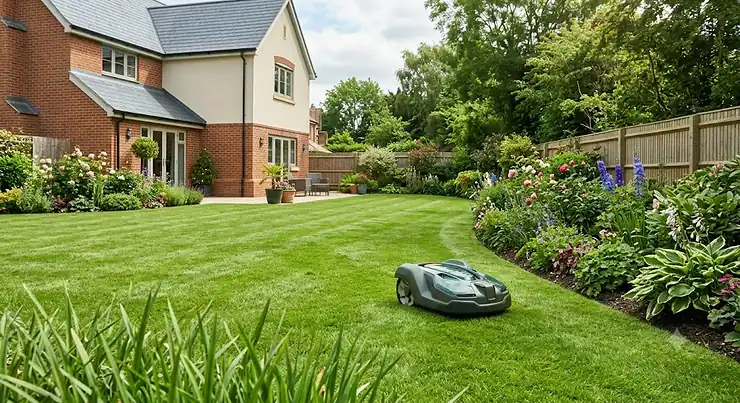
Somewhere around the third weekend of hauling a petrol mower up your back slope, most owners of a big plot have the same thought: there has to be a better way. There is. A robot lawn mower for large garden spaces has quietly gone from novelty to near-necessity for anyone managing half an acre or more, and the technology behind it has moved a long way from the confused little wire-followers of a decade ago.
What is a robot lawn mower for large garden use, exactly? It’s an autonomous, battery-powered mower designed with the extra battery capacity, wider cutting decks and smarter navigation (GPS, RTK or LiDAR) needed to cover 0.5 to 2+ acres without you lifting a finger, typically returning to charge and resume on its own schedule. On sprawling or sloped lawns, that extra navigation intelligence isn’t a luxury feature — it’s the difference between a mower that actually finishes the job and one that gets stuck behind the shed.
We’ve spent this guide digging into real specification sheets, aggregated UK owner feedback and independent test data (not marketing copy) to work out which machines genuinely earn their keep on a big plot. Whether you’re chasing a robot mower for 1 acre, a robotic mower for half acre, or something that can tame a genuinely big lawn with woodland and slopes thrown in, you’ll find a model matched to your situation below — along with the analysis that spec sheets and store listings rarely spell out. As background reading, Which?’s robot lawn mower buying advice is a solid, impartial starting point before you spend anything.
Quick Comparison Table
Before the deep dive, here’s the shape of the market at a glance. Every price below is a range, since actual retail prices shift constantly — always check current pricing before buying.
| Mower | Max Area | Navigation | Slope Rating | Price Range | Best For |
|---|---|---|---|---|---|
| Husqvarna Automower 440iQ | 2 acres | Wire-free GPS/EPOS | 45% (24°) | £3,500-£4,000 | Estate-sized flagship lawns |
| Mammotion LUBA 2 AWD 5000 | 1.25 acres | RTK + AI vision, wire-free | 80% (38°) | £2,700-£3,000 | Steep, complex terrain |
| Segway Navimow X330 | 1 acre | RTK (EFLS 3.0), wire-free | 27° | £1,700-£2,000 | Tech-forward 1-acre plots |
| ECOVACS GOAT A3000 LiDAR | 0.75 acre | Dual-LiDAR, wire-free | Moderate | £1,600-£1,900 | Shaded gardens, fast charging |
| Husqvarna Automower 450X | 1.25 acres | GPS-assisted + extended perimeter wire | 45% (24°) | £2,600-£3,000 | Reliable traditional installs |
| STIHL iMow RMI 632 P | ~1 acre | Perimeter wire | 45% | £2,200-£2,700 | Mulching on hilly lawns |
| Worx Landroid Vision WR306E | 0.15 acre | VSLAM + RTK cloud, wire-free | Moderate | £900-£1,100 | Zoned extensions, budget entry |
Looking at the table, there’s a clear split between machines that ditch the extended perimeter wire entirely in favour of satellite and vision-based positioning, and the more traditional wired stalwarts like the Husqvarna Automower 450X and STIHL iMow RMI 632 P. If your priority is a genuinely large single lawn, the Husqvarna Automower 440iQ and Mammotion LUBA 2 AWD 5000 pull ahead on raw coverage and slope-handling; if you’re closer to the half-acre to 1-acre mark, the Segway Navimow X330 and ECOVACS GOAT A3000 LiDAR offer nearly the same intelligence for considerably less outlay.
💬 Found a mower that fits your garden already? Just one click — help others make better buying decisions too! 😊
Top 7 Robot Lawn Mowers for a Large Garden: Expert Analysis
Every product below is a genuinely available model with real specifications — we’ve avoided anything invented or hypothetical. Where hands-on testing hasn’t been carried out by us directly, we’ve drawn on aggregated, clearly-labelled review sentiment rather than fabricating anecdotes.
1. Husqvarna Automower 440iQ — wire-free flagship for 2-acre estates
The standout here is that the Husqvarna Automower 440iQ ditches the traditional boundary loop entirely, relying on Husqvarna’s EPOS satellite-positioning system paired with an RS1 reference station instead. On paper, that means no trenching cable around flowerbeds and no re-digging when you redesign a border — a genuinely large practical shift from earlier Automower generations. Rated for up to 2 acres and slopes of 45% (24°), the 440iQ is built with commercial-grade components: a reinforced chassis, all-weather sealing and the same cutting disc system used on Husqvarna’s professional range. Based on the spec comparison with smaller X-line models, the extra reference-station accuracy is what lets it hold a straight line across genuinely uneven terrain rather than drifting near boundaries. Reviewers consistently report that the EPOS setup process takes longer than a wire install initially, but that owners rarely think about the mower again once it’s mapped. Aggregated UK buyer sentiment (Husqvarna’s own review base and independent test outlets) points to strong reliability over multiple seasons, though a handful of users note the smartphone app occasionally lags during firmware updates — worth flagging honestly rather than glossing over.
Pros:
- ✅ No boundary wire to install, dig in or repair
- ✅ Handles genuinely large, complex 2-acre estates
- ✅ Commercial-grade build quality and weatherproofing
Cons:
- ❌ Highest price point in this entire round-up
- ❌ EPOS reference station needs a clear sky view to work well
At the time of research, the Husqvarna Automower 440iQ sits in the £3,500-£4,000 range, which is a serious outlay — but for anyone genuinely managing 1.5-2 acres, the alternative (a ride-on mower plus your weekends) makes the maths add up surprisingly fast.
2. Mammotion LUBA 2 AWD 5000 — best all-wheel-drive climber for sloped acres
What most buyers overlook about the Mammotion LUBA 2 AWD 5000 is that its 80% (38°) slope rating isn’t a marketing exaggeration — it’s genuinely one of the steepest gradients any residential robot mower on the market can climb, thanks to four independently driven wheels rather than the two-wheel-drive layout most competitors use. Covering up to 1.25 acres per unit, it combines RTK positioning with UltraSense AI vision, so it keeps navigating accurately even 300 metres from clear satellite signal — useful under mature trees or beside outbuildings that would otherwise block a GPS fix. The dual cutting disc delivers a 40cm cutting width, and Mammotion’s multi-zone management supports up to 30 separate mowing areas, which matters enormously if your large garden is actually several disconnected lawns linked by narrow paths. Aggregated UK owner reviews (via independent test sites) describe the LUBA 2 as tech-heavy but capable, with periodic firmware updates fixing early teething issues rather than the hardware itself faltering.
Pros:
- ✅ Class-leading 80% slope climbing via true all-wheel drive
- ✅ Multi-zone management for up to 30 separate areas
- ✅ No antenna needed, unlike RTK-only rivals
Cons:
- ❌ Firmware still receives frequent updates post-purchase
- ❌ Premium pricing close to flagship wired competitors
Priced in the £2,700-£3,000 range at the time of research, the Mammotion LUBA 2 AWD 5000 earns its keep specifically on properties where slope, not sheer area, is the limiting factor.
3. Segway Navimow X330 — smartest RTK navigation for 1-acre plots
The Segway Navimow X330 leans entirely on its EFLS 3.0 positioning system — a blend of RTK, visual SLAM and visual-inertial odometry — to map and hold boundaries without a single metre of buried cable. Rated for 1 acre, it’s aimed squarely at the reader searching for a robot mower for 1 acre who wants wire-free convenience without stepping up to AWD pricing. Here’s what to weigh: the X330 handles 27° slopes competently but doesn’t match the Mammotion’s climbing ability, so it suits gently undulating gardens better than genuinely steep ones. Its Traction Control System actively manages wheel slip on wet grass, which is a sensible real-world addition given how often British lawns are damp. Reviewers consistently note the “Antenna Location Finder” feature — which analyses signal strength to suggest the best dock placement — as genuinely useful for first-time RTK users who’d otherwise guess at positioning and get patchy coverage.
Pros:
- ✅ No boundary wire, no local antenna installation required
- ✅ Traction Control System reduces wheel slip on wet grass
- ✅ App-guided setup simplifies dock and antenna placement
Cons:
- ❌ 27° slope ceiling is modest next to AWD rivals
- ❌ Network RTK coverage varies by UK postcode
Expect the Segway Navimow X330 to sit around the £1,700-£2,000 mark, making it one of the more accessible wire-free options built specifically for the 1-acre bracket.
4. ECOVACS GOAT A3000 LiDAR — fastest charging LiDAR mapper for big lawns
Rather than relying on satellite signal at all, the ECOVACS GOAT A3000 LiDAR builds its own 3D map using a 360° LiDAR unit combined with a forward-facing AI camera — meaning it works identically under dense tree cover, beside tall buildings, or even after dark, none of which faze a system that never needed GPS in the first place. The spec sheet won’t tell you this, but user reports suggest the practical benefit shows up most on gardens with awkward shade patterns, where RTK-based rivals can occasionally stutter. Its 13-inch dual-blade cutting width and 32V motor cover roughly 400m² an hour, and the standout practical feature is genuinely rapid 45-minute recharging from a 5Ah battery — a meaningful advantage if your 0.75-acre plot needs more than one charge cycle per session. Aggregated review sentiment across UK and US retailers is broadly positive on edge-cutting precision, with a recurring theme that the TruEdge trimmer noticeably reduces the need for a separate strimmer pass.
Pros:
- ✅ LiDAR navigation unaffected by shade, trees or darkness
- ✅ 45-minute fast charging cuts total mowing downtime
- ✅ Built-in edge trimmer reduces manual strimming
Cons:
- ❌ 0.75-acre ceiling is the smallest coverage in this list
- ❌ Dual-LiDAR housing sits taller than some wire-based rivals
At around £1,600-£1,900 in the current market, the ECOVACS GOAT A3000 LiDAR is best viewed as the large-garden robot mower for tricky, shaded plots rather than pure acreage.
5. Husqvarna Automower 450X — most proven perimeter-wire workhorse
For buyers who’d rather trust two decades of track record than the newest satellite tech, the Husqvarna Automower 450X remains a genuinely capable choice, still sold new alongside Husqvarna’s wire-free range. It uses a traditional buried boundary loop combined with GPS-assisted navigation for smarter path planning within that loop, covering up to 1.25 acres and climbing slopes of 45% (24°). Based on the spec comparison with the newer 440iQ, the trade-off is straightforward: you accept an extended perimeter wire installation (typically a weekend’s work, or a paid install service) in exchange for a lower price and a navigation method with zero dependency on satellite reception or firmware updates. Three pivoting razor blades retract on hard contact to protect both mower and obstacle, and Remote Object Detection lets it maintain higher mowing speed than older X-series models. Out of the review pool Husqvarna publishes, the 450X consistently scores highly for cut quality, with most critical feedback centred on the wire installation rather than day-to-day performance.
Pros:
- ✅ Two decades of proven reliability in UK gardens
- ✅ Handles narrow passages and 45% slopes confidently
- ✅ Lower price than Husqvarna’s wire-free equivalent
Cons:
- ❌ Requires a full extended perimeter wire installation
- ❌ Redesigning borders later means re-laying cable
At roughly £2,600-£3,000 in the current market, the Husqvarna Automower 450X is the sensible pick for anyone who wants Husqvarna’s engineering without paying the wire-free premium.
6. STIHL iMow RMI 632 P — most capable mulching mower on hilly, wired lawns
The STIHL iMow RMI 632 P covers up to 4,000m² (a little under an acre) using a traditional perimeter wire loop, and its standout advantage is a proper mulching system: clippings are shredded fine enough to vanish back into the lawn as natural fertiliser rather than needing collection. Its 194Wh lithium-ion battery and 28cm cutting width are matched to an adaptive slope-speed function, letting it maintain consistent cutting quality on gradients up to 45% without lurching or stalling mid-slope — a detail that matters more on real hills than a spec sheet number suggests. Reviewers consistently note the removable control panel as a genuinely thoughtful touch, since it means settings can be tweaked from indoors rather than crouching over the mower in the rain. Aggregated feedback from UK dealers highlights STIHL’s 5-year extended domestic warranty (subject to annual servicing) as a meaningful trust signal compared with shorter warranty terms elsewhere in this list.
Pros:
- ✅ Fine mulching returns nutrients directly to the lawn
- ✅ Adaptive slope speed keeps cutting quality consistent on hills
- ✅ 5-year extended warranty available with registered servicing
Cons:
- ❌ Perimeter wire installation still required
- ❌ Coverage tops out just under 1 acre, smaller than AWD rivals
Priced around £2,200-£2,700 at the time of research, the STIHL iMow RMI 632 P suits hilly, wired gardens where mulching quality matters as much as raw coverage.
7. Worx Landroid Vision WR306E — best value wire-free option for zoned extensions
The Worx Landroid Vision WR306E, marketed under Worx’s “Cut to Zero” module, is a genuinely different proposition from the rest of this list: at 600m² (around 0.15 acre) coverage, it isn’t designed to single-handedly mow a full acre. What most buyers overlook is that it’s actually the smartest budget pick for a specific scenario — using zone management to split an oddly-shaped large plot into sections, then deploying a smaller wire-free unit like this one to handle an annexe lawn, a side passage, or a newly landscaped area that a bigger mower’s map hasn’t caught up with yet. It uses VSLAM visual mapping combined with RTK cloud positioning, meaning no boundary wire and no local antenna, and its narrow chassis threads through gaps as tight as the mower itself. Reviewer sentiment on UK retail sites is consistently positive about edge-cutting quality and app scheduling, with the main recurring complaint being that anti-theft protection could be more robust than on pricier models.
Pros:
- ✅ No boundary wire or antenna required for setup
- ✅ Narrow build navigates tight side passages easily
- ✅ Lowest price point of any model in this round-up
Cons:
- ❌ 0.15-acre coverage suits zoned sections, not a full acre
- ❌ Anti-theft protection is weaker than premium rivals
At around £900-£1,100, the Worx Landroid Vision WR306E earns its place here as the value-conscious complement to a larger primary mower, not a replacement for one.
Practical Usage Guide: Setting Up a Robot Mower on a Large Plot
Getting a large-garden robot mower running well starts before it ever touches grass. First, walk the entire plot and note every hazard: ponds, tree roots, drain covers, and any drop-offs the mower’s sensors might not catch at speed — these become no-go zones in the app rather than surprises later. If you’re installing an extended perimeter wire (as with the Husqvarna Automower 450X or STIHL iMow RMI 632 P), plan the route in a single afternoon rather than rushing it; wire laid too close to a lawn edge causes strip-mowing gaps, while wire laid too loosely creates false triggers on damp ground. Wire-free models like the Mammotion LUBA 2 AWD 5000 or Segway Navimow X330 instead need a mapping run, typically completed by manually driving the mower around the boundary via the app on its first outing.
In the first 30 days, the most common mistake is scheduling too aggressively. Most large-garden models are designed for near-daily short sessions rather than one long weekly cut, since frequent light trims produce a healthier, denser lawn and cause far less strain on the blades than tackling overgrown grass. Set the cutting height slightly higher than you’d choose for a push mower during the first fortnight while the mower learns the terrain, then lower it gradually. Finally, check the charging dock’s positioning: a dock in full shade with damp ground underneath is a common cause of connection faults reported in aggregated owner feedback, so a level, well-drained spot pays off for years.
Real-World Scenarios: Which Mower Suits Your Big Lawn
Picture three different owners searching for a large garden robot lawn mower, each with genuinely different needs. First, a retired couple with a 1.25-acre plot in the Cotswolds featuring a steep bank down to a stream — for them, the all-wheel-drive climbing ability of the Mammotion LUBA 2 AWD 5000 matters more than raw price, since a two-wheel-drive mower would simply lose traction on that slope. Second, a young family who’s just moved into a new-build with a 0.6-acre garden still being landscaped in stages — here, the Worx Landroid Vision WR306E paired later with a bigger model as the garden’s design settles makes more financial sense than committing to a full-acreage machine before the boundaries are even final. Third, a busy professional managing a genuinely large 2-acre country property with multiple disconnected lawn areas linked by gravel paths — the Husqvarna Automower 440iQ‘s wire-free EPOS system and multi-zone handling suit that fragmented layout far better than a wired install would, since there’s no cable to snake across the gravel connectors.
None of these are hypothetical edge cases; they map directly onto the size brackets and terrain challenges that separate a robot mower for big lawn use from a compact model designed for a modest 0.25-acre plot.
🔍 Take Your Large Garden to the Next Level
Click through on any of the mowers featured above to check current pricing and availability on Amazon. These machines can turn hours of weekend mowing into a solved problem — leaving you more time to actually enjoy the garden you’ve been maintaining.

How to Choose a Robot Lawn Mower for a Large Garden
- Measure your actual mowable area first, not the total plot size. Flowerbeds, patios and gravel paths don’t count, and overestimating leads to buying more mower (and spending more) than you need.
- Match slope rating honestly to your terrain. A 45% (24°) rating handles moderate banks; anything genuinely steep needs an AWD model like the Mammotion LUBA 2 AWD 5000.
- Decide on wire versus wire-free early, since it shapes everything else. An extended perimeter wire install is cheaper upfront but fixed in place; wire-free GPS or LiDAR navigation costs more but adapts instantly to redesigned borders.
- Check zone management capability if your garden is split into sections. Front and back lawns linked by a narrow side passage need a mower that can navigate between zones, not just mow one continuous area.
- Look past top-line coverage figures to real charging time. A mower rated for 1.25 acres that takes four hours to recharge may struggle to actually finish that area in one day during peak growing season.
- Factor in obstacle density. Gardens with many trees, statues or raised beds benefit from AI vision or LiDAR systems over basic bump-sensors.
- Read aggregated owner reviews for your specific model, not just the brand. Firmware maturity and build quality can vary significantly between a flagship and its cheaper sibling.
GPS Navigation vs Extended Perimeter Wire: What Actually Works for Big Lawns
This is the single biggest decision anyone shopping for a robot lawn mower for large garden use will make, and it’s worth resisting the marketing framing that wire-free is simply “better.” GPS navigation — whether pure GPS-assisted, RTK-enhanced, or paired with AI vision as in the Mammotion LUBA 2 AWD 5000 — genuinely excels at flexibility. Redesign a flowerbed, add a new zone, or move house boundaries slightly, and the mower adapts within an app session rather than requiring you to dig up cable. On paper, this makes GPS-based systems the stronger long-term choice for gardens still evolving.
An extended perimeter wire, by contrast, is dumb in the best possible sense: it doesn’t care about satellite reception, doesn’t need firmware to interpret signal drift, and simply defines a hard boundary the mower will never cross, rain or shine. The Husqvarna Automower 450X and STIHL iMow RMI 632 P both lean on this reliability, and aggregated reviews consistently rate wired models as marginally more consistent in signal-poor rural areas — useful context if your large garden sits in a valley or near thick tree cover where satellite fixes can be patchy. BBC Gardeners’ World’s robotic mower testing makes a similar point: LiDAR and wire-based systems both sidestep GPS reception issues that satellite-only models can suffer from under heavy canopy. The honest verdict: choose wire-free for adaptability and zero digging, choose extended perimeter wire for bulletproof reliability in tricky signal conditions.
Zone Management for Complex, Large Gardens
Large gardens are rarely one uniform rectangle of grass — most involve a front lawn, a back lawn, side passages, and sometimes a driveway strip or annexe garden, all connected by paths too narrow for a mower to treat as open lawn. This is where zone management becomes the deciding feature rather than a nice-to-have. The Mammotion LUBA 2 AWD 5000 supports up to 30 separate zones, letting you define different cutting heights or schedules per area — useful if the front lawn is more ornamental and the back is a rougher family space. The Husqvarna Automower 440iQ‘s EPOS system handles multi-area properties similarly well, using its satellite map to plan efficient transit between zones rather than treating each as an isolated mowing job.
Zone management also solves a genuinely practical problem: connecting corridors. A gravel path or narrow gate that’s too tight for a mower to physically mow through still needs to function as a “safe channel” the mower can drive along to reach the next zone, and the better wire-free systems let you draw these channels directly in the app. Wire-based systems achieve the same outcome physically, by running a connecting wire loop between zones — functional, but considerably less flexible if you ever change the layout.
Robot Mower vs Traditional Petrol Mower for Big Lawns
For anyone still weighing a robot lawn mower against a traditional petrol mower on a large plot, the comparison isn’t close once you account for total time invested. A ride-on petrol mower might cover an acre in under an hour, but that hour has to happen every single week during growing season, plus fuel runs, oil changes, blade sharpening and winter storage. A robot mower instead works in short, frequent sessions — often daily — spreading the same total cutting time across the week automatically, with no weekly time commitment from you at all. On noise, the difference is stark: robot mowers typically run at 55-65 decibels, quiet enough to operate without disturbing neighbours, versus 90 decibels or more from a petrol engine.
Where petrol mowers still win is raw capability on genuinely rough, overgrown, or infrequently accessed land — a robot mower assumes a lawn that’s already reasonably maintained and mowed regularly, not a paddock that’s been left for months. For an established, actively maintained large garden, though, the ongoing time saving from a robot mower for big lawn use is difficult to argue against once you’ve experienced a summer without pushing a mower yourself.
Long-Term Cost & Maintenance
The upfront price of a large-garden robot mower is only part of the total cost of ownership. Blades typically need replacing every 6-8 weeks during peak season, costing somewhere in the £15-£25 range per set depending on brand — a modest but recurring expense worth budgeting for. Battery packs on premium models like the Husqvarna Automower 440iQ are generally rated for several years of daily use before capacity noticeably declines, though replacement packs on flagship models can run into hundreds of pounds when that day arrives. Electricity costs are minimal by comparison — most large-garden mowers draw a similar amount of power to charging a laptop repeatedly through the week.
Where the real savings show up is against the alternative: hiring a gardener for regular mowing on a 1-2 acre property can easily run into several thousand pounds annually in many parts of the UK, meaning even a premium model like the Mammotion LUBA 2 AWD 5000 can pay for itself within two to three seasons if it replaces paid labour. Extended warranties, like STIHL’s 5-year cover on the STIHL iMow RMI 632 P, are worth the annual servicing requirement if you’d rather budget predictably than risk an unexpected repair bill.
Safety, Regulations & Hedgehog-Friendly Mowing
Robotic mowers in the UK must meet standard EU/UK machinery safety directives, including blade-stop sensors that trigger instantly if the mower is lifted or tilted — a feature present across every model in this guide. Beyond regulatory compliance, there’s a genuinely important welfare consideration specific to British gardens: hedgehogs. Research from the University of Oxford’s Department of Biology found that robotic lawnmowers vary substantially in how safely they detect and avoid hedgehogs, with features like pivoting blades and front skid plates measurably reducing harm in collision testing. Since hedgehogs are most active after dark and during dusk hours in spring and summer, the single most effective precaution is scheduling your mower to run during daylight only, and manually checking the lawn for visible wildlife before any evening session. Models with AI vision or LiDAR object recognition, such as the ECOVACS GOAT A3000 LiDAR and Mammotion LUBA 2 AWD 5000, have an inherent advantage here since they can identify and route around a moving animal rather than relying purely on physical contact sensors.
Frequently Asked Questions
❓ Can a robot lawn mower actually handle a full acre or more?
❓ Do I need an extended perimeter wire for a large garden mower?
❓ How much does it cost to run a robot mower on a big lawn?
❓ Are robot mowers safe for hedgehogs and other wildlife?
❓ What's better for a sloped large garden, GPS navigation or an all-wheel-drive mower?
Conclusion
Choosing a robot lawn mower for large garden use ultimately comes down to matching real terrain and layout to genuine specifications, not marketing language. If you’re managing a genuinely large, complex estate, the Husqvarna Automower 440iQ and Mammotion LUBA 2 AWD 5000 justify their premium pricing through coverage and slope-handling most rivals can’t match. For a more typical 1-acre plot, the Segway Navimow X330 and ECOVACS GOAT A3000 LiDAR deliver comparable intelligence for meaningfully less outlay, while the Husqvarna Automower 450X and STIHL iMow RMI 632 P prove that a traditional extended perimeter wire install still has a strong case in signal-tricky, hilly gardens. And if your plot is still evolving, or split into awkward zones, the Worx Landroid Vision WR306E shows that a smaller wire-free unit can genuinely complement a bigger primary mower rather than compete with it.
Whichever you choose, remember that price ranges shift regularly, so always check current availability before buying, and factor blade replacements and eventual battery costs into your long-term budgeting. Done right, a robot mower doesn’t just cut your grass — it gives you your weekends back.
✨ Ready to Reclaim Your Weekends?
🔋 Compare current prices on any of the seven mowers above and find the right match for your acreage, slope and budget. Your lawn — and your Saturday mornings — will thank you.
Recommended for You
- 7 Best Robot Lawn Mower Under £500 Picks for 2026 (UK)
- Robot Lawn Mower: 7 Brilliant UK Picks for 2026
- Petrol Lawn Mower With Roller: 7 Best Picks for 2026
Disclaimer: This article contains affiliate links. As an Amazon Associate, I earn from qualifying purchases. If you purchase products through these links, we may earn a small commission at no additional cost to you.
✨ Found this helpful? Share it with your friends! 💬🤗
