
In This Article
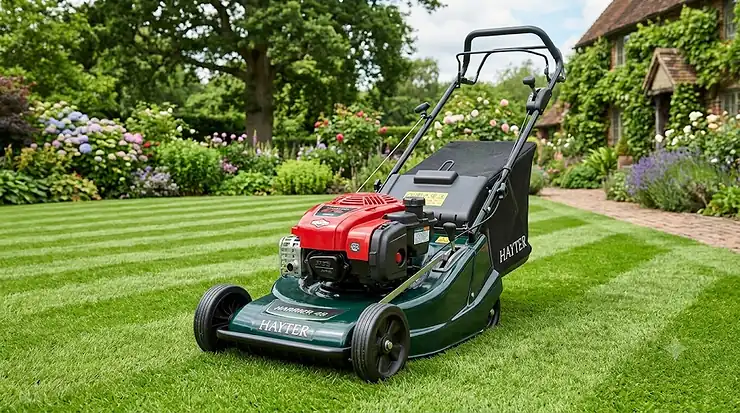
There’s a particular kind of pride that comes from glancing out of the kitchen window and seeing your lawn laid out in crisp, alternating bands of light and dark green, like a scaled-down Wimbledon Centre Court. That effect doesn’t happen by accident, and it doesn’t happen with just any old mower either. It happens because somewhere behind the cutting deck sits a heavy, power-driven roller, quietly pressing the grass blades flat as the machine rolls forward. A petrol lawn mower with roller is, in essence, a stripe-making machine that also happens to cut grass — and once you’ve used one properly, it’s genuinely hard to go back to a standard four-wheeled rotary.
This guide exists because choosing the right one is trickier than it looks. Do you want a proper petrol cylinder mower with rear roller for a bowling-green finish, or would a rotary rear roller petrol mower suit your lawn’s lumps and bumps better? Are you chasing fine lawn stripes on a modest 150m² plot, or do you need something with the muscle to handle 900m² of undulating turf? We’ve dug into real specifications, genuine owner feedback and honest side-by-side comparisons across seven proper contenders — from the legendary Atco Balmoral petrol right through to Honda’s professional-grade rear roller machine — so you can work out which one actually deserves space in your shed.
What is a petrol lawn mower with roller?
A petrol lawn mower with roller is a petrol-powered mower — either a scissor-action cylinder mower or a wheel-free rotary — fitted with a heavy rear roller (and sometimes a front one too) instead of, or in addition to, standard wheels. As the roller passes over freshly cut grass, it bends the blades flat in the direction of travel, creating the classic light-and-dark striped effect associated with cricket pitches, golf greens and formal British lawns.
Before you commit to a machine, it’s worth reading the Royal Horticultural Society’s lawn mowing guide, which explains plainly that a rear roller — not a fancy blade or an expensive brand — is the single feature that actually determines whether you’ll get decent stripes at all.
Quick Comparison Table
| Mower | Type | Cutting Width | Best For | Price Guide |
|---|---|---|---|---|
| Atco Balmoral 14S | Petrol cylinder | 35cm | Classic fine-cut stripes, small lawns | Around £900-£1,000 |
| Webb WERR17SP Supreme | Rotary rear roller | 43cm | Budget-conscious first-timers | Under £550 |
| Mountfield S421R PD | Rotary rear roller | 41cm | Simple, no-fuss small gardens | Around £350-£450 |
| Cobra RM40SPC | Rotary rear roller | 40cm | Reliable mid-range all-rounder | Around £400-£500 |
| Hayter Harrier 41 | Rotary rear roller | 41cm | Premium build, uneven ground | £600-£800 range |
| Allett Kensington 17B | Petrol cylinder | 43cm | Serious lawn enthusiasts | Around £1,300-£1,500 |
| Honda HRD536 QX | Rotary rear roller | 53cm | Large or professional-grade lawns | £1,000-£1,200 range |
Looking at the spread above, there’s a clear fork in the road: cylinder mowers like the Atco Balmoral 14S and Allett Kensington 17B give you the finest possible finish but ask more of your lawn and your wallet, while rotary rear-roller machines such as the Mountfield S421R PD and Cobra RM40SPC trade a little precision for versatility and a gentler price tag. The Honda HRD536 QX sits apart from both camps as the machine built for lawns that have simply outgrown a domestic-sized deck. Whichever route you take, don’t buy on cutting width alone — the roller mechanism, engine reliability and grass-collection system matter just as much for day-to-day satisfaction.
💬 Just one click — help others make better buying decisions too!😊
Top 7 Petrol Lawn Mowers With Roller: Expert Analysis
1. Atco Balmoral 14S — the purist’s fine-stripe cylinder mower
The Atco Balmoral 14S is the machine most people picture when they say the word “Atco” — a proper scissor-cutting cylinder mower with an unapologetically old-school approach to lawn care. Fitted with a 148cc four-stroke engine and a six-bladed hardened steel cutting cylinder across a 35cm width, this is a mower built to slice grass rather than bludgeon it. On paper, that 148cc figure looks modest next to a rotary’s engine, but cylinder mowers don’t need brute force — the scissor action does the precision work, and the engine’s real job is turning the cylinder fast and consistent.
What most buyers overlook about cylinder mowers generally, and the Balmoral specifically, is that the height-of-cut adjustment runs from a genuinely low 6mm right up to 36mm on a micro-set dial, which is far finer control than any rotary offers. That matters if you’re chasing a formal, tightly cropped finish rather than an average domestic cut. The independent cylinder and rear roller engagement — a three-way drive system also seen on the related 14SK variant — lets you disengage the blades to empty the grass box without switching the engine off, a small convenience that saves a surprising amount of faff over a season.
Reviewers consistently note that the steel front and rear rollers are what set this machine apart from anything with wheels: the combination gives it a planted, stable feel even at very low cutting heights, and the classic stripe finish is noticeably crisper than anything a rotary roller can manage. The trade-off, and it’s a real one, is that cylinder mowers dislike long, wet or weedy grass — feed it anything over about 5-6cm and it will labour or clog. This is a mower for lawns that are already reasonably well kept, not one for reclaiming an overgrown patch.
Pros:
- ✅ Genuine cylinder cut gives the finest, most formal stripe available
- ✅ Micro-set height adjustment from 6mm for a true fine-cut finish
- ✅ Removable blade cassette simplifies sharpening and servicing
Cons:
- ❌ Struggles with long, wet, or overgrown grass compared with rotary rivals
- ❌ At around 40kg, it’s noticeably heavier to manoeuvre than rotary equivalents
At around £900-£1,000 depending on retailer and specification, the Atco Balmoral 14S sits at the entry point of proper cylinder mowing rather than budget rotary territory — but for anyone serious about presentation over pure practicality, it earns its keep.
2. Webb WERR17SP Supreme — best value 3-in-1 rear roller starter
If the Balmoral is the purist’s choice, the Webb WERR17SP Supreme is the pragmatist’s. This is a self-propelled rotary mower with a split rear roller, built around a tough ABS thermoplastic deck rather than steel, which keeps the overall weight down to a manageable 31.7kg — genuinely light for a rear-roller machine. Power comes from a Briggs & Stratton 500E Series 140cc engine, a unit with a strong reputation for easy starting, which removes one of the classic frustrations of cheaper petrol mowers.
What sets this Webb apart from most rear roller petrol mowers at a similar price is the three-in-1 functionality: flip a plug and you can switch between collecting, rear discharging or mulching the clippings, whereas most rear-roller rivals only really do collection well. Based on the spec comparison with rivals in this price band, the 43cm cutting width and single-lever height adjustment across six stages (23-77mm) put it roughly on par with far pricier machines for everyday usability, even if the ABS deck won’t feel quite as reassuringly solid as steel underfoot.
Aggregated feedback on Webb’s rear roller range highlights the split roller design specifically — it allows the mower to turn at the end of a run without scuffing or dragging a mark into the fresh stripe, something cheaper single-piece rollers can’t always manage. The 60-litre grass collector is generous for the price point too, meaning fewer trips to the compost heap on a decent-sized lawn.
Pros:
- ✅ Split rear roller turns cleanly without scuffing fresh stripes
- ✅ Rare 3-in-1 mulch, collect, and rear-discharge flexibility at this price
- ✅ Lightweight ABS deck at under 32kg for easier handling
Cons:
- ❌ ABS deck feels less substantial underfoot than steel-decked rivals
- ❌ Six-stage height adjustment is less granular than a cylinder mower’s
Priced under £550 in most UK garden centres, the Webb WERR17SP Supreme represents one of the strongest value propositions in this entire list for anyone taking their first step into rear-roller mowing.
3. Mountfield S421R PD — the simplest self-propelled stripe machine
The Mountfield S421R PD does one job and does it without fuss: get your lawn striped without asking you to think too hard about it. Powered by a STIGA ST140 Autochoke engine displacing 139cc and putting out 2.2kW at 2,900rpm, it drives a 41cm steel cutting blade and is self-propelled at a fixed 4.1km/h — there’s no variable speed dial here, which keeps the control layout refreshingly simple for anyone who just wants to walk behind the machine rather than manage it.
Here’s what the spec sheet won’t tell you outright: that autochoke system genuinely does remove the classic cold-morning starting ritual that puts a lot of people off petrol mowers in the first place, and reviewers across multiple retailers single it out as one of the easier machines in this list to get running first pull. The full-width steel rear roller (rather than a split design) is heavier and simpler than the Webb’s, and while that means slightly less finesse turning at row-ends, it does mean a very definite, deep stripe on lawns up to around 400m².
The 55-litre canvas hard-top collector with a bag-full indicator is a genuinely useful touch that some pricier rivals skip, and the recoil-start engine paired with Mountfield’s 5-year extended warranty (terms apply) gives real peace of mind for a machine at this price. What most buyers overlook is the compact 0.75-0.85 litre fuel tank — it’s not a flaw exactly, but if you have a larger plot you’ll be topping up more often than with the Webb or Cobra.
Pros:
- ✅ Autochoke engine removes the fiddly cold-start ritual entirely
- ✅ Full-width steel roller gives a deep, well-defined stripe
- ✅ 5-year warranty offers strong reassurance at this price point
Cons:
- ❌ Small fuel tank means more frequent top-ups on bigger lawns
- ❌ Fixed single-speed drive offers no pace adjustment for slopes
Sitting in the £350-£450 range, the Mountfield S421R PD is arguably the best-value straightforward option here — ideal for someone replacing a tired old mower who just wants stripes without complexity.
4. Cobra RM40SPC — the dependable British-designed all-rounder
Designed specifically with British lawns and British weather in mind, the Cobra RM40SPC pairs a 135cc Cobra DG450 OHV engine with a 40cm steel cutting deck and a self-propelled single-speed drive running at 3.4km/h. It’s rated for lawns up to 600m², putting it a size class above the Mountfield in terms of what it’s realistically built to handle in a single session.
The full-width rear roller does the expected job of laying down a traditional striped finish, but Cobra’s own material — echoed by independent reviewers — draws attention to a genuinely useful secondary benefit: because the roller supports the mower’s rear end when the front wheels are lined up on a border edge, you can mow right up to flowerbeds and path edges without the front wheel dropping in and scalping the lawn. That’s a subtle but real advantage over four-wheeled rotaries, and one worth weighing if your lawn has a lot of edging.
Based on owner feedback aggregated across several retailers, the six-stage height adjustment from a genuinely low 17mm up to 75mm is unusually wide-ranging for a rotary rear-roller mower, letting you chase a near-cylinder-mower close cut on the low setting while still coping with slightly longer grass at the top end. The 50-55 litre fabric grass bag (capacity varies slightly by retailer listing) uses a hybrid mesh-and-hard-top design that reviewers say compacts clippings well and empties cleanly.
Pros:
- ✅ Cut-to-edge ability thanks to the rear roller supporting the deck
- ✅ Unusually wide 17-75mm height range for a rotary rear roller mower
- ✅ Engineered specifically for British lawn conditions and E10 fuel
Cons:
- ❌ Single fixed self-propelled speed with no variable pace control
- ❌ Steel deck adds weight versus ABS-decked competitors like the Webb
Typically priced in the £400-£500 range, the Cobra RM40SPC earns its reputation as one of the more dependable mid-range choices for anyone with borders and beds to navigate around.
5. Hayter Harrier 41 — the premium choice for uneven, awkward gardens
Hayter’s Harrier 41 has been a fixture of the UK rear-roller market for over five decades, and the current generation shows exactly why. Depending on the specific variant, it’s powered by either a Briggs & Stratton 575EX or 625E Series engine, or a Honda GCVx-145/170 unit on higher-spec models, driving a lightweight aluminium alloy cutting deck across a 41cm width — aluminium rather than steel being the detail that most distinguishes this machine from most of its rivals here.
What that aluminium deck buys you, beyond corrosion resistance, is a genuinely lighter machine that’s easier to lift, wheel around, and store — a point reviewers on retailer sites consistently return to, alongside near-universal praise (a sample rated 4.89 out of 5 across nine verified reviews on one retailer) for the ease of manoeuvring around curved beds and undulating lawns. The signature feature is the two-piece, ribbed rear roller: unlike a single-piece roller, the split design lets each half rotate independently at the end of a pass, meaning you can pivot the mower without scuffing or leaving a turning mark in your stripe — a genuine upgrade over simpler single-roller rivals like the Mountfield.
The variable-speed models (badged VS) let you dial self-propelled pace between roughly 2.2 and 3.4mph, which is a meaningful advantage for anyone with mixed terrain, since you’re not locked into one walking speed across the whole lawn. Hayter’s Trim Side deck design also lets the cutting width run right to the mower’s edge, so you can mow flush against raised beds and retaining walls with far less follow-up trimming. A lifetime crankshaft warranty against bending, subject to terms, backs up the build quality claims.
Pros:
- ✅ Aluminium deck keeps weight down without sacrificing durability
- ✅ Split rear roller turns without scuffing the stripe underneath
- ✅ Variable speed models let you match pace to slopes and terrain
Cons:
- ❌ Noticeably pricier than steel-decked rivals like the Cobra or Mountfield
- ❌ Higher-spec Honda-engined variants push well into premium territory
Prices for the Harrier 41 range broadly across £600-£800 depending on the engine and drive specification chosen, positioning it as the premium rotary rear-roller pick for anyone whose lawn has slopes, curves, or borders that punish clumsier machines.
6. Allett Kensington 17B — the enthusiast’s cartridge cylinder system
The Allett Kensington 17B — the modern successor to what was formerly badged the Atco Balmoral P17SK, which tells you something about this machine’s pedigree — is aimed squarely at gardeners who want a genuine lawn-care system rather than just a mower. Powered by a 127cc Briggs & Stratton XR550 engine (a 122cc Honda GX120 version is also available), it delivers a six-bladed precision cutting cylinder achieving 79 cuts per metre across a 43cm width, with an infinitely variable micro-cutting adjuster running from 6mm to 32mm.
The standout feature, and the reason enthusiasts pay a premium for it, is Allett’s Quick Cartridge (QC) system: the entire cutting cylinder cassette lifts out and can be swapped for an optional scarifier, verticutter, aerator, or ten-bladed fine-finish cassette. What most buyers overlook is that this effectively turns one machine into an entire lawn-care toolkit across the seasons — spring scarifying, summer fine-cutting, autumn aerating — rather than a single-purpose mower that sits idle most of the year. Reviewers on Feefo (a verified-purchase review platform) consistently highlight the double-section steel rear roller with a geared differential drive, which allows each half of the roller to turn at a different speed during a pivot, eliminating the wheel-mark scuffing that plagues simpler single-piece rollers entirely.
The spring tine comb ahead of the cutting cylinder lifts grass upright before the blades reach it, which genuinely improves the evenness of the cut on lawns with any lateral or matted growth — something a plain rotary blade can’t replicate regardless of how sharp it is. Manufactured in Great Britain and backed by a two-year parts-and-labour warranty, this is a machine built for lawns up to around 280-700m² (figures vary slightly by source) where presentation is the priority.
Pros:
- ✅ Quick Cartridge system turns one mower into a full lawn-care toolkit
- ✅ Differential rear roller eliminates scuffing when turning
- ✅ Spring tine comb lifts grass for a genuinely even cylinder cut
Cons:
- ❌ Significant investment compared with any rotary rear-roller option here
- ❌ Like all cylinder mowers, it’s unforgiving of long or overgrown grass
At around £1,300-£1,500 before any optional cartridges, the Allett Kensington 17B is a serious purchase — but for the dedicated lawn enthusiast, the cartridge system arguably justifies the outlay better than any other machine on this list.
7. Honda HRD536 QX — the professional-grade choice for big lawns
When a domestic-sized rear-roller mower simply isn’t going to cut it — literally — the Honda HRD536 QX is where this category tops out. Built around a durable aluminium cutting deck 53cm wide and powered by a Honda GXV160 four-stroke OHV engine, this is a machine explicitly designed to bridge the gap between “keen homeowner” and “small professional contractor” use, and it shows in almost every detail.
The steel rear roller is self-propelled at a single speed and provides the drive for the whole machine, which — on paper — sounds like a simple spec line, but here’s what it means in practice: Honda’s own material and independent retailers both note that, beyond the obvious stripe-making function, the heavy roller firms down soil that’s been lifted by root growth, gradually smoothing out the minor undulations that develop in any lawn over a season. That’s a genuinely useful side-effect most buyers don’t think to ask about. Honda’s Roto-Stop blade-brake system lets you stop the cutting blades without switching off the engine, so emptying the substantial 83-litre grass bag or repositioning the machine around an obstacle doesn’t mean a fresh restart each time.
Reviewers consistently flag the dual air filters and an extra-large 1.5-litre fuel tank as evidence this machine is built for longer, harder sessions than a typical domestic mower — exactly what you’d want if you’re covering up to an acre in one go, as Honda specifies it can. The bend-not-break blade design, paired with a cast-iron cylinder sleeve and crankshaft on specially adapted bearings, points to a machine engineered for years of regular, heavy use rather than a Saturday-afternoon tidy-up.
Pros:
- ✅ Roto-Stop lets you halt blades without switching off the engine
- ✅ Large 1.5-litre tank and dual air filters suit long mowing sessions
- ✅ Cast-iron cylinder sleeve built for genuinely heavy, repeated use
Cons:
- ❌ Considerable size and weight makes it overkill for small gardens
- ❌ Premium price reflects its semi-professional positioning
Expect to pay in the region of £1,000-£1,200 for the Honda HRD536 QX, which places it firmly at the top of this list — the mower to reach for once your lawn, or your ambitions for it, have outgrown anything smaller.
Top 7 Rear Roller Petrol Mowers — Full Comparison
| Model | Engine | Cutting Width | Roller Type | Grass Box | Best For |
|---|---|---|---|---|---|
| Atco Balmoral 14S | 148cc B&S/Kawasaki | 35cm | Steel front & rear | Front-lift | Fine cylinder stripes |
| Webb WERR17SP Supreme | 140cc B&S 500E | 43cm | Split ABS-compatible | 60L | Budget 3-in-1 flexibility |
| Mountfield S421R PD | 139cc STIGA ST140 | 41cm | Full-width steel | 55L | Simplicity, small lawns |
| Cobra RM40SPC | 135cc Cobra DG450 | 40cm | Full-width steel | 50-55L | Edge-to-edge mowing |
| Hayter Harrier 41 | 150-159cc B&S/Honda | 41cm | Split, ribbed | Fabric collector | Uneven, sloping ground |
| Allett Kensington 17B | 127cc B&S XR550 | 43cm | Differential steel | 62L | Cartridge lawn-care system |
| Honda HRD536 QX | GXV160 Honda | 53cm | Steel, self-propelling | 83L | Large or professional lawns |
The pattern across this table is worth pausing on: cutting width alone tells you very little about which mower suits your lawn, since the Atco Balmoral 14S‘s narrow 35cm cylinder outperforms every rotary here on finish quality despite being the smallest deck in the group. Grass box capacity, meanwhile, scales roughly with intended lawn size — the Honda HRD536 QX‘s 83-litre bag makes sense given it’s rated for areas up to an acre, whereas the Mountfield S421R PD‘s 55 litres is proportionate to the smaller lawns it’s designed for. If edge-mowing around beds and borders is a priority, the Cobra RM40SPC and Allett Kensington 17B both stand out for roller designs that specifically address that scenario.
✨ Don’t Miss These Exclusive Deals!
🔍 Take your lawn to the next level with these carefully selected roller mowers. Click on any highlighted model to check current pricing and availability. These machines will help you create the striped finish your neighbours will envy!
Rear Roller Mowers vs Traditional Rotary Mowers
| Feature | Rear Roller Mower | Standard Four-Wheel Rotary |
|---|---|---|
| Lawn stripes | Excellent, consistent | Poor to non-existent |
| Edge-cutting ability | Very good (roller supports overhang) | Limited, front wheels can scalp |
| Manoeuvrability on tight turns | Moderate (split rollers help) | Generally easier |
| Suitability for rough/long grass | Moderate to poor (cylinder types worse) | Good |
| Typical price premium | 15-40% above equivalent rotary | Baseline |
The core trade-off here is one of purpose: a rear roller mower is an aesthetic tool as much as a cutting one, sacrificing a little manoeuvrability and long-grass tolerance in exchange for a finish no wheeled rotary can replicate. If your priority is simply keeping an average family lawn under control with minimum fuss, a standard rotary remains cheaper and more forgiving; but if you’ve ever admired a striped lawn and wondered how it’s done, the roller is genuinely non-negotiable — no amount of clever mowing technique substitutes for one. Consumer body Which? reaches a similar conclusion in its own independent petrol lawn mower testing, noting that fuel type and engine reliability matter just as much as headline features when it comes to which machine actually earns its keep season after season.
Practical Usage Guide: Getting Perfect Stripes From Day One
Buying the right rear roller petrol mower is only half the job — technique does the rest, and it’s simpler than most first-timers expect. Start by mowing the perimeter of your lawn first, in either direction, so you’ve got a clear “track” to turn in at each end of your subsequent passes; trying to turn a self-propelled mower on the lawn itself, before you’ve got a border strip mown, is how new owners end up with scuffed corners in week one.
For your first stripe down the main body of the lawn, pick the longest straight edge — a path, fence line, or flower bed — and use it as your steering reference, since even a slight wobble on pass one will be magnified across the whole lawn. Each subsequent pass should overlap the previous stripe by a few centimetres rather than butting up against it exactly; a small overlap hides any minor unevenness in your steering and avoids thin unmown lines appearing between passes. Common first-30-days mistakes include cutting too short too soon (which weakens the grass and makes stripes look patchy rather than crisp) and forgetting to empty the grass box regularly, since a full box drops clumps that flatten and discolour the fresh stripe underneath.
On maintenance: after every session, especially on a cylinder mower, check the cutting cylinder or blade for debris wrapped around the spindle, and give the roller a wipe down, since grass clippings left to dry on it can affect how cleanly it presses the next stripe. Change the engine oil according to the manufacturer’s schedule (typically after the first 5 hours, then every 25-50 hours), and if the mower is going into winter storage, run the tank dry or add a fuel stabiliser — stale petrol left in a carburettor over winter is one of the most common reasons a mower refuses to start come spring.
💬 Ready to transform your lawn this season? Compare current prices on our top picks above and find your perfect match!
Real-World Scenarios: Which Rear Roller Mower Suits You?
Picture three quite different gardeners. First, there’s the retired couple with a modest 200m² rear garden and a genuine love of pottering — for them, the lightweight Webb WERR17SP Supreme or the ultra-simple Mountfield S421R PD makes far more sense than an aluminium premium machine they’ll rarely push to its limits; ease of starting and a manageable weight matter more here than outright cutting capacity.
Then there’s the keen amateur groundskeeper with a lawn that doubles as a small home cricket pitch or putting green — someone who genuinely cares about cut quality down to the millimetre. For that buyer, the Atco Balmoral 14S or, budget allowing, the Allett Kensington 17B with its cartridge system for scarifying and verticutting through the seasons, is the only sensible route; a rotary rear roller simply won’t deliver the same finish regardless of price.
Finally, consider the family on a semi-rural plot with 700-900m² of slightly undulating grass, borders to navigate, and genuinely limited weekend time. Here, the Hayter Harrier 41‘s variable speed and lightweight aluminium deck earns its premium by making a physically demanding job noticeably less tiring, while the Honda HRD536 QX suits the same scenario if the lawn tips over into truly large territory and mowing time itself becomes the bigger constraint.
How to Choose a Petrol Lawn Mower With Roller
- Measure your lawn honestly. A mower rated for 300m² will feel underpowered and slow on 600m², while an 83-litre-bagged machine is overkill and unwieldy on a postage-stamp lawn.
- Decide cylinder or rotary first. If a formal, close-cropped finish matters more than convenience, a cylinder mower like the Atco Balmoral or Allett Kensington wins every time; if your grass gets a little long between cuts, a rotary rear roller is far more forgiving.
- Check the roller design, not just its presence. Split or differential rollers turn without scuffing; single-piece full-width rollers are simpler but can drag marks into fresh stripes at row-ends.
- Weigh up deck material. Aluminium and ABS decks save weight and resist corrosion; steel decks are heavier but often feel sturdier underfoot for the same money.
- Match the engine to your terrain. Fixed single-speed self-propulsion suits flat lawns; variable-speed drive earns its keep on slopes or mixed ground.
- Look at grass box capacity relative to lawn size. A 45-50L box is fine for a small garden but means constant emptying on a genuinely large plot.
- Factor in warranty and servicing support. A 5-year domestic warranty, like Mountfield’s, offers real peace of mind that a shorter 2-year cover doesn’t quite match.
Common Mistakes When Buying a Rear Roller Petrol Mower
The single most common mistake is buying on cutting width or brand name alone, ignoring roller design entirely — a cheap single-piece roller on an otherwise well-specified mower can still leave scuff marks that spoil an otherwise good stripe. A close second is underestimating weight: a 40kg cylinder mower is a genuinely different physical proposition to push and store than a 26kg rotary, particularly on sloped access paths or if the mower needs carrying up steps to a shed.
Buyers also frequently overlook fuel type compatibility. Most modern engines here, including the Cobra DG450, are explicitly E10-compatible, but older stock or secondhand machines may not be, and running the wrong fuel through incompatible seals can cause long-term damage. The government’s own E10 petrol guidance confirms that some older petrol-powered equipment, not just cars, can be affected, so it’s worth checking your specific engine’s compatibility rather than assuming standard unleaded is automatically fine. Finally, many first-time buyers skip reading about maintenance requirements entirely, then are surprised that a cylinder mower’s cutting cassette needs periodic professional regrinding to stay sharp, which is a genuine ongoing cost that a rotary blade — sharpened cheaply with a file — doesn’t carry.
What to Expect: Real-World Performance
Specs on a page rarely capture what a session with any of these machines actually feels like. On the rotary rear-roller mowers — the Mountfield, Cobra, Webb and Hayter — you’ll notice the extra weight of the roller immediately when you first push the machine off its stand, but that same weight becomes an asset the moment the engine’s running and the roller starts doing the pressing work for you; the self-propelled drive largely cancels out any sense of the machine being cumbersome once it’s moving.
Cylinder mowers like the Atco Balmoral and Allett Kensington feel different again: there’s a distinct, satisfying scissor-hum to the cut rather than the buzzier roar of a rotary blade, and the finish is visibly, immediately finer — you’ll see it in the first metre of the first pass. What reviewers across multiple retailers agree on, regardless of which specific model they tested, is that all of these mowers feel noticeably more “planted” and stable than an equivalent wheeled rotary, particularly at the lawn’s edges, precisely because of that rear roller doing double duty as ballast and steering aid.
Long-Term Cost & Maintenance
Running any petrol mower costs more over its lifetime than the sticker price alone suggests, and rear roller and cylinder machines carry a few costs specific to the category. Budget for an annual service (typically £40-£80 at an independent dealer), oil changes every 25-50 hours of use, and — for cylinder mowers specifically — periodic professional cylinder regrinding, which restores a worn cutting edge but typically costs more than sharpening a rotary blade yourself. Petrol itself, at current UK pump prices, adds a modest but real running cost most electric-mower owners don’t factor into their comparisons.
Against that, consider longevity: several of the machines here, notably the Atco Balmoral and Honda ranges, have decades-long reputations for parts availability and genuine spares support (garden hire spares suppliers still stock components for Balmoral models from the early 2000s), meaning a well-maintained cylinder or premium rotary mower can realistically outlast two or three cheaper machines bought and discarded over the same period. Total cost of ownership, in other words, often favours the pricier machine once you look past the first year.
Features That Actually Matter (And Those That Don’t)
Genuinely worth paying for: a differential or split rear roller (reduces scuffing dramatically), an autochoke or easy-start system (removes real day-to-day friction), and a grass box capacity proportionate to your actual lawn size. Genuinely worth ignoring, or at least not paying a premium for: marginal claims about “class-leading” collection performance that aren’t backed by independent testing, and cosmetic badge differences between what are, underneath, near-identical engines shared across a manufacturer’s range.
Mulching capability is a genuinely useful bonus feature on machines like the Webb WERR17SP where it’s included as standard, but it’s not worth paying a significant premium for on its own if your priority is stripes rather than lawn feeding — you can always compost clippings separately.
Safety, Regulations & Compliance Guide
Petrol is a controlled substance under UK law, and it’s worth knowing the basics before you buy your first can. Under the regulations covered by the Health and Safety Executive’s guidance on storing petrol, you can keep up to 30 litres at home without notifying anyone, but larger quantities require written notification to your local Petroleum Enforcement Authority — relevant if you’re also running a strimmer, chainsaw or generator off the same fuel store. Always let a hot engine cool before refuelling, fill up outdoors rather than in a garage, and store fuel away from living spaces and any potential ignition source.
On the mowing side itself, always disengage the blade drive and switch off the engine before clearing a blockage or emptying the grass box on any of the machines featured here, and keep children and pets well clear of the cutting area while the engine’s running — cylinder mower blades in particular are exposed and sharp along their full width.
Problem → Solution: Fixing Common Rear Roller Mowing Issues
Problem: Stripes look faint or inconsistent. Solution: raise your cutting height slightly (grass needs enough blade length to bend visibly), and check the roller is clean and free of dried, caked grass that prevents it pressing evenly.
Problem: Mower won’t start after winter storage. Solution: drain old fuel and refill with fresh E10 or E5 petrol, check the spark plug for fouling, and clean or replace the air filter — a common culprit after months of inactivity.
Problem: Scuff marks appear at the end of every row. Solution: this is almost always a single-piece roller dragging on the turn; slow down noticeably before pivoting, or consider a model with a split/differential roller like the Cobra, Hayter or Allett next time you upgrade.
Problem: Grass box fills too quickly. Solution: raise the cutting height for your first pass on overgrown grass rather than scalping it in one go, and consider whether a larger-capacity model suits your lawn size better long-term.
Problem: Cylinder mower struggles or stalls in thicker grass. Solution: this is a fundamental limitation of cylinder cutting rather than a fault — mow more frequently to keep growth manageable, or use a side-wheel long-grass kit where the manufacturer offers one.
Buyer’s Decision Framework
If your lawn is under 300m² and mostly flat, choose a budget rotary rear roller like the Mountfield S421R PD or Webb WERR17SP because the extra power and speed range of pricier machines will go largely unused. If you want the finest possible finish and don’t mind slightly more maintenance, choose a cylinder mower like the Atco Balmoral 14S because nothing else replicates that scissor-cut stripe quality. If your lawn has borders, curves, or slopes, choose the Hayter Harrier 41 or Cobra RM40SPC because their roller designs specifically address edge-cutting and turning without scuffing. If your lawn exceeds 700m² or edges into professional territory, choose the Honda HRD536 QX because its tank size, blade-brake system and build quality are engineered for sustained, heavier use.
Frequently Asked Questions
❓ Do all petrol lawn mowers with roller give the same quality of stripes?
❓ Can I fit a roller to a mower that doesn't already have one?
❓ How often should I mow a lawn to keep stripes looking sharp?
❓ Is a petrol cylinder mower with rear roller harder to maintain than a rotary?
❓ What's the minimum lawn size that justifies a rear roller petrol mower?
Conclusion
Choosing the right petrol lawn mower with roller ultimately comes down to being honest about your lawn and your patience for maintenance, rather than chasing the biggest engine or the shiniest badge. If you want the closest thing to a professional finish and don’t mind a bit more upkeep, the Atco Balmoral 14S or Allett Kensington 17B will reward you every single time you mow. If you’d rather have flexibility and forgiveness for slightly longer grass without giving up on stripes entirely, the Mountfield S421R PD, Cobra RM40SPC or Webb WERR17SP Supreme all deliver genuinely good results without demanding cylinder-mower discipline. And if your garden has simply grown beyond what a domestic machine can comfortably handle, the Hayter Harrier 41 and Honda HRD536 QX both scale up without sacrificing the striping quality that got you looking at this category in the first place.
Whichever you choose, remember that the roller does the aesthetic work, but consistent mowing, sharp blades and a bit of straight-line technique are what actually make the stripes last. Take the time to match the mower to your lawn’s real size and terrain rather than its Instagram potential, and you’ll get years of genuinely satisfying use out of it.
✨ Found the right mower for your lawn? Check current prices on your top pick above and get ready for stripe season!
Recommended for You
- Mountfield Petrol Lawn Mower: 7 Best Models Compared (2026)
- Petrol Lawn Mower Under £300: 7 Best Picks Tested for 2026
- Petrol Lawn Mower for Large Garden: 7 Powerful Picks for 2026
Disclaimer: This article contains affiliate links. As an Amazon Associate, I earn from qualifying purchases. If you purchase products through these links, we may earn a small commission at no additional cost to you.
✨ Found this helpful? Share it with your friends! 💬🤗
