
In This Article
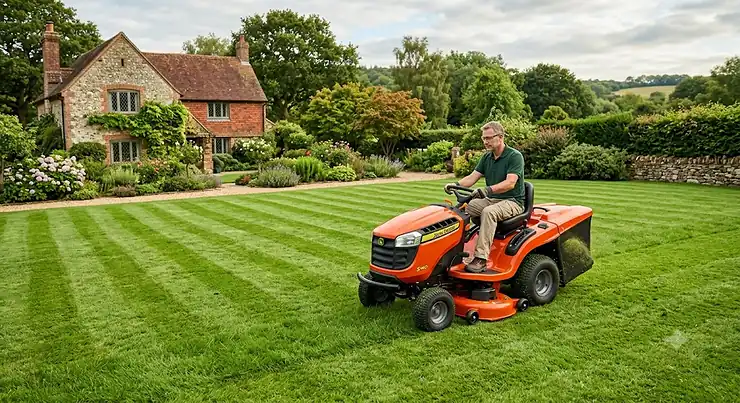
Somewhere between “I’ll just push the mower round twice more” and “why is this taking my entire Saturday” lies the exact moment most people start Googling a ride on lawn mower for 1 acre. It’s not a dramatic realisation. It’s more of a slow-burn resentment that builds up over a summer of near-weekly mowing sessions, each one eating an hour or more of a day you’d rather spend doing literally anything else. A ride on lawn mower for 1 acre is a sit-on machine with a cutting deck slung beneath the chassis, built to cover roughly 4,000-4,500 square metres in a fraction of the time a push mower takes, typically finishing the job in 30-45 minutes rather than two hours of walking. Below, we’ve dug into seven genuine, currently available UK models — spanning deck sizes, engine types and price brackets — with honest analysis of who each one actually suits, so you’re not choosing blind. As the consumer group Which? notes in its own guide to buying a ride-on mower, even the smallest lawn tractors on the UK market carry a serious price tag, so getting the choice right the first time genuinely matters.
This isn’t a rewritten spec sheet. Every product mention below comes with real-world interpretation — what a 240-litre collector actually means on a wet Tuesday in October, why a 92cm deck earns its keep on a full acre but might be overkill on three-quarters of one, and where a single-cylinder engine is a perfectly sensible choice rather than a compromise. Whether you’re weighing up a ride on mower for 1 acre garden against something smaller, or you’ve already decided and just want the best value ride on mower for 1 acre without overpaying for features you’ll never touch, this guide is built to get you there.
Quick Comparison Table: Ride-On Mowers for a 1 Acre Garden
| Mower | Deck Width | Engine | Collection | Best For |
|---|---|---|---|---|
| Mountfield 1530H | 84cm twin-blade | Single-cylinder, 432cc | 240L rear | Best all-round pick for a full acre |
| Cobra LT86MRL | 86cm twin-blade | Single-cylinder, 352cc | 245L rear | Best value ride on mower for 1 acre |
| Countax B255 92cm XRD | 92cm triple-blade | Single-cylinder petrol | Optional 300L powered | Best 92cm deck for a showpiece lawn |
| STIGA Park 500 | Wide articulated deck | Single-cylinder | Mulch/side-discharge | Best tight-turn manoeuvrability |
| John Deere X167 | 107cm | Twin-cylinder V-twin | 270L rear | Best long-term investment |
| Cub Cadet XT1 LT50 | Mid-width twin-blade | Twin-cylinder | Rear bag optional | Best comfort features |
| Ego Power+ Zero Turn | Zero-turn deck | Battery-electric | Mulch/side-discharge | Best petrol-free option |
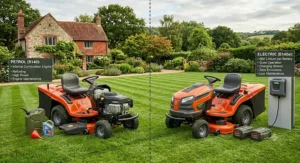
Look closely and a pattern emerges: the cheapest two models on this table both rely on a single-cylinder engine and still manage a comparable collection capacity to machines costing three times as much, which tells you engine cylinder count isn’t the be-all-and-end-all marketing suggests. The Countax B255 92cm XRD stands apart on deck width alone — that extra 8cm over the 84cm class doesn’t sound like much until you’re on your fourth lap of the lawn and realise you’ve made 15% fewer passes. Meanwhile, the Ego Power+ Zero Turn is the outlier worth flagging early: it swaps petrol for batteries entirely, which changes the maintenance conversation covered further down this guide.
💬 Just one click — help others make better buying decisions too!😊
Top 7 Ride-On Lawn Mowers for 1 Acre Gardens: Expert Analysis
1. Mountfield 1530H — best all-rounder for a full acre
The Mountfield 1530H opens this list because it’s the machine most UK dealers point to first when someone says “I’ve got about an acre.” It’s powered by a single-cylinder STIGA ST450 engine displacing 432cc, paired with a pedal-operated hydrostatic transmission that removes gear-shifting from the equation entirely — you simply press further to go faster, ease off to slow down. The 84cm twin-blade deck offers seven cutting heights from 25mm to 80mm, and that twin-blade arrangement (rather than a single blade sweeping the full width) is what gives this machine its notably tidy finish; contra-rotating blades throw clippings toward the centre rather than out to the sides, which matters enormously once you look at the collector. Based on the spec comparison, the standout number here is the 240-litre rear collector — genuinely generous for an 84cm-class machine and a big part of why owners report fewer stops to empty clippings mid-mow. Reviewers consistently note the semi-automatic hydrostatic drive as beginner-friendly, particularly for anyone who’s never driven a ride-on before, while a recurring theme in aggregated feedback is praise for how tightly it manoeuvres around flowerbeds and garden furniture despite its size. What most buyers overlook is the built-in deck-washing nozzle, which turns end-of-season cleaning from a hosepipe wrestling match into a two-minute job.
Pros:
- ✅ 240L collector rarely needs emptying mid-session
- ✅ Hydrostatic drive suits total ride-on beginners
- ✅ Twin-blade deck leaves a genuinely tidy finish
Cons:
- ❌ 84cm deck means more passes than 92cm+ rivals
- ❌ Single-cylinder engine works harder on thick, wet grass
At a price typically sitting in the low-to-mid £2,000s, the Mountfield 1530H represents strong value for anyone who wants a no-drama, dealer-supported ride-on for a straightforward acre plot — check current price before buying, as garden machinery pricing shifts through the season.
2. Cobra LT86MRL — best value ride on mower for 1 acre
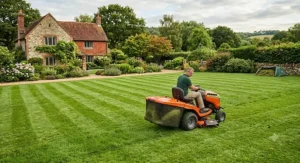
If budget is doing most of the talking in your decision, the Cobra LT86MRL deserves serious attention. It runs a single-cylinder 352cc Loncin OHV engine — a brand less familiar than Honda or Briggs & Stratton, but one that’s become a mainstay of budget-tier garden machinery precisely because it’s simple to service and cheap to source parts for. The 86cm twin-bladed deck edges out the Mountfield above by 2cm, and the 245-litre grass bag is, on paper, even larger. Here’s what to weigh: this is a manual-transmission machine, meaning five forward gears and one reverse via a shift lever rather than a hydrostatic pedal — genuinely fine once you’re used to it, but a small learning curve for someone expecting car-like smoothness on day one. Reviewers consistently flag this as the machine that makes ride-on ownership accessible without a five-figure budget, and the included tow hitch means it can pull a trailer or sweeper from day one, which matters for the accessory-buying advice later in this guide. What the spec sheet won’t tell you, but aggregated owner feedback suggests, is that the gear-shift transmission feels notably more “agricultural” in character than hydrostatic rivals — some owners genuinely prefer the mechanical directness, others find it a small adjustment.
Pros:
- ✅ Genuinely low entry price for an 86cm deck
- ✅ 245L bag among the largest at this price point
- ✅ Included tow hitch adds trailer versatility
Cons:
- ❌ Manual gears feel less refined than hydrostatic rivals
- ❌ Loncin engine has a shorter UK track record than Honda
For anyone specifically searching for the best value ride on mower for 1 acre, the Cobra LT86MRL is the model that keeps coming up — and for good reason, given how much deck and collection you get for the outlay. Prices sit well under £1,500 in most listings, though always check current price at the time of purchase.
3. Countax B255 92cm XRD — best 92cm deck for a showpiece lawn
Step up to the Countax B255 92cm XRD and you’re in genuinely different territory — this is a British-built machine, and it’s the model on this list that most directly answers anyone specifically hunting for a 92cm deck. The XRD cutting system uses three contra-rotating blades rather than the usual two, reinforced with a steel impact bar, and Countax’s own literature describes it as leaving “almost no grass uncut” — a claim that’s plausible given the triple-blade overlap design, though we’d frame it as excellent rather than flawless. Based on the spec comparison, that extra blade and the wider 92cm sweep genuinely does cut mowing time on a full acre, and clippings are thrown rearward into an optional 300-litre Powered Grass Collector — powered, not gravity-fed, which is the detail that matters most in damp British fields where a normal collector would clog. A common theme in aggregated dealer and owner feedback is that Countax machines are built with serviceability front of mind — parts, dealer network and resale value all skew noticeably stronger than budget rivals. This is not a machine for someone who mows twice a season and wants to spend as little as possible; it’s for someone who wants their lawn to look genuinely professional and is happy to pay for the privilege.
Pros:
- ✅ 92cm triple-blade deck cuts passes significantly
- ✅ Powered grass collection copes with wet conditions
- ✅ Strong UK dealer network and parts availability
Cons:
- ❌ Price sits well above budget and mid-range rivals
- ❌ Overkill if your plot is closer to half an acre
Typical pricing for the Countax B255 92cm XRD with the powered collector fitted runs into the mid-to-high £7,000s, so this is very much a premium buy — but for a genuine 92cm deck built to last decades, reviewers consistently frame it as money well spent rather than money merely spent.
4. STIGA Park 500 — best tight-turn manoeuvrability
The STIGA Park 500 takes a different approach to the same problem: instead of a fixed front axle, it uses articulated steering, where the whole front chassis pivots rather than just the wheels turning. What most buyers overlook about articulated steering is that it dramatically tightens the turning circle without needing a zero-turn mower’s price tag or learning curve — you steer more like a small tractor negotiating a farm gate than a car. Powered by a single-cylinder engine with strong mulching performance built into the deck design, this is a mower engineered for people who want to leave clippings on the lawn as free fertiliser rather than bagging and binning them, though a mulch plug swap or side-discharge option typically exists for anyone who prefers to collect. Reviewers consistently highlight the smoothness of the ride and the ease of navigating tight corners around trees, sheds and borders — genuinely useful on a 1-acre plot that isn’t a perfect rectangle. On paper this means less time three-point-turning at the end of each row and more time actually cutting grass, which adds up over a full season of weekly mows.
Pros:
- ✅ Articulated steering tightens turns dramatically
- ✅ Strong mulching performance feeds the lawn naturally
- ✅ Comfortable, stable ride reported across reviews
Cons:
- ❌ Collection setup less generous than dedicated baggers
- ❌ Articulated steering takes a session or two to adapt to
Sitting in the low-to-mid £3,000s at most UK retailers, the STIGA Park 500 suits a buyer who values manoeuvrability and mulching over maximum bag capacity — check current price, as STIGA’s range gets refreshed regularly.
5. John Deere X167 — best long-term investment
There’s a reason independent reviewers describe the John Deere X167 as “the mower equivalent of a Land Rover Defender” — it costs more than nearly everything else on this list, and it’s built with the clear expectation of still being in someone’s garage two decades from now. It runs a twin-cylinder V-twin engine driving a 107cm deck, which is genuinely wider than most 1-acre plots strictly need, but the honest analytical take here is that buying slightly more capacity than your current lawn demands is a reasonable hedge if you might ever extend the garden or move somewhere bigger. The 270-litre rear-collecting hopper is class-leading for capacity, and John Deere’s UK dealer network is famously extensive, meaning parts, servicing and resale value are rarely a headache years down the line — something budget-tier owners occasionally report struggling with once a machine is out of warranty. What the spec sheet won’t tell you, but the secondhand market suggests, is that John Deere ride-ons hold their value unusually well, softening the blow of that higher upfront cost if you ever come to sell.
Pros:
- ✅ Twin-cylinder engine handles thick grass with ease
- ✅ Exceptional UK dealer and parts support
- ✅ Strong resale value versus most rivals
Cons:
- ❌ Significant premium over Mountfield/Cobra-tier machines
- ❌ 107cm deck is genuinely wider than one acre requires
Typically priced from the mid £5,000s upward depending on spec, the John Deere X167 is the buy-it-once option for anyone who sees a ride-on as a decades-long investment rather than a five-year purchase.
6. Cub Cadet XT1 LT50 — best comfort features for weekly use
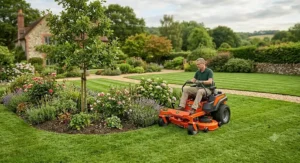
The Cub Cadet XT1 LT50 earns its spot by focusing on the small annoyances of weekly mowing that spec sheets rarely mention. Cruise control maintains a constant speed automatically, which sounds like a gimmick until you’ve mowed the same long straight stretch for the tenth time and realised how much easier it is not to babysit your own throttle foot. Reviewers consistently point to the SmartJet deck-washing system — attach a garden hose, engage the blades, and the underside of the deck gets pressure-washed clean without you needing to tip the machine or crawl underneath it, a genuinely useful bit of engineering for anyone who’s ever fought caked grass off a deck with a scraper. Powered by a twin-cylinder engine and built around a twin-blade deck, this sits comfortably in the mid-range bracket: not as cheap as the Cobra, not as premium as the Countax or John Deere, but arguably the best-judged machine here for someone who mows most weekends through the growing season and wants the small conveniences to add up.
Pros:
- ✅ Cruise control genuinely reduces mowing fatigue
- ✅ SmartJet deck wash saves real cleaning time
- ✅ Twin-cylinder engine copes well with longer grass
Cons:
- ❌ Mid-range pricing sits above true budget options
- ❌ Rear collection often sold as a separate accessory
Expect UK pricing in the high £2,000s to low £3,000s bracket, positioning the Cub Cadet XT1 LT50 as a genuine middle-ground pick — comfortable, well-equipped, and priced accordingly.
7. Ego Power+ Zero Turn — best petrol-free option
Last on this list, and deliberately different in character, is the Ego Power+ Zero Turn — a battery-powered riding mower rather than a petrol one. Zero-turn steering means each rear wheel is driven independently via steering levers, letting the mower pivot on the spot rather than needing a wide turning arc, which is a genuinely different (and for some, more precise) way of mowing than a lawn tractor’s steering wheel. On paper this means covering up to roughly an acre on a single charge with the standard battery set-up, though real-world runtime depends heavily on grass thickness, terrain and how many obstacles you’re weaving around — thick or wet grass drains the battery noticeably faster than a tidy, dry lawn. Here’s what to weigh: there’s no petrol to buy, no oil to change, and no exhaust fumes, but a full recharge can take several hours, so this suits someone who mows in a single planned session rather than in short opportunistic bursts. What most buyers overlook is that additional battery packs can extend coverage for larger plots, at extra cost, which is worth factoring into any value comparison with petrol rivals.
Pros:
- ✅ Zero fuel, oil changes or exhaust emissions
- ✅ Zero-turn steering gives precise obstacle handling
- ✅ Notably quieter operation than any petrol rival here
Cons:
- ❌ Runtime drops noticeably on thick or wet grass
- ❌ Long recharge time versus refuelling a petrol tank
Pricing typically lands in the mid-to-high £4,000s once you account for the battery pack, making the Ego Power+ Zero Turn a premium-adjacent buy for anyone prioritising low running costs and quiet operation over outright cutting speed.
Practical Usage Guide: Getting the Most from Your Ride On Lawn Mower for 1 Acre Garden
Buying the right machine is only half the job — how you run it in the first month genuinely shapes how well it performs for years afterward. Start by mowing a test strip at the highest cutting setting before committing to your usual height; this reveals hidden bumps, sprinkler heads and tree roots that could otherwise damage the blades or deck on your very first pass. For the first 30 days, resist the urge to load the deck to its absolute cutting-height limit on thick grass — the RHS recommends never removing more than a third of the grass height in a single cut, and ride-on decks are no exception to that rule, as detailed in their own lawn mowing guidance. A common mistake with the Mountfield 1530H and similarly specced machines is skipping the running-in period on a brand-new engine — most manufacturers recommend varying the engine speed during the first few hours rather than running flat-out immediately, which protects the piston rings long-term. Maintenance-wise, a realistic schedule looks like: check oil and clean the air filter every 25 hours, sharpen or replace blades at least once a season (twice if you’re cutting weekly through a wet summer), and grease the deck spindles per the handbook. One optimisation trick dealers rarely volunteer: mowing in a slightly different direction each week — alternating stripes, then diagonals, then the opposite stripe direction — reduces soil compaction ruts that a fixed mowing pattern gradually carves into a lawn.
Real-World Scenarios: Which Ride On Mower for 1 Acre Garden Suits You?
Picture three different owners of the same one-acre plot, because the “best” mower genuinely depends on who’s driving it. First, a retired couple with a gently sloping, well-established lawn and no real budget ceiling: for them, the Countax B255 92cm XRD or John Deere X167 make sense, because comfort, low physical effort and long-term reliability matter more than shaving pounds off the purchase price. Second, a young family who’ve just moved into a house with an overgrown acre and a strict budget after the move itself drained their savings: the Cobra LT86MRL is the sensible call here — a genuinely capable machine that won’t strain finances, with a tow hitch ready for a trailer once the garden’s brought under control. Third, an environmentally conscious professional who mows every Sunday morning before the school run and hates the smell of two-stroke fuel lingering on their hands all day: the Ego Power+ Zero Turn solves that specific irritation, trading a bit of runtime flexibility for genuinely fume-free mowing. None of these three owners are wrong — they’re simply weighting comfort, budget and running costs differently, which is exactly the calculation this guide is built to help with.
Grass Collection Trailers and Accessories: Extending Your Ride On Mower for 1 Acre Garden
A grass collection trailer solves a problem every ride-on owner eventually hits: what to do with clippings, leaves, hedge trimmings and general garden debris once the rear bag is full or the job at hand isn’t grass at all. Most UK retailers — including specialists stocking Cobra Garden, The Handy and Agri-Fab ranges — sell tow-behind trailers with a universal hitch pin that fits practically any ride-on or lawn tractor, typically with 200-300kg load capacities and either steel or poly bodies depending on how rough the terrain gets. The problem with relying solely on a mower’s built-in collector is that once it’s full, you’re either stopping to empty it constantly or switching to mulching, which isn’t always appropriate for formal lawns or heavier autumn leaf falls. A tipping trailer solves this by letting you keep mowing while towing a much larger capacity behind you, then dump the load at the compost heap with a lever rather than lifting a heavy bag by hand — a genuinely useful upgrade for anyone managing a full acre with mature trees or hedges nearby. Lawn sweepers, a related accessory, use rotating brushes rather than a mower deck to lift leaves and debris specifically, and typically hold close to double what a standard collector bag manages, meaning fewer stops on a big autumn clean-up day.
How to Choose a Ride On Mower for 1 Acre Garden
Working through this decision methodically saves you from buying on spec-sheet numbers alone. Here’s the reasoning we’d apply, step by step:
- Measure your actual plot, not your guess at it. An acre is roughly 4,047 square metres — pace it out or check a property survey before assuming your garden qualifies, since “about an acre” and an actual acre can differ by a lot.
- Match deck width to plot shape, not just size. A wide 92cm-plus deck suits open, rectangular lawns; a narrower 84cm deck manoeuvres better around trees, beds and tight side-access gates.
- Decide collection versus mulching upfront. Formal lawns and leaf-heavy gardens favour collection; naturalistic or time-pressed mowing favours mulching, which needs no emptying at all.
- Weigh hydrostatic against manual transmission honestly. Hydrostatic drive is easier to learn but typically costs more; manual gears are perfectly fine once you’re used to them and often cheaper.
- Check the slope of your lawn before buying. Any incline over roughly 10-15 degrees changes which machines are genuinely safe to use, regardless of how capable the engine is on paper.
- Factor in storage and access, not just the mower itself. A wide-deck premium machine is no good if it can’t physically fit through your garden gate or side passage.
- Price the total package, not just the headline figure. Collectors, trailers, mulch plugs and towing attachments are often optional extras that push genuine cost well past the sticker price.
92cm Deck vs Smaller Cutting Widths: Does Deck Size Matter for a 1 Acre Garden?
A 92cm deck, like the one on the Countax B255 92cm XRD, cuts roughly 10% more ground per pass than the 84cm decks common on the Mountfield 1530H and similarly sized machines — which sounds marginal until you multiply it across every single row of a full acre, week after week, season after season. What most buyers overlook is that wider decks also mean a wider turning footprint at the end of each row, so the manoeuvrability advantage of a narrower deck partially offsets its extra-pass disadvantage on gardens with lots of obstacles. Based on the spec comparison across this list, a 92cm-class deck earns its keep specifically on open, unobstructed acre-plus plots where you’re mowing in long, uninterrupted stripes; on a broken-up garden full of borders, trees and awkward corners, an 84cm deck with tighter steering often finishes the job just as quickly despite the extra passes. The honest verdict: deck size matters, but plot shape usually matters more, and buying the widest deck you can afford isn’t automatically the smartest move if your garden is more maze than meadow.
Single-Cylinder Engine vs Twin-Cylinder: What Actually Matters
It’s tempting to assume a twin-cylinder engine is simply “better” than a single-cylinder engine, but the reality found across this list is more nuanced. A single-cylinder engine, like the one powering the Mountfield 1530H or Cobra LT86MRL, is mechanically simpler, generally cheaper to service, and perfectly capable of handling a standard one-acre domestic lawn provided the grass isn’t consistently thick or damp. Twin-cylinder engines, found on the John Deere X167 and Cub Cadet XT1 LT50, run smoother with less vibration, generally produce more torque for tackling longer or wetter grass without bogging down, and tend to last longer under sustained heavy use — which matters more for larger or more demanding plots than it does for a tidy suburban acre. Here’s what to weigh: if your lawn is mostly flat, regularly mowed and not routinely left to grow long between cuts, a single-cylinder engine is a genuinely sensible, cost-effective choice rather than a corner cut. If you routinely mow overgrown patches, orchards or rougher grass on uneven ground, the extra torque and smoothness of a twin-cylinder engine starts paying for itself in reduced strain on the machine.
Ride On Lawn Mower for Medium Garden: Where Does 1 Acre Sit?
Garden machinery retailers generally treat anything from around a quarter-acre up to roughly one-and-a-half acres as “medium garden” territory for ride-on purposes — smaller than a proper estate tractor’s remit, larger than a self-propelled push mower can comfortably handle without turning weekend maintenance into a chore. A one-acre plot sits squarely in the upper-middle of that bracket, which is precisely why every machine on this list — from the compact Cobra LT86MRL through to the wider Countax B255 92cm XRD — is realistically suited to it, rather than needing genuine estate-tractor power. The practical takeaway for anyone specifically searching for a ride on lawn mower for a medium garden is that you’re not necessarily choosing between “small mower” and “huge mower” categories; you’re choosing between deck widths, transmission types and collection systems within a fairly forgiving middle bracket where several genuinely different machines can all do the job well.
Common Mistakes When Buying a Ride On Mower for 1 Acre Garden
The single most common mistake is buying based on horsepower or engine size alone, ignoring deck width, collection capacity and transmission type entirely — a bigger number on the spec sheet doesn’t automatically mean a better fit for your specific plot. A close second is skipping the test drive; hydrostatic and manual transmissions feel genuinely different underfoot, and what reads fine on paper can feel awkward in practice for a particular person’s driving style. Another frequent misstep is underestimating storage requirements — ride-on mowers need dry, secure storage year-round, and a machine that doesn’t physically fit through an existing shed door or side gate becomes a logistical headache regardless of how good it is at cutting grass. Buyers also regularly overlook slope: a lawn with even one steeply sloped section changes which machines are genuinely safe, irrespective of how capable they are on flat ground. Finally, many first-time buyers forget to budget for ongoing costs — blades, filters, oil, servicing and eventual belt replacement — treating the sticker price as the whole story when it’s really just the opening chapter.
Best Value Ride On Mower for 1 Acre: Getting Genuine Value Without Overspending
Genuine value isn’t simply “the cheapest machine that technically qualifies” — it’s the balance point between purchase price, running costs, and how well the machine actually matches your specific garden. On that measure, the Cobra LT86MRL earns its best-value tag on this list by combining a genuinely large 245-litre collector and an 86cm deck with a price point well below anything else here, without meaningfully compromising on the fundamentals a 1-acre garden actually needs. The Mountfield 1530H makes a strong secondary value case if hydrostatic drive matters enough to you to justify a modest step up in price. Where buyers most often overspend is chasing features genuinely built for larger properties — a 107cm deck, twin-cylinder power, or premium articulated steering — none of which meaningfully improve the mowing experience on a straightforward, flat, obstacle-light one-acre plot. The honest analytical takeaway: match the machine to the garden in front of you, not the garden you might theoretically have one day, and the “best value” answer becomes considerably clearer.
Long-Term Cost & Maintenance: The Real Cost of Ownership
The purchase price is only the opening line of the total cost of ownership story. Across a typical five-year ownership period, expect annual servicing costs of roughly £80-£150 covering oil, filters and a blade sharpen, plus a full blade replacement every one to two seasons depending on how much grit and debris your lawn throws at the deck. Petrol models add ongoing fuel costs — modest for occasional mowers, more noticeable for anyone cutting weekly through a long growing season — while the Ego Power+ Zero Turn trades that fuel spend for a higher upfront battery cost and, eventually, battery replacement once capacity fades after several years of charge cycles. Premium machines like the Countax B255 92cm XRD and John Deere X167 typically carry higher parts costs per item, but their stronger dealer networks and slower depreciation curve often narrow the real-world gap versus budget machines over a full decade of ownership. Cost-per-use is the most useful lens here: a £1,400 machine mowed weekly for ten years costs roughly £2.70 per cut before servicing, while a £7,000 machine over the same period costs closer to £13.50 per cut — meaning the premium option only truly “pays for itself” through longevity, resale value and reduced hassle, not raw arithmetic.
Safety, Regulations & Compliance Guide for Ride On Mowers
Ride-on mowers are genuinely capable of causing serious injury if used carelessly, and UK guidance is consistent on the fundamentals regardless of which machine you buy. The Health and Safety Executive’s information on safe mower operation stresses keeping bystanders well clear of the cutting area, since ejected debris and broken blade fragments can travel considerable distances — a rule that applies just as much to a Sunday-afternoon domestic mow as it does to commercial groundskeeping. Practically, that means: always check the ground for stones, toys or hidden obstacles before starting; never operate a ride-on across a steep slope (always up and down it, never sideways, to reduce rollover risk); switch off the engine and remove the key before dismounting, even for a moment; and keep children and pets well away from the mowing area entirely, not just “mostly” clear. From a compliance standpoint, all seven machines on this list are supplied as standard consumer garden machinery under UK product safety rules, meaning they arrive with the required guarding, blade-brake clutches and operator-presence safety switches already fitted — but it remains the owner’s responsibility to keep those safety features in working order rather than bypassing them for convenience.
Frequently Asked Questions
❓ How big is a 1 acre garden in real terms?
❓ Is a ride on lawn mower worth it for 1 acre?
❓ What deck size is best for a 1 acre garden?
❓ Do I need a grass collection trailer with my ride-on mower?
❓ Is a single-cylinder engine powerful enough for an acre?
Conclusion
Choosing a ride on lawn mower for 1 acre ultimately comes down to matching a machine’s deck width, engine type and collection system to the specific shape and demands of your garden, rather than chasing the biggest spec sheet number available. The Cobra LT86MRL and Mountfield 1530H cover the sensible middle ground that suits most straightforward one-acre plots without overspending, while the Countax B255 92cm XRD and John Deere X167 justify their premium pricing for buyers who want a genuine long-term, low-hassle investment. The STIGA Park 500 rewards anyone whose garden is more awkward-shaped than rectangular, and the Ego Power+ Zero Turn offers a genuinely different, fume-free mowing experience for buyers willing to trade some runtime flexibility for lower running costs. Whichever direction you lean, the seven machines and comparisons above should leave you confident rather than guessing — and that, ultimately, is what turns a dreaded Saturday chore back into something closer to a straightforward, satisfying task.
✨ Don’t Miss These Exclusive Deals!
🔍 Take your ride on lawn mower for 1 acre search to the next level with these carefully selected models. Click on any highlighted product to check current pricing and availability. The right machine turns a whole afternoon of mowing into a genuinely enjoyable half hour outdoors!
Recommended for You
- Ride On Lawn Mower 2026: 7 Best Models Compared & Rated
- Are Robot Lawn Mowers Worth It? 7 Models Tested for 2026
- Robot Lawn Mower No Perimeter Wire: 7 Best Picks (2026)
Disclaimer: This article contains affiliate links. As an Amazon Associate, I earn from qualifying purchases. If you purchase products through these links, we may earn a small commission at no additional cost to you.
✨ Found this helpful? Share it with your friends! 💬🤗
