
In This Article
Somewhere between the third lap of a long, boring rectangle of grass and the fourth time you’ve had to reverse around the apple tree, most gardeners ask themselves the same question: is there a better way to do this? That’s usually the moment the ride on mower vs zero turn mower debate stops being a spec-sheet curiosity and starts being a genuine buying decision. Both machines let you sit down while the grass disappears beneath you, but they solve very different problems, and picking the wrong one means years of fighting your own equipment.
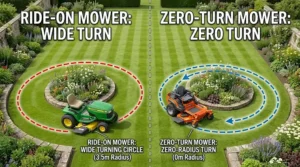
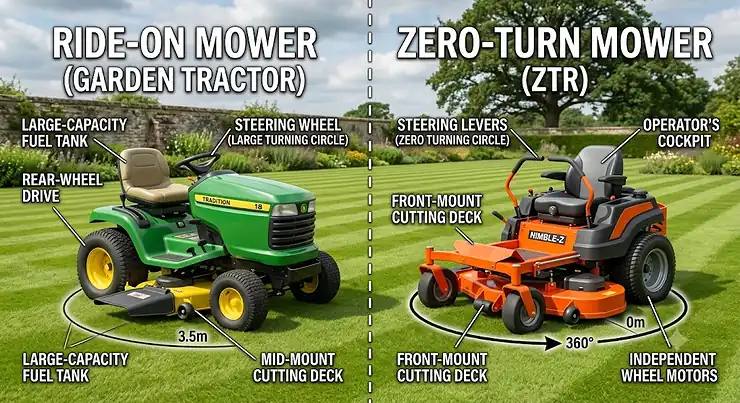
So, what is a zero turn mower? In short, it’s a riding mower whose rear wheels can spin independently, or even in opposite directions, giving it an effective turning radius of almost zero. A traditional ride on mower, or garden tractor, steers with its front wheels like a car and swings much wider around obstacles. That single mechanical difference changes everything else: comfort, speed on the straights, price, and how forgiving the machine is around flowerbeds. The Wikipedia entry on zero-turn mowers traces the concept back to a 1949 Missouri invention, and the basic engineering hasn’t changed much since — only the power sources have, with lithium battery models now sitting alongside the traditional V-twin petrol engines.
This guide walks through seven real, currently available machines — a mix of zero turn and ride on models across budget, mid-range and premium price points — with honest analysis drawn from published specifications and aggregated owner feedback, not invented testimonials. By the end, you’ll know not just which machine is objectively “better,” but which one is better for your particular lawn.
Quick Comparison Table: Ride On Mower vs Zero Turn Mower at a Glance
| Product | Type | Power Source | Price Range | Best For |
|---|---|---|---|---|
| Toro TITAN ZXM6075 | Zero turn | Petrol (726cc V-twin) | £8,700-£9,300 | Large acreage, professional finish |
| Simplicity Courier SZT350 | Zero turn | Petrol (Briggs & Stratton V-twin) | £6,800-£7,200 | Comfort-first striping and hauling |
| Snapper ZTX350 | Zero turn | Petrol (724cc V-twin) | £6,300-£6,700 | Precise control in tighter gardens |
| Cub Cadet XZ5 EL107 | Zero turn | Battery (56V lithium) | £6,900-£7,500 | Quiet, low-fuss premium electric |
| EGO Power+ ZT5201E-L Z6 | Zero turn | Battery (56V ARC Lithium) | £5,300-£5,700 | Tech-savvy mid-size electric |
| Mountfield 1530M | Ride on / garden tractor | Petrol (452cc single) | £2,300-£2,800 | Simple, reliable mid-size lawns |
| Mountfield MTF 98H-SD | Ride on / garden tractor | Petrol (414cc single) | £1,900-£2,100 | Tightest budget entry point |
Look closely at that table and a pattern jumps out immediately: the two ride on mowers cost roughly a third of what the cheapest zero turn model does, but they trade away that pivot-on-a-sixpence agility for simplicity and a lower purchase price. Meanwhile, the battery-powered zero turns from Cub Cadet and EGO sit surprisingly close in price to their petrol rivals, which tells you electric power is no longer the expensive novelty it was a few years back. If your garden is genuinely obstacle-heavy — trees, borders, raised beds — that price gap starts to look like the cost of buying back your Saturday mornings.
💬 Found a favourite already? Compare current prices before you decide — stock and pricing shift fast on these models.
Top 7 Ride-On & Zero-Turn Mowers: Expert Analysis
Coverage here spans true zero turn machines in petrol and electric form, plus two conventional ride on garden tractors, so you can see exactly how the categories stack up against real competitors rather than in the abstract. Prices are UK ranges correct at the time of research and will vary by retailer.
1. Toro TITAN ZXM6075 — commercial-grade power for serious acreage
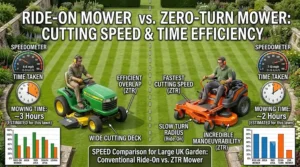
The Toro TITAN ZXM6075 is the machine you buy when “large garden” is actually an understatement — Toro rates it for areas up to roughly 10,000m², which is well beyond what most domestic buyers will ever mow. Under the bonnet sits a 726cc Kawasaki V-twin driving a 152cm cutting deck through Toro’s HG ZT2800 dual hydrostatic transmission, and that combination of engine size and deck width is what lets it chew through big jobs in a fraction of the time a garden tractor would need. What most buyers overlook about a deck this wide is that it isn’t just about speed — fewer passes also means less wheel compaction on the turf itself, which matters if you care about the health of the lawn as much as the tidiness of the stripes.
This is a machine for landowners and smallholders with genuinely large flat lawns or paddocks, not suburban gardens with tight side returns. Aggregated owner and dealer feedback consistently highlights the MyRide® suspension system as a standout, with reports that it meaningfully reduces the bone-jarring feel that cheaper zero turns are known for over rough ground. On the downside, some owners note that a machine this size needs proper storage space and a trailer or ramp for transport if it ever needs servicing off-site.
Pros:
- ✅ Wide 152cm deck clears large areas fast
- ✅ MyRide suspension smooths out rough terrain
- ✅ Hitch-ready for towing carts or spreaders
Cons:
- ❌ Overkill and expensive for gardens under half an acre
- ❌ Size makes storage and transport more demanding
At around the £8,700-£9,300 range, the Toro TITAN ZXM6075 only makes financial sense if your lawn is large enough to genuinely need that deck width — for anything smaller, you’d be paying a premium for capacity you’ll never use.
2. Simplicity Courier SZT350 — the plushest ride with real hauling capability
The Simplicity Courier SZT350 leans hard into comfort without giving up cutting quality, pairing a Briggs & Stratton Professional Series 8270 V-twin with a 132cm fabricated steel deck fitted with three Eliminator® mulching blades. In practice, that means 13 cutting heights from a close 28mm right up to 110mm, so it suits everything from a tight, formal cut to a slightly shaggier low-maintenance lawn. Front and rear suspension is a genuinely useful inclusion here — on bumpier or older lawns with hidden dips, it’s the difference between an hour of mowing feeling like a chore and feeling almost relaxing.
Buyers who care about lawn stripes specifically will want to note the rear rollers, a feature usually reserved for cylinder mowers rather than zero turns, which gives this machine an unusually sharp, professional finish for the price point. Reviewers and owners repeatedly mention the rear cargo bed as more useful than expected — not just for tools, but for hauling compost, mulch or a hedge trimmer around a large plot without a second trip. The trade-off is that a machine this comfort-focused, with front and rear suspension and a heavier deck, weighs more than a stripped-back zero turn, which slightly blunts its top speed.
Pros:
- ✅ Front and rear suspension smooths bumpy lawns
- ✅ Rear rollers deliver genuine striping quality
- ✅ Cargo bed hauls tools without a second trip
Cons:
- ❌ Heavier build slightly reduces top speed
- ❌ Comfort features push price above entry-level zero turns
Priced around £6,800-£7,200, the Simplicity Courier SZT350 earns its keep if you want a lawn that looks professionally striped without paying for a full commercial machine like the Toro.
3. Snapper ZTX350 — the sharpest control feel for tighter, obstacle-heavy gardens
The Snapper ZTX350 shares a lot of DNA with the Simplicity above it — the same 724cc V-twin family and Hydro-Gear® ZT-2800® drive system — but it’s tuned and priced slightly differently, and that shows up most in how it handles. Its 132cm CentreCut™ deck is built from 12-gauge fabricated steel, which is noticeably tougher than the thinner decks found on some budget zero turns, and the rear-eject clipping system keeps grass out of flowerbeds and off patios, a small detail that saves a lot of sweeping up afterwards.
What actually matters here for buyers is the lap bar setup: adjustable, well-padded and precise enough that navigating tightly between trees, borders and garden furniture feels genuinely intuitive rather than like fighting the controls. This is the zero turn to shortlist if your lawn has more corners and obstacles than open straight lines — the reduced overall footprint compared to the Toro makes it easier to thread through gaps. Owner feedback aggregated from retailer review sections points to the foot-pedal deck lift and electronic deck engagement as unusually convenient touches for this price bracket, though a handful of reviews mention the 25kg cargo bed limit as modest next to the Simplicity’s equivalent.
Pros:
- ✅ Tough 12-gauge steel deck resists dents and wear
- ✅ Rear-eject system keeps clippings off paths and beds
- ✅ Compact footprint suits obstacle-heavy gardens
Cons:
- ❌ Smaller cargo bed capacity than rival Simplicity model
- ❌ Still a significant step up in price from ride on tractors
At roughly £6,300-£6,700, the Snapper ZTX350 is arguably the best value of the three petrol zero turns here for anyone whose garden is more maze than meadow.
4. Cub Cadet XZ5 EL107 — the quietest, lowest-fuss premium electric zero turn
If the idea of pull cords, chokes and petrol fumes puts you off ride-on mowing altogether, the Cub Cadet XZ5 EL107 is worth a serious look. It runs on a 56V lithium-ion battery pack driving a 107cm deck, with a claimed run time of up to 90 minutes covering roughly 10,000m² per charge — comfortably enough for most large residential plots in a single session. The real-world meaning of “instant start” here isn’t just convenience; it also means no warm-up time, no flooded carburettor on a cold morning, and none of the maintenance headache that comes with a small petrol engine sitting idle over winter.
This machine is squarely aimed at buyers who want zero-turn agility with none of the noise or servicing associated with petrol engines — genuinely useful if you mow early or in a quiet residential area where neighbours notice engine noise. The 15-position cutting height range (25mm to 114mm) and side discharge, mulching or 230-litre bagging options give it real flexibility across different lawn styles. Aggregated feedback suggests the LED headlights are more than a gimmick for anyone squeezing in a cut after work in autumn or winter, though as with any electric machine, buyers should factor in charging infrastructure and a realistic sense of how far 10,000m² of coverage actually stretches on their specific terrain.
Pros:
- ✅ Instant, effort-free starts with no engine maintenance
- ✅ Genuinely quiet operation for early or evening mowing
- ✅ 230L bagging option covers every clipping preference
Cons:
- ❌ Charging logistics need planning for back-to-back sessions
- ❌ Upfront cost sits close to premium petrol rivals
At around £6,900-£7,500, the Cub Cadet XZ5 EL107 justifies its price for buyers who value quiet, low-maintenance operation over outright raw power.
5. EGO Power+ ZT5201E-L Z6 — the tech-forward choice for mid-size electric mowing
The EGO Power+ ZT5201E-L Z6 takes the electric zero turn concept and pushes the technology angle hard. Up to six 56V ARC Lithium™ batteries combine under EGO’s Peak Power™+ system to deliver an equivalent of roughly 25 horsepower, with coverage of up to 2.5 acres per charge on a triple-bladed, 52-inch fabricated steel deck. Ten cutting height positions and a choice of mulching, bagging or side discharge cover most lawn types, while an LCD control panel lets you toggle between Control, Standard and Sport driving modes depending on how cautious or confident you’re feeling that day.
What sets this model apart in practical terms is the driver-assistance layer most rivals skip entirely: 32 LED headlights for genuinely usable low-light mowing, Bluetooth connectivity, and a USB charging port that’s a small but appreciated touch on longer sessions. For buyers weighing zero turn vs ride on which is better for a mid-size garden with a mix of open lawn and tighter corners, this sits in a comfortable middle ground — smaller and nimbler than the Cub Cadet above it, at a noticeably lower price. The main caveat, consistent with electric mowers generally, is that maximum-battery configurations add cost, so the advertised top-spec runtime figures depend on how many of the six battery bays you actually fill.
Pros:
- ✅ Strong power-to-price ratio among electric zero turns
- ✅ Three driving modes suit different confidence levels
- ✅ LED lighting genuinely extends usable mowing hours
Cons:
- ❌ Full battery configuration adds meaningfully to the price
- ❌ Smaller deck than the Cub Cadet covers less per pass
At around £5,300-£5,700, the EGO Power+ ZT5201E-L Z6 is the most accessible entry point into electric zero-turn mowing on this list.
6. Mountfield 1530M — the best all-rounder among conventional ride on tractors
Stepping away from zero turns entirely, the Mountfield 1530M represents the sensible, traditional ride on mower for lawns up to roughly 5,000m² — plenty for the vast majority of UK gardens that have outgrown a push mower. It’s powered by Mountfield’s own 452cc 7750 engine and features an 84cm twin-blade deck, and despite its overall footprint, Mountfield has kept it narrow enough to fit through a standard garden gate, which is a genuinely underrated feature if your access route is anything less than generous.
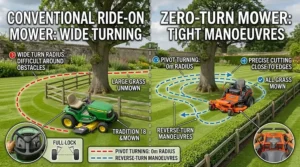
The step-through design and high-backed, padded seat make this an easy machine to live with day to day, and the seven cutting heights (25-80mm) give reasonable flexibility for both a tidy formal lawn and a slightly longer, lower-maintenance cut. What the spec sheet won’t tell you, but owner reports on retailer sites consistently mention, is how forgiving the hydrostatic transmission is for less confident drivers — there’s no clutch to mistime, just smooth pedal-controlled speed. Against a zero turn, the trade-off is obvious: this machine steers with its front wheels like a car, so tight obstacles mean wider, slower manoeuvring rather than a pivot on the spot.
Pros:
- ✅ Narrow enough to pass through most garden gates
- ✅ Hydrostatic transmission is beginner-friendly to drive
- ✅ Twin-blade 84cm deck gives an efficient, even cut
Cons:
- ❌ Wide turning circle struggles around dense obstacles
- ❌ Noticeably slower manoeuvring than any zero turn model
Typically priced around £2,300-£2,800, the Mountfield 1530M delivers genuine ride-on convenience at a fraction of what any zero turn on this list costs.
7. Mountfield MTF 98H-SD — the lightest, cheapest way onto a seat
For anyone whose priority is simply “get me off the push mower without spending a fortune,” the Mountfield MTF 98H-SD is about as cheap as a genuine ride on mower gets in the UK right now. Its 414cc single-cylinder engine produces a modest 7.1kW (9.5hp), but because the whole machine weighs only around 165kg, it doesn’t feel underpowered in the way the horsepower figure alone might suggest. The “SD” in the name stands for side discharge — clippings are ejected to the side by default rather than collected, though Mountfield does sell a separate mulching plug for buyers who’d rather not rake up afterwards.
Seven cutting height settings between 25mm and 80mm give reasonable control over the finish, and the lighter overall build makes this an easier machine to manoeuvre than its heavier ride-on siblings, even without true zero-turn geometry. Buyers should go in with realistic expectations: this is a budget-focused garden tractor, not a commercial machine, so it suits smaller-to-mid gardens rather than genuinely large plots or particularly rough terrain. It’s the obvious starting point for anyone who isn’t yet convinced a ride on mower is worth the investment and wants to test the water before committing serious money.
Pros:
- ✅ Lowest entry price of any ride-on mower here
- ✅ Lightweight build keeps it surprisingly nimble
- ✅ Side discharge or optional mulching plug flexibility
Cons:
- ❌ Modest power limits it on rough or hilly ground
- ❌ No grass collection included as standard
At close to the cheapest end of the market, around £1,900-£2,100, the Mountfield MTF 98H-SD is the sensible budget entry point into ride on mowing.
| Model | Deck Width | Power | Price Range | Rating* | Best For |
|---|---|---|---|---|---|
| Toro TITAN ZXM6075 | 152cm | 726cc petrol | £8,700-£9,300 | ★★★★★ | Large acreage |
| Simplicity Courier SZT350 | 132cm | Petrol V-twin | £6,800-£7,200 | ★★★★½ | Comfort & stripes |
| Snapper ZTX350 | 132cm | Petrol V-twin | £6,300-£6,700 | ★★★★½ | Tight, obstacle-heavy gardens |
| Cub Cadet XZ5 EL107 | 107cm | 56V battery | £6,900-£7,500 | ★★★★½ | Quiet premium electric |
| EGO Power+ ZT5201E-L Z6 | 132cm (52″) | 56V battery | £5,300-£5,700 | ★★★★ | Mid-size electric with tech |
| Mountfield 1530M | 84cm | 452cc petrol | £2,300-£2,800 | ★★★★ | Simple mid-size ride on |
| Mountfield MTF 98H-SD | Compact | 414cc petrol | £1,900-£2,100 | ★★★½ | Tightest budget |
*Ratings reflect an editorial assessment based on published specifications and aggregated owner feedback, not independent hands-on testing of every unit.
Read across that spec table and the split is stark: every zero turn model costs at least double the cheaper of the two ride on tractors, but in return you get a genuinely different steering geometry, not just a marginally tighter turning circle. The two Mountfield ride-ons remain the rational choice for straightforward, mostly open lawns where price sensitivity matters more than manoeuvrability, while the electric zero turns from Cub Cadet and EGO show that battery power has closed the performance gap with petrol without closing the price gap nearly as much.
✨ Don’t Miss These Exclusive Deals!
🔍 Take your lawn care to the next level with these carefully selected mowers. Click on any highlighted model to check current pricing and availability. The right machine will turn a dreaded weekend chore into a genuinely satisfying part of your routine!
Setting Up and Maintaining Your Mower: The First 30 Days
Whichever machine you choose, the first month sets the tone for how well it performs for years afterwards. Start by reading the deck-height and tyre-pressure settings in the manual before your first cut — most new owners set the deck too low, which stresses both the grass and the blades. On a petrol model, run the engine on a slightly rich fuel mix for the first few cuts if the manual recommends it, and check the oil level before every single session for at least the first month; this is when small assembly issues tend to surface.
For zero turn owners specifically, spend the first 20 minutes in an open, obstacle-free area getting used to the lap bars before attempting anything tight. The independent-wheel steering genuinely does take some relearning if you’re used to a steering wheel, and rushing straight into a border-heavy lawn on day one is how most first-scratch stories begin. According to RHS mowing guidance, lawns generally need cutting weekly or fortnightly through the growing season, and following the RHS one-third rule for mowing — never removing more than a third of the grass blade height in one pass — will keep both your lawn and your mower’s engine load in good shape.
A common early mistake on any ride-on machine is skipping the blade-sharpening schedule; a dull blade tears rather than cuts, leaving grass tips brown within a day or two. Aim to check blade sharpness every four to six weeks in the growing season, and keep the underside of the deck clear of built-up clippings, which otherwise trap moisture against the metal and accelerate rust.
Which Mower Suits You? Three Real Garden Scenarios
The half-acre suburban plot with borders and a vegetable patch. If your lawn is broken up by flowerbeds, a shed, and a couple of mature trees, a zero turn like the Snapper ZTX350 earns its keep almost immediately. The independent-wheel steering lets you trim right up to a border in one pass instead of the three-point manoeuvring a wide-turning tractor needs, and over a season that time saving adds up to real hours back.
The straightforward one-acre field-style lawn. If your garden is mostly open, unbroken grass with minimal obstacles, the case for spending extra on zero-turn agility weakens considerably. A Mountfield 1530M will cover the same ground at a fraction of the price, and the wider turning circle barely matters when there’s nothing to turn tightly around in the first place.
The noise-sensitive or environmentally conscious household. For anyone mowing early on weekends, living close to neighbours, or simply wanting to cut fuel costs and emissions, an electric zero turn such as the EGO Power+ ZT5201E-L Z6 solves two problems simultaneously — near-silent operation and zero direct emissions — without sacrificing the manoeuvrability that makes zero turns worth choosing over a tractor in the first place.
The Ride-On vs Zero-Turn Decision Framework
Rather than agonising over every spec, run through this simple priority checklist:
- If your lawn has more than a handful of fixed obstacles — trees, beds, ornaments — choose a zero turn, because the time saved manoeuvring compounds every single cut.
- If your budget caps out under £3,000, a ride on tractor like the Mountfield models is realistically your only option; no genuine zero turn currently sells for that little in the UK.
- If noise or fumes are a genuine concern, prioritise an electric zero turn over a petrol one, regardless of which category you land on.
- If your lawn exceeds roughly three-quarters of an acre, favour a wider deck (132cm or more) over a narrower one, since deck width has a bigger impact on total mowing time than turning radius alone once the lawn is large and mostly open.
- If you’re mowing for the first time on a ride-on machine, a conventional tractor’s steering wheel and forgiving learning curve may outweigh the manoeuvrability advantage of a zero turn until you’ve built confidence.
Ride On Mower vs Zero Turn Mower: Which Is Actually Better?
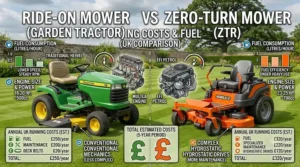
There’s no single answer to zero turn vs ride on which is better — it depends entirely on lawn shape, not lawn size alone. Zero turn mowers win decisively on manoeuvrability and mowing speed around obstacles because the independently driven rear wheels let the machine pivot almost on the spot, cutting right up to an edge without the wide swing a steering-wheel machine needs. On a genuinely open lawn, though, that advantage barely registers, because there’s nothing to pivot around in the first place.
Ride on mowers, or garden tractors, counter with a lower purchase price, simpler mechanics that are cheaper to service, and a steering feel that’s instantly familiar to anyone who’s driven a car — no relearning a lap-bar or joystick system. They also tend to be marginally more stable on slight slopes at low speed, since the front-wheel steering geometry is closer to a conventional vehicle.
| Factor | Zero Turn Mower | Ride On Mower / Garden Tractor |
|---|---|---|
| Manoeuvrability around obstacles | Excellent — near-zero turning radius | Moderate — wider turning circle needed |
| Typical UK price | £5,300-£9,300+ | £1,900-£3,500 |
| Learning curve | Steeper — lap bars take practice | Gentle — steering wheel feels familiar |
| Best lawn shape | Complex, obstacle-heavy | Open, mostly rectangular |
| Servicing cost | Higher, more moving parts | Lower, simpler drivetrain |
The analysis above makes the trade-off explicit: you’re essentially paying a substantial premium for speed and precision around obstacles, not for raw cutting ability. If your lawn is a simple open shape, that premium buys you very little; if it’s broken up by beds, trees or curves, it can transform mowing from an hour-long chore into a fifteen-minute job.
Zero Turn vs Garden Tractor: What’s Actually Different
The terms “ride on mower,” “garden tractor” and “lawn tractor” are frequently used interchangeably in the UK, which causes genuine confusion for first-time buyers. In practice, a garden tractor is simply the conventional, front-steered ride-on category — the Mountfield 1530M and Mountfield MTF 98H-SD in this guide are both textbook examples. A zero turn is a distinct engineering category, not just a fancier garden tractor, because the steering mechanism itself is fundamentally different — independently driven rear wheels rather than a steered front axle.
This distinction matters for towing and attachments too. Garden tractors are generally better suited to pulling trailers, spreaders or aerators in a straight line at low speed, because the front-steering geometry behaves predictably under load. Zero turns can tow light loads — the Toro TITAN ZXM6075 even ships with a hitch kit — but the pivoting rear-wheel steering makes precise reversing with a trailer attached noticeably trickier than on a conventional tractor. If towing attachments is a regular part of your garden routine rather than an occasional task, that’s a genuine point in the garden tractor’s favour that pure cutting performance figures won’t show you.
How to Choose Between a Ride On Mower and a Zero Turn Mower
Work through these criteria in order for the clearest path to a decision:
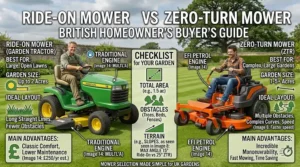
- Measure your lawn’s actual shape, not just its area — a simple rectangle behaves very differently to a lawn broken up by beds and trees, and shape matters more than raw size for this decision.
- Set a realistic budget band before shortlisting anything, since zero turns and garden tractors occupy almost entirely separate price brackets in the UK.
- Decide on petrol or electric power based on how often you’ll mow, your storage setup for charging, and how much noise or emissions matter to you.
- Check your access route and storage width, including gates and shed doors, against the machine’s actual footprint before falling for a wide-deck model.
- Consider who else will drive it, since a steering wheel on a garden tractor is far more forgiving for less confident or occasional users than lap bar controls.
- Factor in attachments and towing needs, because that use case still favours conventional garden tractors over zero turns.
- Read aggregated owner reviews on the specific model, not just the marketing copy, before committing — as the Which? guide to buying a ride-on lawn mower points out, cutting width and engine power should be matched to your actual terrain rather than the biggest number you can afford.
Zero-Turn Radius and Lap Bar Steering: The Manoeuvrability Features That Actually Matter
Zero-turn radius manoeuvrability is the single feature that defines this entire mower category, yet it’s also the most misunderstood on a spec sheet. In practice, it means the mower can rotate around a point roughly in the centre of its rear axle, rather than needing forward-and-back space to complete a turn. The real-world benefit isn’t just “tighter turns” in the abstract — it’s the ability to mow directly up to a border, pivot, and mow directly back along the next strip, with almost no unmown strip left behind and no wasted passes.
Lap bar steering is how that manoeuvrability is actually delivered to the driver, and it’s worth understanding before you buy rather than after. Two independent bars, one per side, control forward, reverse and turning simultaneously — push both forward evenly to drive straight, push one further than the other to curve, and push one forward while pulling the other back to pivot on the spot. It’s genuinely more intuitive than it sounds within an hour of practice, closer to steering a wheelchair or shopping trolley than driving a car, but it is a different skill to relearn if you’ve only ever driven a steering-wheel machine.
For large flat lawns specifically, the manoeuvrability advantage of a zero turn matters far less than it does in an obstacle-heavy garden — on open ground, deck width and top speed do more heavy lifting than turning radius. That’s precisely why the Toro TITAN ZXM6075, built for wide-open acreage, prioritises a bigger deck over ultra-tight manoeuvring, while a smaller-footprint model like the Snapper ZTX350 is tuned more towards precision in confined spaces. Matching the machine’s actual strengths to your lawn’s shape, rather than chasing the biggest headline spec, is where most buying mistakes happen.
Common Mistakes When Buying a Ride On or Zero Turn Mower
The single most common error is buying based on lawn area alone, ignoring shape entirely — a flat, open half-acre and a winding, tree-dotted half-acre need genuinely different machines despite an identical size on paper. A close second is underestimating storage requirements; a 132cm deck zero turn needs meaningfully more shed or garage space than most buyers initially plan for, and cramped storage leads to scraped bodywork and awkward manoeuvring before the mower even reaches the lawn.
Buyers also frequently skip a test drive or in-person viewing where possible, relying entirely on online specifications. Lap bar sensitivity, seat comfort and visibility over the bonnet vary noticeably between brands in ways that raw numbers don’t capture. Finally, many first-time buyers focus exclusively on purchase price while ignoring servicing costs — zero turns generally have more complex hydrostatic transmissions than garden tractors, and that complexity translates into higher servicing bills over the machine’s lifetime, a detail that rarely features in the initial buying decision but matters considerably by year three.
Safety and Slopes: What UK Buyers Need to Know
Both categories of machine carry real risk if used carelessly, and UK safety guidance is consistent on the key points regardless of which type you buy. The Health and Safety Executive’s guidance on the safe use of mowers emphasises that the greatest injury risk comes from contact with moving blades and drive mechanisms, along with the danger of overturns on slopes and banks — advice originally written for agricultural use but directly relevant to any ride-on mower on sloped domestic ground.
Zero turn mowers, because of their rear-wheel-drive pivoting action, generally handle less well on side slopes than front-steered garden tractors, and most manufacturers explicitly recommend mowing slopes up and down rather than across wherever possible. If your garden includes any meaningful gradient — anything beyond a gentle undulation — a conventional ride on tractor with front-wheel steering is often the genuinely safer choice, not just the cheaper one. Whichever machine you choose, never operate it with bystanders nearby, always engage the parking brake before dismounting, and keep the ignition key separate from the mower when it’s unattended, particularly if children have access to the garden.
Long-Term Cost & Maintenance: Ride On vs Zero Turn
The purchase price is only the opening figure in the total cost of ownership. Petrol zero turns and garden tractors both need annual servicing covering oil changes, blade sharpening, filter replacement and belt checks, typically running from roughly £80-£150 per service depending on the workshop and engine size. Zero turns, with their dual hydrostatic transmissions, tend to sit at the upper end of that range once the machine is a few years old, simply because there’s more transmission hardware to inspect and maintain compared with a garden tractor’s single drivetrain.
Electric models like the Cub Cadet XZ5 EL107 and EGO Power+ ZT5201E-L Z6 flip this equation considerably. There’s no oil, no spark plugs, no fuel filter and no annual carburettor clean-out, which meaningfully lowers routine servicing costs over the machine’s life, even though the upfront purchase price sits closer to premium petrol models. Battery replacement eventually becomes a cost to plan for, typically several years down the line, but for buyers mowing a mid-size garden regularly, the running-cost savings on fuel and servicing can offset a meaningful portion of that eventual expense. Whichever category you land on, factor blade sharpening, deck cleaning and, for petrol machines, off-season fuel stabiliser into your annual budget rather than treating the purchase price as the whole story.
Frequently Asked Questions
❓ Ride on mower vs zero turn mower: which cuts a large lawn faster?
❓ Is a zero turn mower worth it for a small garden?
❓ Can a zero turn mower go on hills?
❓ What's the difference between a zero turn mower and a garden tractor?
❓ How much does a zero turn mower cost in the UK?
Conclusion
The ride on mower vs zero turn mower decision ultimately comes down to a question most buyers skip over in their rush to compare horsepower and deck width: what shape is your actual lawn? A zero turn like the Snapper ZTX350 or the electric EGO Power+ ZT5201E-L Z6 earns every penny of its premium price on a garden dotted with beds, trees and awkward corners, where its independently driven rear wheels turn a fiddly, time-consuming job into something genuinely quick. On a simple, open plot, though, a conventional garden tractor such as the Mountfield 1530M delivers nearly all the same practical benefit — sitting down instead of pushing — for a fraction of the outlay.
None of the seven machines covered here is objectively “the best” in isolation; each earns its place for a specific lawn shape, budget or noise tolerance. What matters is matching the machine’s genuine strengths, verified through real specifications and aggregated owner experience rather than marketing copy, to the garden you actually have rather than the one in the brochure photo. Take the time to measure your lawn’s shape, be honest about your budget ceiling, and the right choice tends to become obvious fairly quickly.
Recommended for You
- Ride On Lawn Mower for 1 Acre: 7 Best Picks Tested for 2026
- Ride On Lawn Mower 2026: 7 Best Models Compared & Rated
- Are Robot Lawn Mowers Worth It? 7 Models Tested for 2026
Disclaimer: This article contains affiliate links. As an Amazon Associate, I earn from qualifying purchases. If you purchase products through these links, we may earn a small commission at no additional cost to you.
✨ Found this helpful? Share it with your friends! 💬🤗
