
In This Article
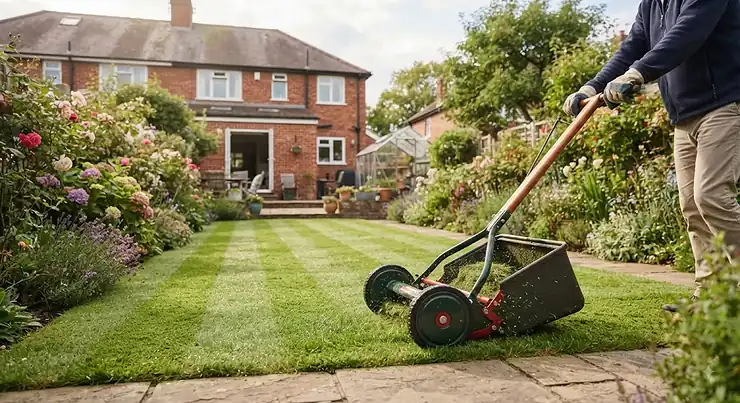
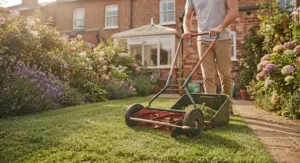
A push lawn mower is a fuel-free, motorless mower you move by hand, using either a spinning cylinder of blades (a reel mower) or, less commonly, an unpowered rotary blade, to cut grass through simple mechanical motion. No plug, no petrol, no charging cable — just you, the handle, and a lawn that needs taming. If you’ve spent the last few summers wrestling a temperamental petrol engine or listening to next door’s strimmer at 8am on a Sunday, the appeal is obvious.
There’s also something quietly satisfying about it. You push, the reel spins, the grass falls in a neat little curtain behind you — no fumes, no extension lead trailing across the flower bed, no trip to the petrol station with a leaky red canister rattling around in the boot. This guide rounds up seven real, currently available push lawn mowers spanning budget, mid-range and premium, tested against what actually matters: how they cut, how they push, and who they suit. We’ve dug through verified specs and genuine aggregated review sentiment rather than recycling marketing copy, because the whole point of a push reel mower review is helping you avoid an expensive mistake, not padding out a shopping list.
Whether you’re chasing the best manual push lawn mower for a pocket-handkerchief courtyard or the best hand push mower for a proper stretch of British lawn, you’ll find a fair, evidence-based steer below — including where cylinder mowers genuinely outperform their petrol and electric rivals, and where they don’t.
Quick Comparison Table
| Mower | Cutting Width | Best For | Price Range |
|---|---|---|---|
| Webb WEH18 | 46cm | Best all-rounder for British lawns | £140-£180 range |
| Fiskars StaySharp Plus | 43cm | Best for rough or uneven ground | £160-£210 range |
| Great States 415-16 | 40cm | Best budget five-blade cut | Under £100 |
| American Lawn Mower Co. 1304-14GC | 35cm | Best for tiny courtyard lawns | Under £100 |
Even at a glance, the spread here tells its own story: cutting width tends to track price, but not always in the way you’d expect, since a narrower deck can be the smarter buy on a small or awkwardly shaped plot. The Webb WEH18 earns its “all-rounder” tag by balancing width, roller striping and UK parts availability, while the Great States 415-16 proves that a genuinely usable five-blade cylinder mower doesn’t have to break £100. Notice, too, that “best for rough ground” and “best budget” pull in opposite directions — which is exactly why the full breakdown below matters more than this snapshot.
💬 Already got a shortlist? Jump straight to the product that matches your lawn — or keep scrolling for the full verdict on all seven.🤗
Top 7 Push Lawn Mowers: Expert Analysis
We’ve deliberately mixed budget, mid-range and premium picks here, alongside a couple of lesser-known but genuinely capable alternatives, so there’s a realistic option whatever your lawn size or patience for assembly instructions.
1. Webb WEH18 — best all-rounder for British lawns
The Webb WEH18 (also badged the Webb H18) is about as close as manual mowing gets to a national default, and there’s a reason British lawn-care shops keep it in stock year-round. Built by a long-established British garden machinery brand, it pairs a 46cm cutting width with a five-blade hardened-steel cylinder that runs on a contact-free “no-touch” design, meaning the blades slice grass without actually grinding against the fixed bottom blade.
That contact-free cutting matters more than it sounds: less metal-on-metal friction means less wear over time and a quieter, smoother push, since you’re not fighting resistance from blades scraping a bar with every rotation. Tool-free height adjustment runs from roughly 25mm up to 76mm, which is an unusually generous range for a cylinder mower — most rivals top out much lower — so it copes with an occasional missed fortnight of mowing rather than just pristine, weekly-cut turf. A two-piece rear roller adds the classic striped finish, and the 22-litre grass collector is a reasonable size for a garden under roughly 200 square metres.
Based on the spec comparison with cheaper five-blade alternatives, the Webb WEH18 is the pick for anyone who wants one mower for the whole growing season rather than swapping settings constantly. It suits established, reasonably level lawns best; if your garden slopes hard or has tree roots breaking the surface, a rotary alternative may cope better. Verified Amazon UK buyer reviews consistently praise the quality of cut once the cylinder is correctly adjusted, with several owners specifically calling the experience “satisfying.” The recurring complaint is assembly — a meaningful minority find the instructions unclear — and a few buyers with larger lawns wish the grass box held more before needing emptied.
Pros:
- ✅ Wide 25-76mm height range suits most of the season
- ✅ Contact-free blades mean quieter, smoother, longer-lasting cutting
- ✅ Rear roller delivers a genuine striped finish
Cons:
- ❌ Assembly instructions are a common sticking point
- ❌ 22L grass box needs frequent emptying on bigger lawns
At around £140-£180 range at the time of research, this sits mid-pack for price but arguably top of the pack for versatility — a fair trade if you mow weekly rather than fortnightly.
2. Fiskars StaySharp Plus — best for rough or uneven ground
Fiskars took the traditional reel mower and rebuilt the cutting geometry from the ground up, and the Fiskars StaySharp Plus is the clearest result. Its “StaySharp Technology” cuts grass without the blades physically touching the counter-blade — Fiskars claims this makes it around 40% easier to push than a conventional cylinder mower — while a “Momentum Technology” flywheel effect is said to deliver roughly 75% more cutting force than a standard push design.
In practice, what that spec sheet translates to is a mower that shrugs off the situations that jam a normal reel mower: thicker tufts, the odd stray twig, slightly longer grass after a rainy fortnight. The cutting width sits at 43cm, and height adjustment stretches from 4cm to 10cm — unusually tall for a cylinder mower, since most competitors max out closer to 5-7.5cm. That taller ceiling is precisely why it handles rough, uneven lawns better than most rivals on this list; a shorter cutting range simply can’t cope with longer grass without bogging down. There’s no grass collector fitted, so you’re either raking up after or mulching in place, which suits gardeners happy to leave short clippings down as a natural feed.
A tester writing for Product Reviews described the comparable Fiskars reel mower as an easy recommendation for anyone with a small-to-midsize plot wanting to cut their reliance on petrol and batteries, singling out the height-adjustment lever as genuinely simple to use across varying terrain. That lines up with the wider aggregated sentiment: buyers rate the build quality highly and note it feels noticeably easier to push through longer grass than cheaper alternatives, though a handful mention the lack of a grass box as an inconvenience on larger plots.
Pros:
- ✅ Handles rough, uneven or slightly overgrown lawns confidently
- ✅ Tall 4-10cm height range avoids clogging on longer grass
- ✅ Reviewers rate the push effort as noticeably lighter
Cons:
- ❌ No grass collector included as standard
- ❌ Premium pricing versus basic five-blade competitors
Expect to pay in the £160-£210 range, which puts it at the premium end of this list — justified if your lawn is anything less than billiard-table flat.
3. Gardena Classic 380 — lightest push, easiest for beginners
German engineering has a reputation for over-thinking simple things, but the Gardena Classic 380 is refreshingly no-nonsense. It’s a five-blade cylinder mower with a 38cm cutting width, height adjustment across roughly 13-30mm, and a kerb weight light enough that carrying it up garden steps doesn’t feel like a workout.
What most buyers overlook about lighter mowers like this one is that reduced weight isn’t just about storage convenience — it directly changes how the mower feels underfoot on soft or slightly sloped ground, where a heavier cylinder mower can bog down or drag. The trade-off is a shorter maximum cutting height than the Webb WEH18 or Fiskars StaySharp Plus, so it’s better suited to lawns mown regularly rather than ones left to grow for weeks. Folding handles make it genuinely easy to store in a shed or garage corner without dedicating a whole wall to it.
Gardeners World’s testing of comparable 16-inch Gardena cylinder mowers specifically flagged ease of use as the standout trait — simple assembly, an intuitive height adjuster, and handling that doesn’t punish first-time reel mower owners. Honest analysis here says this is the mower to hand a nervous first-timer, or anyone who found a heavier cylinder mower a genuine chore last summer.
Pros:
- ✅ Noticeably lighter than most rivals on this list
- ✅ Simple, beginner-friendly height adjustment
- ✅ Folds flat for easy shed or garage storage
Cons:
- ❌ Shorter maximum cutting height limits use on longer grass
- ❌ Narrower 38cm deck means more passes on bigger lawns
At roughly £90-£130 range, it’s comfortably mid-pack on price and arguably the best entry point for someone switching from powered mowers for the first time.
4. Bosch AHM 38 G — best compact pick for small gardens
Bosch’s manual reel mower line doesn’t shout about itself, which is very on-brand for a company that made its name on precision rather than showmanship. The Bosch AHM 38 G runs a five-blade cylinder against a fixed counter-blade, a 38cm cutting width, and height adjustment across roughly 13-42mm — a genuinely useful middle ground between the Gardena’s shorter range and the Fiskars’ towering one.
Here’s what the spec sheet won’t tell you outright: that mid-range height adjustment is what makes this mower forgiving of an inconsistent mowing schedule without tipping into “this needs the Fiskars instead” territory. At just under 11kg, it’s light enough to manoeuvre around borders and garden furniture without constant repositioning, and the compact footprint stores flat against a fence or shed wall. Based on the spec comparison with the Gardena Classic 380, the Bosch trades a touch of lightness for a taller cutting ceiling, which suits gardens that occasionally get away from you.
Aggregated buyer sentiment around Bosch’s manual mower range consistently highlights precision of cut and straightforward handling as the headline strengths — unsurprising, given the brand’s broader reputation in garden tools — while a smaller number of reviewers note the narrower 38cm deck means more back-and-forth passes on anything beyond a modest plot.
Pros:
- ✅ Balanced height range suits varied mowing schedules
- ✅ Lightweight build at under 11kg
- ✅ Compact enough for tight storage spaces
Cons:
- ❌ 38cm width means extra passes on larger lawns
- ❌ Fewer UK stockists than Webb or Fiskars
Priced around £90-£120 range, this is a sensible middle option for anyone who wants Bosch reliability without stretching to a premium cylinder mower.
5. Great States 415-16 5-Blade Reel Mower — best budget five-blade cut
American-made and unfussy, the Great States 415-16 proves you don’t need a big-name badge to get a genuinely usable cylinder mower. It runs five heat-treated alloy blades across a 40cm (16-inch) swath, with cutting height adjustable across roughly 25-64mm, and a cushioned T-style handle that noticeably eases the strain of tight turns around flower beds.
Heat-treated alloy blades matter more than the phrase suggests: they resist dulling significantly longer than the softer stamped-steel blades found on the cheapest reel mowers, which means fewer trips to sharpen or replace them over a season. Back rollers add stability without the full striping effect of a proper rear roller system, and the width sits in a useful middle ground — wide enough to make reasonable progress, narrow enough to stay manageable for smaller frames or less-experienced users.
Reviewers researching this class of mower consistently flag it as a strong value pick specifically because the blade quality outperforms the price point, with the five-blade cylinder cutting cleanly even on grass most budget mowers would struggle with. The honest trade-off: no grass collector is bundled as standard on the base model, and the T-style handle, while comfortable, offers less precise steering than a full loop handle on tighter corners.
Pros:
- ✅ Heat-treated blades resist dulling far longer than budget rivals
- ✅ Comfortable T-style handle eases tight-corner turning
- ✅ Genuinely strong value against pricier five-blade competitors
Cons:
- ❌ No grass collector included on the base model
- ❌ T-style handle gives less precise steering than a loop handle
At under £100 at the time of research, this is the mower to recommend when someone asks for the best manual cylinder push mower without wanting to spend big.

6. American Lawn Mower Company 1304-14GC — best for tiny courtyard lawns
Not every garden needs a wide-decked mower, and the American Lawn Mower Company 1304-14GC is built specifically for the ones that don’t. At 35cm (14 inches) cutting width with a five-blade cylinder and a fitted grass catcher, it’s the smallest, lightest option on this list — and deliberately so.
What most buyers overlook about narrow-deck mowers is that a smaller cutting width isn’t purely a compromise; on a tight courtyard, terraced back yard, or oddly shaped urban plot, a narrower deck actually manoeuvres around obstacles — bins, washing lines, garden ornaments — far more easily than a wide 46cm cylinder ever could. The included grass catcher is a genuine convenience at this size, since smaller lawns tend to be mown more often and in shorter sessions, making bagged clippings more practical than raking.
Aggregated reviews of this eco-friendly small-yard category consistently describe the cutting action as clean and the overall footprint as ideal for exactly the kind of compact urban lawn where a full-size mower would be overkill — and, frankly, a nuisance to store. The trade-off is obvious: this isn’t the mower for anything beyond a modest plot, and the narrow height-adjustment range means it’s happiest on grass that’s cut regularly rather than left to grow.
Pros:
- ✅ Compact 35cm deck manoeuvres tight urban gardens easily
- ✅ Grass catcher included as standard
- ✅ Lightest mower on this list, easy to store or carry
Cons:
- ❌ Too narrow for anything beyond a small lawn
- ❌ Limited height range suits frequent, regular mowing only
Typically found under £100, it’s a smart, honestly-scoped buy rather than a mower trying to punch above its size.
7. Webb WEH12R — best for a striped, showpiece lawn
If your ambition runs to lawn stripes that wouldn’t look out of place on a cricket outfield, the Webb WEH12R is built with exactly that in mind. It combines a 30cm cutting width with dual rollers — a zinc-plated front roller plus a substantial rear roller — and an 11.1kg build that’s heavy enough to press a visible stripe into the turf as it passes.
That dual-roller setup is the whole story here: most cylinder mowers rely on a single rear roller for striping, but the Webb WEH12R’s front-and-rear combination flattens grass more consistently on both the push and the turn, which is exactly what produces the crisp, alternating light-and-dark bands lawn perfectionists chase. Height adjustment runs a tighter 13-25mm range, adjusted via wing nuts on the front roller rather than a lever — fiddlier than a quick-adjust system, but it locks in place more securely once set, which matters if you’re chasing a precise, repeatable cut week after week. The 18-litre grass box is modest, reflecting the narrower 30cm width and the assumption that this mower suits smaller, more manicured lawns rather than sprawling ones.
Based on the spec comparison with the wider Webb WEH18, the WEH12R trades raw cutting speed for finish quality — it’s slower to mow a given area but rewards the extra time with a genuinely showpiece result. Reviewers researching this striping-focused category consistently rate the visual finish as the standout feature, while noting the grass box requires more frequent emptying and the wing-nut height adjustment is less convenient for quick seasonal changes.
Pros:
- ✅ Dual front-and-rear rollers produce crisp, even stripes
- ✅ Heavier build helps flatten grass for a sharper finish
- ✅ Once set, height adjustment stays securely locked in place
Cons:
- ❌ Wing-nut height adjustment is fiddlier than a lever system
- ❌ Narrower 30cm width and 18L box suit smaller lawns only
Sitting in the £150-£190 range, this is a specialist buy — brilliant if striping genuinely matters to you, unnecessary if it doesn’t.
Practical Usage Guide: Getting the Most From Your Push Lawn Mower
A push mower rewards a bit of technique in a way powered mowers don’t really demand. On first use, resist the urge to attack overgrown grass straight away — cylinder mowers cut best in multiple passes, taking off no more than a third of the grass height each time, which happens to match the RHS’s own mowing guidance almost exactly. Set the height adjustment to its highest setting for that first cut, then gradually lower it over subsequent mows as the lawn recovers.
Maintenance is refreshingly low-effort compared with a petrol engine, but it isn’t zero. Wipe the blades down after mowing damp grass, since trapped moisture accelerates rust on cheaper stamped-steel blades far faster than on the heat-treated alloy versions. Check the cylinder-to-bottom-blade contact every few weeks — too tight and the mower becomes exhausting to push; too loose and it folds grass instead of cutting it cleanly. Most common first-30-days mistakes trace back to skipping this adjustment entirely, then blaming the mower for a rough cut that a five-minute tweak would have fixed.
Real-World Scenarios: Which Push Mower Suits Your Lawn?
Picture a first-time buyer in a Victorian terrace with a courtyard garden barely bigger than a parking space — for them, the American Lawn Mower Company 1304-14GC or Gardena Classic 380 make far more sense than a wide-decked mower that would spend more time turning around than actually cutting. Their priority is manoeuvrability and easy storage, not raw cutting speed.
Now picture a family with a decent-sized suburban lawn, mown weekly through spring and summer, wanting one dependable mower for the whole season without constant fiddling. The Webb WEH18 fits that brief precisely, thanks to its wide height range and rear-roller finish. Finally, consider a keen gardener with an older, slightly uneven lawn who’s tired of a reel mower jamming on every third pass — that’s the exact situation the Fiskars StaySharp Plus was engineered to solve, with its taller cutting range and contact-free blades shrugging off rough patches a standard cylinder mower would choke on.
Problem → Solution: Common Push Mower Frustrations Solved
Problem: The mower jams or “folds” grass instead of cutting it. This is almost always a cylinder-to-blade adjustment issue rather than a mower fault — tighten the contact slightly, or if the grass is simply too long, raise the cutting height and take a second lighter pass afterwards.
Problem: Pushing feels like unnecessary hard work. Check the grass isn’t damp, since wet clippings add real drag; also confirm the blades aren’t over-tightened. Models with contact-free technology, like the Fiskars StaySharp Plus, are specifically engineered to reduce this resistance.
Problem: The lawn looks patchy or uneven after cutting. This usually points to an uneven lawn surface rather than the mower — a model with a wider wheelbase and roller, such as the Webb WEH18, tends to ride over minor bumps more forgivingly than a narrow-decked mower.
Problem: Grass clippings scatter everywhere. If your chosen mower lacks a grass collector, such as the Fiskars StaySharp Plus, mow slightly more often so clippings stay short enough to act as a natural mulch rather than an unsightly mess.
Problem: Blades seem to dull quickly. Cheaper stamped-steel blades wear faster than heat-treated alloy ones, like those on the Great States 415-16 — a light oil wipe after damp cutting sessions meaningfully extends blade life either way.
How to Choose a Push Lawn Mower
- Measure your lawn first. Anything under roughly 150 square metres suits a narrower-decked mower like the American Lawn Mower Company 1304-14GC; larger, more open lawns benefit from a wider deck such as the Webb WEH18.
- Check the height-adjustment range, not just the number of blades. A taller maximum height, as on the Fiskars StaySharp Plus, matters more than blade count if your lawn ever gets away from you between cuts.
- Decide if a grass collector is a genuine priority. Bagged clippings suit tidy urban gardens; mulching in place suits eco-conscious gardeners happy to skip the emptying step.
- Weigh up your own strength and stamina. Lighter mowers such as the Gardena Classic 380 suit smaller frames or less-frequent gardeners far better than a heavier, roller-equipped model.
- Think about storage before you buy, not after. Folding handles and lighter builds matter enormously if you’re working with a small shed rather than a full garage.
- Factor in your lawn’s terrain. Uneven or slightly bumpy ground favours contact-free, taller-adjustment mowers like the Fiskars StaySharp Plus over a standard low-range cylinder mower.
- Set a realistic budget band, not a single number. Prices genuinely shift, so shop within a range — under £100 for solid budget options, £140-£190 for feature-rich mid-range and premium picks.
Push Lawn Mower vs Petrol and Electric Rotary Mowers
A fair comparison has to acknowledge what push mowers can’t do: they won’t cope with genuinely long, rough or bramble-strewn grass the way a petrol rotary mower will, and they’re objectively slower over a large area. That’s the honest trade-off, and no amount of clever cylinder engineering changes it.
What they win on is everything else. There’s no fuel to buy, no engine to service, no extension cable to trail across the lawn, and critically, none of the noise. A petrol mower typically runs somewhere around 95-100 decibels at the operator’s ear — loud enough to require hearing protection under UK workplace noise regulations if used professionally — while a cylinder push mower sits closer to ordinary conversation level. That single difference is why push mowers remain the default choice for postage-stamp gardens, terraced housing with close neighbours, and anyone mowing early on a weekend morning without wanting a doorstep confrontation.
| Factor | Push Cylinder Mower | Petrol Rotary Mower | Electric Rotary Mower |
|---|---|---|---|
| Running cost | None | Fuel + servicing | Electricity only |
| Noise level | Very low | High | Moderate |
| Best for | Small-mid, tidy lawns | Large, rough lawns | Mid-size, cable-friendly gardens |
Looking at the table above, a push mower like the Webb WEH18 wins decisively on running cost and neighbourly goodwill, but a petrol machine remains the more sensible choice for anything approaching half an acre of rougher grass. Electric rotary mowers sit in an awkward middle ground — quieter than petrol, but still tethered to a cable or battery charge cycle that a push mower simply doesn’t need to think about.
How the Reel Blade Mechanism Actually Works
The reel blade mechanism is what separates a genuine cylinder mower from a basic unpowered rotary blade, and understanding it explains almost every buying decision above. A reel mower’s cylinder carries several curved blades — typically five on the models in this guide — arranged around a horizontal axle. As you push, the wheels drive that cylinder to spin, and each curved blade sweeps past a single fixed bottom blade in a genuine scissor action, slicing grass cleanly rather than tearing it.
That scissor cut is precisely why cylinder mowers produce a noticeably finer finish than rotary alternatives, and it’s not just cosmetic. According to Wikipedia’s overview of lawn mower mechanisms, reel or cylinder designs were the original mechanical mowing technology, predating rotary blades by decades, precisely because the shearing action was recognised early on as gentler on grass tissue. A clean scissor cut seals faster and browns less than a torn edge, which is also why fine ornamental and sports turf almost always gets cut with a cylinder mower rather than a rotary one. The number of blades on the reel directly affects finish quality too — five blades, as on most mowers in this guide, strike a sensible balance between a fine cut and manageable pushing effort, while cheaper three-blade reels cut more coarsely.
Quiet Operation and No Electricity Required: The Eco Case for Push Mowers
Strip away the marketing language and the case for a push mower is straightforwardly environmental. No electricity required means no grid draw, no standby power, and no dependency on a functioning socket anywhere near the lawn — genuinely useful for allotments, communal gardens, or anywhere a cable simply isn’t practical. Quiet operation, meanwhile, is about more than personal convenience: sustained exposure to loud garden machinery contributes to noise pollution that affects wildlife activity as much as it affects your neighbours’ Sunday lie-in.
There’s a genuine ecological upside beyond the obvious zero-emissions point, too. Groups like Plantlife’s No Mow May campaign have highlighted how mowing regime — not just frequency, but the type of cut — influences which plants and pollinators thrive in a lawn. A push mower’s gentler scissor action and typically higher achievable heights on models like the Fiskars StaySharp Plus make it easier to leave grass slightly longer without sacrificing a tidy appearance, which supports exactly the kind of lawn diversity conservation groups now actively recommend.
👉 Ready to go electricity-free? Check current prices on our top picks above before you decide.
Common Mistakes When Buying a Push Lawn Mower
The single biggest mistake is buying on cutting width alone, without checking the height-adjustment range — a wide deck is useless if the mower can’t cope with your grass length between cuts. A close second is underestimating terrain: a bumpy, root-strewn lawn genuinely needs a mower like the Fiskars StaySharp Plus with a taller cutting range, not a bargain-basement reel mower that will jam on the first uneven patch.
Buyers also frequently skip checking blade material, assuming all cylinder blades are equal — they aren’t. Heat-treated alloy blades, as fitted to the Great States 415-16, hold their edge substantially longer than basic stamped steel, and that difference compounds every single mow. Finally, many first-time buyers overlook storage entirely, only to discover their chosen mower doesn’t fold and doesn’t fit the available shed space — worth checking before, not after, delivery arrives.
Long-Term Cost & Maintenance
This is where push mowers genuinely separate themselves from powered alternatives on total cost of ownership. There’s no fuel line item, ever, and no annual service bill for spark plugs, oil changes or air filters. Realistically, ongoing costs amount to occasional blade sharpening — often DIY-able with a basic sharpening kit — and eventual wheel or handle replacement parts after several years of use.
Compare that with a petrol rotary mower’s running costs: fuel, annual servicing, oil, and the eventual engine repair that tends to arrive right when you least expect it. Over a five-year ownership window, a mid-range push mower like the Webb WEH18 or Bosch AHM 38 G will almost certainly cost less overall than a comparably capable petrol machine, even accounting for the higher upfront price of premium models like the Fiskars StaySharp Plus. The maths favours push mowers most clearly for smaller lawns mown frequently, where a petrol engine would spend most of its life underused anyway.
Safety, Regulations and Noise Compliance in the UK
Push mowers carry genuinely fewer safety considerations than powered alternatives — no fuel to store, no blade guard interlocks to worry about, and no risk of an extension cable getting caught underfoot. That said, basic precautions still apply: sturdy footwear rather than sandals, keeping hands and feet clear of the cylinder while adjusting height, and storing the mower somewhere children can’t access the blades directly.
On the regulatory side, there’s genuinely little to navigate. Push mowers fall outside the noise-at-work thresholds that apply to petrol equipment used commercially, and since they carry no motor, they’re exempt from the CE/UKCA electrical safety marking requirements that apply to corded and battery mowers. For anyone mowing a shared or terraced garden, that regulatory simplicity pairs neatly with the practical noise benefit covered earlier — one less thing to think about before you start.
Frequently Asked Questions
❓ What is the best manual push lawn mower for a small UK garden?
❓ How much does a good push lawn mower cost?
❓ Are push reel mowers hard to push?
❓ Do push lawn mowers work on long or wet grass?
❓ How do you sharpen or maintain a push reel mower blade?
Conclusion
Across budget, mid-range and premium options, the honest verdict is that there’s no single best push lawn mower — only the best one for your specific lawn. The Webb WEH18 remains the sensible default for an average British garden, the Fiskars StaySharp Plus earns its premium price on genuinely rough or uneven ground, and the Great States 415-16 proves a tight budget doesn’t mean a poor cut. Smaller plots are far better served by the compact American Lawn Mower Company 1304-14GC or lightweight Gardena Classic 380 than by anything wider, while the Webb WEH12R‘s dual rollers are worth the extra outlay only if a striped, showpiece finish genuinely matters to you.
What all seven share is the same fundamental appeal: no fuel, minimal noise, low long-term running costs, and a cleaner scissor-style cut than any rotary mower manages. If your lawn is under roughly 300 square metres and reasonably level, a push mower isn’t a compromise choice — for a huge number of UK gardens, it’s simply the smarter one.
✨ Don’t Miss These Exclusive Deals!
🔍 Take your lawn care to the next level with these carefully selected push mowers. Click on any highlighted model above to check current pricing and availability on Amazon. These honest, spec-backed picks will help you find a genuinely satisfying, fuss-free way to keep your lawn looking its best.
Recommended for You
- Hover Mower vs Rotary Mower: 7 Ultimate Picks for UK Gardens 2026
- Hover Mower for Slopes: 7 Top Picks That Actually Work (2026)
- Best Hover Mower 2026: 7 Top UK Picks (Tested; Compared)
Disclaimer: This article contains affiliate links. As an Amazon Associate, I earn from qualifying purchases. If you purchase products through these links, we may earn a small commission at no additional cost to you.
✨ Found this helpful? Share it with your friends! 💬🤗
