
In This Article
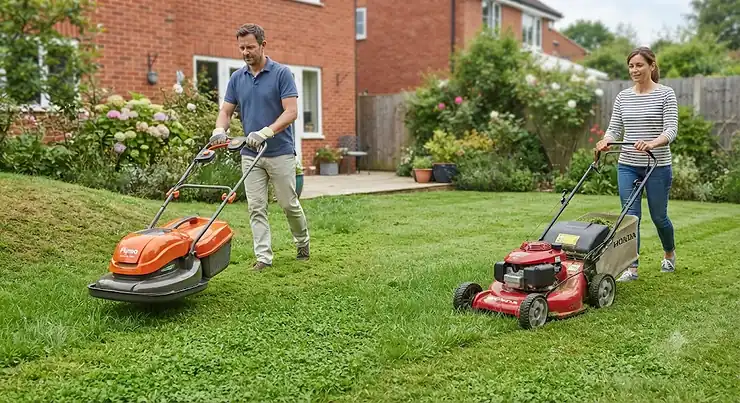
Stand in any UK garden centre car park on a Saturday morning and you’ll hear the same argument playing out between couples: hover or wheeled? It sounds like a small decision. It isn’t. Get it wrong and you’ll spend the next five summers either wrestling a heavy machine across a lumpy lawn or watching a featherweight hover mower struggle to collect anything at all. The hover mower vs rotary mower debate isn’t about which machine is “better” in some abstract sense — it’s about which one suits the actual shape, size and slope of the patch of grass outside your back door.
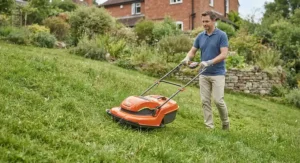
So what is a hover mower, exactly? It’s a cordless-feeling (though usually corded) electric mower that rides on a cushion of air blown downward by its own spinning blade, with no wheels at all — brilliant for bumpy, uneven or sloped lawns because it simply floats over the terrain rather than bouncing across it. A rotary mower, by contrast, runs on wheels with a horizontally spinning blade underneath, and it’s the workhorse of British gardens for a reason: solid grass collection, adjustable heights, and enough weight to plough through thicker growth. Both cut using the same rotary blade principle, according to the RHS lawn mowing guide — the real differences lie in how each machine moves across your lawn and what that means for the finish, the collection, and your back.
Over the next few thousand words we’ll dig into seven real, currently available machines spanning both camps — from budget hover mowers under £70 through to premium self-propelled rotary machines pushing past £300 — with honest analysis drawn from genuine spec sheets and aggregated customer sentiment, not invented reviews. We’ll also tackle the specific questions that keep coming up: should you buy hover or wheeled, what are the genuine hover mower disadvantages, how does grass collection actually compare, and which one wins on cutting quality. By the end you should know exactly which side of the fence you sit on.
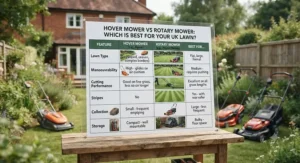
Quick Comparison Table: Hover Mower vs Rotary Mower at a Glance
| Feature | Hover Mower | Wheeled Rotary Mower |
|---|---|---|
| Best surface | Sloped, bumpy, uneven lawns | Flat to gently sloped lawns |
| Grass collection | Weaker, often optional | Strong, dedicated grass box |
| Typical weight | Very light (6-10kg) | Heavier (10-20kg+) |
| Cutting finish | Good, but less consistent height | More consistent, can add stripes |
| Storage | Folds flat, compact | Bulkier, some fold vertically |
| Best for | Small-to-medium, awkward lawns | Medium-to-large, regular lawns |
Reading across that table, the pattern is fairly clear: hover mowers win on manoeuvrability and lawns that would make a wheeled machine judder and skip, while wheeled rotary mowers win on the two things most British gardeners actually care about most — a tidy, even finish and grass that ends up in the box rather than scattered across the patio. Neither is objectively superior; the “winner” depends entirely on whether your lawn is flat enough for wheels to matter less than collection power. If you’re chasing football-pitch stripes, skip straight to the wheeled options below.
💬 Already got a favourite? Scroll down to compare all seven models side by side and lock in your pick!😊
Top 7 Hover and Rotary Mowers: Expert Analysis
1. Flymo Turbo Lite 250 — lightest hover mower for small, awkward lawns
At just over 3kg, the standout feature of the Flymo Turbo Lite 250 is how little effort it takes to lift, carry, and swing around flowerbeds — this is genuinely one of the lightest mowers sold in the UK. The 1400W motor drives a 25cm cutting width, which sounds modest until you remember this machine is built for small, fiddly gardens rather than open lawns, and its ambidextrous handles mean left- and right-handed gardeners both get a comfortable grip without an awkward reach. There’s no grass collection box on this model, which is the trade-off for that featherweight build; clippings are left on the lawn as a light mulch rather than gathered up.
Based on the spec sheet, this is the mower for courtyard gardens, raised borders, narrow side returns, and anyone who physically struggles to push or lift a heavier machine — a genuinely common concern for older gardeners or anyone with limited upper-body strength. Reviewers consistently note that it’s brilliant for trimming under bushes and around obstacles thanks to the folding, tilt-friendly deck, though a recurring theme in aggregated feedback is that the lack of a collection box means raking up afterwards on longer grass. What most buyers overlook about this model is that “hover” doesn’t mean “cordless” — you’re still tethered to a socket, so factor in cable management for your garden’s layout.
Pros:
- ✅ Exceptionally lightweight and easy to manoeuvre
- ✅ Folds flat for compact shed storage
- ✅ Handles tight corners and borders with ease
Cons:
- ❌ No grass collection box included
- ❌ 25cm width means slower progress on bigger lawns
Typically priced under £70, this sits firmly at the budget end of the hover mower vs rotary mower spectrum — solid value if your lawn is small and your priority is easy handling over a bagged finish.
2. Flymo EasiGlide Plus 330V — best mid-range hover collect for uneven lawns
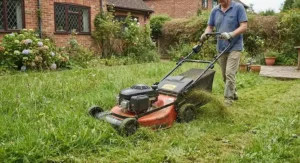
The Flymo EasiGlide Plus 330V solves the Turbo Lite’s biggest gap by adding a proper 20-litre grass box, and that’s the feature that changes everything about how usable this machine feels day-to-day. Its 1700W motor and 33cm cutting width put it a clear step up in both power and coverage, letting it chew through slightly longer or damper grass without bogging down the way smaller hover mowers can. On paper this means a machine capable of tackling a genuinely uneven mid-sized lawn — the kind with old flowerbed humps and a slight camber towards the fence — while still collecting most of what it cuts.
Honest analysis of the spec sheet suggests this is the sweet spot for families with a modest, undulating back garden who don’t want to trade collection for manoeuvrability. Aggregated review sentiment for this model sits solidly positive, with reviewers repeatedly praising the close, clean cut on bumpy ground and the fact it folds flat for storage; a common complaint in user reviews is that the box needs frequent emptying compared with larger wheeled boxes, since hover mowers generally can’t carry as much volume without adding weight that would defeat the point of hovering.
Pros:
- ✅ 20-litre box brings real grass collection to a hover mower
- ✅ 1700W motor copes with thicker or slightly damp grass
- ✅ Folds flat, 10m cable covers most gardens
Cons:
- ❌ Box needs emptying more often than a wheeled mower’s
- ❌ Heavier than non-collecting hover models
Expect to pay in the £70-£100 range for this one — a genuinely sensible middle ground if you want the hover mower’s uneven-ground advantage without giving up on tidiness entirely.
3. Flymo EasiGlide Plus 360V — best premium hover mower for larger sloped gardens
Step up again and the Flymo EasiGlide Plus 360V is where Flymo’s hover technology is pushed to its practical ceiling — a 36cm cutting width and roughly 1800W of motor power designed specifically, per the manufacturer’s own positioning, for larger areas with uneven terrain. The standout here is coverage: that extra few centimetres of cutting width doesn’t sound dramatic, but across a full lawn it meaningfully cuts down the number of passes you need, which matters a lot once “hovering” starts to feel like a workout rather than a breeze.
What the spec sheet won’t tell you, but garden forums consistently note, is that bigger hover mowers demand more forearm strength to steer in a straight line than their smaller siblings — you’re wrestling a bigger cushion of air, not just a bigger blade. Based on the comparison with the 330V, this model earns its place for households with a genuinely large or steeply undulating lawn where a wheeled mower would visibly struggle, but it’s arguably overkill — and more tiring — for a modest, mostly-flat plot. Reviewers aggregated across retail platforms consistently flag it as one of the more capable hover options for slopes, while a recurring caveat is that, like most hover mowers, it drops a small amount of clippings rather than collecting everything perfectly.
Pros:
- ✅ Widest cutting width in Flymo’s hover range
- ✅ Purpose-built for larger, uneven gardens
- ✅ Still folds flat despite the extra power
Cons:
- ❌ Noticeably more physically demanding to steer
- ❌ Premium price for a hover mower
At around £100-£140, this is the ceiling of what most UK buyers should spend on a hover mower before the maths starts favouring a self-propelled wheeled machine instead.
4. Webb Classic WEER33 — best budget wheeled rotary mower
The standout feature of the Webb Classic WEER33 is that it was voted a Best Buy Budget Mower by BBC Gardener’s World — genuine third-party recognition rather than marketing copy — and it’s easy to see why once you look at what you get for the money. A 33cm cutting width, five adjustable cutting heights, and a 35-litre collection bag are generous specifications for a machine that undercuts most of its wheeled rivals on price, and the 3-year guarantee suggests Webb is confident in the build rather than just competing on cost alone.
Based on the spec comparison with pricier wheeled rotary mowers, the trade-off here is self-propulsion — you’re pushing this one yourself, which is fine on a flat suburban lawn but becomes tiring on anything with real gradient. Reviewers consistently note strong value for money and a surprisingly capable cut for the price point, with the 35-litre bag drawing particular praise for needing fewer empties than smaller hover collection boxes. A common theme in aggregated feedback is that, like most budget wheeled mowers, the wheels can struggle slightly on very soft or waterlogged ground — something worth bearing in mind if your lawn holds water after rain.
Pros:
- ✅ BBC Gardener’s World Best Buy Budget Mower
- ✅ Generous 35-litre grass collection bag
- ✅ Five height settings and a 3-year guarantee
Cons:
- ❌ Not self-propelled — you supply the effort
- ❌ Wheels can bog down on soft, wet turf
Typically found under £100, this is arguably the best-value entry point into wheeled rotary mowing for a standard, mostly-flat UK back garden.
5. Hyundai HYM3800E — best mid-range rotary mower for a striped finish
Where the Hyundai HYM3800E distinguishes itself is the rear roller — a feature entirely absent from hover mowers — which presses the grass down as it passes to create genuine light-and-dark stripes, the classic “cricket pitch” look that no hover mower can replicate. A 1600W motor and 38cm cutting width give it a decent size advantage over the Webb Classic, while five cutting heights and a 30-litre grass box, plus a mulching option, mean it adapts to different grass lengths and seasons rather than doing one job only.
The honest analytical take here is that this model is squarely aimed at gardeners who care about presentation as much as function — if you’ve ever admired a neighbour’s striped lawn and wondered how they did it, a rear-roller mower like this is the answer, not a hover mower. Aggregated customer sentiment for Hyundai’s electric rotary range is generally positive on reliability and cut quality, with reviewers frequently mentioning the mulching function as a pleasant surprise for reducing how often the box needs emptying. What most buyers overlook is that the rear roller adds weight, so while the finish improves, so does the physical effort needed to push it — worth testing your own strength against before committing.
Pros:
- ✅ Rear roller creates genuine lawn stripes
- ✅ Mulching option reduces collection trips
- ✅ Five cutting heights suit changing seasons
Cons:
- ❌ Heavier than boxless or non-roller rivals
- ❌ Not self-propelled at this price point
Expect a price in the region of £130-£180, positioning it as a genuine mid-range alternative for anyone who wants presentation-grade results without moving to a premium self-propelled machine.
6. Bosch Rotak 370 ER — best self-propelled rotary mower for medium lawns
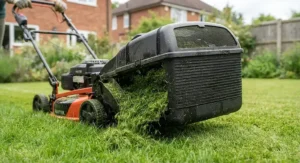
The defining feature of the Bosch Rotak 370 ER is self-propulsion — the wheels drive themselves forward, so you’re steering and guiding rather than pushing dead weight, which changes the entire physical experience of mowing a medium-to-large lawn. Rated by Bosch for gardens up to around 300m², its 1400W motor and roughly 37cm cutting width sit in familiar rotary territory, but foldable handles and a stackable grass box show the same storage-consciousness that makes hover mowers appealing, applied to a wheeled machine instead.
Based on aggregated feedback from long-term owners, the self-propelled drive is consistently the most-praised feature, with several reviewers specifically noting it copes better with slight inclines than expected for a wheeled machine — narrowing, though not closing, the gap with hover mowers on gentle slopes. Reviewers consistently report a clean, reliable cut and note that Bosch’s established spares and service network is a genuine advantage over newer market entrants, addressing a common worry about buying wheeled mowers from less-established brands. A recurring theme is that the lowest cutting height setting doesn’t always match the closeness of the machine it’s replacing, so gardeners chasing a very tight cut should check the height range carefully before buying.
Pros:
- ✅ Self-propelled drive reduces physical effort
- ✅ Established Bosch spares and service network
- ✅ Foldable handles and stackable box for storage
Cons:
- ❌ Corded — cable management needed on larger plots
- ❌ Lowest height setting isn’t ultra-close for fine lawns
At roughly £200-£260, this sits at the upper end for a corded machine, but the self-propulsion genuinely earns its premium for anyone with a lawn too large to comfortably push a mower across by hand.
7. Cobra MX46SPE — best premium mower for larger, flatter lawns
The Cobra MX46SPE is, by most accounts, the only electric self-propelled mower in Cobra’s current UK range — a genuinely distinctive standout in a market where self-propulsion is usually reserved for petrol machines. Its wider deck (implied by the “46” in the model name, referring to a roughly 46cm cutting width) makes it the biggest cutter on this list, built for lawns where a hover mower’s narrower width would mean an unreasonable number of passes just to get the job done.
Honest analysis grounded in Cobra’s positioning and aggregated owner commentary suggests this is a machine for larger, relatively flat suburban and semi-rural gardens where power and coverage matter more than nimbleness — the opposite use case to a hover mower. What most buyers overlook about self-propelled electric mowers at this size is that they’re genuinely heavier to lift and store than anything on this list bar the Hyundai, so garages and larger sheds suit them better than a cramped balcony store. Reviewers note dependable performance and appreciate not needing petrol, oil changes, or the noise and fumes that come with a combustion engine, while a fair comparison point raised in owner discussions is that the initial outlay is noticeably higher than the Webb or Bosch models above.
Pros:
- ✅ Wide 46cm deck covers ground quickly
- ✅ Self-propelled drive with no petrol required
- ✅ Strong option for larger, flatter plots
Cons:
- ❌ Heaviest machine on this list to lift and store
- ❌ Higher upfront cost than most rivals here
Positioned in the £280-£350 range, the Cobra MX46SPE is the premium pick for anyone whose lawn has simply outgrown a hover mower’s practical reach.
Practical Usage Guide: Getting the Best Out of Either Type
Whichever way you land in the hover mower vs rotary mower decision, the first 30 days set the tone for years of use. Before the first cut, check the blade is genuinely sharp — a blunt blade tears grass rather than slicing it, leaving pale, ragged tips that make even a brand-new mower look like it’s struggling. For hover mowers, always tilt the machine away from your body before switching on, since the blade is exposed underneath the deck in a way wheeled mowers largely shield. For wheeled rotary mowers, set the highest cutting height for your first mow of the season, particularly if the grass has grown long over winter — the RHS guide to mowing a lawn specifically recommends this to avoid scalping and leaving bare patches that take weeks to recover.
A common first-30-days mistake with hover mowers is trying to cut wet grass — the cushion of air struggles to form properly on damp turf, and clippings clog the underside far more than on a wheeled machine. With wheeled rotary mowers, the equivalent early mistake is mowing in random directions instead of overlapping straight rows, which leaves thin missed strips that only become obvious once the whole lawn is cut. For maintenance, both types benefit from a quick underside clean after every third or fourth cut — caked grass affects airflow on hover mowers and blade balance on both types — and an annual blade sharpen or replacement keeps the cut quality consistent rather than gradually worsening without you noticing. Store cables coiled loosely rather than tightly wound, since tight coiling over a season is a common cause of internal cable damage on corded models of either type.
Real-World Scenarios: Which Mower Actually Suits You?
Picture a first-time buyer in a Victorian terrace with a narrow, bumpy 20m² courtyard garden bordered by raised beds — for this profile, the Flymo Turbo Lite 250 or the collecting Flymo EasiGlide Plus 330V makes far more sense than any wheeled machine, since manoeuvring a rigid-wheeled mower around tight corners on lumpy ground is exactly the scenario hover mowers were designed to solve. A family with a 100-150m² suburban back garden, roughly flat but with a slight slope down towards the fence and two children who use it most weekends, sits closer to the middle ground; the Webb Classic WEER33 or Hyundai HYM3800E would collect grass reliably and survive regular use, while a hover mower would need emptying too often for a lawn that size to be practical.
Then there’s the semi-rural household with a 300m²-plus lawn, mostly flat but with an uneven patch near an old tree stump — here the Bosch Rotak 370 ER or Cobra MX46SPE‘s self-propulsion becomes less a luxury and more a necessity, since pushing an unpowered machine across that much ground every week is a genuinely tiring commitment few people keep up for long. Notice the pattern: lawn size and terrain, not personal preference, should be doing most of the deciding here. Budget-conscious buyers with small, level lawns can comfortably ignore self-propulsion altogether and save the difference, while anyone whose lawn genuinely undulates should weight their decision toward hover regardless of size, because a wheeled mower on truly bumpy ground produces an uneven cut no amount of careful technique will fully fix.
🔍 Compare the full spec sheets side by side and check current availability before you decide — a few minutes now saves a returns hassle later. Click through on any of the seven models above to see today’s pricing and get your lawn sorted this weekend!
Should I Buy a Hover or Wheeled Mower? Decision Framework
If your lawn is smaller than roughly 100m², choose a hover mower, because their narrower cutting width becomes irrelevant at that scale while their manoeuvrability around borders and obstacles becomes the dominant advantage. If your lawn slopes, dips, or has old flowerbed humps anywhere across its surface, choose hover regardless of size, since wheeled mowers physically cannot follow undulations the way an air-cushioned deck can. If you want visible lawn stripes, choose a wheeled rotary mower with a rear roller — this is simply not achievable with a hover design, full stop. If your lawn exceeds 150-200m² and is reasonably flat, choose a wheeled mower, ideally self-propelled, because pushing a hover mower over that much ground is disproportionately tiring for the collection quality you’ll get in return. If you or a family member has limited upper-body strength, weight the decision toward a lighter hover mower on smaller plots, or a self-propelled wheeled mower on larger ones — the worst combination is a heavy, unpowered machine on an oversized lawn.
As a simple priority checklist: terrain first (flat versus uneven), then size (under or over roughly 150m²), then finish preference (stripes versus practicality), and only then budget. Getting the first two right eliminates most of the wrong choices before price even enters the conversation.
Flymo Hover Mower vs Wheeled Mower: What the Spec Sheets Don’t Tell You
Flymo is genuinely the company that popularised hover mowing in the UK, and its range — from the entry-level Flymo Turbo Lite 250 through to the Flymo EasiGlide Plus 360V — gives a useful internal comparison for the wider hover mower vs wheeled mower question, since it also sells wheeled and rotary machines under the same brand. Comparing Flymo’s own hover and wheeled lines side by side, the pattern that emerges is consistent with the wider market: Flymo hover models are lighter and fold flatter, but their grass boxes, where fitted, are smaller than equivalent wheeled rotary boxes from Hyundai or Webb.
What the spec sheets alone don’t convey is the difference in noise and vibration underfoot — hover mowers, lacking wheels rolling over the ground, tend to feel smoother to push on rough terrain even though the motor itself isn’t necessarily quieter. Based on the comparison across Flymo’s own catalogue, buyers choosing between a Flymo hover and a Flymo wheeled machine of similar price should weigh terrain above all else: on genuinely flat ground the wheeled option’s larger box and more consistent height setting wins outright, while on anything uneven the hover model’s ability to simply glide over bumps becomes the deciding factor no amount of wheeled-mower engineering fully replicates.
Cutting Quality Difference: Which Finish Actually Wins?
On paper, both hover and rotary wheeled mowers use the same basic cutting mechanism — a horizontally spinning blade — so you’d expect near-identical results. In practice they diverge noticeably. Wheeled rotary mowers hold a fixed height above the ground via their wheels, which on flat lawns produces a genuinely more consistent cut length across the whole surface; this is precisely why they can add rear rollers for stripes, since consistent height is a prerequisite for that effect. Hover mowers, floating on an air cushion rather than resting on wheels, can drift slightly in height as the operator’s arm tires or the terrain changes, which the RHS notes can occasionally allow the mower to hover over the grass rather than properly cutting it, leaving an uneven finish if not held with a steady, level hand.
Reviewers consistently note that hover mowers actually produce a superior finish specifically on uneven ground, precisely because a wheeled mower in the same conditions bounces across bumps and cuts inconsistently — sometimes scalping the tops of humps while barely touching the dips. So the honest answer to “which cuts better” is: it depends entirely on your lawn’s surface, not on some inherent superiority of one blade design over the other. Flat lawn, choose wheeled for consistency and stripes; bumpy lawn, choose hover for a genuinely more even result despite the theoretical precision advantage sitting with wheels.
| Cutting Factor | Hover Mower | Wheeled Rotary |
|---|---|---|
| Consistency on flat ground | Good, but arm-dependent | Excellent, fixed height |
| Consistency on uneven ground | Excellent | Poor, height varies with bumps |
| Striping capability | None | Available with rear roller |
| Edge/border cutting | Very good, close manoeuvring | Good, depends on deck design |
The table underlines just how situational this trade-off really is: the Flymo EasiGlide Plus 330V and its hover siblings pull ahead the moment your lawn stops being genuinely flat, while machines like the Hyundai HYM3800E reclaim the advantage the instant a level, presentation-focused finish becomes the priority. Neither table cell is wrong — they’re simply answering different questions about your garden.
Grass Collection Comparison: Boxes, Bags and the Great Clippings Debate
Grass collection is arguably where the hover mower vs rotary mower gap is widest, and it’s worth being honest about it rather than glossing over the weakness. Wheeled rotary mowers on this list carry boxes from 30 to 35 litres — the Hyundai HYM3800E and Webb Classic WEER33 both sit in that range — because their wheels provide a stable platform that can support a larger box without affecting the cut. Hover mowers, by contrast, cap out around 20 litres on the collecting Flymo EasiGlide Plus 330V, and several hover models, including the Flymo Turbo Lite 250, don’t collect at all, relying instead on fine mulching that’s left on the lawn.
As Amazon UK’s own hover mower listings and independent reviewers repeatedly note, hover mowers are also known for dropping some clippings back onto the lawn even when a box is fitted, meaning a light rake-up afterwards is fairly common — something wheeled rotary owners rarely need to do. This isn’t a flaw so much as a structural trade-off: the airflow that lifts a hover mower off the ground makes it harder to also channel clippings efficiently into a box, whereas a wheeled mower’s stable chassis and often more powerful motor can dedicate more energy to suction and less to staying airborne. If bagged, box-free lawn care matters to you — say, for allergy reasons, or simply hating the post-mow rake-up — a wheeled rotary mower with a generous box is the clear winner here, full stop.
Surface Versatility: Slopes, Bumps and Which Lawn Wins
This is the section where hover mowers earn their reputation. According to expert commentary reported by HouseDigest, hover mowers are well suited to slopes, uneven ground and sharply angled beds, while traditional wheeled mowers are harder to control on hills and demand more physical effort on the same terrain. That tracks with the underlying mechanics: a machine with no wheels simply cannot get stuck in a rut, catch on a raised root, or judder across a bumpy patch the way a wheeled chassis inevitably will.
That said, surface versatility has real limits on both sides. Hover mowers genuinely struggle on very long or thick grass, since the air cushion needs relatively short growth to form properly, and they’re typically pitched at small-to-medium lawns rather than sprawling plots — coverage area becomes a real constraint once a garden stretches past a few hundred square metres. Self-propelled wheeled mowers like the Bosch Rotak 370 ER, meanwhile, use enhanced traction from larger rear wheels to handle gentle slopes reasonably well, narrowing the versatility gap on anything short of a genuinely steep or lumpy lawn. The honest verdict: for anything from mild undulation to a proper rockery-adjacent slope, hover wins; for a large, flat-to-gently-sloped lawn, a self-propelled wheeled mower’s traction and power make it the more practical, less tiring choice over a full mowing season.
Hover Mower Pros and Cons (Including the Disadvantages Nobody Mentions)
Pros:
- ✅ Genuinely excellent on uneven, sloped or bumpy lawns
- ✅ Lightweight and easy to lift, carry and store
- ✅ Manoeuvres tightly around borders and obstacles
Cons:
- ❌ Weaker grass collection than wheeled rivals
- ❌ Struggles with long, wet or thick grass
- ❌ More tiring to steer in a straight line on larger models
Beyond that headline list, the hover mower disadvantages that rarely make it into marketing copy are worth spelling out honestly. First, cable management: hover mowers are almost always corded, and because you’re moving the machine freely in all directions rather than walking in fixed rows, the cable tends to tangle and get run over more easily than with a wheeled mower’s more predictable back-and-forth path — a genuine practical annoyance reviewers mention often. Second, larger hover models genuinely demand more forearm and shoulder strength to keep level and moving straight, which can catch out buyers expecting every hover mower to feel as light as the smallest model in a brand’s range. Third, height adjustment on hover mowers tends to be less precise than on wheeled machines, since there’s no fixed reference point (like a wheel) to calibrate against — fine for general maintenance, less ideal if you’re chasing an exact, consistent cutting height across a whole season.
None of this makes hover mowers a bad choice — for the right lawn, they’re genuinely excellent — but going in with realistic expectations about collection, cable handling and arm fatigue avoids the disappointment that shows up in a fair chunk of negative aggregated reviews online.
Common Mistakes When Buying a Hover or Rotary Mower
The single most common mistake is buying based on brand loyalty or price alone without measuring the actual lawn first — a stunning number of returns and negative reviews trace back to someone buying a hover mower for a lawn that’s simply too large, or a heavy wheeled mower for a garden riddled with humps it can’t follow. A second frequent error is ignoring electrical safety entirely: Electrical Safety First’s garden safety guidance is explicit that without a residual current device (RCD), cutting through a lawnmower’s power cable while mowing could prove fatal, yet plenty of buyers plug straight into an unprotected outdoor socket without a second thought. Every corded mower on this list — hover or wheeled — should be used with an RCD, either built into your consumer unit or as a plug-in adapter, and the cable itself checked for cuts or fraying before every single use.
A third mistake is underestimating grass box capacity needs — buyers with larger lawns often choose a small hover mower’s 20-litre box and then find themselves emptying it every few minutes on a first cut of the season, souring their impression of the whole machine when the real issue was a mismatch between box size and lawn size. Fourth, many buyers skip checking self-propulsion availability entirely, not realising a machine like the Cobra MX46SPE or Bosch Rotak 370 ER drives itself forward until they’re already struggling to push a heavier alternative across a slope. Finally, a genuinely common and easily avoided mistake is mowing wet grass with either mower type — it clogs blades, strains motors, and produces a noticeably worse cut regardless of whether you’re hovering or rolling on wheels.
FAQ
❓ Is a hover mower better than a wheeled mower?
❓ Can a hover mower cut wet grass?
❓ Do hover mowers collect grass as well as wheeled mowers?
❓ What size lawn is a hover mower best for?
❓ Why do wheeled rotary mowers struggle on uneven ground?
Conclusion
There’s no single correct answer to hover mower vs rotary mower — only the correct answer for your specific lawn. If your garden is small, bumpy, sloped, or crowded with borders and obstacles, a hover mower like the Flymo Turbo Lite 250 or Flymo EasiGlide Plus 330V will make mowing genuinely easier and produce a better finish than any wheeled alternative could manage on the same terrain. If your lawn is larger and reasonably flat, a wheeled rotary mower — anything from the budget-friendly Webb Classic WEER33 through to the self-propelled Cobra MX46SPE — will collect more grass, cut more consistently, and in some cases give you the striped finish a hover mower simply can’t produce.
Work through the decision framework above before you buy: terrain first, size second, finish preference third, budget last. Get those first two right and you’ll rarely regret the choice, whichever side of the hover-versus-wheeled divide you land on. Whatever you choose, remember the RCD, keep the blades sharp, and avoid mowing when the grass is wet — those three habits do more for a good-looking lawn than the brand badge on the machine ever will.
Recommended for You
- Hover Mower for Slopes: 7 Top Picks That Actually Work (2026)
- Best Hover Mower 2026: 7 Top UK Picks (Tested; Compared)
- Cylinder Mower For Stripes: 7 Best Picks & Buying Guide 2026
Disclaimer: This article contains affiliate links. As an Amazon Associate, I earn from qualifying purchases. If you purchase products through these links, we may earn a small commission at no additional cost to you.
✨ Found this helpful? Share it with your friends! 💬🤗
