
In This Article
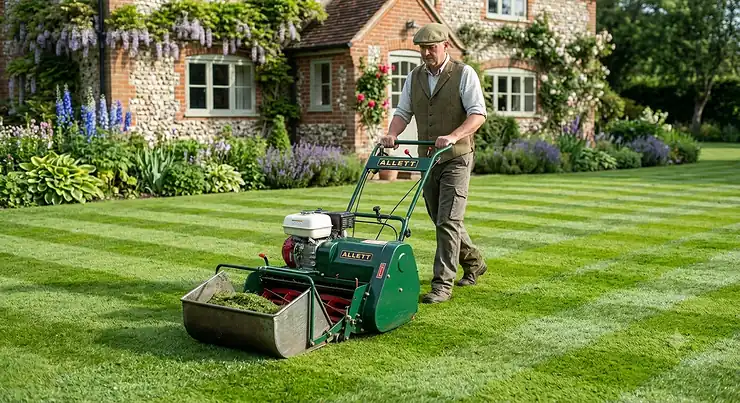
A cylinder mower for stripes is a push or self-propelled lawnmower with a rotating, scissor-action blade cylinder and a rear roller that presses the grass flat as it passes, creating the light-and-dark banded effect seen on cricket pitches and bowling greens. If you’ve ever driven past a garden with those crisp, alternating bands and wondered how on earth the owner gets them so straight, the answer usually isn’t a magic touch — it’s the machine underneath them.
There’s a reason cylinder mowers have such a devoted following among gardeners who take their lawns seriously. Rotary mowers chop; cylinder mowers cut with a genuine scissoring action, and that difference shows up in both the health of the grass and the sharpness of the stripe. This guide walks through seven real cylinder mowers sold in the UK, spanning cheap manual push models through to petrol and cordless machines built for larger plots, with honest analysis based on published specifications and aggregated customer feedback — not fabricated hands-on testing. You’ll also find a full breakdown of how the rear roller and blade count actually influence your stripes, common buying mistakes, and a practical setup guide so your first mow doesn’t end in a patchy mess.
Whether you’re chasing a Wimbledon-style finish on a modest suburban lawn or trying to work out whether a manual push mower can really compete with a petrol machine, this is written to give you the comparative depth that a bare Amazon listing simply can’t. For a sense of how independent reviewers approach this category, Gardeners’ World’s hands-on testing of push mowers is a useful independent starting point alongside this guide.
Quick Comparison Table
| Mower | Power Type | Cutting Width | Blades | Best For |
|---|---|---|---|---|
| Webb WEH12R | Manual (push) | 30cm | 5 | Tiny, flat lawns on a tight budget |
| Webb 20V Cordless Cylinder Mower | Battery | 30cm | 5 | Small lawns, cable-free convenience |
| Allett Classic 12E Plus | Mains electric | 30.5cm | 5 | Small-to-medium lawns, reliable stripes |
| Atco Balmoral 14S | Petrol | 35cm | 6 | Medium lawns, self-propelled power |
| Allett Kensington 14B | Petrol | 35.6cm | 6 | Medium-large lawns, cartridge versatility |
| Allett Sandringham 14E | Mains electric | 35.6cm | 5 | Deepest stripes via double rollers |
| Allett Liberty 43 | Battery | 43cm | 6 | Larger lawns, cordless convenience |
Looking at the spread above, the cheapest realistic entry point into cylinder-mower striping is the manual Webb WEH12R, while the widest cut and largest coverage per charge comes from the Allett Liberty 43. Notice that blade count climbs alongside cutting width and price — that’s not a coincidence, and we’ll unpack exactly why further down. If your lawn is under roughly 100m² and reasonably flat, almost anything on this list will suit you; beyond that, the self-propelled petrol and larger battery options earn their keep.
💬 Found this comparison useful? A quick share helps other gardeners find their perfect stripe too!😊
Top 7 Cylinder Mowers for Stripes: Expert Analysis
Choosing between these seven means weighing power source, cutting width, blade count and price against the realities of your own lawn. Below, each model gets a genuine breakdown of what the spec sheet means in practice, drawing on manufacturer data and aggregated customer sentiment.
1. Webb WEH12R — the honest £150 stripe starter
The Webb WEH12R is proof that you don’t need an engine to get proper stripes; this is a fully manual, human-powered cylinder mower with a chain-driven cutting action and a rear roller doing the visual heavy lifting. Specs-wise, it offers a 30cm cutting width from a five-blade hardened-steel cylinder, tool-free height adjustment between roughly 13mm and 23mm, an 18-litre grass bag, and a weight of around 11kg. In practice, that low weight and narrow cutting height range mean it’s best suited to lawns that are already reasonably level and kept on the shorter side — asking it to plough through overgrown grass will just stall the cylinder. Based on the spec comparison with its battery and mains-powered siblings, this is squarely a small-garden tool: Webb itself pitches it at lawns up to around 83m². Reviewers consistently note that assembly is quick, the double-roller design produces a genuinely crisp stripe for the price, and the silent, emission-free operation is a big draw for anyone mowing near bedrooms or a nervous cat. A recurring criticism in user feedback is that the grass catcher can be fiddly to click into place and that it’s not a machine for anything beyond a modest plot.
Pros:
- ✅ Genuinely low price of entry for cylinder-mower stripes
- ✅ Silent, zero-emission push operation
- ✅ Double roller design gives crisp definition for its size
Cons:
- ❌ Narrow height range limits it to already-tidy lawns
- ❌ Hard work on anything beyond a small, flat plot
At around £130-£170, the Webb WEH12R is the cheapest genuine route into cylinder-mower striping and represents strong value if your lawn is small and your patience for a bit of elbow grease holds up.
2. Webb 20V Cordless Cylinder Mower — cable-free stripes on a budget
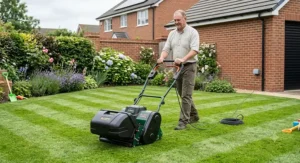
Where the WEH12R relies on muscle, the Webb 20V Cordless Cylinder Mower swaps human effort for a 20V lithium-ion battery while keeping the same 30cm cutting width and five-blade cylinder. The included 4Ah battery delivers around 60 minutes of runtime, which on paper sounds modest, but for a mower this size that’s typically enough for a full small-to-medium lawn in one sitting. It uses a chain drive from the roller to the cylinder and a large rear roller paired with a zinc front roller, and the manual height adjustment runs from 13mm to 23mm, tool-free. What most buyers overlook about entry-level cordless cylinder mowers is that the battery, not the blade, is usually the limiting factor — if your lawn takes longer than an hour to cut, you’ll want a spare battery or a mains-powered alternative instead. Based on the spec sheet, this sits as a genuine step-up for anyone who found a manual mower too much like hard work but isn’t ready to commit to a trailing cable across the garden. Aggregated feedback on Webb’s cordless cylinder range tends to praise the stripe quality relative to price and the freedom from a power lead, with occasional comments about the runtime being tight on larger or longer grass.
Pros:
- ✅ No cable to trail across flowerbeds or trip over
- ✅ Same 5-blade cylinder quality as the manual model
- ✅ Chain-driven rollers keep stripes consistent
Cons:
- ❌ 60-minute runtime is limiting for bigger lawns
- ❌ Spare battery is an extra cost most buyers will want
Priced in the £220-£280 range, the Webb 20V Cordless Cylinder Mower offers a sensible middle ground between manual effort and full mains dependency, provided your lawn fits within one battery charge.
3. Allett Classic 12E Plus — the mains-electric benchmark
The Allett Classic 12E Plus is where cylinder mowing starts to feel genuinely serious, and it’s arguably the most recognisable entry-level machine from Britain’s best-known striping-mower brand. It runs a 420W mains motor driving a five-blade “Quick Cartridge” cylinder across a 30.5cm width, with five preset cutting heights from 6mm to 32mm and a 15-metre cable that Allett rates at roughly 50 feet of genuine reach. On paper this means noticeably more consistent cutting pressure than a battery or manual mower, since mains power doesn’t sag as the cylinder meets thicker grass. The steel rear roller (fixed, not driven) does the striping work, while the polyethylene front roller controls cutting height — a two-roller system that’s a genuine step up in engineering from the budget models above. What the spec sheet won’t tell you, but reviewers note repeatedly, is that the cartridge system is the real selling point long-term: the cutting cylinder unclips and can be swapped for an optional scarifier cartridge, effectively turning one machine into two. Aggregated customer sentiment is strongly positive, with buyers frequently comparing it favourably to previous national-brand mowers and praising the ease of assembly, though the fixed mains cable is occasionally flagged as a hassle on larger plots.
Pros:
- ✅ Mains power gives consistent cutting force throughout
- ✅ Cartridge system allows a bolt-on scarifier later
- ✅ Five-position height dial suits variable lawn conditions
Cons:
- ❌ Mains cable limits freedom of movement on bigger gardens
- ❌ Not self-propelled, so pushing effort remains
Sitting in the region of £650-£700, the Allett Classic 12E Plus represents a genuine step into “proper” cylinder mowing without crossing into petrol-mower territory on price.
4. Atco Balmoral 14S — self-propelled petrol power for bigger plots
The Atco Balmoral 14S takes the same cylinder-and-roller principle and adds a 148cc four-stroke petrol engine with recoil start, a 35cm cutting width, and — critically — self-propulsion, meaning the machine drives itself forward while you steer and guide it. The six-blade hardened-steel cylinder offers a finer cut than the five-blade electric models above, with height adjustment fully variable from 6mm to 36mm plus a dedicated low setting for scarifying. Here’s what to weigh with this one: self-propulsion changes the entire mowing experience on anything beyond a small garden, because you’re no longer fighting the machine’s own resistance on top of the cutting load. Based on the independent cylinder and rear roller setup, the Balmoral is built to keep striping consistent even when the self-propelled drive is doing most of the work, which matters because some rival petrol mowers let the drive wheels disturb the stripe pattern. Reviewers consistently rate Atco’s Balmoral range highly for durability and parts availability — Atco has decades of spares support in the UK — though the trade-off is the ongoing petrol, oil and servicing routine that electric owners simply don’t have.
Pros:
- ✅ Self-propelled drive removes pushing effort on bigger lawns
- ✅ Six-blade cylinder gives a finer finish than budget models
- ✅ Strong parts and servicing network across the UK
Cons:
- ❌ Petrol running costs and annual servicing add up
- ❌ Heavier and noisier than electric or battery equivalents
Expect to pay in the £900-£1,100 range for the Atco Balmoral 14S, positioning it as a serious mid-tier choice for anyone with a medium lawn who wants power without going fully premium.
5. Allett Kensington 14B — the cartridge-swapping all-rounder
The Allett Kensington 14B sits above the Classic range as Allett’s flagship homeowner cartridge machine, built around a 127cc Briggs & Stratton XR550 petrol engine, a six-blade cylinder delivering 79 cuts per metre, and a 35.6cm cutting width. Allett rates it for lawns up to around 400m², and the self-propelled drive combined with a spring-tine comb — which lifts grass upright before the blades reach it — is designed to deliver a genuinely even cut on lawns that see regular family use. Based on the spec comparison with the Balmoral, the meaningful difference is versatility: the Kensington accepts Allett’s full accessory range, including scarifier, aerator, verticut and lawn brush cartridges, so one machine can handle several seasonal lawn-care jobs rather than just mowing. What most buyers overlook is that this modularity is what justifies the higher price tag over a straightforward petrol cylinder mower — you’re paying for a platform, not just a mower. Aggregated reviews of the Kensington range consistently highlight the quality of the stripe finish and the smoothness of the self-propelled drive, with the recurring caveat that the initial outlay is a genuine step up from entry-level petrol machines and that the additional cartridges are sold separately.
Pros:
- ✅ Accepts scarifier, aerator and verticut cartridges
- ✅ 79 cuts per metre for a genuinely fine finish
- ✅ Spring-tine comb improves consistency on uneven grass
Cons:
- ❌ Significant upfront cost compared with a standard petrol cylinder mower
- ❌ Extra cartridges are an additional purchase
Typically priced around £1,750-£1,850, the Allett Kensington 14B suits keen gardeners with medium-to-large lawns who see mowing as one part of a wider lawn-care routine rather than a standalone chore.
6. Allett Sandringham 14E — double rollers, deeper stripes
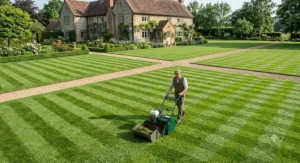
The Allett Sandringham 14E is where mains-electric power meets genuinely premium engineering: a 420W motor drives a five-blade cylinder across a 35.6cm width, but the standout feature is the combination of front and rear rollers working together, rather than just a rear roller doing all the work. At around 28kg, it’s noticeably heavier than the Classic 12E, and that weight is deliberate — combined with both rollers, it flattens the grass more decisively, which translates directly into a bolder, more defined stripe. Here’s what to weigh: despite the heft, it’s self-propelled, driven by the rear roller itself, so pushing effort stays low even though the machine weighs considerably more than its cheaper sibling. Based on the 88 cuts-per-metre figure, this cylinder spins finer than most petrol machines in this guide, giving a scissor-cut finish that suits ornamental and show-quality lawns particularly well. Aggregated feedback on Allett’s dual-roller electric range consistently singles out the depth and longevity of the stripe pattern as the standout benefit, with the main drawback being that a 22-metre mains cable, while generous, still ties you to a socket in a way a battery machine doesn’t.
Pros:
- ✅ Front and rear rollers combine for deeper, longer-lasting stripes
- ✅ 88 cuts per metre for a genuinely fine cut
- ✅ Self-propelled despite the heavier build
Cons:
- ❌ Mains cable still limits reach on larger gardens
- ❌ Considerably heavier to store and manoeuvre than entry models
Sitting around £1,850-£2,000, the Allett Sandringham 14E is aimed squarely at gardeners who see stripe definition as the priority and are happy to stay tethered to a socket for it.
7. Allett Liberty 43 — cordless muscle for the largest lawns
The Allett Liberty 43 is the widest-cutting, most powerful cordless option here, built around a 410W motor powered by a 40V 10Ah lithium-ion battery, giving roughly 40 minutes of runtime from a 100-minute charge. Its six-blade cylinder delivers 79 cuts per metre across a full 43cm width, and — much like the Sandringham — it uses both a front roller with a fixed grass rake and a split rear roller with a geared differential, which Allett says makes manoeuvring its 38.5kg weight around tight lawn edges considerably easier than the weight alone suggests. On paper this means genuinely large lawns, up to around 500m², become realistic without a power cable trailing behind you, which is the single biggest quality-of-life upgrade over the Sandringham for bigger properties. What the spec sheet won’t tell you, but the differential-geared rear roller hints at, is that turning circles are noticeably tighter than you’d expect from a machine this size — a detail that matters more than raw cutting width once you’re actually working around flower beds and trees. Reviewers of Allett’s Liberty range consistently praise the freedom from cables on larger plots, while the recurring criticism is the price, and the reality that 40 minutes of cutting time means larger lawns may need a battery swap mid-mow.
Pros:
- ✅ Widest cut in this guide at 43cm, ideal for larger lawns
- ✅ Geared differential rear roller aids manoeuvrability
- ✅ No cable, unlike the equivalent mains-electric models
Cons:
- ❌ Highest price point of the seven mowers featured
- ❌ 40-minute runtime may require a spare battery on large plots
Expect to pay in the region of £2,200-£2,400 for the Allett Liberty 43, making it the premium choice for anyone with a larger lawn who’s decided cordless convenience is worth paying for.
Top 7 Products at a Glance
| Mower | Weight | Height Range | Price Range | Rating Basis |
|---|---|---|---|---|
| Webb WEH12R | ~11kg | 13-23mm | £130-£170 | Strong aggregated sentiment on value |
| Webb 20V Cordless Cylinder Mower | ~13kg | 13-23mm | £220-£280 | Positive on freedom from cables |
| Allett Classic 12E Plus | 21.7kg | 6-32mm | £650-£700 | Consistently praised build quality |
| Atco Balmoral 14S | ~30kg | 6-36mm | £900-£1,100 | Strong on durability, servicing |
| Allett Kensington 14B | ~35kg | 6-32mm | £1,750-£1,850 | Praised for versatility, finish |
| Allett Sandringham 14E | 28kg | 6-32mm | £1,850-£2,000 | Best-in-class stripe depth |
| Allett Liberty 43 | 38.5kg | 6-32mm | £2,200-£2,400 | Best for larger cordless coverage |
The pattern in this table is fairly clear: price climbs in step with cutting width, self-propulsion, and roller sophistication rather than any single flashy feature. If you’re mowing under 150m², the Webb WEH12R or Webb 20V Cordless Cylinder Mower will do everything you need without paying for capability you’ll never use. Once you’re managing a lawn approaching 400-500m², the jump to a self-propelled petrol or larger battery machine like the Allett Kensington 14B or Allett Liberty 43 stops being a luxury and starts saving genuine time and effort.
How to Get Stripes with a Cylinder Mower
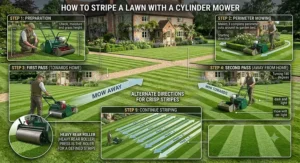
Getting a clean stripe isn’t really about the cutting at all — it’s about how the roller presses the grass. Follow this sequence for consistent results:
- Mow the perimeter first. Go around the entire lawn’s edge at a right angle before you start your stripes; this gives you a clean border to turn within.
- Pick a straight reference line. Aim your first pass at a fixed point in the distance, such as a fence post or door frame, to keep the line true.
- Cut in straight, parallel passes. Mow to the end, turn a tight 180 degrees, and return directly alongside your previous pass, overlapping slightly.
- Keep the cutting height generous. A lawn cut too short shows less contrast between light and dark bands, so stay towards the higher end of your mower’s range in summer.
- Alternate direction on subsequent cuts. Switching between straight and diagonal stripes prevents ruts forming from repeatedly driving the same wheel tracks, a point the RHS specifically flags in its own mowing guidance below.
- Finish, don’t start, on the edges. Save the final lap around the border for last, so you don’t accidentally lay a stray diagonal line across your finished stripes.
- Keep blades sharp. A blunt cylinder tears rather than slices the grass tip, which dulls the light reflection that makes stripes visible in the first place.
For independent guidance on choosing the right lawn mower type for your garden, the Royal Horticultural Society’s own advice service is a genuinely useful sanity check before you commit to a machine.
Cylinder Mower with Rear Roller: Why the Roller Matters More Than the Blades
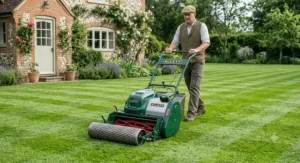
It’s a common misconception that the blades themselves create the stripe — they don’t. The stripe illusion comes entirely from light reflecting differently off grass blades bent in opposite directions, and it’s the roller, not the cutting cylinder, that does the bending. A cylinder mower with rear roller pairs a scissor-action cutting head with a weighted cylinder that flattens the grass as the mower passes over it, and the heavier and better-designed that roller is, the more pronounced and longer-lasting the stripe becomes.
This is precisely why the premium machines in this guide — the Allett Sandringham 14E and Allett Liberty 43 — use both a front and rear roller rather than relying on the rear roller alone. The front roller controls the cutting height and pre-flattens the grass slightly, while the rear roller does the definitive bending pass. Reviewers and manufacturers alike consistently note that a single lightweight roller, as found on entry-level manual mowers like the Webb WEH12R, still produces a visible stripe, but it fades faster between cuts than the deeper impression left by a heavier dual-roller system. If deep, long-lasting stripes are your priority over budget, roller design should weigh more heavily in your decision than cutting width or engine size.
Cylinder Blade Count Explained: 5, 6, or 10 Blades?
Blade count on a cylinder mower directly determines cuts per metre — essentially, how many times the grass is sliced as the mower moves forward one metre. More blades mean a finer, closer-cropped finish with less visible “chatter” in the cut line, but they also mean more moving parts to keep sharp and aligned.
Looking across this guide, the five-blade Webb WEH12R, Webb 20V Cordless Cylinder Mower and Allett Classic 12E Plus sit at the accessible end, delivering perfectly respectable stripes for typical family lawns. The six-blade Atco Balmoral 14S, Allett Kensington 14B and Allett Liberty 43 step up to a noticeably crisper finish, with the Kensington and Liberty both quoted at 79 cuts per metre. At the top end, Allett also sells 10-blade cassettes as an optional upgrade for its cartridge-based mowers, aimed at genuinely formal or ornamental lawns where a bowling-green finish is the goal. For most UK gardens, five or six blades is the practical sweet spot — a 10-blade cylinder is genuinely overkill unless you’re chasing a show-quality finish and are prepared to sharpen more frequently.
Cylinder Mower vs Rotary Mower for Lawn Stripes
Cylinder and rear-roller rotary mowers can both produce stripes, but they get there in noticeably different ways, and the distinction matters more than most buying guides admit.
| Factor | Cylinder Mower | Rotary Mower with Roller |
|---|---|---|
| Cutting action | Scissor-style, clean slice | Horizontal spinning blade, impact chop |
| Stripe sharpness | Crisp, consistent edges | Good, but can show gradient in centre |
| Best lawn condition | Level, regularly mown | Copes better with rough or uneven ground |
| Lowest cut height | Very low (as little as 6mm) | Generally higher minimum |
| Typical cost | Higher for equivalent width | Usually cheaper |
A cylinder mower’s slicing action avoids the ragged blade-tip damage that a rotary’s spinning chop can cause, which is part of why cylinder-cut lawns often look and stay healthier between mows. However, rotary mowers with a roller attachment cope far better with longer, damper, or uneven grass, and they’re generally the more forgiving, affordable route to a striped lawn if your garden isn’t billiard-table flat. If your lawn is already well-established, level, and mown regularly, a cylinder mower will out-stripe a rotary every time; if it’s patchy, bumpy, or grows fast and unevenly, a rotary with a roller is the more realistic starting point.
Alternating Light and Dark Bands: The Science of a Striped Lawn
The alternating light and dark bands on a striped lawn are an optical effect, not a difference in grass colour or length. As the roller passes over the grass, it bends the blades either towards or away from the viewer; blades leaning away reflect more light back at you and appear pale, while blades leaning towards you show more shadow and appear darker. Walk to the opposite end of the same lawn and the light and dark stripes will appear to swap — nothing about the grass itself has changed, only the angle from which you’re viewing it.
This is why lawn health genuinely matters for striping results: a thin, patchy lawn simply doesn’t have enough leaf blade to bend convincingly in either direction, so the contrast will always look weaker regardless of how good your mower is. A dense, well-fed lawn with decent blade width will show off even a modest roller’s work far more dramatically than a sparse one will show off a premium machine.
✨ Ready to See the Difference for Yourself?
🔍 Check current prices on today’s top-rated striping mowers on amazon.co.uk and get your lawn looking its best this season. From budget manual pushers to premium dual-roller machines, there’s a match for every garden and every level of ambition!
Best Striping Lawn Mower for Your Lawn Size and Budget
There’s no single best striping lawn mower — only the best one for your specific lawn, budget and appetite for maintenance. Use this simple framework to narrow things down:
- If your lawn is under 100m² and budget is tight, choose a manual push cylinder mower like the Webb WEH12R, because the effort required stays manageable at that size and the upfront cost is lowest.
- If you want cable-free convenience on a small-to-medium plot, choose a battery cylinder mower like the Webb 20V Cordless Cylinder Mower, because you avoid trailing leads without paying petrol-mower prices.
- If you have a settled routine and a medium lawn, choose a mains-electric machine like the Allett Classic 12E Plus, because consistent power beats battery runtime anxiety when you’re mowing regularly.
- If your lawn exceeds 300m² and you want self-propulsion, choose a petrol option like the Atco Balmoral 14S or Allett Kensington 14B, because the drive system removes the physical strain of pushing a heavier machine.
- If stripe depth matters more than anything else, choose a dual-roller machine like the Allett Sandringham 14E, because the combined front-and-rear roller setup produces the boldest, longest-lasting bands in this guide.
Price range and value analysis broadly track this logic too: the Webb WEH12R and Webb 20V Cordless Cylinder Mower deliver the best pound-for-pound value for small gardens, while the Allett Kensington 14B and Allett Liberty 43 only really justify their higher price tags once lawn size or accessory versatility genuinely demands it. Buying more machine than your lawn needs is the single most common way people overspend on this category.
Practical Usage Guide: Setting Up Your Cylinder Mower for Perfect Stripes
Getting a new cylinder mower home is only half the job — set-up and early habits make a real difference to how good your first stripes look. Start by checking the cutting height before your first mow; most manufacturers ship their mowers on a mid-range setting, and cutting too low on the first pass can scalp an uneven lawn badly. Give the cylinder and bottom blade a quick visual check for alignment, since knocks during transit can occasionally shift the setting on entry-level models.
For your first thirty days, mow more frequently than you think you need to — cutting a third of the grass height regularly, rather than letting it grow long and hacking it back, is what keeps a cylinder mower’s fine blades happy and produces denser growth for better stripe contrast. A common first-month mistake is mowing wet grass, which clogs the cylinder and can smear rather than slice; wait for the lawn to dry where possible. Finally, build a simple maintenance habit: wipe down the cylinder and rollers after each cut to stop grass build-up, and check the bottom blade for sharpness every few months, since a cylinder mower cutting with a dull edge tears grass tips brown rather than leaving the clean white cut that heals fastest.
Real-World Scenarios: Which Cylinder Mower Suits Your Lawn?
Picture three different UK gardens and how the choice plays out in practice. First, a first-time buyer with a 60m² rectangular back garden in a terraced house, budget-conscious and mowing weekly through summer — the Webb WEH12R suits this perfectly, since the lawn is small enough that manual effort stays manageable and there’s no petrol storage or charging routine to think about.
Second, a family with a 250m² lawn who mow twice weekly in growing season and want reliable results without fuss — the Allett Classic 12E Plus fits well here, offering mains-powered consistency for a lawn that’s used regularly enough to justify the step up from manual or battery power, provided there’s a nearby socket.
Third, a retired couple with a 450m² garden who’ve decided striping is genuinely part of their gardening hobby rather than a chore — the Allett Kensington 14B or Allett Sandringham 14E both make sense here, since the larger cutting width and self-propulsion or dual-roller finish reward the extra time invested in the lawn as a feature of the garden rather than a background task.
Common Mistakes When Buying a Cylinder Mower for Stripes
The most frequent mistake is buying based on cutting width alone, without checking whether the lawn is actually flat enough for a cylinder mower to work well — cylinder blades scalp badly on bumps and hollows that a rotary mower would shrug off. A close second is underestimating battery runtime on cordless models; a 40-60 minute runtime sounds generous until you’re partway across a genuinely large lawn with no spare battery to hand.
Buyers also frequently overlook ongoing running costs: a petrol machine needs fuel, oil changes and occasional servicing that a mains-electric or manual mower simply doesn’t, and that cost difference compounds over several seasons. Finally, many people buy the narrowest, cheapest cylinder mower available for a lawn that’s genuinely too large for it, then find themselves mowing for well over an hour each session — a mistake that a slightly wider or self-propelled model would have avoided entirely.
Long-Term Cost & Maintenance of Cylinder Mowers
Total cost of ownership on a cylinder mower goes well beyond the sticker price. Manual and battery models have the lowest ongoing costs — no fuel, minimal electricity, and the main expense is periodic blade sharpening, ideally done professionally roughly once a year according to most manufacturer guidance. Mains-electric machines add a small, fairly negligible electricity cost but otherwise sit close to the manual and battery models in overall running expense.
Petrol cylinder mowers carry the highest long-term costs: fuel across a full mowing season, annual oil changes, air filter replacement, and the eventual cost of a professional cylinder “backlap” or resharpen to keep the scissor-action cutting clean. Against that, petrol and larger battery machines cut faster over bigger areas, so the cost-per-square-metre mowed can still work out favourably for larger gardens despite the higher unit price. As a rough rule, if your lawn takes under 20 minutes to mow with any given machine, the cheaper power source usually wins on total value; beyond that, the time saved by a faster, self-propelled machine starts to offset its higher running costs.
Safety, Regulations & Compliance for Garden Machinery
All lawn mowers sold in the UK, cylinder types included, must comply with outdoor noise emission rules that cap how loud garden machinery can legally be when placed on the market. These requirements are set out in UK government guidance on noise emission from outdoor equipment regulations, which manufacturers must meet before a mower can carry the required conformity marking. In practical terms for buyers, this means any cylinder mower legitimately sold in the UK will have a declared sound power level, useful to check if you’re mowing near neighbours or during quieter hours.
Beyond noise, day-to-day safety comes down to sensible habits: always disconnect the power source (unplug, remove the battery, or stop the petrol engine) before clearing debris from the cylinder or adjusting the cutting height, keep children and pets away while mowing, and never attempt to sharpen a cylinder blade at home — the RHS specifically advises taking cylinder mowers to a professional for blade sharpening, unlike rotary blades which are more straightforward to handle yourself. Petrol models also bring fuel storage considerations, so keep petrol in an approved container away from heat sources, and always let the engine cool before refuelling.
Lawn Stripes Cylinder Mower: Matching the Machine to Your Garden Style
Not every gardener wants the same thing from a lawn stripes cylinder mower, and matching the machine to your actual gardening style matters more than chasing the highest spec on paper. Beginners generally do best starting with a manual or entry-level battery model, since the lower cost and simpler mechanics mean less to go wrong while you learn the basic mowing pattern that produces good stripes. Families with children and pets tend to prioritise safety and noise, making mains-electric or battery machines a more practical everyday choice than petrol, particularly for smaller gardens used throughout the week.
Keen hobbyist gardeners chasing a genuinely show-quality finish are the group best served by the premium end of this guide — the dual-roller Allett Sandringham 14E or the cartridge-flexible Allett Kensington 14B — since both offer the finer cutting cylinders and roller sophistication that produce the sharpest, longest-lasting bands. Seniors or anyone concerned about physical strain should prioritise self-propelled models regardless of budget tier, since pushing even a lightweight manual cylinder mower across a larger lawn adds up to genuine physical effort over a full mowing season.
What to Expect: Real-World Performance on UK Lawns
Specs on paper only tell part of the story, so here’s what they translate to in everyday British gardening conditions. A five-blade, 30cm-class mower like the Allett Classic 12E Plus will typically handle a modest suburban lawn in well under half an hour once you’re into a regular mowing rhythm, producing stripes that stay visible for several days before needing a repeat pass. Self-propelled petrol machines like the Atco Balmoral 14S noticeably reduce physical fatigue on lawns over roughly 200m², something that matters more than most buyers expect once they’re several passes into a warm summer afternoon.
Cylinder mowers generally perform best on lawns mown at least weekly through the growing season; leave it two or three weeks and you’ll likely need to raise the cutting height and go over the lawn twice, since cylinder cutting heads aren’t designed to hack through significant overgrowth the way a rotary mower can. On typical British weather, damp mornings are the main enemy — wet grass clogs the cylinder and produces a smeared rather than sliced finish, so most experienced users wait until early afternoon on dewy days.
FAQ
❓ Can a cylinder mower cut long grass?
❓ Do I need a rear roller to get lawn stripes?
❓ How often should I sharpen a cylinder mower blade?
❓ Is a petrol or electric cylinder mower better for stripes?
❓ What height should grass be for the best stripes?
Conclusion
A cylinder mower for stripes isn’t a single product so much as a spectrum, running from an £150 manual push machine that rewards patience and effort, right through to a cordless £2,400 powerhouse built for genuinely large gardens. What ties every option in this guide together is the same underlying principle: the roller creates the stripe, the blades create the health of the cut, and matching both to the actual size and condition of your lawn matters more than chasing the highest spec sheet.
If you’re starting out on a small, tidy lawn, the Webb WEH12R or Webb 20V Cordless Cylinder Mower will get you genuinely good results without overspending. If your garden is more established and mown regularly, the Allett Classic 12E Plus is the benchmark mid-range choice most reviewers keep returning to. And if stripe depth and finish quality are the whole point of the exercise for you, the Allett Sandringham 14E and Allett Kensington 14B represent the more considered investment, while the Allett Liberty 43 is the one to reach for once your lawn genuinely outgrows anything smaller.
Whichever you choose, remember that the mower is only half the equation — a well-fed, healthy lawn will always show off a good roller’s work far better than a struggling one, however premium the machine pushing it.
Recommended for You
- Cylinder Mower vs Rotary Mower: 7 Real Picks Ranked (2026)
- Cylinder Lawn Mower: 7 Best Picks for a Flawless UK Lawn 2026
- Husqvarna Ride On Mower: 7 Best Models Ranked (2026 Guide)
Disclaimer: This article contains affiliate links. As an Amazon Associate, I earn from qualifying purchases. If you purchase products through these links, we may earn a small commission at no additional cost to you.
✨ Found this helpful? Share it with your friends! 💬🤗
