
In This Article
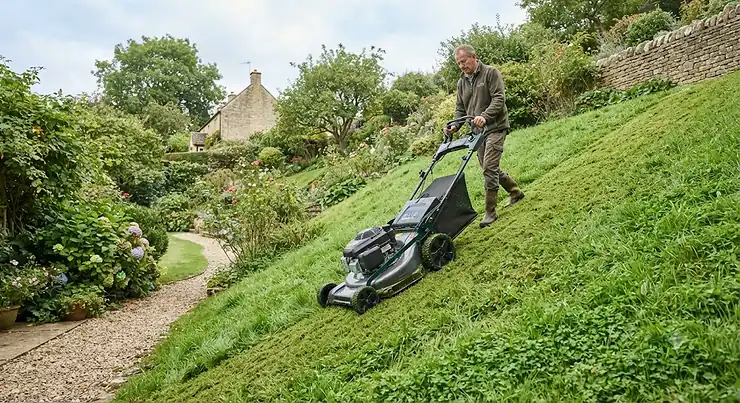
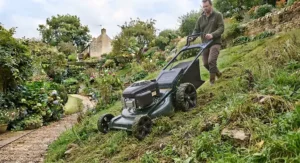
If you’ve ever wrestled a push mower up a bank and watched it roll straight back down onto your shins, you already know why a self-propelled lawn mower for slopes isn’t a luxury — it’s basic self-preservation. A self-propelled lawn mower for slopes is a mower whose engine or motor drives the wheels rather than relying on you to shove it forward, using traction systems such as rear-wheel or all-wheel drive to keep grip on inclines that would leave a standard push mower slithering sideways. That single mechanical difference changes everything about how a gradient feels underfoot.
British gardens are rarely flat. Between Victorian terraces built on hillsides, new-build estates carved into sloping fields, and the sheer geological stubbornness of the countryside, a huge number of us are mowing something closer to a ski slope than a bowling green. According to the Royal Horticultural Society, choosing the right type of mower for your lawn’s size and terrain is one of the first decisions that shapes how enjoyable — or miserable — mowing becomes. The wrong choice on a slope doesn’t just make Saturday morning harder; it can genuinely be dangerous.
This guide cuts through the marketing spin. We’ve researched seven real mowers on the market, from a 21kg budget petrol model to a five-figure all-wheel-drive robot, and paired every spec sheet with honest analysis of what it actually means when you’re standing on a 15-degree bank with wet grass underfoot. We’ll unpack rear-wheel drive versus all-wheel drive, walk through the buying mistakes that catch people out, and give you a genuine decision framework rather than a sales pitch dressed up as advice. If you’ve been typing “self propelled mower hilly garden” into Google at 11pm, this is the article that should have come up first.
Quick Comparison Table
Before we go deep on any single model, here’s the shape of the market at a glance. Each of these mowers takes a different approach to the same problem: keeping the drive wheels planted when the ground tips away from you.
| Mower | Drive Type | Power Source | Best For |
|---|---|---|---|
| Mountfield SP41 | Rear-wheel drive | 123cc petrol | Small gardens, gentle slopes, tight budgets |
| Hyundai HYM510SP | Rear-wheel drive | 196cc petrol | Medium-large lawns with moderate gradients |
| Honda HRX 537 HY | Rear-wheel drive (hydrostatic) | 202cc petrol | Large, complex lawns needing variable pace |
| Husqvarna Automower 435X AWD | All-wheel drive | Battery (robotic) | Steep, hands-free slopes up to 35° |
Looking at this table, the pattern is clear: as slope severity and lawn complexity increase, manufacturers lean harder on drive sophistication rather than raw engine size alone. A budget rear-wheel-drive mower like the Mountfield SP41 is genuinely capable on a gentle incline, but once you’re talking about a proper bank, the hydrostatic control of the Honda HRX 537 HY or the all-wheel traction of the Husqvarna Automower 435X AWD starts to earn its higher price. Weight, wheel size, and where the engine sits over the chassis all matter just as much as the headline “self-propelled” label.
💬 Just one click — help others make better buying decisions too!😊
Top 7 Self-Propelled Lawn Mowers for Slopes: Expert Analysis
We’ve deliberately spread this list across budget, mid-range, and premium territory, and across petrol, battery, and robotic power, because “best” depends enormously on how steep your slope actually is and how much of your Saturday you want to spend on it.
1. Mountfield SP41 — best lightweight starter for gentle slopes
The standout here is weight: at roughly 21-23kg, this is one of the lighter self-propelled mowers you’ll find, which matters more than people expect once you’re lifting it in and out of a shed built on uneven ground. It’s powered by a 123cc STIGA ST120 Autochoke engine driving a 39cm cutting deck, with five cutting heights from 25-70mm and a 40-litre grass bag. In practice, that engine size means it copes fine with a gentle bank or a lumpy lawn, but it isn’t built to fight a proper hill — the self-propel drive is useful rather than muscular. Based on the spec comparison with heavier rear-wheel-drive machines further down this list, the SP41 is best matched to small to medium gardens (up to around 250-400m²) with mild undulation rather than a genuine slope. Reviewers consistently report that it struggles in damp or long grass, where the deck can clog, and that the self-propel speed feels brisk for anyone wanting a slower, steadier pace. What most buyers overlook about this model is that its narrow 39cm deck, while limiting on a large lawn, actually makes it easier to manoeuvre around flower beds and trees that so often complicate sloped gardens.
Pros:
- ✅ Genuinely light for a self-propelled petrol mower
- ✅ Compact deck suits gardens with obstacles and borders
- ✅ Low upfront cost for a self-propelled drive system
Cons:
- ❌ Limited power for anything beyond gentle inclines
- ❌ Prone to clogging in damp or long grass
In the current market, expect to pay around £190-£230 for the SP41, and at that price it’s a sound value pick — provided your “slope” is closer to a gentle roll than a genuine hillside.
2. Hyundai HYM510SP — best rear-wheel-drive workhorse for real gradients
The standout feature is the drive itself: this is a genuine rear-wheel-drive mower, with the 196cc engine sending power to large 203mm rear wheels rather than a token front-wheel assist. That 196cc Hyundai IC200VE engine produces a claimed 4.2kW, paired with a 51cm steel deck and six cutting heights from 25-75mm, which in practice means it holds a consistent cutting speed even when grass is thick or the ground rises sharply beneath it. Based on the spec sheet, the combination of a wide deck, a 70-litre collector, and genuine rear-wheel drive makes this a strong match for medium-to-large gardens with noticeable slopes, since the engine’s weight sits over the driven wheels and helps them bite rather than spin. Reviewers commonly note that the single-speed self-propel system is dependable rather than adjustable — you get one walking pace, not a dial — and a handful of owners have described the drive as “adequate but not powerful” on the steepest sections of their gardens, so it suits moderate rather than extreme gradients. The 70-litre collector and OPC (Operator Presence Control) safety cut-out are the kind of practical touches that don’t show up in a five-second glance at a listing but matter enormously once you’re using the mower weekly.
Pros:
- ✅ True rear-wheel drive built for uneven and sloped ground
- ✅ Large 70-litre collector reduces trips to the compost heap
- ✅ Six-position height adjustment via one central lever
Cons:
- ❌ Single-speed drive can’t be dialled back for cautious walkers
- ❌ At around 38.7kg net weight, it’s heavier to lift and store
Typically priced in the £230-£280 range, the HYM510SP represents strong value for anyone whose garden has a real slope rather than a gentle dip — the rear-wheel-drive advantage genuinely earns its keep here.
3. Mountfield S461R PD — best for a striped finish on gently sloped lawns
The standout advantage is the full-width rear roller, a feature most budget slope mowers skip entirely because it adds weight and cost. That roller doesn’t just create the classic striped lawn look; it also adds stability when mowing along borders and turning at the top of a slope, since the extra ballast at the rear keeps the drive wheels weighted down. Powered by a STIGA engine through a 46cm steel chassis, the S461R PD is self-propelled via the rear wheels, and on paper the roller’s added weight should, in theory, improve traction on modest gradients compared with roller-free rivals of similar engine size. Here’s what to weigh: the roller is brilliant for presentation-focused gardens with rolling, gentle slopes, but it isn’t designed as a specialist hill-climbing tool, and on genuinely steep sections the extra mass can work against you when manoeuvring at the top of a bank. Aggregated owner sentiment across UK garden machinery retailers tends to praise the finish quality and rear roller stripes while flagging that, like most mid-range self-propelled mowers, the drive is single-speed and best suited to a steady, unhurried pace.
Pros:
- ✅ Rear roller adds traction weight and a professional striped finish
- ✅ Solid steel chassis built for repeated seasonal use
- ✅ Self-propelled drive reduces effort on rolling terrain
Cons:
- ❌ Roller design isn’t optimised for steep, technical slopes
- ❌ Heavier than roller-free rivals, which affects storage and lifting
Expect a price in the mid-£300s to low-£400s range, positioning this mower as a strong middle-ground choice for anyone who wants a manicured finish on a moderately sloped, well-maintained lawn.
4. STIHL RM 248 T — best for consistent, no-fuss reliability on uneven lawns
The standout here is straightforward dependability: German-engineered build quality on a 46cm self-propelled deck that’s designed to be started, used, and put away without drama, season after season. Its petrol engine drives the rear wheels, and the cutting width strikes a deliberate balance between coverage and manoeuvrability, which matters on gardens with slopes that also happen to be narrow or broken up by beds and paths. In practice, this means the RM 248 T is less about outright hill-climbing power and more about consistent behaviour on lawns that are uneven rather than dramatically steep — it’s the mower equivalent of a dependable family hatchback rather than a 4×4. What most buyers overlook about STIHL’s mid-range mowers is that the brand’s reputation for parts availability and dealer servicing genuinely matters on a machine you’ll be relying on for years of sloped-lawn duty, since a mower that’s easy to get serviced locally stays useful for longer than one with a patchy parts network. Reviewers consistently note that it handles typical British conditions — slightly damp grass, mixed terrain — better than smaller, lighter mowers in the same price bracket, without needing the raw torque of the heavier-duty options further up this list.
Pros:
- ✅ Dependable rear-wheel-drive self-propulsion for weekly use
- ✅ Strong UK dealer network for servicing and parts
- ✅ Balanced 46cm deck suits mixed, uneven, gently sloped lawns
Cons:
- ❌ Not purpose-built for the steepest gradients in this list
- ❌ Fewer headline features than pricier hydrostatic rivals
Priced broadly in the £350-£450 range depending on retailer, the RM 248 T sits as a sensible mid-range pick for gardens with everyday slopes rather than extreme banks.
5. EGO Power+ LM2135E-SP — best cordless self-propelled option for slope traction without the noise
The standout feature is Touch Drive self-propulsion powered entirely by battery, with variable speed controlled by a fingertip dial rather than a fixed single pace — a genuinely useful distinction on sloped ground where you want to slow right down on the steep bits. The 52cm deck is driven by a 56V 7.5Ah battery delivering up to around 60 minutes of runtime, enough to cover roughly 1,000m² on a charge according to the manufacturer, with a brushless motor that avoids the noise and fumes of petrol equivalents. On paper, this means you get the responsiveness of variable-speed self-propulsion — genuinely helpful for easing off on a slope rather than being dragged along at one fixed pace — without the maintenance overhead of an engine. The spec sheet won’t tell you this, but user reports suggest the trade-off is weight: at nearly 29kg without factoring in the size of the box it arrives in, it’s a genuine two-person lift for some owners when moving it into storage, and the self-propel technique takes a little practice to get smooth. Aggregated review sentiment is broadly positive on cutting performance and quietness, with the most common criticism being the price relative to non-self-propelled EGO models that share the same battery platform.
Pros:
- ✅ Variable-speed drive lets you ease off on the steepest sections
- ✅ Quiet, emission-free operation ideal for regular use
- ✅ Wide 52cm deck covers larger lawns efficiently
Cons:
- ❌ Heavy to lift and carry despite being cordless
- ❌ Self-propel technique needs a short learning curve
Typically found in the £650-£800 range as a kit with battery and charger, this is a premium pick for slope owners who want petrol-level self-propulsion without the noise, smell, or servicing.
6. Honda HRX 537 HY — best hydrostatic drive for large, complex sloped lawns
The standout feature is genuinely stepless hydrostatic transmission, letting you dial in any speed from a dead stop up to around 4mph rather than choosing between fixed gears — a meaningful advantage when a lawn shifts from flat to steeply sloped within a few strides. Power comes from Honda’s Euro 5-compliant GCV200 202cc engine, driving a 53cm Xenoy composite deck with seven cutting heights from 19-101mm and an 88-litre collector, all backed by Honda’s seven-year domestic warranty. Based on the spec comparison with fixed-speed rivals in this list, the ability to smoothly slow down mid-slope and regain pace on flatter ground is precisely what steep, uneven gardens demand — you’re not fighting a mower that wants to run away from you downhill or stall going up. Honda itself is candid that hydrostatic speed control helps manage gentle changes in level but shouldn’t be treated as a specialist tool for the steepest or most unstable slopes, a distinction worth taking seriously rather than glossing over. What most buyers overlook is the Roto-Stop blade brake clutch, which lets you pause the blades — engine still running — to shift the mower across a path or empty the bag mid-slope without a full restart, a genuinely practical safety feature on a bank.
Pros:
- ✅ Stepless hydrostatic drive adapts instantly to gradient changes
- ✅ Roto-Stop clutch allows safe pauses without switching off
- ✅ Seven-year domestic warranty reflects serious build confidence
Cons:
- ❌ Premium price compared with fixed-speed rear-wheel-drive rivals
- ❌ At around 44-45kg, it’s heavy to manoeuvre off the mowing line
Expect a price in the £1,300-£1,700 range depending on retailer promotions, which is a serious outlay — but for large, genuinely complex sloped lawns, the variable-speed control is difficult to replicate at a lower price point.
7. Husqvarna Automower 435X AWD — best all-wheel-drive robot for the steepest slopes
The standout feature is right there in the name: genuine all-wheel drive, engineered specifically to keep every wheel independently powered and gripping as the robot navigates slopes that would leave conventional walk-behind mowers, and most other robotic mowers, struggling for traction. This model is rated by Husqvarna to handle inclines up to 70% gradient — around 35 degrees — inside the mowing area, with an articulated, pivoting rear body designed to maintain contact and traction across genuinely rough, undulating ground rather than just a mild slope. On paper, this means the 435X AWD occupies a different category entirely from every petrol or battery push mower on this list: rather than you walking behind it and physically managing the gradient, the AWD traction system and onboard sensors do that work autonomously, working areas up to roughly 3,500m². Here’s what to weigh: this is a genuinely different proposition from a walk-behind mower, and the AWD system exists specifically to solve the problem that defeats ordinary self-propelled machines — a slope so steep that a human operator standing on it becomes the actual safety risk. Reviewers have described it as feeling engineered for extreme terrain rather than an ordinary suburban lawn, and while the cutting quality and quiet operation draw consistent praise, the price puts it firmly in specialist territory rather than an impulse purchase.
Pros:
- ✅ All-wheel-drive traction system built for extreme gradients
- ✅ Removes the operator from the most dangerous part of the slope
- ✅ Fully autonomous mowing once boundaries are set
Cons:
- ❌ Price puts it well beyond typical domestic mower budgets
- ❌ Installation and boundary setup require more upfront effort
Priced broadly in the £4,500-£5,500 range, this is very much a specialist investment — but for a garden with a genuinely dangerous bank, it may be the only mower on this list that removes the risk entirely rather than merely managing it.
Top 7 Products: Specification Comparison
| Mower | Cutting Width | Power | Drive System | Weight (approx.) | Price Range |
|---|---|---|---|---|---|
| Mountfield SP41 | 39cm | 123cc petrol | Rear-wheel | 21-23kg | £190-£230 |
| Hyundai HYM510SP | 51cm | 196cc petrol | Rear-wheel | ~39kg | £230-£280 |
| Mountfield S461R PD | 46cm | STIGA petrol | Rear-wheel | Mid-weight | £350s-£420s |
| STIHL RM 248 T | 46cm | Petrol | Rear-wheel | Mid-weight | £350-£450 |
| EGO LM2135E-SP | 52cm | 56V battery | Rear-wheel style self-propel | ~29kg | £650-£800 |
| Honda HRX 537 HY | 53cm | 202cc petrol | Hydrostatic RWD | ~44-45kg | £1,300-£1,700 |
| Husqvarna 435X AWD | 22cm | Battery, robotic | All-wheel | ~17kg (robot) | £4,500-£5,500 |
Set side by side like this, the trade-offs become obvious: cutting width and engine size climb steadily as you move down the list, but so does price, and the jump from rear-wheel to all-wheel drive represents a completely different category of machine rather than a simple upgrade. If your slope is manageable on foot and you just want more grip than a push mower gives you, the Hyundai HYM510SP or STIHL RM 248 T deliver rear-wheel-drive traction at a fraction of the Husqvarna’s cost. Only choose the Husqvarna Automower 435X AWD if your slope is genuinely hazardous to walk on — its price only makes sense once you’re solving a safety problem, not just a convenience one.
Practical Usage Guide: Setting Up and Maintaining Your Slope Mower
Buying the right mower is only half the job — how you use it on a gradient determines whether you get a clean cut or a hospital visit. Before your first mow, walk the slope without the mower and note any hidden dips, tree roots, or soft patches; these become genuinely hazardous once you’re managing an engine and blade on the same ground. Set your cutting height slightly higher than usual for the first few passes on a slope, since a lower blade setting increases the risk of scalping on uneven ground and puts more strain on the drive system as it works to maintain traction.
In the first 30 days, the most common mistake is mowing straight up and down a steep bank rather than across it — for walk-behind mowers this increases the risk of the machine (or you) sliding backwards, so working across the contour in overlapping horizontal passes is generally safer, changing direction weekly to avoid rutting the turf. Keep an eye on the drive belt and wheels after the first few cuts; slope mowing puts asymmetric strain on components that flat-lawn mowers rarely experience, and a quick check for wear extends the machine’s working life considerably.
For ongoing maintenance, sharpen or replace blades roughly every season, since blunt blades tear rather than cut, and torn grass on a slope is far more prone to disease and erosion than on flat ground. Clean the underside of the deck after every few cuts, particularly on damp slopes where clippings clump and reduce airflow, and check tyre pressure or wheel condition regularly, because uneven wheel wear compounds instability on already-uneven ground.
Real-World Scenarios: Matching the Mower to Your Garden
Different gardens demand genuinely different machines, and the “best” mower changes completely depending on your specific situation. If you’re a first-time buyer with a modest, gently sloping suburban plot of a few hundred square metres and a tight budget, the Mountfield SP41 makes sense: it’s light enough to manage, cheap enough to not sting if your gardening habits change, and perfectly adequate for mild undulation. If you’re maintaining a medium-to-large family garden with a genuine incline — the kind where a football rolls to one corner and stays there — the Hyundai HYM510SP or STIHL RM 248 T offer proper rear-wheel-drive traction without premium pricing.
For a larger, more complex property — perhaps a converted rectory garden or a plot with several distinct sloped sections and mature borders — the variable hydrostatic control of the Honda HRX 537 HY genuinely earns its price, since being able to slow down mid-gradient rather than fighting a fixed speed reduces both fatigue and risk. And if you’re dealing with the kind of slope the RHS itself acknowledges is often “neither usually realistic nor safe to maintain” with close-mown grass conventionally — a genuinely steep bank where standing upright while operating machinery is the real hazard — the Husqvarna Automower 435X AWD isn’t overkill; it’s arguably the only appropriate tool, because it removes the human operator from the dangerous part of the equation entirely.
Problem → Solution: Fixing Common Slope-Mowing Headaches
Problem: The mower keeps slipping or spinning its wheels on wet grass. Wait for the grass to dry where possible, and consider a genuine rear-wheel-drive model like the Hyundai HYM510SP, since weight naturally shifts backward on an incline, pressing the driven wheels down for extra grip.
Problem: You’re exhausted after mowing a sloped lawn. A self-propelled mower removes the pushing effort, but on a genuine hill, a variable-speed system such as the hydrostatic drive on the Honda HRX 537 HY or the dial-controlled EGO Touch Drive lets you match the machine’s pace to your own rather than fighting a single fixed speed.
Problem: The cut is uneven, with scalped patches on the high side of ridges. Raise the cutting height slightly on undulating ground and check that wheels are set evenly, since a mower tilted even slightly on uneven turf will scalp one side and leave the other too long.
Problem: You’re worried about safety on a genuinely steep section. This is precisely the scenario where a walk-behind mower — however good its drive system — may not be the right tool. An AWD robotic option like the Husqvarna Automower 435X AWD is specifically engineered to handle gradients up to 35 degrees without a person standing on the slope at all.
Problem: Storage space is limited but you need serious traction. Foldable-handle models like the Mountfield SP41 or STIHL RM 248 T fold down for compact storage while still offering genuine rear-wheel-drive self-propulsion.
How to Choose a Self-Propelled Mower for Slopes
Choosing correctly comes down to matching the machine’s traction system, power, and control to the actual severity of your garden’s gradient — not to the biggest engine you can afford. Here’s a practical, step-by-step approach:
- Measure your slope honestly. Walk it and note where you’d genuinely struggle to keep footing; a rough visual estimate is rarely accurate, so a basic inclinometer app can help quantify the gradient.
- Prioritise drive type over engine size. A rear-wheel-drive mower with a modest engine typically outperforms a front-wheel-drive mower with a bigger one on an incline, since traction — not raw power — is the limiting factor.
- Match weight to your physical capability. A heavier mower with better traction is only an advantage if you can comfortably manoeuvre and lift it in and out of storage.
- Consider variable-speed control for complex gradients. If your lawn shifts between flat and steep sections, a hydrostatic or dial-controlled drive avoids the jerkiness of a single fixed speed.
- Check the manufacturer’s slope rating. Most mowers specify a maximum recommended gradient in the manual; treat it as a genuine limit rather than a suggestion, in the same way the RHS advises picking equipment suited to your specific lawn conditions.
- Factor in wet-weather grip. If your region sees regular rain, wider, deeper-treaded rear wheels resist slipping better than narrow ones.
- Decide whether autonomy solves your problem better than power. For genuinely dangerous slopes, an AWD robotic mower may be safer than any walk-behind machine, however capable.
Rear-Wheel Drive vs All-Wheel Drive: Which Traction System Wins on Slopes?
Rear-wheel drive is the default choice for the vast majority of domestic slope mowers, and for good reason. As you push or walk behind a self-propelled mower uphill, your body weight and the engine’s mass both shift rearward, pressing the driven wheels down into the turf and improving grip exactly when you need it most. This is the rear-wheel-drive advantage in a nutshell: gravity works with the drive system rather than against it. Front-wheel-drive mowers, by contrast, tend to lose traction on an incline because weight shifts away from the driven wheels at precisely the wrong moment, which is why virtually none of the mowers in this guide use front-wheel drive.
All-wheel drive takes this further by powering every wheel independently, distributing traction across the whole footprint of the machine rather than concentrating it at the back. On a walk-behind mower this is genuinely rare in the UK market — most AWD traction systems appear on robotic mowers like the Husqvarna Automower 435X AWD, where an articulated, pivoting body actively adjusts wheel contact across broken, undulating ground. The distinction matters practically: rear-wheel drive comfortably handles the moderate-to-fairly-steep slopes most UK gardens present, while AWD is reserved for genuinely extreme terrain where even a well-driven rear-wheel mower would struggle to maintain a straight line.
| Factor | Rear-Wheel Drive | All-Wheel Drive |
|---|---|---|
| Typical slope handling | Moderate to fairly steep | Extreme (up to ~35°) |
| Common on | Petrol & battery walk-behind mowers | Robotic mowers |
| Example | Hyundai HYM510SP | Husqvarna Automower 435X AWD |
| Price impact | Modest premium over standard drive | Significant premium |
| Best For | Everyday sloped domestic lawns | Genuinely hazardous banks |
Interpreting this table, the honest advice is that most UK gardeners don’t actually need all-wheel drive — a properly specified rear-wheel-drive mower like the Hyundai HYM510SP covers the vast majority of sloped lawns. AWD earns its considerably higher price only when the alternative is a genuinely risky slope that a human operator shouldn’t be walking on at all.
✨ Don’t Miss These Exclusive Deals!
🔍 Take your slope-mowing setup to the next level with these carefully selected products. Click on any highlighted item to check current pricing and availability. These tools will help you create a safer, more manageable garden your whole family will enjoy!
Common Mistakes When Buying a Mower for a Hilly Garden
The single biggest mistake is buying based on cutting width alone, assuming a wider deck automatically means a better mower. On a slope, a wide deck without adequate drive and weight distribution can actually be harder to control, since more of the machine’s mass sits away from the driven wheels. A close second is ignoring weight entirely — buyers chase powerful engines without considering whether they can comfortably lift and manoeuvre a 40kg-plus machine up their own garden steps to a shed.
Another recurring error is assuming “self-propelled” automatically means “slope-capable.” As we’ve covered, front-wheel-drive self-propelled mowers exist and are genuinely poor performers on inclines, so checking the specific drive type — not just the word “self-propelled” in the listing — is essential. Buyers also frequently underestimate how much fixed-speed drive systems struggle on lawns with varying gradient, buying a single-speed mower for a garden that actually needs the flexibility of hydrostatic or dial-adjustable control.
Finally, many people simply don’t check the manufacturer’s stated maximum slope rating before buying, assuming any self-propelled mower will cope with any incline. Exceeding a mower’s rated slope tolerance isn’t just a performance issue — as UK safety enforcement data shows, it’s a genuine safety risk that has led to serious and even fatal incidents involving larger machinery.
What to Expect: Real-World Performance on Slopes
Specs on a page rarely translate directly into how a mower feels underfoot, so here’s the honest, practical picture. A budget rear-wheel-drive mower like the Mountfield SP41 on a gentle 5-10 degree slope feels entirely manageable — you’ll notice slightly more resistance guiding it at the top of the bank, but nothing that feels precarious. Step up to a proper 15-20 degree gradient with a mid-range machine such as the Hyundai HYM510SP, and you’ll genuinely feel the rear wheels working, particularly if the grass is thick; the mower pulls itself forward rather than needing much input from you, though turning at the top of the slope requires more deliberate care.
With a hydrostatic mower like the Honda HRX 537 HY, the difference on mixed terrain is immediately obvious: rather than the mower’s pace lurching as the ground changes, you dial the speed down approaching a steep section and bring it back up on the flat, which noticeably reduces fatigue over a long mowing session. And with the Husqvarna Automower 435X AWD, the “real-world performance” question changes entirely — you’re not experiencing the slope at all during mowing, since the robot handles it autonomously; your real-world experience becomes checking the app and watching from a safe distance.
Features That Actually Matter (And Those That Don’t)
Genuine drive type — rear-wheel versus front-wheel versus all-wheel — matters more than almost any other spec, since it’s the difference between a mower that climbs confidently and one that spins its wheels uselessly. Variable-speed control matters significantly on gardens with mixed gradients, and a decent-sized collector genuinely reduces how often you’re interrupted mid-slope to empty grass. Wheel size and tread depth matter too, since larger wheels with deeper tread grip loose or slightly wet turf noticeably better than small, smooth ones.
On the other hand, cosmetic features like flashy LED headlights or app connectivity for non-robotic mowers add little to actual slope performance, however good they look in marketing photos. Similarly, an oversized engine on a mower with poor drive geometry won’t out-perform a smaller-engined machine with genuinely good rear-wheel traction — power without grip just spins wheels faster. Marketing terms like “all-terrain” on budget mowers are also worth scrutinising closely; without a specified drive type and slope rating, the phrase is often aspirational rather than technically meaningful.
Long-Term Cost & Maintenance on Sloped Lawns
Slope mowing accelerates wear on specific components, and factoring that into your total cost of ownership avoids nasty surprises. Drive belts and transmission components on rear-wheel-drive mowers typically wear faster when regularly used on inclines than on flat lawns, since the mechanism is under more sustained load; budgeting for a belt replacement every few seasons on a heavily used slope mower is realistic rather than pessimistic. Blades also dull more quickly on uneven, sloped turf, where scalping and uneven contact are more common, so factor in sharpening or replacement roughly once or twice per season depending on use.
Petrol mowers like the Hyundai HYM510SP or Honda HRX 537 HY carry ongoing fuel and servicing costs, but generally have a longer proven service life on demanding terrain, backed in Honda’s case by a genuine seven-year domestic warranty that reflects manufacturer confidence in long-term reliability. Battery mowers like the EGO LM2135E-SP eliminate fuel costs and reduce servicing needs, but battery capacity degrades gradually over years of use, and a replacement battery represents a meaningful mid-life cost worth factoring in. The Husqvarna Automower 435X AWD sits at the other extreme: minimal ongoing labour cost since it operates autonomously, but the high upfront investment and specialist installation mean the total cost of ownership only makes sense when weighed against the alternative — either paying for regular professional slope-mowing services or accepting real personal risk.
Safety and Slope-Mowing Regulations in the UK
Slope mowing isn’t just a comfort issue — it’s a genuine safety concern with real regulatory weight behind it, particularly for anyone managing grounds professionally. The Health and Safety Executive publishes specific guidance on mower-related risks, including overturns when working on slopes or banks, and UK enforcement action has followed incidents where operators were seriously injured or killed using machinery on gradients without proper risk assessment. While that guidance is aimed primarily at agricultural and commercial mowing, the underlying principles apply just as much in a domestic garden: never exceed a mower’s manufacturer-rated maximum slope, always mow across a gradient rather than straight up and down with a walk-behind machine, and never operate machinery on a slope you personally feel unsteady standing on.
Practical domestic precautions include wearing sturdy, grippy footwear rather than trainers, avoiding mowing wet or frosty slopes entirely, and keeping children and pets well clear of any sloped mowing area. If your garden includes a bank steep enough that you genuinely question your own footing, that’s the clearest possible signal that a walk-behind mower — regardless of how good its drive system is — may not be the appropriate tool, and that an autonomous AWD option or professional grounds maintenance service deserves serious consideration instead.

Frequently Asked Questions
❓ What is the best type of self-propelled mower for a steep slope?
❓ Is rear-wheel drive better than front-wheel drive for hills?
❓ Can a self-propelled mower tip over on a slope?
❓ Is an all-wheel-drive lawn mower worth the extra cost?
❓ How steep is too steep for a self-propelled lawn mower?
Conclusion
There’s no single “best” self-propelled lawn mower for slopes — there’s only the best mower for your specific gradient, garden size, and budget. If your slope is gentle and your garden modest, the Mountfield SP41 does the job without unnecessary spend. For genuine, everyday hills, rear-wheel-drive workhorses like the Hyundai HYM510SP and STIHL RM 248 T deliver real traction at sensible prices, while the Mountfield S461R PD adds a striped finish for those who care about presentation as much as performance. Step up to variable-speed control with the EGO LM2135E-SP or the Honda HRX 537 HY if your lawn shifts between flat and steep sections within the same mowing session, and reserve the all-wheel-drive Husqvarna Automower 435X AWD for genuinely hazardous banks where removing the human operator from the slope entirely is the safest option available.
Whichever machine you choose, the underlying principle from every credible source we’ve referenced — from the RHS’s gardening advice to the HSE’s formal safety guidance — is consistent: match the machine to the gradient honestly, respect the manufacturer’s slope rating, and never treat a steep bank as just another patch of lawn. Do that, and mowing a sloped British garden stops being a battle and starts being, at worst, a mildly satisfying Saturday chore.
✨ Ready to tackle your slope with confidence?
Compare current prices on today’s top pick and take the strain out of your next mow! 🌱🤗
Recommended for You
- Self-Propelled Petrol Lawn Mower UK: 7 Best Picks for 2026
- Self-Propelled Lawn Mower: 7 Best Picks (2026 Guide)
- Push Mower vs Electric Mower: 7 Best Picks for UK Gardens (2026)
Disclaimer: This article contains affiliate links. As an Amazon Associate, I earn from qualifying purchases. If you purchase products through these links, we may earn a small commission at no additional cost to you.
✨ Found this helpful? Share it with your friends! 💬🤗
