
In This Article
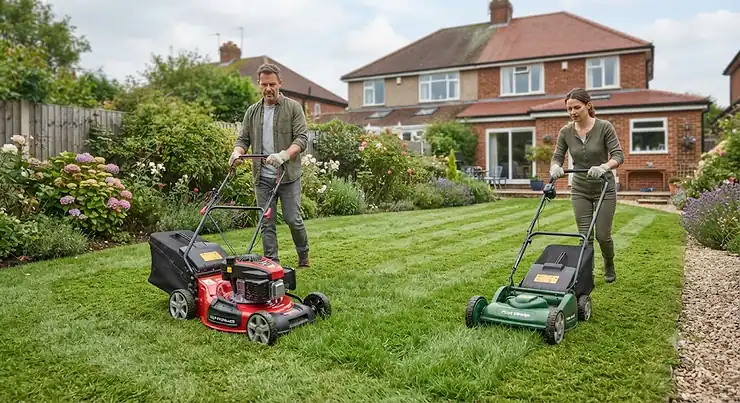
Somewhere between the garden centre aisle and your own back lawn, a genuinely annoying question is waiting for you: self-propelled vs push lawn mower — which one actually deserves your money? A self-propelled mower is a lawn mower with a drive system that moves the wheels forward on its own, so you steer and guide rather than shove; a push mower relies entirely on your own muscle to move it across the grass. That’s the whole distinction in a nutshell, but the real-world consequences of choosing wrongly are anything but simple.
Get it wrong and you’ll know within about ten minutes of your first cut. Buy a push mower for a quarter-acre plot with a slope at the back, and you’ll be drenched in sweat by the third pass, wondering why you didn’t just pay the extra £150. Buy a hefty self-propelled petrol beast for a poky 40m² courtyard lawn, and you’ll spend more time wrestling it out of the shed than actually mowing.
This guide leans on real specifications, genuine aggregated review sentiment, and honest side-by-side analysis of seven current UK models spanning budget push mowers through to premium self-propelled cordless machines. According to the RHS lawn mowing guide, most British lawns need mowing weekly or fortnightly from March to October, which is exactly the kind of repeated, physical task where the right drive system starts to matter enormously. We’ll work through effort reduction, speed control, large-lawn suitability, and the genuine long-term value of paying more for self-propulsion, so that by the end you’ll know precisely which side of this argument your garden belongs on.
Quick Comparison Table: Self-Propelled vs Push Lawn Mower
Before diving into individual products, here’s the shape of the decision in miniature.
| Factor | Push Mower | Self-Propelled Mower | Best For |
|---|---|---|---|
| Physical effort | High — you supply all forward motion | Low — wheels drive themselves | Self-propelled: anyone with joint issues, larger plots, or slopes |
| Typical price range | Budget to mid-range (roughly £80-£220) | Mid-range to premium (roughly £250-£700) | Push: tight budgets and small, flat gardens |
| Speed control | You set the pace naturally | Often has adjustable drive speed | Self-propelled: mixed terrain, varying grass density |
| Ideal lawn size | Up to around 150-300m² | 300m² and upwards | Self-propelled: larger or irregularly shaped plots |
| Manoeuvrability in tight spots | Excellent — light and easy to redirect | Good, but drive can fight you on sharp turns | Push: gardens with lots of borders, pots and obstacles |
Reading across that table, the honest takeaway is that neither type is objectively “better” — it’s a trade-off between money and muscle. A push mower like the Bosch Rotak 32R genuinely shines in a small, flat garden where its light weight makes tight manoeuvring effortless, while something like the Cobra RM43SP80V earns its higher price tag the moment your lawn stretches past a couple of tennis courts or climbs a gentle slope. Where you land on this table should be dictated by lawn size and your own physical comfort with pushing weight repeatedly, not by which option simply looks more impressive on the shelf.
💬 Not sure which side of this table you fall on? Scroll down to the Buyer’s Decision Framework further in this guide for a quick gut-check.🤗
Top 7 Self-Propelled and Push Lawn Mowers: Expert Analysis
We’ve deliberately mixed budget, mid-range and premium options across both drive types, covering corded electric, cordless battery, and petrol power, so whatever your garden and budget look like, there’s a genuine, verifiable match below.
1. Bosch Rotak 32R — sharpest edge-to-edge cut on a budget push mower
The Bosch Rotak 32R is a corded electric push mower built around a 1200W Powerdrive motor, and that standout feature — the “grass combs” either side of the cutting deck — genuinely earns its billing by letting the blade reach right up to fence lines and border edges. With a 32cm cutting width, 20-60mm height adjustment across three settings, and a 31-litre grass box, this is squarely a small-to-medium lawn tool rather than an all-rounder. Weighing under 10kg, the appeal here isn’t power for power’s sake; it’s that anyone can lift, carry and manoeuvre it without a second thought. Based on the spec comparison, the trade-off for that light weight is a 10-metre power cable that becomes genuinely limiting once your plot pushes past roughly 150m², forcing extension leads into the mix. Reviewers consistently note that build quality feels reassuringly solid for the price point, though a handful flag that the cutting height range tops out lower than rival corded mowers, which matters if you prefer a longer, shaggier finish. If you cannot verify a specific reported fault pattern, it’s fairer to say sentiment leans positive on cut quality and negative on cable management rather than invent numbers that don’t exist. This is the mower for a courtyard garden, a new-build plot, or anyone who wants zero maintenance beyond an occasional blade sharpen.
Pros:
- ✅ Grass combs cut cleanly right up to fences and borders
- ✅ Lightweight at under 10kg, easy to lift and store
- ✅ Corded 1200W motor never needs charging or refuelling
Cons:
- ❌ 10m power cable limits reach on bigger plots
- ❌ 32cm deck means more passes on lawns over roughly 150m²
At the time of research, the Rotak 32R typically sits in the £110-£180 range depending on retailer stock. For a small, flat lawn, it’s genuinely hard to beat on value — check current price before you buy, since electricals like this fluctuate with seasonal promotions.
2. Flymo Speedi-Mo 360VC — best corded push mower for mid-size lawns
Stepping up in both deck size and motor power, the Flymo Speedi-Mo 360VC is a wheeled electric push mower with a 36cm cutting width and a 1500W motor, and that extra wattage is the standout feature worth expanding on: it copes with thicker, slightly overgrown grass in a way that smaller corded motors simply can’t. The 40-litre grass box includes a vision window so you can see when it needs emptying without stopping to lift the lid, and the central single-lever height adjustment makes seasonal changes quick rather than fiddly. What most buyers overlook about corded mowers in this bracket is that the extra cutting width genuinely cuts your total mowing time — a 36cm deck covers roughly 12% more ground per pass than the Bosch above, which adds up across a whole lawn. Reviewers consistently report that the dual-lever handle design feels comfortable over longer sessions, a small but real ergonomic win if you’re mowing for twenty minutes or more. On the downside, this is still a corded machine with no self-propulsion, so on anything beyond a gentle incline you’re doing all the work yourself, and the trailing lead remains a hazard to manage around trees, borders and washing lines. It suits a household with a medium, mostly flat lawn who wants more grunt than an entry-level corded mower without paying for cordless or self-propelled convenience.
Pros:
- ✅ 1500W motor handles thicker grass than typical entry-level mowers
- ✅ 40L box with vision window cuts down on emptying trips
- ✅ Central single-lever height adjustment is quick to use
Cons:
- ❌ Still corded, so the trailing lead needs active management
- ❌ No self-propulsion, so slopes remain genuinely hard work
Prices for the Speedi-Mo 360VC generally sit in the £130-£190 range at UK retailers. It’s a sensible upgrade pick if the Bosch above feels a size too small for your plot.
3. Cobra M41C — most affordable petrol push option for cable-free cutting
For gardens without an accessible power socket, or simply too large to trail a cable around, the Cobra M41C offers hand-propelled petrol mowing with genuine cable-free freedom as its standout feature. Under the polymer deck sits a 131cc Cobra DG500 OHV engine (an upgrade from the earlier 98.5cc DG350 unit fitted to older stock), driving a 41cm cutting width with seven height settings from 25mm to 75mm and a 50-litre fabric grass bag. Here’s what the spec sheet won’t tell you, but reviewers note: petrol power at this size genuinely does mulch through longer, damp grass more confidently than most corded electrics, because there’s no risk of motor overload cutting the power. Aggregated review sentiment, including a BBC Gardeners’ World Magazine budget best buy nod for this model, points to strong value for the engine size, though buyers frequently mention that hand-propelling a roughly 19.6-22kg petrol mower across anything past about 300m² becomes noticeably tiring by the second half of the lawn. Based on the spec comparison, this is the honest middle ground for someone who wants petrol reliability and unlimited range but isn’t ready to pay the premium that self-propulsion adds to a petrol chassis — ideal for a medium garden where the owner is happy to supply the muscle in exchange for a lower purchase price.
Pros:
- ✅ No cable or battery, so working range is unlimited
- ✅ 131cc OHV engine copes with longer, damp grass confidently
- ✅ Voted a BBC Gardeners’ World Magazine budget best buy
Cons:
- ❌ Hand-propelled only, which gets tiring past roughly 300m²
- ❌ Needs petrol, oil changes and annual servicing to stay reliable
The M41C typically retails in the £165-£210 range. It’s the natural next step up from electric push mowers once cable length becomes the limiting factor rather than budget.
4. Hyundai HYM430SPE — best-value petrol self-propelled all-rounder
This is where self-propulsion enters the picture properly. The Hyundai HYM430SPE pairs a 139cc / 3.7hp Hyundai OHV engine with rear-wheel-drive self-propulsion, and that drive system is the standout feature worth dwelling on: once you engage it, you’re steering and guiding rather than pushing, which transforms the physical experience of mowing entirely. The 420mm cutting deck offers six height settings from 25mm to 75mm, feeds into a 45-litre grass collector, and starts via push-button electric ignition backed by a recoil pull as a fallback — genuinely useful if the battery ever runs flat mid-season. On paper this means a medium-to-large lawn, roughly the size of a 20×20 metre plot according to Hyundai’s own guidance, becomes manageable without the leg-day burn a push petrol mower delivers. Reviewers consistently note the rear-wheel-drive system copes noticeably better with uneven or slightly bumpy ground than front-wheel-drive rivals, since the weight sits over the driven wheels rather than pulling away from them. What most buyers overlook is that Operator Presence Control — a safety feature that cuts the engine the moment you release the handle — adds a genuine layer of protection that budget petrol push mowers at this price point often lack. At around 30kg, it’s noticeably heavier to manhandle in and out of a shed than any electric mower in this guide, and like any petrol engine it needs oil, a clean air filter and occasional spark plug attention to keep running well.
Pros:
- ✅ Rear-wheel-drive self-propulsion removes the pushing effort
- ✅ Push-button electric start backed by recoil as a fallback
- ✅ 45L bag and 420mm deck cover medium lawns efficiently
Cons:
- ❌ Petrol servicing (oil, spark plug, air filter) adds ongoing cost
- ❌ At around 30kg it’s heavier to lift into storage than electric rivals
Expect to pay somewhere in the £280-£330 range for the HYM430SPE, making it one of the most accessible entry points into genuine self-propelled mowing.
5. Worx Nitro WG749E — best variable-speed cordless self-propelled for slopes
The Worx Nitro WG749E brings cordless convenience to self-propulsion, and its standout feature is genuinely clever: a variable-speed drive that lets you dial the self-propelled pace up to 5.2km/h to match your own walking speed, rather than fighting a fixed, one-size-fits-all drive. Two 20V PowerShare batteries combine to deliver 40V to a brushless motor turning a 46cm deck, with seven cutting heights from 20mm to 80mm and a 55-litre collection box for fewer emptying trips on bigger lawns. Here’s what most buyers overlook about the Intellicut system: it automatically increases motor power when it senses thicker or longer grass, then backs off again in lighter patches, which in practice means the battery lasts noticeably longer than a mower running at full power throughout. Based on the spec comparison, this matters most on gently sloped gardens, where the self-propelled rear-wheel drive genuinely does the climbing for you rather than leaving you leaning into the handlebar. Aggregated review sentiment is strongly positive on power delivery, with reviewers noting it feels closer to petrol performance than earlier cordless mowers, though a recurring theme in feedback is that a rear roller for striping would round the package off — this model doesn’t include one. Independent testing from BBC Gardeners’ World Magazine broadly backs this up, rating cordless self-propelled mowers in this class highly for user-friendliness. Worx recommends it for lawns from roughly 500 up to 800m², depending on grass density and mowing frequency, positioning it firmly as a step-up mower for a household that has outgrown a small corded machine.
Pros:
- ✅ Variable-speed self-propelled drive adjusts to your own pace
- ✅ Intellicut automatically boosts power in thick, dense patches
- ✅ Two swappable batteries mean no mid-mow charging wait
Cons:
- ❌ RRP sits well above the budget push mowers in this guide
- ❌ 55L box needs fairly regular emptying on the largest lawns it’s rated for
The WG749E carries an RRP around £450, though it’s often found in the £380-£450 range at UK retailers. It’s a strong pick for anyone wanting cordless self-propulsion without stepping all the way up to premium pricing.
6. Cobra RM43SP80V — premium cordless self-propelled with striping roller
Sitting at the top of this line-up, the Cobra RM43SP80V pairs twin 40V batteries (delivering 80V combined) with a brushless motor, a 43cm cutting deck, and — its genuine standout feature — a rear roller that presses stripes into the lawn as you go, the same finishing touch traditionally associated with much heavier petrol cylinder mowers. Self-propelled drive runs at a steady 3.2-3.3km/h, five to seven cutting heights span 17mm to 75mm, and the 50-litre grass bag keeps emptying trips down even on a full-size plot. What the spec sheet won’t tell you, but reviewers consistently note, is how quiet this mower is in practice compared with a petrol equivalent of similar power — several owners specifically mention being able to mow early morning or evening without disturbing neighbours, a genuine benefit brushless cordless motors deliver over combustion engines. Based on aggregated review sentiment, buyers rate the self-propelled system highly for taking the effort out of rougher ground and gentle slopes, echoing exactly the kind of terrain where push mowers struggle most. With a runtime of up to around 101 minutes on a full charge and roughly 29kg of weight, it’s built for larger, established gardens rather than pocket-sized plots, and the safety key start is a thoughtful touch that prevents accidental startups when it’s parked in the shed. This is the mower for someone who has decided cordless self-propulsion is worth paying for and wants the striped finish of a proper high-end lawn without a petrol cylinder mower’s maintenance demands.
Pros:
- ✅ Rear roller leaves a genuinely professional-looking striped finish
- ✅ Twin 40V batteries deliver near-petrol power without fumes or noise
- ✅ Self-propelled drive takes real strain out of slopes and rough ground
Cons:
- ❌ One of the pricier cordless mowers featured in this guide
- ❌ At around 29kg it’s not the easiest machine to carry up steps
At the time of research, the RM43SP80V generally sits in the £550-£650 range, positioning it as a genuine premium purchase — always check current price and stock, since Cobra’s cordless range is regularly updated.
7. Greenworks GDG24LM33 — lightest budget push mower for pocket-size lawns
Closing out the seven with a return to entry-level territory, the Greenworks GDG24LM33 is a 24V cordless push mower whose standout feature is sheer lightness: at just 9.5kg, it’s genuinely one of the easiest mowers in this guide to lift, carry and store, cordless convenience included. The 33cm cutting deck offers five height settings between 25mm and 70mm, feeding a 30-litre grass bag, and the battery is interchangeable across the wider Greenworks 24V tool family, which is a real practical bonus if you already own their trimmer or hedge cutter. On paper this means roughly 280m² of coverage per charge, with a full recharge taking around two hours — sensible numbers for a small garden rather than a genuine all-rounder. Reviewers consistently report that it mows well on flat, established lawns but can struggle in very long or damp grass, occasionally needing a second pass, which tracks with its modest motor size relative to larger corded or petrol machines. Aggregated feedback also flags the 46-minute typical runtime as more than adequate for the small lawns it’s designed for, though naturally not something you’d want to rely on for a larger plot. As a push mower with no self-propulsion, it firmly belongs in a small, flat garden where cable-free convenience and low weight matter more than raw cutting power or effort reduction.
Pros:
- ✅ Just 9.5kg, genuinely easy for most people to manoeuvre
- ✅ Battery interchangeable with other Greenworks 24V garden tools
- ✅ Compact 33cm deck folds down small for shed storage
Cons:
- ❌ No self-propulsion, so it’s still pushed entirely by hand
- ❌ 280m² recommended area limits it firmly to smaller plots
Typically found in the £115-£200 range depending on retailer and battery bundle, the GDG24LM33 is a genuinely sensible budget pick for anyone whose lawn genuinely doesn’t need self-propulsion.
✨ Compare Your Shortlist Before You Buy
🔍 Take the guesswork out of mowing day. Click through on any of the seven models above to check current pricing and availability on amazon.co.uk, and match the spec sheet against your own lawn size before you commit. A few minutes of comparison now saves a season of regret later.
Effort Reduction: How Self-Propelled Drive Changes Mowing Day
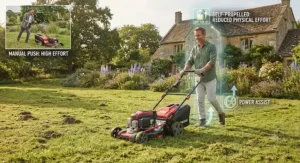
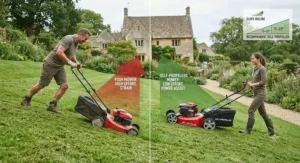
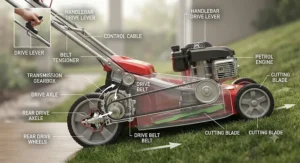
The single biggest reason people upgrade from a push mower to a self-propelled one is effort reduction, and it’s worth being specific about what that actually means in practice rather than repeating the marketing line. With a push mower, every metre of forward motion comes from your legs and core, repeated for the entire lawn, every single time you mow. With a self-propelled mower like the Hyundai HYM430SPE or Worx Nitro WG749E, the drive wheels do that work instead, and your job shrinks down to steering, turning at the end of rows, and occasionally holding the handle back on a downhill stretch.
This matters most in three specific situations: larger lawns where the cumulative distance walked adds up fast, sloped gardens where pushing weight uphill repeatedly is genuinely strenuous, and for anyone with joint pain, reduced mobility, or simply less day-to-day fitness than they’d like. Reviewers of the Cobra RM43SP80V specifically and repeatedly mention how much easier rough or uneven ground becomes once the mower is doing its own forward motion, which lines up with the physics: you’re no longer fighting friction and gradient with your own bodyweight on every pass.
There’s a genuine trade-off worth naming honestly, though. Self-propelled drive adds weight, complexity and cost, and on a small, flat, obstacle-heavy lawn, that extra drive system can actually make manoeuvring around borders and pots slightly more awkward than a light push mower, since the wheels want to keep moving forward even as you’re trying to redirect around a flowerbed. Effort reduction is a real and valuable benefit, but it’s specifically a large-lawn and sloped-lawn benefit — on a tiny courtyard plot, the juice may genuinely not be worth the squeeze.
Real-World Scenarios: Which Mower Type Suits Your Garden?
Specs only tell half the story, so here are three realistic UK household profiles matched to the products above, with honest reasoning for each.
The first-time homeowner with a 60m² rear garden. Flat, fenced, dotted with a few borders and a small patio. Budget matters, storage space is tight, and the lawn takes fifteen minutes to cut either way. Here, a light push mower like the Bosch Rotak 32R or Greenworks GDG24LM33 genuinely makes more sense than paying extra for self-propulsion you’ll barely notice on a lawn this size — the money’s better spent on a decent border edger.
The family with a 400m² garden on a gentle slope, cutting weekly through the growing season. This is precisely the scenario self-propulsion earns its keep. A Hyundai HYM430SPE or Worx Nitro WG749E turns a genuinely tiring weekly chore into something one parent can knock out solo in twenty minutes without needing a lie-down afterwards, and the wider cutting decks on both models mean fewer passes across a lawn this size.
The keen gardener with an 800m²-plus plot who wants a striped, lawn-magazine finish. Here the Cobra RM43SP80V‘s rear roller and premium cordless power genuinely justify the higher outlay, particularly if a petrol mower’s noise, fumes and servicing schedule are things you’d rather avoid altogether. For this kind of buyer, self-propulsion isn’t a luxury — it’s the only realistic way to maintain a lawn this size without turning mowing into a half-day event.
Problem → Solution: Common Mowing Frustrations, Solved
Even with the right mower type, a handful of recurring problems crop up across UK gardens. Here’s how to actually deal with them.
Problem: the mower struggles or stalls in long, damp British grass. Solution: raise the cutting height for the first pass of the season rather than dropping straight to your preferred short cut, and mow more frequently through spring so the mower is never tackling an overgrown lawn in one go — the RHS guide to mowing technique specifically recommends this staged approach after winter.
Problem: a push mower feels exhausting on a lawn that’s grown since you bought it. Solution: rather than assuming you need a whole new mower, honestly assess whether the extra effort is occasional (a few overgrown weeks) or structural (the lawn has genuinely outgrown a push mower). If it’s the latter, models like the Hyundai HYM430SPE solve the problem permanently rather than every single mowing session.
Problem: self-propelled drive feels too fast or jerky around borders. Solution: this is exactly what variable speed control solves — the Worx Nitro WG749E‘s adjustable drive lets you slow the propulsion right down near obstacles and speed back up on open stretches, rather than fighting a fixed pace throughout.
Problem: grass box needs constant emptying on a bigger lawn. Solution: match box capacity to lawn size rather than just cutting width — both the Worx Nitro WG749E and Cobra RM43SP80V carry 50-55 litre boxes specifically because they’re designed for larger plots where frequent stops would otherwise eat into your afternoon.
Problem: uneven cuts or scalped patches on bumpy lawns. Solution: rear-wheel-drive self-propelled mowers, such as the Hyundai above, tend to track more evenly over undulating ground than front-wheel-drive models, because the driven wheels stay planted under the mower’s weight rather than being pulled from the front.
How to Choose Between a Push and Self-Propelled Lawn Mower
Working through these criteria in order will get you to a sensible decision faster than browsing specs at random.
- Measure your lawn properly first. Pace it out or check a property listing — “it feels big” isn’t a number you can shop against, and the gap between a 150m² and 400m² lawn is the single biggest factor in this whole decision.
- Be honest about slopes and uneven ground. Even a gentle incline becomes noticeably harder work with a push mower repeated weekly across a whole season, which is exactly where self-propulsion earns its price premium.
- Consider your own physical comfort with repeated pushing. This isn’t about strength in the abstract — it’s about whether forty minutes of pushing resistance against your legs, week after week, sounds like exercise you want or a chore you’ll start avoiding.
- Set a realistic budget band, not just a purchase price. Petrol self-propelled models add servicing costs; cordless models add battery replacement down the line. Factor in three to five years of ownership, not just the sticker price.
- Check storage space before falling for extra features. A rear roller or wider deck sounds appealing until it doesn’t fit through your shed door — measure before you buy.
- Match grass box capacity to lawn size. A 30-litre box on a 400m² lawn means constant emptying trips that erode any effort savings self-propulsion gave you in the first place.
- Decide on power source last, not first. Petrol, corded electric and cordless battery all now offer both push and self-propelled variants — pick your drive type based on the criteria above, then choose the power source that fits your garden’s electrical access and your appetite for maintenance.
Push vs Self-Propelled: Which Is Better?
Framed as a straight fight, push vs self-propelled which is better genuinely depends on the two variables that matter most: lawn size and your own physical preference, in that order. On lawns under roughly 200m², a push mower does everything a self-propelled one does at a noticeably lower price, with less weight to store and fewer moving parts to maintain — the effort difference on a plot this size is genuinely marginal, often just a few extra minutes of light exertion.
| Comparison Point | Push Mower | Self-Propelled Mower |
|---|---|---|
| Effort on flat ground | Noticeable but manageable | Minimal |
| Effort on slopes | Significant | Substantially reduced |
| Purchase price | Lower | Higher |
| Weight to store/lift | Generally lighter | Generally heavier |
| Best lawn size | Small to medium | Medium to large |
Looking at the table above, the crossover point where self-propulsion genuinely pays for itself in reduced effort tends to sit somewhere around the 250-300m² mark for most people, though anyone with existing joint or mobility concerns should weight that figure downward significantly. Reviewers of self-propelled models consistently describe the change as “not having to think about pushing at all,” which is a qualitative shift push mower owners on larger lawns simply don’t get to experience, however light their machine is.
Where self-propulsion genuinely loses ground is manoeuvrability in tightly landscaped gardens — reviewers of driven mowers occasionally mention the propulsion fighting them on sharp turns around flowerbeds, a complaint push mower owners never raise, since a light push mower goes exactly where you point it with zero resistance. Push mowers also remain the meaningfully cheaper, lower-maintenance choice, and for a lawn genuinely small enough to mow in ten minutes, that simplicity has real value that shouldn’t be dismissed just because self-propulsion sounds more impressive.
Is a Self-Propelled Mower Worth It? Long-Term Cost & Maintenance
Is a self-propelled mower worth it, financially, over several years of ownership? The honest answer requires looking past the initial purchase price to total cost of ownership.
| Cost Factor | Push Mower (Petrol/Electric) | Self-Propelled Mower |
|---|---|---|
| Upfront price | Lower | Higher |
| Annual servicing (petrol) | Standard | Standard, plus drive-belt checks |
| Battery replacement (cordless) | Applies if cordless | Applies if cordless |
| Time saved per mow | None | Meaningful on larger lawns |
| Physiotherapy/joint strain risk | Higher on bigger lawns | Lower |
That last row is easy to dismiss as a soft, unquantifiable factor, but it genuinely shouldn’t be. If pushing a mower across your lawn repeatedly causes real physical discomfort, the “cost” of a push mower isn’t just its purchase price — it’s the accumulated strain of an activity you’ll be repeating twenty-plus times a year for years to come. Self-propelled models like the Hyundai HYM430SPE and Cobra RM43SP80V carry a higher upfront cost, roughly £150-£400 more than comparable push mowers in this guide, but on a lawn over around 300m², the time saved and effort avoided across a typical five-to-seven-year ownership period genuinely does offset that gap for most buyers.
Where self-propulsion is harder to justify financially is on smaller lawns, where the effort difference is marginal and the extra spend doesn’t buy you much beyond convenience. A sensible rule of thumb: if your current push mower genuinely leaves you out of breath or achy, or your lawn has grown since you bought it, that’s a stronger signal to upgrade than simply wanting the newer, shinier option.
Speed Control and Cutting Performance: Features That Actually Matter
Not every self-propelled mower is built the same, and speed control is the feature most worth understanding before you buy rather than after. Fixed-speed self-propelled mowers, like the Hyundai HYM430SPE, drive forward at one set pace once engaged — fine for most lawns, but it can feel slightly brisk when manoeuvring tightly around borders or slightly sluggish on wide open stretches where you’d naturally walk faster.
Variable-speed models, such as the Worx Nitro WG749E, solve this by letting you dial the drive speed up or down to match your own natural walking pace, which reviewers consistently rate as a meaningful comfort improvement over fixed-speed rivals rather than a gimmick. What most buyers overlook is that speed control interacts directly with cutting quality: mowing too fast for the grass density can leave an uneven, streaky finish, while systems like Worx’s Intellicut automatically compensate by boosting motor power in thicker patches rather than relying on you to slow down manually.
By contrast, features that genuinely matter less than marketing suggests include maximum stated top speed (irrelevant if you’re not walking that fast anyway) and cosmetic deck styling. Features that consistently do matter, based on aggregated review sentiment across all seven mowers here, are grass box capacity relative to lawn size, cutting height range for seasonal flexibility, and — for self-propelled models specifically — whether the drive speed is adjustable or fixed.
Self-Propelled Mowers for Large Lawns and Sloped Gardens
Suitability for large lawns is where self-propelled mowers move from “nice to have” to genuinely necessary. On a lawn over around 400-500m², a push mower turns mowing into a session lasting well over an hour, with fatigue building steadily throughout — reviewers of larger push mowers frequently mention needing to pause partway through, which itself adds time and breaks the rhythm of the job.
The Worx Nitro WG749E, rated by Worx for lawns up to 800m², and the Cobra RM43SP80V, built for larger established plots with a 50-litre box specifically to reduce emptying stops, are both designed around exactly this scenario. Wider cutting decks (43-46cm on these two versus 32-41cm on the push mowers above) mean fewer total passes, compounding the effort saved by self-propulsion itself.
Slopes add a second dimension entirely. Even a gentle gradient means a push mower owner is fighting gravity on every uphill pass, and reviewers across multiple self-propelled models specifically call out sloped or uneven ground as the scenario where the drive system earns its price most convincingly. If your garden combines size and gradient — a genuinely common combination on British properties with rear gardens that slope away from the house — self-propulsion stops being a luxury upgrade and becomes close to essential for keeping mowing a manageable, weekly task rather than a dreaded one.
Common Mistakes When Buying a Lawn Mower
Even careful shoppers fall into a handful of predictable traps.
Buying based on cutting width alone. A wider deck covers more ground per pass, but it’s meaningless if the mower is too heavy to push comfortably or too wide to fit through your side gate — measure access routes before you shop by deck size.
Assuming self-propulsion is always worth the extra cost. As covered above, on a genuinely small, flat lawn, that extra spend buys convenience you may barely notice, while a lighter push mower would actually be easier to manoeuvre around borders.
Ignoring grass box capacity relative to lawn size. A 30-litre box that’s perfect for a small garden becomes a genuine annoyance on a 400m² plot, turning one mowing session into three trips to the compost heap.
Overlooking storage dimensions. Self-propelled mowers, particularly petrol ones like the Hyundai, are meaningfully bulkier and heavier than push mowers — check they’ll actually fit your shed or garage before falling for the spec sheet.
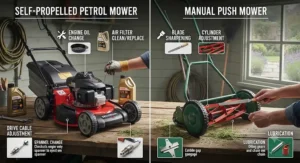
Skipping the maintenance reality check. Petrol mowers need oil, fuel, spark plugs and annual servicing; cordless batteries degrade and eventually need replacing. Neither drive type is maintenance-free, whatever the marketing implies, so factor realistic upkeep into your decision rather than assuming a higher price tag means “no more thinking about it.”
Safety, Regulations & Compliance for UK Mower Buyers
Whichever type you choose, a few practical UK-specific points are worth knowing. Garden power tools sold in Great Britain, including lawn mowers, need to meet product safety requirements under either the CE marking or the newer UKCA marking system, and current government guidance confirms manufacturers can use either marking on products sold in Great Britain under transitional rules (gov.uk guidance on the UKCA marking). In practice, this means checking that any mower you buy — including private imports or second-hand purchases — carries a valid CE or UKCA mark, since this indicates it’s met recognised UK or EU safety standards for electrical and mechanical equipment.
Beyond the marking itself, a handful of practical safety habits apply regardless of drive type: always disconnect the spark plug lead or remove the battery before clearing a blockage or adjusting the cutting height, never mow wet grass on a slope where footing is unreliable, and keep children and pets well clear while the mower is running, particularly with self-propelled models where the forward drive means the machine can keep moving even if you briefly lose your footing. For corded electric push mowers, an RCD (residual current device) plug adaptor is a cheap and sensible safeguard against accidental cable damage while mowing.
Do I Need a Self-Propelled Mower? Your Buyer’s Decision Framework
If you’ve read this far and still aren’t sure, this simple framework should settle it.
If your lawn is under roughly 150-200m² and flat, choose a light push mower — the Bosch Rotak 32R or Greenworks GDG24LM33 — because self-propulsion would add cost and weight you’re unlikely to appreciate day to day.
If your lawn is medium-sized (200-400m²) with mostly flat ground and no power socket nearby, choose a hand-propelled petrol mower like the Cobra M41C, prioritising unlimited range over effort reduction.
If your lawn is medium-to-large (300m²+) or includes any noticeable slope, choose a self-propelled model — the Hyundai HYM430SPE for petrol reliability, or the Worx Nitro WG749E for cordless convenience with adjustable speed.
If you want the largest lawn covered with the least physical effort and a striped, professional finish, choose the Cobra RM43SP80V, accepting the higher price as the cost of genuinely effortless mowing on a demanding plot.
If you’re simply unsure and your budget allows it, lean toward self-propulsion. Reviewers who upgrade from push to self-propelled mowers overwhelmingly describe it as a change they wish they’d made sooner, while the reverse — someone regretting buying a self-propelled mower — is a far rarer sentiment in aggregated feedback.
Frequently Asked Questions
❓ Is a self-propelled mower worth it for a small garden?
❓ Do I need a self-propelled mower if my lawn is flat?
❓ What is the main advantage of a self-propelled lawn mower?
❓ How does speed control work on a self-propelled mower?
❓ Are self-propelled mowers harder to manoeuvre than push mowers?
Conclusion
Working through this comparison honestly, the self-propelled vs push lawn mower decision really does come down to two questions: how big and how sloped is your lawn, and how much do you value not physically pushing weight across it, week after week. Push mowers — the Bosch Rotak 32R, Flymo Speedi-Mo 360VC, Cobra M41C and Greenworks GDG24LM33 — remain genuinely excellent, sensible choices for small-to-medium, mostly flat gardens, where their lower price and lighter weight are real, tangible advantages rather than compromises.
Self-propelled models — the Hyundai HYM430SPE, Worx Nitro WG749E and Cobra RM43SP80V — earn their higher price tags specifically on larger or sloped lawns, where effort reduction stops being a nice-to-have and becomes the difference between mowing being a manageable weekly task or a chore you start putting off. None of the seven mowers here is objectively “the best” in isolation; each one is the right answer for a specific combination of lawn size, budget and physical preference, which is exactly why matching the product to your actual garden matters more than chasing the highest spec sheet.
Whichever way you land, buying based on real measurements of your lawn, an honest assessment of your own comfort with physical effort, and genuine product specifications — rather than marketing claims alone — will get you a mower you’re still glad you bought two summers from now.
✨ Ready to Find Your Perfect Match?
🔍 Revisit the Buyer’s Decision Framework above, measure your lawn if you haven’t already, and click through to check current pricing on whichever model fits your garden best. The right mower turns a dreaded weekly chore into a genuinely quick, manageable job — and that’s worth getting right the first time.
Recommended for You
- Self-Propelled Lawn Mower for Slopes: 7 Best Picks for 2026 (UK)
- Self-Propelled Petrol Lawn Mower UK: 7 Best Picks for 2026
- Self-Propelled Lawn Mower: 7 Best Picks (2026 Guide)
Disclaimer: This article contains affiliate links. As an Amazon Associate, I earn from qualifying purchases. If you purchase products through these links, we may earn a small commission at no additional cost to you.
✨ Found this helpful? Share it with your friends! 💬🤗
