
In This Article
Somewhere in a British garden shed right now, there’s a Mountfield that’s outlived at least one marriage, two house moves and a truly heroic number of Bank Holiday mowing sessions. That’s not an accident. A mountfield petrol lawn mower has been the default choice for UK gardens since 1962, and the brand’s reputation for “does the job, doesn’t fuss” reliability is earned rather than marketed. But “Mountfield” isn’t one mower — it’s a sprawling range of hand-propelled, self-propelled and rear-roller machines with wildly different engines, deck widths and price points, which makes picking the right one trickier than it sounds.
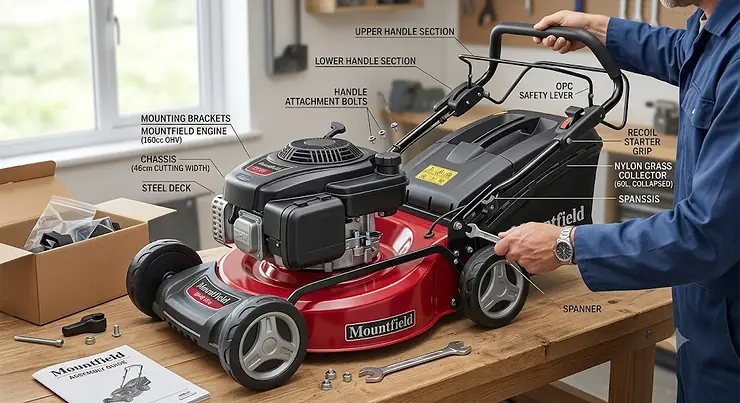
So, what is a Mountfield petrol lawn mower? In short, it’s a rotary mower built or badge-engineered by STIGA (Mountfield’s Italian parent company since 2000) that uses a small four-stroke petrol engine to spin a rotating blade, cutting grass at a walking pace with no cord to trip over and no battery to run flat mid-lawn. As the RHS explains in its lawn mowing guide, regular mowing at the right height and frequency is what actually keeps a lawn dense and healthy, and the mower you choose has a direct bearing on how easy that habit is to keep up.
This guide walks through seven genuine Mountfield models — from a lightweight 24kg starter mower to a Honda-engined workhorse for half-acre gardens — with honest analysis drawn from real specs and aggregated owner feedback, not marketing copy. We’ll cover the best Mountfield mower for different garden sizes, a dedicated Mountfield SP53 review and Mountfield HP45 review, how Mountfield stacks up against Cobra, what those Stiga engines are actually like to live with, and the warranty terms that catch people out. By the end, you’ll know exactly which cutting width, engine and price bracket suits your lawn — and which questions to ask before you buy.
Quick Comparison: The 7 Mountfield Petrol Mowers at a Glance
Before diving into the detail, here’s the shape of the range. Every model below is a genuine current or recently discontinued (but still widely stocked) Mountfield product, spanning entry-level push mowers through to premium rear-roller machines.
| Model | Propulsion | Cutting Width | Engine | Best For |
|---|---|---|---|---|
| Mountfield HP45 | Hand-propelled | 45cm | Mountfield ST120, 123cc | Budget-conscious first-time buyers |
| Mountfield SP41 | Self-propelled | 39-41cm | STIGA ST120, 123cc | Small to medium lawns, bad backs |
| Mountfield HP185 | Hand-propelled | 46cm | STIGA/Mountfield, 139cc | Best value per cc |
| Mountfield SP53 | Self-propelled | 51cm | STIGA ST170, 166cc | Large, sloped lawns |
| Mountfield SP53H | Self-propelled | 51cm | Honda GCV, 167cc | Buyers who want a 20-year engine |
| Mountfield S421R PD | Self-propelled | 41cm | STIGA ST140, 139cc | Classic lawn stripes, small plots |
| Mountfield S461R PD | Self-propelled | 46cm | STIGA ST170, 166cc | Stripes on a medium lawn |
Looking at the spread, there’s a clear pattern: propulsion and engine size climb together with cutting width, which makes sense because a wider deck needs more torque to keep the blade tip speed consistent. The two roller models (Mountfield S421R PD and Mountfield S461R PD) sit slightly apart from the rest of the range, trading a bit of raw grunt for the cosmetic win of a striped finish. If your priority is simply “get the grass cut with minimum fuss,” the SP-series wins; if you want a lawn that looks like a cricket outfield, the S-series roller mowers are worth the premium.
💬 Found the model that’s calling your name already? Check current pricing and availability before you read on!
Top 7 Mountfield Petrol Lawn Mowers: Expert Analysis
1. Mountfield HP45 — best entry-level push mower for small gardens
The Mountfield HP45 is where most people’s Mountfield journey starts, and it’s a sensible place to begin. Built around the Mountfield ST120 123cc OHV engine, this hand-propelled mower has a 45cm steel cutting deck and covers lawns up to roughly 600m² without breaking a sweat — figuratively, if not literally, since you’re doing the pushing.
The engine’s overhead-valve design means lower vibration and better fuel economy than the side-valve units still lurking in some budget mowers, and the auto-choke system is designed to make cold starts less of a lottery. Six cutting heights from 22mm to 65mm cover everything from a tight spring trim to a shaggier midsummer cut, and the 60-litre grass bag with a hard top means fewer trips to the compost heap than you’d get from a 40-litre rival.
Based on the spec comparison with its self-propelled siblings, the Mountfield HP45 makes most sense for flat, compact gardens where pushing isn’t a chore, or for anyone who’d rather save roughly £60-£80 and put the effort in themselves. What most buyers overlook is that the lack of self-propulsion isn’t purely a cost-cutting measure — a lighter, non-driven mower is often easier to manoeuvre tightly around flower beds than a heavier SP model fighting its own drive wheels.
Reviewers consistently report that the Mountfield HP45 starts reliably, with several owners on Amazon.co.uk noting it fires up first or second pull even from new. A recurring theme in aggregated feedback is that the printed instruction manual is thin and occasionally unclear on assembly, though the mower itself performs well once set up.
Pros:
- ✅ Genuinely capable 45cm steel deck for the price
- ✅ Auto-choke engine starts reliably in most reviews
- ✅ Roomy 60-litre grass collector needs emptying less often
Cons:
- ❌ No self-propulsion, so slopes are hard work
- ❌ Instruction manual criticised as unclear by several buyers
At around £180-£220, the Mountfield HP45 is honest value: no frills, but a proper steel-decked mower from a brand with fifty years of history behind it.
2. Mountfield SP41 — best self-propelled mower for small to medium lawns
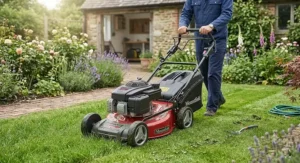
Step up to the Mountfield SP41 and you add self-propulsion to a broadly similar-sized deck, which for anyone with even a mild slope is transformative. Powered by a STIGA ST120 Autochoke 123cc engine, the SP41 drives itself along at a fixed walking pace of roughly 3.4km/h once you pull the propulsion bar towards the handle — release it, and the drive disengages while the engine keeps running.
On paper this means less physical effort per mow, and in practice testers describe the single-speed drive as “just about right” — not so fast you’re jogging to keep up, not so slow it feels sluggish on an incline. The polypropylene chassis keeps weight down to around 20-23kg depending on spec, considerably lighter than the steel-decked SP53, which matters when you’re lifting it in and out of a shed.
What the spec sheet won’t tell you, but reviewers note, is that self-propulsion on a mower this size is almost always worth the extra outlay, even on flat lawns, simply because it reduces fatigue over a longer mowing session. Owners with 15-year-old steel-bodied Mountfields upgrading to a lighter plastic-chassis SP41 report it as a deliberate move away from rust issues on older steel decks.
Aggregated review sentiment for the Mountfield SP41 is strongly positive, with an average rating in the mid-4-star range across retailer review platforms; common praise centres on easy starting and manoeuvrability, while occasional complaints mention a printed manual that under-explains assembly.
Pros:
- ✅ Self-propelled drive removes effort on inclines
- ✅ Lightweight polypropylene deck resists rust long-term
- ✅ Compact 39-41cm width suits tighter urban gardens
Cons:
- ❌ Fixed single-speed drive, no variable pace
- ❌ Smaller 40-litre bag needs more frequent emptying on longer grass
Typically priced in the £220-£260 range, the Mountfield SP41 earns its place as one of the most recommended small-garden petrol mowers in the whole range.
3. Mountfield HP185 — best value hand-propelled mower for larger lawns
The Mountfield HP185 punches above its price bracket. It pairs a 139cc engine with a 46cm cutting width, giving it noticeably more grunt than the smaller HP45 while remaining a hand-propelled machine, which keeps the price refreshingly low for what it offers.
Independent testing from Gardeningetc found the Mountfield HP185 started first time throughout a six-week test period on a lawn of over 1,000m², and rated it a strong four-star recommendation, calling it hard to fault for the money. The larger engine capacity compared with the entry-level HP45 translates into real-world confidence when tackling longer or thicker grass — you’re less likely to bog the blade down mid-pass, which matters more than raw cutting width when grass has been left a fortnight too long.
Based on the spec comparison with its closest rival, the Cobra M46SPC, the Mountfield HP185 gives up self-propulsion but claws back roughly £30-£60 in price, and at a lighter weight than the Cobra it’s arguably easier to muscle around a lawn without power assistance anyway. Reviewers consistently note that its 20cm wheels roll smoothly even on slightly uneven turf, reducing the “dig-in” feeling that cheaper hand mowers can suffer from.
Pros:
- ✅ 139cc engine handles longer grass with real confidence
- ✅ Started first time in extended independent testing
- ✅ Excellent value against self-propelled rivals like the Cobra M46SPC
Cons:
- ❌ No self-propulsion despite the larger 46cm deck
- ❌ Same fixed cutting-height range as smaller siblings, less flexibility at the extremes
At approximately £220-£250, the Mountfield HP185 is arguably the sharpest value pick across the entire lineup for gardens between 600m² and 1,000m².
4. Mountfield SP53 — best self-propelled mower for large, sloped lawns
This is the model most people mean when they search for a Mountfield SP53 review, and consumer body Which? has independently lab-tested the SP53 alongside rivals from Bosch, Cobra, Flymo, Honda and Stihl. It’s Mountfield’s flagship self-propelled push mower. The Mountfield SP53 runs on a 166cc STIGA ST170 Autochoke OHV engine producing a peak of around 3.5 horsepower, driving a 51cm steel cutting deck through a single-speed self-propelled system.
Key specs translate directly into everyday performance here: the 166cc engine gives the SP53 enough torque to climb noticeable inclines without the blade bogging down in thick grass, something the smaller 123cc-engined models in this range genuinely can’t match. The 60-litre grass box, five cutting heights from 27mm to 90mm and steel deck construction all point toward a mower built for lawns up to around 2,500m² — genuinely large by UK suburban standards.
Reviewers consistently describe the Mountfield SP53 starting first time from new, with minimal smoke and manageable noise for a 4-stroke petrol unit. A recurring theme across owner feedback, however, is that the fabric grass collector’s plastic clips are prone to failure if fitted the wrong way round during assembly — a known and fixable issue, but one worth checking on delivery. Several owners also flagged that the plastic drive-belt guard underneath the deck can crack if the mower is repeatedly used on long, dry grass, allowing clippings to jam the drive belt.
Honestly weighing this up: the Mountfield SP53 is one of the best-specced petrol mowers under £450 currently on amazon.co.uk, but buyers with genuinely large or tussocky lawns should budget time for the occasional belt-guard check as preventative maintenance rather than treating it as a fault.
Pros:
- ✅ 166cc engine tackles slopes and thick grass with ease
- ✅ Reliable first-time starts reported across most owner reviews
- ✅ Large 60-litre collector and 51cm deck suit big lawns
Cons:
- ❌ Fabric grass bag clips can fail if assembled incorrectly
- ❌ At 34-35kg, it’s genuinely heavy to lift or transport
Expect to pay somewhere in the £340-£400 bracket for the Mountfield SP53, positioning it as a mid-to-premium buy that’s still well under Honda-engined alternatives.
5. Mountfield SP53H — best for buyers who want a Honda engine’s reputation
Same 51cm deck, same self-propelled chassis, different heart. The Mountfield SP53H swaps the STIGA engine for a 167cc Honda GCV four-stroke unit rated at 4.4hp, with a generous 0.95-litre fuel tank for longer sessions between refills.
Honda’s reputation for engine longevity isn’t marketing spin — it’s built on decades of small-engine manufacturing, and reviewers consistently note lower vibration, quieter running, and cleaner emissions compared with the standard STIGA-engined SP53. One owner in aggregated feedback described replacing a 20-year-old Honda-engined mower and immediately buying another Honda-powered Mountfield specifically because of that track record; that kind of brand loyalty around a single engine supplier tells you something the spec sheet alone doesn’t.
Here’s what to weigh: the practical cutting performance between the STIGA and Honda versions of the SP53 is close, since deck geometry and cutting width are identical. What most buyers overlook is that they’re not really choosing between two mowers — they’re choosing between two engine philosophies. STIGA’s ST170 is perfectly capable and considerably cheaper; Honda’s GCV is a known long-haul performer that costs more upfront but, based on aggregated review patterns across the wider small-engine market, tends to need less remedial work over a 10-15 year ownership span.
A genuine complaint that surfaces in verified reviews is the grass collection basket on the “Elite” trim, where the fabric attaches to a plastic frame that can come away under load if fitted incorrectly during initial setup — the same issue seen on the standard SP53, since the collector is shared across the range.
Pros:
- ✅ Honda GCV engine has an outstanding longevity reputation
- ✅ Larger fuel tank means fewer mid-mow refills
- ✅ Full throttle control adjusts power to grass conditions
Cons:
- ❌ Meaningfully more expensive than the STIGA-engined SP53
- ❌ Shares the same grass-bag assembly quirk as the standard model
Budget around £480-£550 for the Mountfield SP53H — a genuine premium, but one that’s arguably justified if you intend to keep the mower for well over a decade.
6. Mountfield S421R PD — best for classic lawn stripes on a small plot
If a striped lawn matters to you, the standard SP-series mowers simply can’t deliver it — they lack a rear roller. The Mountfield S421R PD solves that with a 41cm cutting width, a STIGA ST140 Autochoke 139cc engine, and a full-width rear roller designed specifically to lay down that classic British lawn-stripe effect.
The self-propelled drive runs at a fixed 4.1km/h, powered by 2.2kW at 2900rpm — enough for the smaller 41cm deck to feel genuinely effortless on lawns up to around 400m². Reviewers note the height adjustment (20-70mm across five positions) is centrally controlled by a single lever, which the S421R PD’s reviewers rate as noticeably slicker than the individually-adjusted wheel system found on some rival roller mowers.
Honest analysis here: rear-roller mowers are, by design, a trade-off. The roller adds weight and cost without adding cutting performance — its entire job is cosmetic. If you don’t care about stripes, the S421R PD’s £280-£330 asking price buys less practical mower than the plainer SP41. But if a manicured, striped finish genuinely matters to you (and for many UK gardeners with a lawn as the centrepiece of the garden, it does), this is the smallest, most affordable way into that look from Mountfield’s petrol range.
One point flagged consistently by suppliers: these roller mowers are specified to cut grass no longer than around 12cm at a time, with the blade boss designed to shear off as a safety feature if it strikes a hard object or overly long, tough grass — a sensible fail-safe, but it does mean strimming first if the lawn’s gotten away from you.
Pros:
- ✅ Genuine, professional-looking lawn stripes from a compact machine
- ✅ Single-lever height adjustment is quick and consistent
- ✅ 5-year extended warranty as standard on qualifying purchases
Cons:
- ❌ Roller adds cost without improving raw cutting performance
- ❌ Not suited to overgrown grass beyond around 12cm
At roughly £280-£330, the Mountfield S421R PD is a style-driven purchase, and there’s nothing wrong with that if stripes are the goal.
7. Mountfield S461R PD — best rear-roller mower for medium lawns
The Mountfield S461R PD is essentially the S421R PD’s bigger sibling, pairing the same rear-roller styling with the 166cc STIGA ST170 Autochoke engine borrowed from the SP53, and widening the cutting deck to 46cm. That combination gives it noticeably more capability on medium-sized lawns (up to roughly 40m x 40m, per Mountfield’s own guidance) without stepping up to the SP53’s 51cm width.
The 127mm-diameter full-width roller is larger than the S421R PD’s, which in practice means straighter, more defined stripes — a detail that matters if a crisp finish is the whole point of buying a roller mower in the first place. A quick-connect hose fitting under the deck also simplifies the single most tedious maintenance task on any petrol mower: washing grass paste off the underside of the chassis after every cut.
Here’s what to weigh against the plainer S461PD (non-roller) or the SP53: the Mountfield S461R PD effectively sits in the middle of Mountfield’s range, offering more power than the S421R PD but a narrower deck than the SP53. For a genuinely medium lawn — bigger than a postage stamp, smaller than a paddock — that middle ground is often exactly right, and reviewers consistently describe it as “dependable” and “sturdy” thanks to the steel chassis shared with its self-propelled siblings.
Pros:
- ✅ Wider 46cm deck than the S421R PD covers more ground per pass
- ✅ Larger 127mm roller produces crisper, more even stripes
- ✅ Quick-connect deck-wash fitting speeds up cleaning
Cons:
- ❌ Narrower cut than the non-roller SP53 for a similar price
- ❌ Roller design means less manoeuvrability around tight obstacles
Priced around £380-£440, the Mountfield S461R PD is the natural pick for anyone who wants both stripes and a bit more cutting width than the entry-level roller model offers.
How Mountfield’s Stiga Engines Actually Perform
Every Mountfield petrol lawn mower engine question eventually comes back to one fact: since 2000, Mountfield has been owned by the Italian STIGA Group, and most of its engines — the ST120, ST140 and ST170 units seen throughout this range — are manufactured at STIGA’s own plant rather than bought in from a third party. That’s unusual in a market where many budget mowers simply bolt on whatever cheap engine is available that quarter.
In practical terms, the ST120 (123cc, found on the HP45 and SP41) is a genuinely modest unit best suited to lawns under roughly 400m². Step up to the ST140 (139cc, S421R PD) and you get a meaningful bump in low-end torque that’s noticeable the moment you hit slightly longer grass. The ST170 (166cc, SP53 and S461R PD) is the range-topper among the STIGA units, and reviewers across multiple independent test sites describe it starting first-pull “every time” once warmed through its first few uses — a claim that’s hard to fake across dozens of separate owner reports.
What most buyers overlook is that auto-choke systems, standard across the current STIGA-engined range, remove one of the classic petrol-mower headaches: flooding the engine on a cold morning by over-choking manually. That single feature probably prevents more frustrated first mows than any spec-sheet number. Where STIGA’s own engines genuinely lag Honda is long-term reputation rather than immediate performance — Honda’s small engines have a multi-decade track record of running 15-20 years with only routine servicing, a bar STIGA’s units, still a relatively young engine programme by comparison, haven’t yet had the same length of time to prove themselves against.
Mountfield vs Cobra Mower: Which Should You Buy?
Cobra is the brand most UK gardeners hadn’t heard of a decade ago and increasingly ask about today. The formula is straightforward: design the range in Staffordshire, manufacture overseas, fit Briggs & Stratton engines to the petrol mowers, and price the finished machines around a quarter below equivalent Mountfield or Honda models. That’s a genuinely different approach from Mountfield’s STIGA-owned, Italian-engineered model, and it shows up in how the two brands compare on paper.
| Factor | Mountfield | Cobra |
|---|---|---|
| Engine supplier | STIGA (own-brand) or Honda | Briggs & Stratton or Honda |
| Typical price position | Mid-range | Roughly 25% below Mountfield/Honda |
| Self-propelled options | Yes, across SP and S ranges | Yes, across SP and roller ranges |
| Best For | Buyers wanting an established British high-street name with a STIGA-engineered core | Value-focused buyers who want Briggs & Stratton reliability at a lower price |
Interpreting that table: neither brand is objectively “better” across the board. Where Mountfield pulls ahead is availability and brand recognition — you’ll find Mountfield in B&Q, most garden centres and countless independent dealers, which matters enormously for spare parts and warranty servicing. Where Cobra pulls ahead is straightforward value; a Briggs & Stratton-engined Cobra self-propelled mower routinely undercuts an equivalent-spec Mountfield SP model by a genuine margin, and Briggs & Stratton’s engine reputation is arguably on par with STIGA’s own units.
Forum discussion among UK gardeners repeatedly surfaces the same pattern: owners whose Mountfield eventually needs a repair are often steered toward Cobra by independent repair technicians, less because Mountfield is unreliable and more because Cobra’s simpler parts ecosystem and Briggs & Stratton engines are easy for small repair shops to service. That’s a genuinely useful data point if you live somewhere without a Mountfield-authorised dealer nearby — check what your local repair shop actually stocks parts for before you commit to either brand.
✨ Weighing up Mountfield against Cobra? Compare current listings for both side by side before you decide.
Twin-Blade Decks and Mulch Plugs: How Mountfield Mowers Recycle Grass
The term “twin-blade mulch” gets thrown around loosely in lawn mower marketing, so it’s worth being precise about what Mountfield actually offers. True twin-blade mulching decks — two stacked or counter-rotating blades that shred clippings extra-finely before they’re expelled — appear on Mountfield’s wider ride-on and garden-tractor models, such as certain 102cm-deck machines in the larger range. On the walk-behind petrol mowers covered in this guide (the HP, SP and S-series), Mountfield instead uses a single, well-shaped mulching blade paired with a removable plastic mulch plug that blocks the discharge chute, forcing clippings to recirculate under the deck until they’re chopped fine enough to settle back into the turf.
Practically, the single-blade-plus-plug system on models like the Mountfield SP53 and Mountfield S461R PD still delivers genuine mulching performance for typical domestic use — it’s simpler to maintain and cheaper to replace than a twin-blade assembly, with no risk of the two blades falling out of sync with each other. A properly set up mulching mower produces finely shredded clippings that settle in among the grass, acting as a natural mulch that helps hold in moisture and returns nitrogen to the soil as it breaks down, with no grass collection needed at all.
For most UK lawns under an acre, that single-blade system is entirely sufficient; true twin-blade mulching decks earn their keep mainly on the wider commercial-leaning ride-on mowers Mountfield builds for larger plots, where cutting width alone makes fine mulching harder for a single blade to achieve.
How to Choose the Best Mountfield Mower
Working out the best Mountfield mower for your specific garden comes down to answering a handful of practical questions, in this order:
- Measure your lawn. Anything under roughly 400m² suits the entry-level HP45 or SP41; between 400-1,000m² points toward the HP185 or S421R PD; over 1,000m² up to around 2,500m² needs the SP53, SP53H or S461R PD’s extra engine capacity.
- Assess the slope. Any noticeable incline makes self-propulsion worth the extra £40-£80 over the equivalent hand-propelled model — your back will thank you within the first summer.
- Decide if stripes matter. If a striped finish is important to you, only the rear-roller S421R PD and S461R PD deliver it; every other model in this range uses plain wheels.
- Set your engine budget. STIGA-engined models offer strong value; Honda-engined variants like the SP53H cost more but carry a longer-term reliability reputation worth factoring into cost-per-year, not just sticker price.
- Check grass-box size against mowing frequency. If you mow fortnightly rather than weekly, prioritise the 55-60 litre collectors on the SP53, SP53H and roller models over the 40-litre bags on entry-level mowers.
- Confirm warranty terms before buying. Registration deadlines and servicing requirements (covered below) directly affect what you’re protected against.
- Factor in storage space. All models fold their handles for storage, but steel-decked machines like the SP53 are considerably heavier to manoeuvre into a shed than the polypropylene-bodied SP41.
Working through those seven checkpoints in order should narrow seven models down to one or two realistic contenders fairly quickly.
Setting Up and Maintaining Your New Mower
Getting a new Mountfield petrol lawn mower from box to first cut correctly matters more than most owners realise, and it’s an area where following the printed instructions properly (despite the manual’s occasional shortcomings noted in reviews above) genuinely prevents future problems.
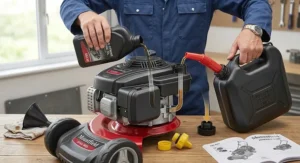
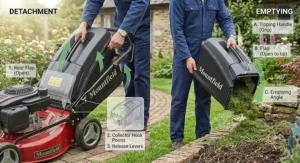
On unboxing, expect the handles to need unfolding and locking with the supplied wing nuts or quick-release clamps — a two-person job on the heavier SP53 and roller models simply because of their 34-35kg weight. Fit the grass collector before your first mow rather than after, since assembling it correctly (fabric facing the right way round on the frame) is exactly the step that generates the most complaints in aggregated reviews. Add SAE30 4-stroke engine oil to the separate oil reservoir — most Mountfield mowers ship dry, and running one without oil, even briefly, can cause real engine damage.
For the first 30 days, avoid the classic new-owner mistake of mowing overly long grass in one pass; take the deck to its highest setting for the first cut, then progressively lower it over subsequent mows, which spares both the engine and the blade boss from unnecessary strain. The RHS’s step-by-step mowing guide recommends never removing more than one-third of the grass height in a single cut — a rule that applies regardless of which Mountfield model you’ve bought.
A simple seasonal maintenance schedule keeps any of these mowers running for years: change the oil and check the spark plug at the start of each mowing season, sharpen or replace the blade annually (more often if you regularly hit stones or edging), and, per Mountfield’s own advice, rinse the underside of the steel deck after each cut in wet conditions to prevent grass paste building up and corroding the chassis over time.
Real Gardens, Real Mowers: Matching Machines to Lawns
Three brief scenarios illustrate how the theory above plays out in practice.
The compact terrace garden. A young couple with a 200m² rear garden, mostly flat, mowing weekly through spring and summer — the Mountfield HP45 or SP41 both fit comfortably, with the SP41’s self-propulsion worth the small premium if either partner finds pushing tiresome. Storage in a small shed favours the SP41’s lighter polypropylene build.
The sloped suburban plot. A family with a 900m² garden that rises noticeably toward the back fence, mowed fortnightly, values low physical effort above all else. Here the Mountfield SP53‘s self-propelled drive and 166cc engine earn their keep on the incline in a way a hand-propelled machine simply can’t replicate, regardless of engine size.
The stripe-obsessed retiree. A gardener with time to invest in a genuinely showpiece 350m² lawn, mowing twice weekly through peak season and taking real pride in the finish, is the exact buyer the Mountfield S421R PD was designed for — the rear roller delivers the cosmetic result that matters most to this use case, even though it isn’t the most powerful or practical mower in the range.
Common Mowing Problems and How to Fix Them
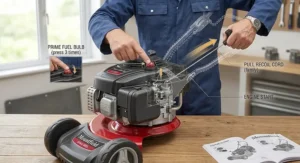
Problem: the mower won’t start on a cold morning. Most current Mountfield engines use auto-choke, which removes manual choke error from the equation — if it still won’t fire, check fresh fuel is in the tank (petrol degrades within a few months) and that the spark plug isn’t fouled.
Problem: the grass collector keeps falling apart. This is a documented, recurring issue across SP53 and SP53H reviews, caused by the fabric bag being clipped to its plastic frame the wrong way round during assembly. Reseating it correctly, clips facing outward, resolves it in most reported cases.
Problem: uneven cut or scalped patches. Almost always a blade height issue on uneven ground; the anti-scalp plate fitted to most Mountfield decks helps, but on genuinely bumpy lawns raising the cutting height by one notch solves the majority of scalping complaints.
Problem: the self-propelled drive belt slips or comes off. A recurring cause on the SP53 is a cracked plastic belt guard allowing clippings to jam the drive belt after repeated use on long, dry grass — inspecting and clearing debris from underneath the deck after heavy sessions prevents this.
Problem: the mower struggles in long grass. Cutting height set too low for the grass length is the most common cause; take a first high pass, then a second pass at your preferred height, exactly as recommended for the larger-cc models in this range.
Mountfield Warranty Explained
Mountfield warranty terms trip up more buyers than any other part of the ownership experience, largely because the headline “5-year warranty” advertised on product pages comes with conditions that aren’t always obvious at checkout. Under Mountfield’s own published terms, the product must be registered within 30 days of purchase, and to maintain the longer warranty period, the machine has to be serviced by an authorised dealer before the end of its second year of ownership, then annually after that.
Miss that servicing window and, per Mountfield’s own published terms, the warranty typically reverts to a standard shorter period rather than being voided outright — still useful cover, but not the headline figure advertised. Consumable parts such as blades, belts and fabric grass bags are explicitly excluded unless there’s evidence of a manufacturing fault rather than normal wear, and damage caused by non-approved replacement parts or failure to follow the owner’s manual will also void a claim.
Practically, this means budgeting for one paid or authorised annual service if you want to hold Mountfield to their full extended warranty term, and keeping proof of purchase (ideally uploaded to a MyMountfield account) so a claim isn’t held up by a missing receipt years down the line.
Long-Term Cost & Maintenance
A petrol mower’s true cost extends well beyond the purchase price, and it’s worth running the numbers before comparing sticker prices alone. Annual running costs for any of these seven models are broadly similar: expect roughly £15-£25 a year in fuel for a typical 400-800m² lawn mowed weekly through the season, plus £8-£15 for a bottle of SAE30 oil changed once a season, and a replacement blade every one to two years at roughly £15-£25 depending on model.
Where the real cost difference emerges is engine longevity. The Honda-engined Mountfield SP53H costs meaningfully more upfront than the STIGA-engined Mountfield SP53, but if Honda’s broader reputation for 15-20 year small-engine service life holds true for this unit as it has elsewhere, the effective cost-per-year narrows considerably over a full ownership span. Conversely, a cheaper HP45 or SP41 kept for its more typical 8-10 year lifespan, then simply replaced, may work out cheaper overall for a smaller garden that never truly stresses the engine.
Servicing costs matter too: maintaining the full 5-year Mountfield warranty requires an annual authorised service, typically £40-£70 depending on your local dealer, which should be weighed against simply self-servicing (oil, blade, spark plug) and accepting the shorter fallback warranty period if a fault does arise.
Safety and Fuel Storage Regulations for Petrol Mowers
Owning any petrol mower means storing petrol at home, and UK law is specific about how much you can keep and where. Per HSE guidance on storing petrol safely, you can keep up to 30 litres of petrol at home or other non-workplace premises without informing your local Petroleum Enforcement Authority, which comfortably covers the needs of a domestic lawn mower — most owners will only ever keep a single small jerry can on hand.
Beyond the volume limit, sensible practice matters just as much as legal compliance: keep fuel in an approved, clearly labelled container away from any living space, ideally in a detached shed or garage rather than one attached to the house, and away from any source of ignition. Since petrol degrades within a few months, only buy what you’ll realistically use in a season, and consider a fuel stabiliser if the mower will sit unused over winter — several reviewers in this guide specifically recommended this to prevent gummed-up carburettors come spring.
Basic operational safety applies across every model here: always disengage the blade (or switch off the engine entirely) before clearing blockages, never mow wet grass on a slope where footing is uncertain, and keep children and pets well clear while the engine is running, given how easily loose stones or debris can be thrown by a spinning blade.
Features That Actually Matter (And Those That Don’t)
After working through seven models’ worth of specs, a pattern emerges about which numbers genuinely predict a good ownership experience and which are largely marketing noise.
Actually matters: engine displacement relative to lawn size (a 166cc engine on a small 300m² lawn is overkill; a 123cc engine on a sloped 1,000m² lawn will struggle); self-propulsion on any garden with a meaningful incline; grass box capacity relative to how often you’re realistically willing to empty it; and steel versus polypropylene deck construction, which genuinely affects both weight and long-term corrosion resistance.
Matters less than you’d think: the exact number of cutting-height positions (five versus six rarely changes real-world results, since most owners settle on one or two preferred heights and rarely deviate); marginal differences in bag colour or handle padding; and headline horsepower figures in isolation, since torque delivery and gearing matter more to actual cutting performance than a single peak-power number.
Based on the spec comparison across this entire range, the single feature worth prioritising above all others is matching engine size and propulsion type to your actual lawn — everything else is refinement around that core decision.
FAQ
❓ What is the best Mountfield petrol lawn mower for a small garden?
❓ Is the Mountfield SP53 self-propelled?
❓ How long is the Mountfield warranty?
❓ Is Mountfield or Cobra better for a petrol lawn mower?
❓ Can a Mountfield petrol mower mulch grass clippings?
Conclusion
Seven models, one brand, and genuinely different answers depending on what’s actually growing in your garden. If you’ve got a small, flat plot and want to spend as little as sensibly possible, the Mountfield HP45 does the job without ceremony. Sloped or larger gardens shift the calculus firmly toward self-propulsion, where the Mountfield SP41 and Mountfield SP53 cover the small-to-large spectrum respectively, and anyone chasing a genuinely showpiece striped lawn has two honest options in the Mountfield S421R PD and Mountfield S461R PD.
The STIGA-versus-Honda engine question, most visible in the choice between the standard Mountfield SP53 and the Honda-powered Mountfield SP53H, ultimately comes down to whether you value a lower purchase price or a longer-term reliability reputation more — both are defensible positions, and neither is a bad decision. What matters most, based on everything covered in this guide, is sizing the engine and propulsion to your actual lawn rather than defaulting to the biggest or most expensive model on the shelf.
Whichever model fits your garden, register it within 30 days, keep a rough note of annual servicing, and store fuel sensibly — the unglamorous admin that quietly determines whether your Mountfield becomes one of those mowers still running a decade from now.
✨ Ready to Find Your Perfect Mountfield Mower?
🔍 Compare current prices and availability on the models covered in this guide before they’re back in stock elsewhere. A well-matched mower pays for itself in fewer frustrated Saturday mornings and a lawn your neighbours will genuinely envy!
Recommended for You
- Petrol Lawn Mower Under £300: 7 Best Picks Tested for 2026
- Petrol Lawn Mower for Large Garden: 7 Powerful Picks for 2026
- 7 Best Petrol Lawn Mowers UK 2026: Tested, Ranked & Reliable
Disclaimer: This article contains affiliate links. As an Amazon Associate, I earn from qualifying purchases. If you purchase products through these links, we may earn a small commission at no additional cost to you.
✨ Found this helpful? Share it with your friends! 💬🤗
