
In This Article
There’s a particular kind of smugness that comes from watching a machine do your chores for you, and nothing delivers it quite like standing at the kitchen window on a Tuesday evening, tea in hand, watching a robot lawn mower quietly stripe your garden while you do absolutely nothing. That’s the promise, anyway. The reality is a little more nuanced, and that’s exactly what this guide is here to unpack.
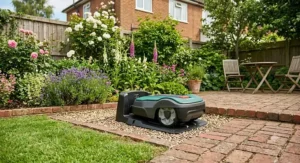
A robot lawn mower is a battery-powered, self-navigating machine that cuts grass automatically and returns to its charging dock on its own, using either a buried perimeter wire, GPS/RTK satellites, LiDAR, or camera-based vision to stay inside your lawn’s boundaries. Instead of one weekly grass massacre, it “little-and-often” mows in short, frequent bursts, which — as we’ll get into — is genuinely better for the health of your turf.
British gardens are, frankly, a nightmare for robotics. We’ve got narrow side passages, flower beds shoved in at odd angles, slopes that would make a mountain goat nervous, and rain roughly eleven months of the year. So when a robot lawn mower actually copes with all that, it earns its keep. Independent consumer testing shows these machines can now maintain plots ranging from compact 250m² courtyards right up to 1,800m² or more, which tells you there’s genuinely a machine out there for almost every plot size, from a pocket-handkerchief city garden to a proper paddock.
This article breaks down seven real, currently available robot lawn mowers spanning budget, mid-range and premium territory, plus everything you need on perimeter wire installation, rain sensors, mulching, running costs, and the mistakes that trip up first-time buyers. Prices below are indicative ranges only — always check current pricing before buying, since retailers shuffle their figures more often than the mower shuffles round your begonias.
Quick Comparison Table
| Mower | Navigation | Best For | Price Range |
|---|---|---|---|
| Segway Navimow i105E | Vision + RTK | Best value wire-free entry | around £300-£400 |
| Bosch VISIMOW | Vision AI | Simplest setup, small lawns | under £600 |
| WORX Landroid M500 Plus | Boundary wire | Reliable, expandable ecosystem | £500-£700 range |
| Husqvarna Automower 305 | Boundary wire | Steep, complex small gardens | £1,100-£1,350 range |
| eufy Robot Lawnmower E15 | RTK + mapping | Hands-off automation, mid-large lawns | £900-£1,200 range |
| Segway Navimow i208 LiDAR | LiDAR + RTK | Fast automapping, medium-large lawns | £900-£1,300 range |
| Mammotion Luba 2 AWD | AWD + Vision + RTK | Slopes, rough ground, big plots | £1,600-£2,500 range |
Look at that spread for a second: you’re going from a sub-£400 entry ticket right up to genuine estate-grade kit costing several thousand, and the jump isn’t just about brand snobbery. It tracks almost perfectly with navigation sophistication — wire-free vision and RTK systems cost more to engineer than a simple buried cable, and all-wheel-drive units capable of climbing serious inclines carry a premium for the extra motors and torque. If your garden is a flat rectangle, don’t overspend on LiDAR you’ll never need; if it’s a lumpy, sloped, oddly-shaped mess (most British gardens, honestly), the extra spend on navigation quality earns its keep fast.
💬 Just one click — help others make better buying decisions too!😊
Top 7 Robot Lawn Mowers: Expert Analysis
1. Segway Navimow i105E — best budget entry into wire-free mowing
The standout thing about the Navimow i105E is that it drags wire-free navigation — usually a premium feature — down to a genuinely entry-level price point. It combines camera-based vision with RTK satellite positioning, which in plain English means it uses both “eyes” and “GPS” to work out where it is, rather than following a buried cable.
That dual system is rated for gardens up to roughly 500m², and reviewers note it handles slopes up to around 35%, which covers the gentle undulations of most suburban plots without breaking a sweat. Independent testers have logged strong customer satisfaction scores, describing it as a genuinely capable machine rather than a stripped-down toy.
Based on the spec comparison, this is the mower for someone whose garden is fairly simple in shape but who doesn’t want the hassle (or cost) of laying wire. Reviewers consistently note the setup is refreshingly quick — closer to unboxing a robot vacuum than commissioning a garden appliance. First-time buyers with tight budgets and city-sized plots are the obvious audience here; anyone with a sprawling, multi-zone garden should look further down this list.
Pros:
- ✅ Genuine wire-free tech at a budget-friendly price point
- ✅ Handles moderate slopes without losing traction
- ✅ Fast, low-fuss initial setup process
Cons:
- ❌ Newer brand with a shorter long-term reliability track record
- ❌ RTK accuracy can dip under dense tree cover
Price-wise, expect to pay around £300-£400 depending on retailer offers — genuinely excellent value for wire-free entry, and one of the strongest cost-per-square-metre deals on this list.
2. Bosch VISIMOW — easiest three-button setup on the market
What immediately stands out about the VISIMOW is how aggressively Bosch has simplified the onboarding experience. Three buttons, vision-based mapping, no boundary wire, no RTK antenna to plant in the lawn — you genuinely can be mowing within an hour of opening the box.
The trade-off for that simplicity is scope: this is built for smaller, straightforward gardens rather than sprawling multi-zone plots, and its camera-only navigation (no satellite backup) means it leans harder on good daylight and clear sightlines. What most buyers overlook about vision-only systems is that they can get a little confused in deep shade or when garden furniture moves around, so consistency matters more than raw ambition here.
The honest analytical take is that this suits someone who wants the absolute lowest cognitive load — no app-based zone-mapping marathon, no wire-laying weekend. It’s the mower equivalent of a phone that “just works.” Aggregated review sentiment consistently highlights the even cut quality and the surprisingly low asking price relative to rival wire-free options.
Pros:
- ✅ Genuinely the simplest setup of any model tested
- ✅ Impressively even cut quality straight out of the box
- ✅ Priced well below most wire-free competitors
Cons:
- ❌ Vision-only navigation struggles in heavy shade
- ❌ Best suited to smaller, simpler garden shapes
At under £600, this is arguably the most approachable wire-free mower on the UK market right now, especially for nervous first-timers.
3. WORX Landroid M500 Plus (WR165E) — best proven boundary-wire ecosystem
The Landroid range has been quietly dominant for years, and the M500 Plus is the current standard-bearer for boundary-wire mowing done properly. It’s rated for lawns up to around 500m², built on proven boundary wire technology that’s reportedly been chosen by well over a million homeowners worldwide, which is the kind of track record you can’t fake.
Key specs with real-world meaning: it runs on WORX’s PowerShare battery platform, meaning the same battery can, in some configurations, be shared across other WORX garden tools — a genuinely clever piece of ecosystem thinking that reduces the number of chargers cluttering your shed. It also has a self-levelling blade deck, which keeps cut height consistent even as the mower crosses slightly uneven turf.
Here’s what to weigh: boundary wire means an upfront installation chore (pegging or burying cable around your lawn’s edge), but it also means rock-solid, weather-proof containment that doesn’t care about tree cover or cloud cover the way satellite systems sometimes do. Reviewers repeatedly praise the balance the Landroid range strikes between features and price, and note the smartphone app is genuinely intuitive rather than an afterthought bolted on for the box art.
Pros:
- ✅ Trusted, proven boundary wire reliability at scale
- ✅ PowerShare battery works across other WORX tools
- ✅ Self-levelling deck keeps cut height consistent
Cons:
- ❌ Wire installation adds a weekend of upfront labour
- ❌ Reshaping flower beds later means re-laying wire sections
Expect a price in the £500-£700 range, which for a 500m² capacity with this feature set represents strong value against premium wire-free rivals.
4. Husqvarna Automower 305 — best for small, complex, sloped gardens
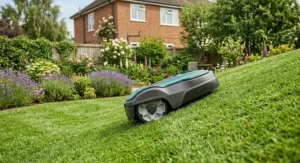
Husqvarna basically invented this category, and the Automower 305 shows that heritage. It’s well suited to maintaining smaller lawns with real complexity, handling slopes of up to 40%, which is a genuinely serious incline rating — steeper than most domestic gardens will ever throw at it.
What most buyers overlook about this model is its weather intelligence: it includes a weather timer that automatically adjusts cutting frequency to match seasonal grass growth rates, plus a frost guard that pauses mowing when frost risk is detected, protecting both the blades and the turf itself from unnecessary wear. It also switches into a systematic passage-mowing pattern in narrow spots, reducing the messy wheel tracks that random-pattern mowers tend to leave in tight corners — a small detail that matters enormously if your garden has a tight side return.
Reviewers highlight the compact, lightweight chassis as genuinely easier to lift and manoeuvre by hand than rival premium models, while some flag that average satisfaction ratings sit lower than you’d expect for the price, which is worth factoring into your decision if reliability data matters more to you than badge prestige. Complex, sloped, narrow-passage gardens are where this machine earns its keep; flat rectangular lawns don’t need this level of sophistication.
Pros:
- ✅ Handles slopes up to 40% with confident traction
- ✅ Weather timer and frost guard protect the lawn
- ✅ Compact, lightweight and easy to manoeuvre by hand
Cons:
- ❌ Installation kit for the boundary wire sold separately
- ❌ Some reviewers report mixed long-term satisfaction scores
Pricing typically sits in the £1,100-£1,350 range including VAT, positioning it as a premium small-garden specialist rather than a budget pick.
5. eufy Robot Lawnmower E15 — best hands-off mapping experience
The eufy E15 is the mower for people who want to set it up once and genuinely never think about it again. It works well on gardens up to around 800m² with mostly flat turf and clear boundaries, automatically mapping the lawn and planning efficient mowing routes without a boundary wire in sight.
Key specs, real-world translation: the automatic mapping means you skip the tedious manual zone-drawing that some wire-free rivals demand, and built-in sensors handle obstacle navigation without needing any wire at all. Based on the spec comparison, this positions the E15 as one of the more “install and forget” options in the mid-to-premium bracket.
Aggregated reviewer sentiment consistently praises the app’s polish and the mower’s obstacle avoidance, describing the cutting quality as even across long grass — a detail that matters because plenty of wire-free competitors struggle once grass gets past the “should have mowed last week” stage. This suits time-poor households with reasonably flat 500-800m² gardens who value app-based control over ultimate slope-climbing ability.
Pros:
- ✅ Fully automatic mapping with no wire installation
- ✅ Strong, reliable obstacle avoidance in testing
- ✅ Polished, intuitive companion app
Cons:
- ❌ Premium pricing compared to wire-based alternatives
- ❌ Needs reasonably clear sky exposure for positioning accuracy
Budget around £900-£1,200, which sits it firmly in the “pay for convenience” tier of the market.
6. Segway Navimow i208 LiDAR — fastest automapping for medium-large gardens
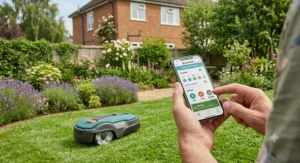
Where the i105E is Segway’s budget play, the i208 LiDAR is the step up for bigger, less forgiving lawns. It’s built for medium-sized gardens up to 800 sq. metres of any shape and size, and it’s known for incredibly fast automapping paired with a genuinely powerful companion app.
The standout feature is genuinely the speed of that initial mapping run — LiDAR spins up a 3D picture of your garden dramatically faster than older satellite-only systems needed to triangulate boundaries. First impressions from independent garden equipment reviewers are consistently strong too, praising the sleek design, easy controls, and a handy onboard LED screen for at-a-glance status checks without reaching for your phone.
Here’s the honest caveat, though: rough terrain is reportedly where the i208 lets itself down, so if your lawn has bumpy, uneven ground rather than smooth turf, an all-wheel-drive alternative further down this list will cope better. For well-kept, reasonably flat lawns up to 800m², this remains one of the quietest, quickest-mapping options currently sold in the UK.
Pros:
- ✅ Exceptionally fast LiDAR-based automapping
- ✅ Whisper-quiet operation praised across reviews
- ✅ Handy onboard LED screen for quick status checks
Cons:
- ❌ Struggles on rough or uneven terrain
- ❌ Confusing model naming makes comparison-shopping tricky
Expect to pay somewhere in the £900-£1,300 range, competitive against the eufy E15 for similar-sized plots.
7. Mammotion Luba 2 AWD — best for slopes, rough ground and large estates
If your garden laughs at ordinary robot mowers — steep banks, rough patches, awkward multi-zone layouts — the Luba 2 AWD is built specifically to shut that laughter down. It combines all-wheel-drive traction with multi-camera AI vision and RTK positioning, a genuinely heavyweight navigation stack aimed squarely at large or difficult plots.
What the spec sheet won’t tell you outright, but the engineering implies, is that AWD fundamentally changes how a mower behaves on slopes and loose or uneven ground compared to two-wheel-drive rivals: power is distributed to all four wheels rather than just a rear pair, dramatically reducing wheel-spin and getting-stuck incidents on banks that would defeat the Navimow i208 or eufy E15. Mammotion’s related Luba Mini 2 model is even rated for climbing gradients as steep as 80%, giving a sense of how aggressively this range chases difficult terrain.
Reviewers and industry awards alike have praised the range’s sustainability credentials and precision coverage across genuinely large green spaces, positioning it as a legitimate step towards commercial-grade capability sold into the domestic market. This is overkill for a tidy suburban rectangle, but for anyone managing half an acre or more of sloped, complicated ground, it’s arguably the most capable machine on this list.
Pros:
- ✅ All-wheel-drive traction conquers steep, rough terrain
- ✅ Multi-camera AI vision plus RTK for precise large-area coverage
- ✅ Recognised industry awards for build quality and sustainability
Cons:
- ❌ Significant premium investment over mid-range models
- ❌ Genuinely excessive for small, flat, simple gardens
Pricing sits in the £1,600-£2,500 range depending on configuration, reflecting its position as the specialist, large-garden flagship of this line-up.
Perimeter Wire Installation: Your Practical Setup Guide
If you’ve gone the boundary-wire route (Landroid or Automower, for instance), the installation weekend is where most of the actual work happens — and where most first-30-days frustration originates. Start by walking your lawn’s edge and sketching a rough map, noting flower beds, trees, ponds, and anything else that needs a wire loop excluding it. Most kits include hundreds of ground pegs and 100-150 metres of wire, which is usually generous for an average UK garden but worth double-checking against your actual perimeter length before you start pegging.
Lay the wire roughly 30cm in from any hard edges like patios or paths, and give a wider berth — 35-40cm — around obstacles you want the mower to avoid entirely, since the wire acts as an electronic fence the mower’s sensors detect and steer away from. Keep the wire flat and taut rather than kinked; sharp corners confuse the navigation logic more than smooth curves do. For narrow passages between buildings or fences, run a corridor at least the width of the mower plus a small margin, and expect the mower to switch into a more deliberate “systematic” mowing pattern here rather than its usual randomised route.
Once the loop is laid and connected to the charging station, most systems run a calibration cycle before the first proper cut — don’t skip this, and don’t schedule your first unattended run until you’ve watched at least one full circuit. Common first-30-days mistakes include laying wire too close to soft lawn edges (causing scalping at the boundary), forgetting to account for seasonal plant growth encroaching on the loop, and underestimating slope transitions where wire needs extra pegs to stay flush with the ground.
Real-World Scenarios: Matching Mowers to Your Garden
Picture Sarah, a first-time buyer with a neat 300m² rear garden in a Manchester terrace — flat, rectangular, no real obstacles beyond a washing line. She doesn’t need LiDAR or AWD; the Segway Navimow i105E or Bosch VISIMOW covers her needs at a fraction of the premium-tier cost, and either would be mowed and forgotten within a weekend.
Now consider Dave, retired in Devon, with a 700m² garden that slopes noticeably towards a vegetable patch and includes a narrow side passage to the bins. His priorities are reliability and slope confidence rather than raw speed, so the Husqvarna Automower 305 or eufy E15 make more sense — both handle complexity and gradient without demanding constant supervision, and Dave’s not fussed about the wire-laying weekend since he’s got the time and the patience.
Finally, there’s the Hendersons, a family with a genuinely large half-acre plot including a sloped orchard section and rougher, less-manicured ground near a boundary hedge. Budget isn’t their main concern; capability is. The Mammotion Luba 2 AWD is built precisely for this scenario — rough terrain, real slopes, and enough coverage area that a smaller mower would simply run out of daylight hours trying to keep up.
Common Problems and Solutions in the First 30 Days
New owners hit a fairly predictable set of snags. First: the mower gets stuck repeatedly in the same spot. Solution — check for a subtle dip or root causing wheel-spin, and either add an extra boundary loop to exclude that patch or, for wire-free models, flag the obstacle manually in the app so future routes avoid it.
Second: uneven or patchy cutting results in the first fortnight. This is almost always a height-setting issue rather than a fault — start on the highest cut setting and gradually lower it over several sessions rather than scalping the lawn on day one, following the same “no more than a third of grass height” principle recommended for conventional mowing.
Third: the mower loses its way home or takes an oddly long route back to the dock. For boundary-wire systems, check the wire tension and connection points near the charging station; for satellite or vision models, tree cover or nearby buildings can temporarily block signal, so consider repositioning the dock if it’s tucked under dense foliage.
Fourth: unexpected pauses during light rain. This is usually the rain sensor working exactly as intended rather than malfunctioning — more on that shortly. Finally, battery life seeming to drop off after a few months is often down to charging habits rather than a faulty cell; avoid leaving the mower on charge unnecessarily once full, echoing wider lithium-ion battery care guidance.
Robot Lawn Mower Buying Guide: How to Choose
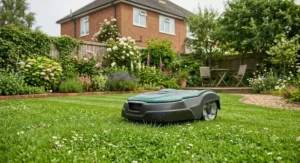
How do you choose the right robot lawn mower? Match navigation type to garden complexity, verify coverage against your actual lawn size, check slope rating against your steepest incline, decide on wire versus wire-free based on how much upfront labour you’re willing to do, and always compare aggregated review sentiment rather than manufacturer marketing alone. Here’s that broken down into a proper decision framework:
- Measure your lawn accurately before shopping — pacing it out roughly is not good enough, since undersized mowers labour endlessly and oversized ones are wasted spend.
- Identify your steepest slope percentage, since this single spec eliminates more unsuitable models than any other filter.
- Decide wire versus wire-free honestly — if you’re not willing to spend a weekend laying cable, rule out boundary-wire models immediately regardless of their other merits.
- Check narrow passage width anywhere the mower must travel between zones; anything under roughly 60cm needs specific compatibility checking.
- Weigh app quality and connectivity, since a clunky app turns a “set and forget” purchase into a recurring irritation.
- Factor in noise levels if you have close neighbours or want to mow at unsociable hours — most modern models run remarkably quietly, but not all.
- Budget for accessories, including any installation kit, extra boundary wire, or off-limits modules, which aren’t always bundled in the headline price.
Common Mistakes When Buying a Robot Lawn Mower
The single biggest mistake is buying based on coverage-area marketing alone. A mower rated for “up to 800m²” on a flat test lawn will often underperform on a genuinely complex 500m² garden with slopes and tight corners — capacity ratings assume relatively favourable conditions, not your specific worst-case obstacle course.
A close second is ignoring slope percentage entirely. Buyers routinely assume “it’s just a lawn” without checking their actual gradient, then discover the hard way that a mower rated for 20% incline simply cannot maintain traction on their 35% slope. Related to this: underestimating how much the garden changes seasonally — a boundary wire laid in spring can end up buried under summer plant growth by August, quietly disabling sections of the containment loop.
Buyers also frequently skip checking narrow passage compatibility, assuming any mower will squeeze through any gap, and then find their side-return passage is simply too tight. And finally, many people focus exclusively on the upfront price while ignoring blade replacement costs, wire repair costs, and battery replacement timelines — the genuine total cost of ownership, covered properly further down.
Robot Lawn Mower vs Traditional Petrol Mower
| Factor | Robot Lawn Mower | Petrol Mower |
|---|---|---|
| Time investment | Minutes of setup per week | 30-90 minutes active mowing |
| Cutting frequency | Little and often, automatic | Weekly or fortnightly, manual |
| Noise | Very quiet, some run at night | Loud, daytime-only realistically |
| Running cost | Low electricity cost | Ongoing fuel + servicing |
| Upfront cost | Higher purchase price | Lower purchase price |
The frequency difference is genuinely the biggest hidden advantage here, and it’s not just convenience — finely mulched clippings that fall back among the grass help hold in moisture and return nitrogen to the soil as they decompose, something petrol mowers achieve less consistently because they cut less often and typically remove clippings rather than recycling them. Petrol mowers remain cheaper upfront and don’t depend on charging infrastructure, which matters if electricity access near your lawn is awkward. But for anyone valuing their weekends and a consistently healthier-looking lawn, the robot option wins on almost every metric except initial sticker price.
Features That Actually Matter (And Those That Don’t)
Slope rating, coverage area accuracy, and obstacle detection quality genuinely matter — these determine whether the mower can physically do its job on your specific lawn. App polish matters more than people expect too, since a frustrating interface undermines the entire “set and forget” value proposition. Battery swap ecosystems, like WORX’s PowerShare, matter if you already own compatible tools, turning a mower purchase into a shed-wide cost saving.
What matters far less, frankly, is headline top speed — robot mowers aren’t racing anything, and a marginally faster model rarely finishes noticeably sooner given how these machines work in short, frequent bursts rather than one long session. Similarly, some marketing around “AI” features amounts to fairly modest object-recognition improvements rather than genuinely transformative intelligence — useful, but not worth paying a huge premium over a well-reviewed RTK or LiDAR system without AI branding.
Rain Sensors and Weather Sensing Explained
Nearly every modern robot lawn mower includes a rain sensor, and it’s one of those quietly essential features that’s easy to underrate until you don’t have it. The sensor detects moisture and automatically pauses or delays mowing during and immediately after rainfall, then resumes once conditions dry out. This isn’t just about the mower staying clean — cutting wet grass produces uneven results, clumps clippings unpleasantly rather than mulching them finely, and can accelerate wear on blades and undercarriage components exposed to mud and moisture.
Based on the spec comparison across this list, models with weather-adaptive scheduling (like the Husqvarna’s weather timer or WORX’s Landroid range) go a step further, adjusting cutting frequency to match seasonal growth rates predicted from local weather data, rather than simply pausing during active rain. What most buyers overlook is that a good rain sensor actually reduces long-term maintenance costs, since it prevents the wet-grass clogging and blade strain that shortens component lifespan. If you live somewhere with genuinely unpredictable British weather (so, everywhere), don’t treat this as optional — treat it as a baseline requirement.
Mulching and Micro-Clippings: The Science of a Healthier Lawn
Mulching is arguably the most underappreciated benefit of robot mowing, and it’s rooted in genuine horticultural science rather than marketing spin. According to RHS lawn care guidance, mulching mowers produce far more finely shredded clippings than an ordinary rotary mower, and these micro-clippings settle among the grass to act as a natural mulch — holding moisture in the soil, improving drought resistance, and returning nitrogen as they break down, all with no collection needed at all.
Robot mowers are particularly well-suited to this because of how frequently they cut. Rather than removing a third of the grass height in one weekly session (producing clippings too long to disappear invisibly), a robot mowing in small daily or every-other-day passes produces genuinely tiny micro-clippings that vanish into the turf almost immediately. Here’s what to weigh: this means less thatch build-up over time, reduced need for separate feeding in many cases, and a lawn that copes noticeably better with dry spells — directly echoing the wider expert principle that light, frequent mowing leaves short clippings that act as a moisture-retentive mulch, especially useful during hot weather. It’s a genuine case where the “lazy” automated approach outperforms traditional manual mowing on pure lawn-health grounds, not just convenience.
Long-Term Cost & Maintenance
The upfront price tag is only part of the ownership story. Blades typically need replacing every few months of active use, costing relatively modest sums each time but adding up over several seasons — budget for this rather than treating it as a surprise. Boundary wire, where used, occasionally needs repair connectors after accidental garden fork mishaps or frost heave, a small but recurring cost worth factoring in.
Battery replacement is the bigger long-term consideration. Lithium-ion packs in robot mowers typically last several years of seasonal use before capacity noticeably degrades, at which point a replacement battery can represent a meaningful chunk of the original purchase price. Weighing cost-per-use over a five-year ownership period, even premium models like the Mammotion Luba 2 AWD or Husqvarna Automower 305 tend to work out competitively against paying for a lawn care service or replacing a petrol mower’s fuel, oil, and servicing costs annually. The value proposition improves the longer you keep the machine and the larger your lawn — small gardens see a slower payback period than larger, more labour-intensive plots.
Robot Mowers for Specific Audiences: Small Gardens, Slopes & Time-Poor Households
For compact city gardens under 400m², simplicity beats sophistication almost every time — the Segway Navimow i105E or Bosch VISIMOW deliver everything needed without paying for capability that will sit unused. For genuinely sloped or complex plots, slope rating and AWD traction (Husqvarna Automower 305 or Mammotion Luba 2 AWD) should dominate the decision over app features or design flair.
Time-poor households — busy families, dual-income couples, anyone who resents weekend chores — benefit most from the “install once, forget forever” models like the eufy E15 or Segway i208 LiDAR, where the mapping and scheduling genuinely require minimal ongoing input. Older or less mobile gardeners often prioritise machines that are physically light and easy to lift for storage or maintenance, which points back towards the Husqvarna’s notably compact chassis over bulkier AWD alternatives. There’s no single “best” audience match here — it’s genuinely about being honest with yourself about your garden’s actual demands rather than buying aspirationally.
Safety, Regulations & Compliance for UK Gardens
Robot lawn mowers run on lithium-ion batteries, and while failures are relatively uncommon, it’s worth taking basic precautions seriously. Guidance from Electrical Safety First recommends always using the original charger, avoiding leaving units on continuous charge unnecessarily, and making sure you have adequate smoke or heat alarm coverage nearby — sensible safeguards for lithium-ion equipment generally, not just mowers specifically.
On the containment side, most modern models include built-in child and pet lift/tilt sensors that immediately halt blade rotation if the mower is picked up or tipped, alongside PIN-protected controls to prevent unauthorised restarts. If you have young children or pets with free run of the garden, check this feature is present and enabled rather than assuming it. Boundary wire installations should also be buried or securely pegged rather than left exposed where it could be a trip hazard, particularly along paths and patios where foot traffic is heaviest. None of this should put anyone off — these are mature, well-regulated consumer products — but a few minutes of sensible setup goes a long way.

FAQ
❓ Are robot lawn mowers worth it for a small UK garden?
❓ Do robot mowers work without a boundary wire?
❓ How steep a slope can a robot lawn mower handle?
❓ What is the best automatic lawn mower for a sloped garden?
❓ Do robot mowers need much maintenance?
Conclusion
Robot lawn mowers have moved decisively past the “novelty gadget” phase and into genuinely sensible home appliance territory, and the seven models above prove there’s real choice at every budget level — from the Bosch VISIMOW’s three-button simplicity right through to the Mammotion Luba 2 AWD’s estate-grade capability. The right pick depends entirely on being honest about your garden: its size, its slopes, its awkward corners, and how much upfront installation effort you’re genuinely willing to put in.
What ties every model on this list together is the underlying shift in how lawns get cut — little, frequent passes rather than one dramatic weekly ordeal, with genuine mulching and moisture benefits that traditional mowing struggles to match. Whether you land on a budget wire-free entry point or a premium all-wheel-drive workhorse, you’re buying into an approach that’s better for your lawn and infinitely better for your Saturday mornings.
✨ Don’t Miss These Exclusive Deals!
🔍 Take your robot lawn mower search to the next level with these carefully selected models above. Click through to check current pricing and availability, and give yourself back every weekend this summer!
Recommended for You
- Petrol Lawn Mower With Roller: 7 Best Picks for 2026
- Mountfield Petrol Lawn Mower: 7 Best Models Compared (2026)
- Petrol Lawn Mower Under £300: 7 Best Picks Tested for 2026
Disclaimer: This article contains affiliate links. As an Amazon Associate, I earn from qualifying purchases. If you purchase products through these links, we may earn a small commission at no additional cost to you.
✨ Found this helpful? Share it with your friends! 💬🤗
