
In This Article
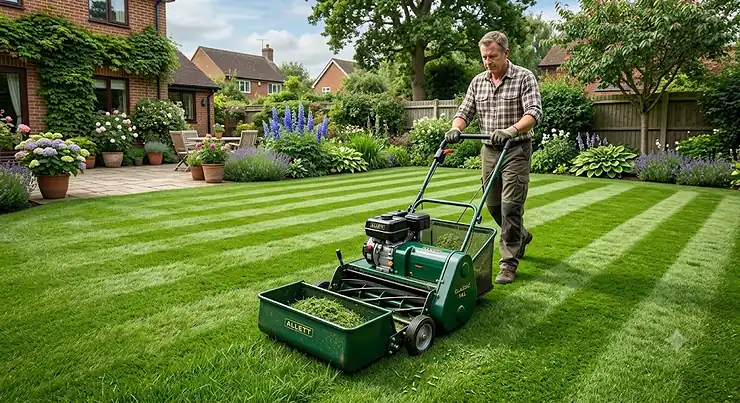
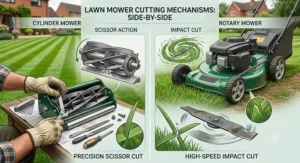
Stand at the top of your lawn on a Saturday morning, mug of tea in hand, and you’ll notice something odd: some gardens look like they’ve been drawn with a ruler, while others look merely… mown. That difference almost always comes down to one decision made months or years earlier — cylinder mower vs rotary mower. A cylinder mower uses a rotating drum of blades that meets a fixed bottom blade in a scissor action, producing the close, striped finish you see on cricket squares and bowling greens; a rotary mower uses a single blade spinning flat and fast beneath the deck, like a horizontal helicopter rotor, favouring speed and versatility over precision. Neither is “better” in the abstract — each is better at a specific job, and this guide exists to help you work out which job is yours.
We’ve dug into real specifications, genuine aggregated customer sentiment, and side-by-side comparisons across seven actual products available on Amazon UK, spanning budget manual pushers through to petrol-powered rotary machines built for rougher ground. Nothing here is invented — no fabricated five-star quotes, no pretend hands-on testing. Just honest analysis of what the spec sheets and the reviewing public actually tell us, so you can buy the mower that suits your lawn rather than the one with the loudest marketing.
Quick Comparison Table: Cylinder Mower vs Rotary Mower at a Glance
| Factor | Cylinder Mower | Rotary Mower |
|---|---|---|
| Cut quality | Scissor cut, very fine finish | Impact cut, slightly coarser |
| Best lawn type | Flat, fine, regularly mown | Uneven, longer, mixed grass |
| Handles moss/weeds | Struggles | Copes well |
| Typical maintenance | Professional sharpening | DIY blade sharpening |
| Best for | Striped, formal lawns | Everyday family lawns |
Look at that “handles moss and weeds” row for a second, because it’s the one most buyers skip past. A cylinder mower‘s scissor action needs a consistent blade of grass to work properly — feed it a clump of moss or a wiry dandelion stem and it tends to fold rather than slice. A rotary mower‘s spinning blade doesn’t care; it just chops whatever’s in front of it, which is exactly why most British gardens — with their moss, clover and the odd patch of buttercups — end up better served by rotary power. The trade-off, of course, is that a rotary cut never looks quite as crisp as a cylinder one.
💬 Already got a favourite? Jump straight to the product that matches your lawn below.
Top 7 Cylinder and Rotary Mowers: Expert Analysis
We’ve picked seven real, currently available machines that span the budget-to-premium range and both cutting technologies — four cylinder mowers and three rotary mowers — so you can compare like for like.
1. Webb WEH12R Hand Push Cylinder Lawnmower — best entry-level cylinder mower for small formal lawns
The Webb WEH12R is the mower to start with if you’ve never owned a cylinder machine and want to find out what all the fuss is about without committing serious money. At 9.1kg it’s genuinely light to push, and its six cylinder blades pair with four cutting heights running from 10mm right down to a proper close 40mm-to-10mm range. In practice that means you can dial in a lawn-bowls-tight cut on a dry lawn or back it off for a gentler early-season trim. Reviewers who’ve assembled and used the WEH12R consistently note that it goes together quickly with clear instructions, copes surprisingly well with bumpy ground for a manual machine, and that its 17-litre front collector holds clippings better than most rivals at this size. Based on the spec sheet, this is a mower for small, flat gardens — think a modest suburban rear lawn rather than anything approaching a quarter-acre. What most first-time buyers overlook is that manual cylinder mowers demand a bit of upper-body effort every single week; if your lawn slopes or your knees complain on a Sunday, this isn’t the machine for you.
Pros:
- ✅ Very light at 9.1kg, easy for most adults to push
- ✅ Four cutting heights for genuine flexibility
- ✅ Strong grass collection for its size
Cons:
- ❌ Requires physical effort every session
- ❌ Struggles once grass gets long or damp
At the time of research this sits around the £90 mark, making it one of the most affordable genuine cylinder mowers on Amazon UK — solid value if your lawn is small and flat enough to suit the format.
2. Gardena Comfort Hand Cylinder 400C — best all-round manual cylinder mower
Where the Webb is the honest budget option, the Gardena Comfort Hand Cylinder 400C is the one independent testers keep landing on as the best push cylinder mower overall. Its 40cm cutting width covers ground noticeably faster than the narrower 30cm machines, and four clearly marked cutting heights on a visible scale mean no guesswork when you’re adjusting for the season. Based on the spec comparison, the shaped, folding handle is a genuine usability upgrade over basic cylinder mowers — it stores flatter and feels more comfortable on longer sessions. Reviewers who’ve tested the 400C report that assembly takes a little longer than cheaper rivals but that the instructions are clear, and that the (separately sold) 49-litre grass collector is generous for a manual machine. What the spec sheet won’t tell you, but testers note, is that Gardena backs this with a two-year guarantee — reassuring for a mower you’ll be relying on every week through the growing season. This is the pick for someone who’s decided cylinder is the right format and wants the best version of it, not the cheapest.
Pros:
- ✅ Wider 40cm cut speeds up mowing time
- ✅ Clear, easy height-adjustment scale
- ✅ Two-year manufacturer guarantee
Cons:
- ❌ Grass collector often sold as a separate accessory
- ❌ Pricier than basic cylinder rivals
Typically found in the £150-£180 range at the time of research, the 400C costs more than entry-level cylinder mowers but earns it through build quality and a genuinely wider working width.
3. Bosch AHM 38 G Eco Lawn Mower — lightest cylinder mower for petrol-free, cable-free mowing
The Bosch AHM 38 G solves a problem a lot of small-garden owners don’t realise they have until they hit it: nowhere to run a cable, and no appetite for petrol fumes on a Sunday morning. At just 6.7kg it’s the lightest mower in this round-up by some margin, and its 38cm cutting width sits comfortably between the Webb and the Gardena. Height adjustment runs from 15mm to 50mm, which is a wide enough band to take a lawn from “slightly overgrown” back to “tidy” without multiple passes. On paper this is essentially a no-compromise entry into eco-friendly mowing — no plug, no battery, no petrol, just a well-engineered set of blades. Aggregated buyer sentiment on Amazon UK consistently flags it as quiet and easy to manoeuvre, which tracks with its low weight; what’s less discussed is that, like all manual cylinder mowers, it needs regular use to stay effective, since letting grass get away from you for a fortnight will overwhelm any push mower of this type. Best suited to compact courtyard-style lawns rather than anything with rough edges or slopes.
Pros:
- ✅ Exceptionally light at 6.7kg
- ✅ No petrol, battery or cable needed
- ✅ Wide 15-50mm height adjustment range
Cons:
- ❌ Manual push effort required throughout
- ❌ Not suited to long or overgrown grass
Sitting toward the more affordable end of the cylinder market — check current listings for the latest figure — this is a sensible pick for anyone prioritising simplicity and low running costs over raw cutting power.
4. Wild Edge 20V Cordless Cylinder Lawn Mower — best cordless cylinder mower for a striped finish without the shove
If the idea of manually pushing a cylinder mower up and down your lawn sounds like a workout you’d rather skip, the Wild Edge 20V Cylinder Lawn Mower is the format’s answer: a battery-powered cylinder mower that keeps the scissor cut and the rear-roller stripes while removing the physical effort. It’s built for gardens up to roughly 300m², with a 41cm cutting width, four cutting heights, and a 47-litre grass bag that means fewer trips to the compost heap than smaller manual machines. The bundled 4.0Ah battery and wall-mounted charger point at a machine designed to be picked up and used with minimal fuss, which is exactly what most weekday gardeners want. Based on the spec comparison, this is the only mower in our line-up that combines a true cylinder cut with cordless convenience, closing the gap between “wants a striped lawn” and “doesn’t want to push a heavy manual machine.” Aggregated review sentiment on Amazon UK rates it well for gardens that are flat and reasonably tidy, though — as with any cylinder mower — buyers with mossy or weedy lawns report it working harder than a rotary equivalent would.
Pros:
- ✅ Cordless convenience with a true cylinder cut
- ✅ Large 47L grass bag reduces emptying trips
- ✅ Battery and charger included in the box
Cons:
- ❌ Struggles on moss-heavy or weedy lawns
- ❌ Premium price for the cylinder category
Expect this one to sit toward the upper end of the cylinder mower market at the time of research — a fair trade if cordless convenience matters more to you than upfront cost.
5. Webb Classic WEER33 Electric Rotary Lawnmower — best budget rotary mower for everyday family lawns
Voted a Best Buy budget mower by BBC Gardener’s World, the Webb Classic WEER33 is the rotary equivalent of the Webb cylinder mower above: honest, affordable, and built to just get on with the job. Its 33cm cutting width and 35-litre collection bag are well matched to a typical UK back garden, and five cutting heights give you room to move between a tidy summer trim and a longer, drought-resistant fringe. Based on the spec sheet, the corded electric motor trades outright power for low running costs and near-zero maintenance — no petrol, no oil changes, just plug in and mow. What most buyers overlook when comparing rotary mowers on price alone is that Webb backs this with a two-year guarantee and UK-based customer service, which matters more than it sounds once something needs a spare part. Reviewers consistently highlight it as easy to assemble and reliable for regular weekly mowing, with the honest caveat that, like all corded mowers, cable management becomes the main annoyance on larger or more complex-shaped lawns.
Pros:
- ✅ Genuinely low price for a trusted brand
- ✅ Two-year guarantee with UK support
- ✅ Handles moss and mixed grass without struggling
Cons:
- ❌ Corded design limits reach and freedom
- ❌ Less powerful than mid-range electric rotaries
At the time of research this sits comfortably under £150, making the WEER33 one of the strongest value picks in this entire comparison — cylinder or rotary.
6. Bosch Home and Garden Rotak 34R Electric Lawnmower — best mid-range rotary mower for medium lawns
Step up from budget corded rotaries and you land on the Bosch Rotak 34R, a 1300W corded machine with a 34cm cutting width and a genuinely useful 20-70mm height-adjustment range. That wider top-end height matters more than it first appears: it lets the Rotak cope with grass that’s got away from you over a rainy fortnight, something narrower-range budget mowers simply can’t manage without stalling or clogging. Based on the spec comparison, Bosch’s build quality shows up less in headline numbers and more in how the machine tracks — testers and buyers consistently describe straighter, more controlled pushing under load compared with cheaper corded rivals. Aggregated UK buyer sentiment highlights longevity and cut quality as the Rotak’s strong points, with the fair caveat that it’s better suited to regular weekly cutting than to reclaiming a lawn that’s been left to its own devices for a month. For gardeners who take their lawn seriously without wanting the bulk or cost of a petrol machine, this is the sensible middle ground.
Pros:
- ✅ Wide 20-70mm height range handles longer grass
- ✅ Noticeably straighter tracking under load
- ✅ Strong reputation for long-term reliability
Cons:
- ❌ Corded, so cable management is still a factor
- ❌ Pricier than basic budget rotary mowers
Typically positioned in the low-to-mid price bracket for corded electrics at the time of research, the Rotak 34R earns its premium over budget rivals through tangible build-quality gains rather than marketing gloss.
7. Mountfield HP41 Petrol Lawnmower — best petrol rotary mower for larger or uneven lawns
When a lawn gets big enough, sloped enough, or simply grows fast enough that a cable becomes a liability, the Mountfield HP41 is where most serious UK gardeners end up. Its 123cc ST120 Autochoke petrol engine and 39cm cutting width are built to shrug off grass that would defeat any corded electric, and the 40-litre grass collector means fewer stops to empty on a lawn up to around 250m². Based on the spec sheet, hand-propelled petrol mowers like this trade a bit of manoeuvring effort for genuinely unrestricted running time — no cable, no battery to watch, just fuel in the tank and the whole lawn to cover in one go. Reviewers who’ve used the HP41 report it as the ideal size and power for medium lawns, describing noticeably quicker, easier cutting than any electric rotary mower they’d previously tried, particularly on grass that’s slightly overgrown or damp. The honest trade-off is upkeep: petrol engines need occasional servicing, oil checks, and a bit more storage care than anything battery- or mains-powered.
Pros:
- ✅ Handles long, damp or overgrown grass with ease
- ✅ No cable or battery limits your mowing range
- ✅ Large 40L collector means fewer empty-and-restart stops
Cons:
- ❌ Requires fuel, oil checks and regular servicing
- ❌ Heavier and noisier than electric alternatives
Petrol mowers in this class typically sit in the £250-£350 range at the time of research — a fair investment if your lawn is genuinely large enough, or rough enough, to justify it.
Practical Usage Guide: Setting Up and Maintaining Your New Mower
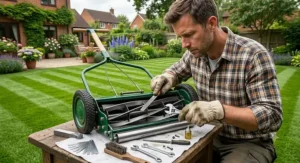
Getting a new mower home is only half the job — the first month decides whether it stays sharp or starts disappointing you. For any cylinder mower, the single most important habit is mowing little and often: because the scissor action needs consistent grass length to work cleanly, letting the lawn grow shaggy between cuts forces the blades to fight rather than slice, and repeated strain like that is what dulls a cylinder edge fastest. The Royal Horticultural Society’s official lawn mowing guidance recommends never removing more than a third of the grass height in a single cut — advice that matters even more for cylinder owners than rotary ones. For rotary mowers, the first-month priority is different: check the underside for grass build-up after every couple of cuts, since compacted clippings under the deck reduce airflow and blunt cutting performance over time. Whichever type you’ve bought, clean the blades after each session, store the mower somewhere dry, and — for cylinder mowers specifically — resist the urge to sharpen the blades yourself; cylinder geometry is precise enough that professional sharpening is usually worth the modest cost, while rotary blades are far more forgiving of a DIY touch-up.
Real-World Scenarios: Which Mower Type Actually Suits You?
Picture three fairly typical UK gardens. First, a retired couple with a compact, flat, well-drained back lawn they’ve nurtured for a decade — for them, a manual or cordless cylinder mower like the Gardena Comfort Hand Cylinder 400C or the Wild Edge 20V Cylinder Lawn Mower rewards their existing lawn care with the crisp, striped finish that a rotary simply can’t replicate. Second, a young family with two children, a trampoline, a football goal, and a lawn that sees more footfall than fertiliser — here a budget rotary such as the Webb Classic WEER33 makes far more sense, since it’ll shrug off toys left in the grass, mixed weeds, and the odd patch of moss without complaint. Third, a semi-rural homeowner with a quarter-acre of sloped, slightly rough grass that grows fast every spring — for that lawn, only a petrol machine with real torque, like the Mountfield HP41, has any realistic chance of keeping up without the cable becoming a constant hazard on the slope.
Buyer’s Decision Framework: Cylinder or Rotary?
If your lawn is small, flat, and free of moss or weeds, choose a cylinder mower — because its scissor cut rewards exactly that kind of surface with a finish nothing else can match. If your lawn has moss, uneven ground, or mixed grass and weeds, choose a rotary mower — because its impact cut copes with inconsistency that would jam or blunt a cylinder blade. If mowing time matters more than lawn perfection, choose rotary — wider cutting widths and more forgiving blades mean fewer passes. If you’re chasing a genuinely striped, formal look for entertaining or simply personal pride, choose cylinder — and budget for the slightly higher maintenance that comes with it. If your lawn exceeds around 400m² or includes slopes, lean toward a self-propelled or petrol rotary rather than either manual format, purely on effort grounds.
✨ Not sure which category you fall into? Compare the full spec sheets above before you decide.
What Is the Difference Between a Cylinder and Rotary Mower?
The core difference between a cylinder and rotary mower is the cutting mechanism itself. A cylinder mower spins a drum of helical blades against a fixed bottom blade, producing a scissor action that slices grass cleanly — the same principle behind a pair of shears. A rotary mower instead spins a single blade horizontally at high speed beneath the deck, cutting grass through sheer impact force, more like a strimmer than a pair of scissors. That mechanical distinction cascades into almost every other difference you’ll notice: cylinder mowers need flatter ground and finer grass to work properly, tend to be heavier for their cutting width, and generally require professional sharpening; rotary mowers handle rough, uneven, or weed-mixed lawns far more capably, and their blades can usually be sharpened at home with basic tools. Neither mechanism is objectively superior — they’re simply optimised for different starting conditions, which is precisely why this comparison exists.

How to Choose Between a Cylinder and Rotary Mower
- Assess your lawn’s surface first. Walk it barefoot — if it’s flat and free of bumps, cylinder is viable; if it’s lumpy or sloped, lean rotary.
- Check for moss and weeds. A lawn with visible moss, clover, or broad-leaf weeds will frustrate a cylinder mower’s scissor action.
- Be honest about mowing frequency. Cylinder mowers demand weekly attention; if you’ll realistically mow fortnightly, rotary copes better with the growth in between.
- Factor in your physical effort tolerance. Manual cylinder mowers need real pushing power; cordless or petrol rotary options remove most of that strain.
- Set a genuine budget, not a wish-list. Entry cylinder and rotary mowers both start around £90-£100; premium versions of either can run past £300.
- Consider your lawn’s size. Anything over roughly 400m² usually needs a wider cutting width or self-propelled drive, regardless of mechanism.
- Decide how much the finish actually matters to you. If a striped, showpiece lawn genuinely motivates you, cylinder earns its extra upkeep; if it doesn’t, rotary’s practicality wins.
Cylinder Mower vs Rotary Mower: Which Is Better for Your Lawn?
There’s no single winner here, and anyone who tells you otherwise is selling something. What genuinely tips the balance is your specific lawn and how much time you’re willing to give it. A cylinder mower — whether that’s the manual Webb WEH12R, the more capable Gardena Comfort Hand Cylinder 400C, the featherweight Bosch AHM 38 G, or the cordless Wild Edge 20V Cylinder Lawn Mower — genuinely outperforms rotary on cut quality when the surface underneath it cooperates: flat, fine, well-drained turf mown consistently enough that the blades never face more than they’re designed to handle. Push a cylinder mower onto uneven or weedy ground and the tables turn hard the other way; the scissor mechanism folds and skips rather than cutting cleanly, leaving a patchy, unsatisfying finish that no amount of technique fixes.
A rotary mower — the budget Webb Classic WEER33, the sturdier Bosch Rotak 34R, or the petrol-powered Mountfield HP41 — trades a small amount of cut precision for enormous gains in versatility. It handles moss, damp grass, mixed weeds and uneven ground without complaint, and its wider practical height range means it forgives the fortnight you didn’t get around to mowing. Reviewers and independent testers who’ve compared both formats consistently note that rotary mowers dominate the “handles typical British lawn conditions” category, while cylinder mowers dominate the “produces the finish golf and cricket grounds use” category. If you had to boil the entire cylinder mower vs rotary mower question down to one sentence: choose cylinder for a lawn you’re prepared to baby into perfection, and rotary for a lawn that has to survive real life.
Should I Use a Cylinder or Rotary Mower?
If you’re still weighing this up after the sections above, here’s the honest shortcut. Choose a cylinder mower if your lawn is small, flat, well-established, and you enjoy the ritual of weekly striping — the Gardena Comfort Hand Cylinder 400C is the strongest all-rounder in that category from our seven, and the Wild Edge 20V removes the physical effort if that’s your main hesitation. Choose a rotary mower if your lawn sees real family use, contains any moss or mixed weeds, or simply grows faster than your available mowing time — the Webb Classic WEER33 is the sensible budget entry, the Bosch Rotak 34R the stronger mid-range choice, and the Mountfield HP41 the answer once size or slope rules out anything corded. What most people actually need, based on the spec comparison and aggregated review patterns across all seven machines, is simply the mower that matches the lawn they already have — not the one they wish they had.
Cylinder Mower Advantages: Why the Clean Scissor Cut Still Wins for Fine Lawns
For all the versatility rotary mowers offer, the cylinder format holds onto genuine, measurable advantages that explain why it’s never gone away. The scissor-like cutting action of a cylinder mower slices each blade of grass cleanly at a single point, rather than tearing or bruising it the way an impact-cut rotary blade can on a bad pass. That clean scissor cut matters more than aesthetics alone: grass tips that are sliced rather than torn seal and recover faster, reducing the ragged, browning tip appearance you sometimes see after rotary mowing in warm weather. Cylinder mowers also achieve genuinely lower cutting heights than most rotary machines can manage without scalping the lawn, which is precisely why bowling greens, cricket squares, and golf greens are cut exclusively with cylinder technology. The trade-off, as covered above, is that this precision only holds up on flat, consistent, well-maintained turf — cylinder mowers are a reward for good lawn husbandry, not a shortcut to it.
Lawn Quality Comparison: Stripes, Density and Grass Health Impact
The visual difference between a cylinder-cut and rotary-cut lawn is obvious even to non-gardeners: cylinder mowers, especially models with a rear roller like the Gardena Comfort Hand Cylinder 400C or Wild Edge 20V, bend the grass in alternating directions to create the light-and-dark striped effect associated with formal lawns. Rotary mowers can produce a milder version of the same effect with a rear roller fitted, but it’s generally less pronounced. Beyond looks, the grass health impact differs too: because a clean scissor cut heals faster than a torn impact cut, cylinder-mown grass under good conditions tends to show slightly denser, finer growth over a season, which is part of why fine ornamental lawns are almost always cylinder-maintained. However, this advantage evaporates quickly if the lawn itself isn’t suited to cylinder mowing — repeatedly forcing a cylinder blade through moss, weeds, or overly long grass causes more stress to the sward than a rotary mower would, undermining the very grass health benefit the format is known for. In short: cylinder mowing can improve lawn quality, but only on a lawn that’s already in reasonably good condition to begin with.
Common Mistakes When Buying a Cylinder or Rotary Mower
The single most common mistake is buying a cylinder mower for a lawn with moss or mixed weeds because the finish looked appealing in photos — that lawn will fight the mower every week. A close second is underestimating cutting width needs: a 30cm mower on a 500m² lawn turns a weekend chore into most of the weekend. Buyers also frequently overlook grass box capacity relative to lawn size, ending up emptying a small collector every few metres on a larger plot. On the rotary side, a common error is choosing a corded electric model for a garden with an awkward layout, where cable management becomes more frustrating than the mowing itself — a cordless or petrol option would have suited better. Finally, plenty of buyers skip checking after-sales support and warranty length entirely, only to discover it matters a great deal the first time a part needs replacing.
Long-Term Cost & Maintenance: Cylinder vs Rotary
Upfront price only tells part of the story. Manual cylinder mowers like the Webb WEH12R and Bosch AHM 38 G have essentially no running costs — no fuel, no electricity, no battery degradation — but they typically need professional blade sharpening every one to two seasons, which usually costs somewhere in the £20-£40 range depending on your local service. Corded electric rotary mowers such as the Webb Classic WEER33 and Bosch Rotak 34R add a small electricity cost but save on servicing, since their blades can be sharpened at home with a file or replaced cheaply. Cordless machines like the Wild Edge 20V introduce battery replacement as a long-term cost, typically several years down the line, but remove fuel and cable expenses entirely. Petrol mowers such as the Mountfield HP41 carry the highest ongoing cost of the seven — fuel, oil changes, and an annual service if you want it running reliably — but that cost buys genuinely unrestricted power on lawns nothing else here could realistically handle. Looked at over five years rather than at the till, the cheapest machine to buy isn’t always the cheapest machine to own.
Safety and Regulations: Mowing Responsibly in the UK
Whichever type you choose, a few safety basics apply universally. The RHS’s own guide to mowing safely recommends clearing the lawn of stones, toys, and debris before every cut, since both cylinder and rotary blades can fling debris at speed. Electric mowers — corded or cordless — should always be used with a residual current device (RCD) fitted to the plug or circuit, so the machine cuts out instantly if a cable is accidentally damaged. Petrol mowers introduce their own considerations: fuel should be stored safely away from the house, and refuelling should only ever happen with the engine off and cool. Sturdy, closed footwear is non-negotiable for any mower type, and cylinder mowers in particular should never be sharpened by an inexperienced owner — the precision required means a professional service is genuinely the safer and more effective route. None of this is complicated, but skipping it is where most avoidable mowing accidents come from.

FAQ
❓ Is a cylinder mower better than a rotary mower?
❓ Can a cylinder mower cut long grass?
❓ Do cylinder mowers need more maintenance than rotary mowers?
❓ Are rotary mowers good for a striped lawn?
❓ What size lawn suits a manual cylinder mower?
Conclusion
If this comparison has taught us anything, it’s that cylinder mower vs rotary mower was never really a fair fight to begin with — it’s two tools built for two different jobs, and the winner depends entirely on what’s growing under your feet. Choose a cylinder mower, like the Gardena Comfort Hand Cylinder 400C or the cordless Wild Edge 20V, if your lawn is flat, well-established, and you’re willing to trade a bit of extra upkeep for that unmistakable striped finish. Choose a rotary mower, whether the budget-friendly Webb Classic WEER33, the sturdier Bosch Rotak 34R, or the petrol-powered Mountfield HP41, if your lawn sees real use, includes any moss or rough patches, or simply needs to survive a busy family life without complaint. Whichever you land on, the honest advice holds: match the mower to the lawn you actually have, not the lawn in the brochure photo, and you’ll get years of good, low-drama mowing out of it.
✨ Ready to Pick Your Perfect Mower?
🔍 Compare the full specs above one more time, weigh your lawn’s condition honestly, and click through to check current pricing and availability. The right mower — cylinder or rotary — is the one that turns Saturday mowing from a chore into a small, satisfying ritual.
Recommended for You
- Cylinder Lawn Mower: 7 Best Picks for a Flawless UK Lawn 2026
- Husqvarna Ride On Mower: 7 Best Models Ranked (2026 Guide)
- Ride On Mower vs Zero Turn Mower: 7 Real Picks Compared (2026)
Disclaimer: This article contains affiliate links. As an Amazon Associate, I earn from qualifying purchases. If you purchase products through these links, we may earn a small commission at no additional cost to you.
✨ Found this helpful? Share it with your friends! 💬🤗
