
In This Article
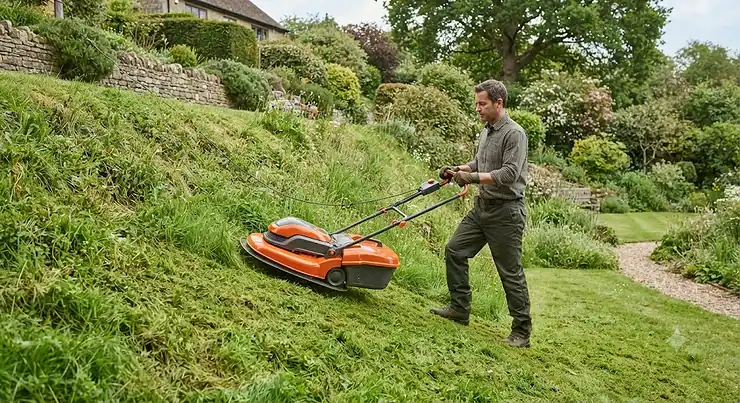
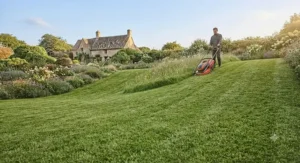
Somewhere between “gentle incline” and “please send help” sits the average British back garden, and if yours tips, dips, or drops away towards a fence line, you already know that a normal mower just doesn’t cut it — literally. A hover mower for slopes solves a very specific problem: it floats on a cushion of air rather than rolling on wheels, which means it can be pushed sideways across a bank without sliding, digging in, or scalping the turf. What is a hover mower for slopes? It’s an electric or battery-powered mower whose spinning fan lifts the whole deck a few millimetres off the grass, letting you glide it in any direction — including straight across a gradient a wheeled mower would slither down.
That’s the theory, anyway. In practice, not every hover mower on Amazon is built the same, and the difference between a £70 budget model and a £400 cordless machine is often exactly the difference between “coped fine” and “left me sweating halfway up the bank.” Slopes chew through motors, batteries, and patience faster than flat lawns ever will, so getting the spec sheet right matters more here than almost anywhere else in gardening.
This guide breaks down seven genuinely available hover mowers, sourced from real listings and aggregated review sentiment rather than marketing copy, and works through the practical side too: technique, safety, cost of ownership, and which type of buyer suits which machine. According to the Royal Horticultural Society’s mowing guidance, regular cutting keeps turf dense and weed-resistant — advice that applies just as much to a bank as it does to a flat lawn, provided you’ve got the right tool for the job. By the end, you should know exactly which hover mower for slopes fits your garden, your budget, and your patience threshold.
Quick Comparison Table
If you’ve got thirty seconds and a slope to deal with, here’s the shortlist before the deep dive.
| Mower | Best For | Cutting Width | Power Source |
|---|---|---|---|
| Flymo Hover Vac 250 | Small lawns & awkward corners | 25cm | Corded electric |
| Flymo EasiGlide 300 | All-round budget slope mowing | 30cm | Corded electric |
| Flymo EasiGlide Plus 360V | Larger sloped lawns | 36cm | Corded electric |
| Cobra AirMow 51 80V | Big or remote slopes, no socket nearby | 51cm | Cordless battery |
Looking at this shortlist, the pattern is fairly clear: cutting width and grass box size climb together with garden size, while the Cobra AirMow 51 80V stands apart as the only cordless option, trading some run-time for total freedom from cables. For a typical UK terrace or semi garden under 150m², the Flymo EasiGlide 300 hits the sweet spot between price and capability, but if your slope backs onto a boundary fence far from any plug socket, that cordless flexibility on the Cobra AirMow 51 80V stops being a luxury and starts being the only sensible option.
💬 Found a pick you like already? Tap through to check today’s price and availability before it changes!
Top 7 Hover Mowers for Slopes: Expert Analysis
We’ve picked across budget, mid-range, and premium tiers, plus a couple of configurations — with and without grass collection — because not every sloped lawn needs the same approach. Every product below includes real specifications, honest interpretation of what those specs mean on a gradient, and aggregated review sentiment where genuine reviews exist.
1. Flymo Hover Vac 250 — smallest deck for tight, awkward slopes
The Hover Vac 250 is the mower Flymo built for gardens where “steep” and “small” collide — think a narrow side return with a slope, or a front garden bank barely wider than the machine itself. Its 25cm cutting width and 1400W motor sound modest, but on a slope that’s actually an advantage: less deck means less weight to fight against gravity, and a tighter turning circle for negotiating flower beds cut into a bank. The 15-litre grass box is on the small side, so expect to empty it more often than you would with a bigger machine, though that’s a fair trade for a mower light enough to lift back onto its feet one-handed if it does slide.
Reviewers consistently describe it as the default entry point into UK hover mowing — reliable, unglamorous, and specifically praised for gliding over uneven ground where wheeled mowers stall. It’s best suited to small lawns under roughly 200m² with awkward levels or a single manageable bank, not a sprawling sloped acreage. First-time buyers and anyone downsizing from a bulkier wheeled mower tend to rate it highly for how little physical effort it demands.
Pros:
- ✅ Lightest deck on this list — easiest to lift and reposition
- ✅ Tight turning circle for awkward bank shapes
- ✅ Genuinely low physical effort on gentle-to-moderate gradients
Cons:
- ❌ 15L grass box needs frequent emptying on longer grass
- ❌ 25cm width means more passes on anything but a small lawn
Prices generally sit in the budget bracket — check current price, but expect this to be among the cheapest genuine hover mowers available. For a small, awkward sloped lawn, the value case is strong: you’re not paying for capacity you’ll never use.
2. Flymo EasiGlide 300 — best all-round pick for typical UK slopes
If there’s a “default” hover mower for slopes in the UK, this is probably it. The EasiGlide 300 pairs a 30cm cutting width with a motor that (depending on the exact listing) ranges from 1300W up to 1700W, a 20-litre collection box, and four cutting heights between 10mm and 30mm. Made in the UK and shipped pre-assembled, it’s designed to be lifted out of the box, have its handle clicked into place, and put straight to work — no tools, no fuss. What that motor range means in practice is straightforward: the higher-wattage variants cope noticeably better with damp or longer grass on a slope, where a weaker motor can bog down and lose the air cushion that makes hovering possible in the first place.
Independent testing from Ideal Home found the motor made light work of long, damp grass and was genuinely easy to manoeuvre on a small, uneven lawn, though testers noted it throws out a fair amount of loose clippings that need raking up afterwards — worth knowing if your slope sits next to a path or patio. Lawn Care Pro’s review calls it a strong entry-level pick for smaller lawns and budgets, singling out the compact, lightweight build as highly manoeuvrable.
Pros:
- ✅ Genuinely capable on damp or longer grass, not just short lawns
- ✅ 20L box reduces stop-start emptying versus the 250
- ✅ Ships fully assembled with minimal setup
Cons:
- ❌ Scatters clippings outside the box on thicker grass
- ❌ 10-12m cable limits reach on larger plots
Expect a price in the £90-£110 range at the time of research, positioning it firmly as a value pick rather than a premium one — but on a modest UK slope, that’s often all you need.
3. Flymo EasiGlide 330VX — mid-range pick with dual ambidextrous handles
Step up from the 300 and you land on the 330VX, Flymo’s mid-tier hover with a wider 33cm deck and a genuinely useful ergonomic tweak: dual ambidextrous starter handles, so only one hand needs to be gripping the safety bar at any time. On a slope, that matters more than it sounds — it frees your other hand to steady yourself or grab a fence post, rather than white-knuckling a single handle the whole way across a bank. The 1700W motor and 20-litre box carry over from the smaller model, but the wider deck also compacts clippings more tightly, which the manufacturer notes translates into less frequent emptying than you might expect from the numbers alone.
There’s no mulching function here, which is a deliberate omission on hover mowers generally — the airflow that keeps the deck floating doesn’t lend itself to fine mulching the way a wheeled rotary’s enclosed deck does. For slope work that’s rarely a dealbreaker, since collection is usually preferable on a bank anyway (mulched clippings sliding downhill onto a path is not a good look).
Pros:
- ✅ Ambidextrous dual handles ease grip fatigue on long sessions
- ✅ Wider 33cm deck covers ground faster than the 300
- ✅ Compacts clippings well, reducing emptying frequency
Cons:
- ❌ No mulching option if you’d prefer to feed the lawn
- ❌ Heavier than the 250 and 300, noticeable on steep pushes
Typically priced a little above the EasiGlide 300 — check current price — the 330VX earns its premium through comfort features that specifically help on inclines, making it a sensible step up for anyone mowing a bank more than once a week.
4. Flymo EasiGlide Plus 360V — best for larger sloped lawns
When the slope isn’t just a bank but half the garden, the EasiGlide Plus 360V is the Flymo to reach for. Its 36cm cutting width is the widest in the standard EasiGlide range, and the 1800W motor is paired with a 26-litre grass box — six litres more than the 330VX — specifically to reduce how often you’re trudging back to the compost heap mid-mow. Reviewers who’ve compared it against the smaller EasiGlide models consistently flag the bigger box as the standout advantage: same broad power delivery, but more mowing between emptying, which counts for a lot when you’re navigating a slope rather than strolling a flat lawn.
What the spec sheet won’t tell you outright is that wider decks on hover mowers do lose a little of the effortless “float” feeling that makes the smaller models so easy to fling around — more deck means more air needed to lift it, and on a very steep bank that can mean slightly more resistance than the compact 250 or 300. For a large or gently-to-moderately sloped lawn, though, the trade-off firmly favours the 360V’s extra coverage per pass.
Pros:
- ✅ Largest grass box in the standard EasiGlide range at 26L
- ✅ 36cm deck covers large sloped lawns in fewer passes
- ✅ Strong 1800W motor handles thicker grass without stalling
Cons:
- ❌ Loses some of the featherlight manoeuvrability of smaller models
- ❌ Wider deck is trickier around tight bank curves
At around the £120-£150 mark based on current retailer pricing, this sits at the upper end of Flymo’s corded range — a fair ask if your slope genuinely spans a large lawn rather than a single bank.
5. Flymo SimpliGlide 360 — lightest true hover for steep banks without collection
Strip out the grass box entirely and you get the SimpliGlide 360: a 36cm deck, 1800W motor, and a machine that weighs in at just 7.5kg — remarkably light for its cutting width, and a genuine benefit when you’re the one lifting it back onto a steep bank after a slip. Without a collection box to fill and empty, this is arguably the purest expression of the “hover mower for slopes” concept: point it at the bank, glide it side to side, and let clippings fall where they land, which on rougher or more informal slopes is often exactly what you want anyway.
Reviewers describe it as aimed squarely at medium garden sizes rather than tiny courtyards, with four cutting heights from 10mm to 30mm giving reasonable flexibility for both a tidy formal look and a slightly longer, more relaxed cut on an ornamental bank. It’s not the machine to choose if you need a pristine, clipping-free finish next to a patio — but for a genuine slope where collection barely matters, the lighter weight pays for itself in reduced fatigue.
Pros:
- ✅ Lightest 36cm-deck hover mower in this line-up at 7.5kg
- ✅ No box to empty — keep moving across the slope
- ✅ Four cutting heights suit both formal and informal banks
Cons:
- ❌ No clipping collection means raking may still be needed near paths
- ❌ Not ideal where a scalped, box-collected finish is the goal
Priced competitively around £90-£100 — often close to the smaller EasiGlide 300 — the SimpliGlide 360 offers genuinely excellent value for anyone whose entire lawn is essentially one long bank.
6. LawnMaster 1700W 33cm Hover Mower — budget alternative brand with a safety-focused build
Not every good hover mower wears a Flymo badge. LawnMaster’s 33cm hover, built by Cleva (a manufacturer with a genuinely substantial global appliance production history), pairs a 1700W motor using what the brand calls T-Drive torque management — automatically maintaining blade speed in wet or long grass rather than letting it bog down — with a patented mechanical Safe-Stop brake that actively halts the blade the moment the machine is switched off. On a slope, where a slip is more likely and reaction time matters, that brake is a genuinely meaningful safety feature rather than a marketing footnote.
Cutting height runs from 12mm to 33mm across four settings via the supplied spacers, and the 10m cable and folding handles match the category standard. Aggregated reviews of LawnMaster’s 33cm hover range describe it as easy to manoeuvre on uneven surfaces, with the airflow doing its job on rough ground; a recurring theme in the same review pool is noticeable handle vibration during longer sessions, which is worth factoring in if you’ll be out there for more than twenty minutes at a stretch.
Pros:
- ✅ T-Drive maintains blade speed automatically in tough grass
- ✅ Safe-Stop brake halts the blade instantly on power-off
- ✅ Genuinely competitive pricing against the equivalent Flymo
Cons:
- ❌ Aggregated reviews note more handle vibration than rival brands
- ❌ Smaller UK review pool than the market-leading Flymo range
Generally available in the £80-£100 range, this is the one to consider if you want Flymo-equivalent slope performance without paying the brand premium — provided the vibration trade-off doesn’t put you off.
7. Cobra AirMow 51 80V — premium cordless pick for steep or remote slopes
For a slope that’s genuinely steep, or simply too far from a socket to make a corded mower practical, the Cobra AirMow 51 80V is in a different league entirely. Twin 40V 5Ah lithium-ion batteries combine to deliver 80V of power to a brushless motor, and Cobra’s own specifications state it’s rated to handle gradients up to 45° — a figure well beyond what any corded electric hover mower in this list is designed for. The 51cm deck is the widest here by a considerable margin, and a clever 3-in-1 wheel kit lets you engage wheels for transport across a driveway or patio, then lift them away the moment you’re back on grass and need the hover to take over.
What that 45° rating means in practice is worth being precise about: it’s the manufacturer’s stated capability, not an independent third-party test, so treat it as an upper bound to plan around rather than a guarantee in all conditions — wet grass, moss, or a poorly-drained bank will always reduce effective grip regardless of what the mower is rated for. Runtime estimates vary between roughly 20 and 45 minutes per charge depending on the source and grass conditions, which on a large sloped lawn may mean planning your session around a mid-mow recharge. Being cordless also removes the single biggest hazard of hover mowing on a bank — trailing cable underfoot — which alone justifies the premium for many buyers with a genuinely large or awkward slope.
Pros:
- ✅ No trailing cable — removes the biggest slope-mowing hazard
- ✅ Widest 51cm deck covers large sloped areas fastest
- ✅ Manufacturer-rated for gradients up to 45°
Cons:
- ❌ Sits in the premium price bracket, well above corded rivals
- ❌ Runtime estimates vary by source — budget for a recharge on big lawns
This sits in the premium price bracket — expect to pay considerably more than any corded model here, so check current price and availability before committing. For a large or power-inaccessible slope, though, it’s arguably the only entry on this list actually engineered for the steepest gradients rather than merely coping with them.
Practical Usage Guide: Setting Up and Mowing Your Slope Safely
Getting a hover mower for slopes out of the box is the easy part — using it well on a genuine gradient takes a bit more care than flat-lawn mowing. Start by walking the slope dry, in decent boots, before you ever switch the mower on: note any dips, molehills, or exposed roots that could catch a wheel-free deck off balance. On your first few uses, keep the cutting height on the highest setting; a shorter first cut on uneven ground risks scalping the high points of a bank, which looks patchy and stresses the grass.
The single most important technique is direction: always push the mower across the slope, moving side to side along the contour, rather than straight up and down. This isn’t just about cut quality — pushing up and down means the mower (and you) are constantly fighting gravity along the steepest possible line, whereas working across the contour lets the machine’s air cushion do more of the work. Keep both hands on the handle where the model allows, take shorter passes than you would on a flat lawn, and never mow a wet or dew-covered bank — not only is grip drastically reduced, but electrical safety becomes a real concern too.
For maintenance, rinse grass build-up from underneath the deck after every third or fourth cut (unplugged, obviously), and check the blade for nicks each month during the growing season — a chipped blade unbalances the airflow that keeps the whole machine hovering evenly. A common first-30-days mistake is leaving the cutting height too low for the first cut of the season; ease into it, and your slope will thank you with denser, more even growth by midsummer.
Hover Mower vs Wheeled Mower for Slopes
This is the comparison most buyers actually need to make before they even start browsing models. A wheeled rotary mower relies on friction between tyre and turf to stay under control; on anything past a gentle incline, that friction simply isn’t enough, and the mower either slides sideways or, on a steeper bank, risks tipping. A hover mower for slopes sidesteps the entire problem by never relying on grip in the first place — it floats, so there’s nothing to slide on beyond the cushion of air itself, and it’s genuinely light enough to correct by hand if it does drift.
| Factor | Hover Mower | Wheeled Mower |
|---|---|---|
| Slope handling | Glides across gradients confidently | Struggles or slides past ~15-20° |
| Manoeuvrability around obstacles | Excellent — floats in any direction | Limited by wheel turning circle |
| Weight | Generally lighter | Often heavier, harder to lift on a slip |
| Cut quality on flat lawns | Good, less precise stripes | Often superior, especially with a roller |
| Typical price bracket | Budget to mid-range | Wide range, budget to premium |
The trade-off is that wheeled mowers, particularly those with a rear roller, generally produce a crisper, more striped finish on flat ground — something a hover mower’s floating deck can’t quite replicate. If your garden is a genuine mix of flat lawn and a sloped section, many UK gardeners end up owning both rather than expecting one machine to do everything well; a hover mower for the bank and a wheeled or cylinder mower for the level areas isn’t an unusual combination, and it’s often cheaper overall than one do-everything machine that compromises on both jobs.
Air-Cushion Flotation: How Hover Mowers Actually Work
Air-cushion flotation is the mechanism behind every hover mower on this list, and it’s a genuinely clever bit of 1960s engineering that’s barely changed since. A fan, mounted directly beneath the spinning cutting blade, forces air downward and outward under the deck, creating a thin cushion of pressurised air that lifts the entire machine a few millimetres clear of the grass. Because the mower is no longer resting its full weight on the turf, it can be pushed in any direction — forward, backward, sideways — with dramatically less resistance than a wheeled machine, which is exactly why it copes so well with a slope: there’s no wheel trying to grip a surface it can’t get purchase on.
The trade-off for that manoeuvrability is precision. Air-cushion flotation inherently makes for a slightly less consistent cutting height than a wheeled deck riding on fixed rollers, since the “float” can vary a millimetre or two depending on grass density and ground firmness. On a formal, bowling-green-style lawn that matters; on a bank or awkward slope where consistency of cut is already secondary to simply getting the job done safely, it’s a trade most gardeners are happy to make.
Gradient Mowing: What’s the Best Mower for a Sloped Garden?
Gradient mowing — cutting grass on any incline steeper than a typical flat lawn — is really a spectrum problem rather than a single yes/no question, and the best mower for a sloped garden depends heavily on where your particular slope sits on that spectrum. As a rough guide, most corded electric hover mowers are comfortable up to somewhere around 25-30°, beyond which even a floating deck starts to feel the pull of gravity working against the operator rather than the machine. Steeper than that, and you’re generally into specialist cordless hover territory, or, on genuinely severe banks, tools designed specifically for banks and slopes such as a strimmer or brushcutter rather than any mower at all.
The RHS’s own guidance on steep banks and slopes makes a point worth taking seriously: it’s often neither realistic nor safe to maintain close-mown grass on a genuinely steep bank, and letting it run longer or planting ground-cover instead can be a better long-term solution than fighting the gradient every fortnight. For anything up to a moderate slope, though, a well-chosen hover mower remains the most practical answer — just match the machine’s realistic capability to your garden’s actual gradient rather than its marketing claims.
Bank Mowing Technique: Doing It Safely and Getting a Clean Cut
Bank mowing technique differs from ordinary lawn mowing in a few specific, non-negotiable ways. First, always start at the bottom of the bank and work upward in horizontal strips — this way, clippings from each pass fall onto the section you’ve already cut rather than the section you’re about to do, keeping your view of the turf clear. Second, keep your footing on the flattest available ground at all times; many hover mowers have handle extensions or adjustable-height bars specifically so the operator can stand on level ground at the bottom or top of a bank while the deck itself works the slope.
Cable management deserves its own mention for corded models: drape the lead over your shoulder rather than letting it trail on the ground, where a hover mower’s own airflow can genuinely suck the cable towards the blade housing. Electrical Safety First’s garden safety guidance is unambiguous on this point — an RCD-protected socket is essential for any electric garden tool, since without one, cutting through a lead could be fatal rather than merely inconvenient. Finally, never attempt bank mowing in wet conditions; damp grass on an incline is one of the few scenarios where even the lightest hover mower can genuinely get away from you.
Hover Mower for an Awkward Shaped Garden
Slopes rarely arrive in neat rectangles. A hover mower for an awkward shaped garden earns its keep specifically because it can pivot on the spot and glide sideways around a curved bed, a tree root, or an oddly-angled boundary in a way no wheeled mower with a fixed turning circle ever can. This is where the smaller-decked models on our list — the Flymo Hover Vac 250 in particular — genuinely outperform their wider siblings, because a narrower deck simply has more room to manoeuvre in a tight, irregular space.
If your garden combines a slope with genuinely fiddly shaping — narrow side passages, borders cut into the bank, steps interrupting the level — prioritise a smaller cutting width over raw power every time. You’ll make more passes overall, but each pass will actually be usable, rather than fighting a wide deck that can’t get into the corners where an awkward garden’s problems usually live.
Real-World Scenarios: Matching the Mower to Your Garden
The new-build terrace owner: A typical modern estate garden with a single sloped bank at the rear, roughly 15-20°, and a lawn under 100m². Budget matters, and the slope is modest rather than severe. The Flymo Hover Vac 250 or Flymo EasiGlide 300 both suit this profile well — light enough for occasional users, cheap enough that the investment feels proportionate to a small garden.
The family with a genuine hillside garden: A larger plot, 300m² or more, with a significant slope running the full width of the lawn and no realistic flat section to fall back on. Here the extra deck width and grass box capacity of the Flymo EasiGlide Plus 360V earns its keep, cutting mowing time meaningfully compared with the smaller models, provided a power socket is within reasonable cable reach.
The rural or off-grid mower: A cottage garden with a steep bank well away from any outdoor socket, or simply a preference for never running a cable across wet grass. The Cobra AirMow 51 80V is the obvious fit — its cordless freedom and 45° gradient rating solve a problem none of the corded models on this list are built to address, even if it costs considerably more upfront.
Problem → Solution: Common Slope-Mowing Headaches
Problem: The mower keeps drifting sideways down the bank. This is usually a technique issue rather than a machine fault — you’re likely mowing at too shallow an angle to the contour. Steepen your side-to-side line slightly and keep a firmer, more deliberate grip; lighter models like the Flymo SimpliGlide 360 are also easier to correct mid-drift than heavier wide-deck machines.
Problem: Clippings are spraying onto the path below the slope. Non-collecting hover mowers, like the SimpliGlide range, will always do this to some extent. Switching to a collection model such as the Flymo EasiGlide 300 solves it directly, or simply mow with the discharge side facing uphill wherever your machine allows.
Problem: The motor bogs down partway up the bank. This is almost always a sign the grass is longer or damper than the motor’s wattage can comfortably handle. Raise the cutting height for that pass, or, if it happens repeatedly, it’s a genuine signal to move up to a higher-wattage model like the Flymo EasiGlide Plus 360V rather than fighting the same underpowered machine season after season.
Problem: No power socket anywhere near the slope. Rather than running a long extension lead across a bank — a genuine electrical hazard on wet grass — this is precisely the scenario the Cobra AirMow 51 80V was designed to solve.
Long-Term Cost & Maintenance
The upfront price of a hover mower for slopes is only part of the real cost. Corded electric models are cheap to run — a typical 1700W motor used for half an hour a week costs pennies in electricity — and maintenance is minimal: an annual blade sharpen or replacement (typically under £15 for a genuine part), the occasional deck clean, and that’s largely it. Batteries introduce a different calculation for cordless models like the Cobra AirMow 51 80V: lithium-ion cells degrade gradually over several years of charge cycles, and a replacement battery pack, when eventually needed, represents a meaningful chunk of the original purchase price.
Over a five-year ownership window, a budget corded model like the Flymo Hover Vac 250 will likely cost the least overall — low purchase price, negligible running costs, cheap parts. A premium cordless machine costs more to buy and, eventually, more to keep running, but that cost has to be weighed against what it’s actually solving: for a genuinely inaccessible slope, the alternative might be paying a gardener to strim it by hand every fortnight, which very quickly outstrips the price difference between corded and cordless. BBC Gardeners’ World’s testing of cordless mowers is a useful independent reference point if you’re weighing battery-powered options generally, beyond hover mowers specifically.
Features That Actually Matter (And Those That Don’t)
Motor wattage and cutting width genuinely matter on a slope — they’re the difference between a machine that maintains its air cushion through damp grass and one that bogs down halfway up a bank. Grass box capacity matters too, more than most buyers expect, simply because emptying a box on an incline is more awkward and time-consuming than doing it on flat ground, so fewer trips genuinely save effort. A dedicated slope or gradient rating, where a manufacturer actually states one (as Cobra does for the AirMow 51), is worth taking seriously as a planning figure.
What matters rather less: the number of cutting height settings beyond four or five, which is largely a marketing differentiator rather than a practical one for most UK lawns, and cable length beyond about 10-12m, since anything longer becomes unwieldy to manage on a slope regardless of how far it theoretically reaches. Mulching capability is essentially irrelevant here too — hover mowers aren’t built for it, and on a genuine slope, collected clippings are usually preferable to mulch sliding downhill anyway.
Safety & Regulations: Mowing Slopes Safely in the UK
Electrical safety is the single biggest practical concern with any corded hover mower for slopes, and it’s not optional. Every socket used for an electric mower should carry RCD (residual current device) protection — without it, cutting through a damaged cable while mowing wet or dewy grass on a bank could be genuinely life-threatening rather than merely damaging to the mower. If your consumer unit doesn’t already include RCD protection, a plug-in RCD adaptor is a cheap and straightforward fix, and testing it via the built-in test button every few months takes seconds.
Beyond electrics, sensible practice includes never mowing a wet or dewy slope, wearing footwear with genuine grip rather than smooth-soled trainers, and keeping children and pets well clear of the work area — a hover mower’s exposed side discharge and lighter build make it less forgiving of a stray foot than a heavier wheeled mower’s enclosed deck. There’s no specific UK legal gradient limit for domestic mowing, but manufacturer-stated slope ratings, where given, should be treated as genuine upper limits rather than targets to test.
Buyer’s Decision Framework
If your slope is under 20° and your lawn is small, choose a compact corded hover mower like the Flymo Hover Vac 250, because raw power and grass box capacity matter less than manoeuvrability at this scale. If your slope covers a large lawn and you’re within reasonable cable reach of a socket, choose a wide-deck corded model like the Flymo EasiGlide Plus 360V, because coverage per pass becomes the deciding factor once the area grows. If your slope is steep, remote from any power source, or you simply want to eliminate cable risk entirely, choose a cordless option like the Cobra AirMow 51 80V, accepting a higher upfront cost for genuine freedom and a manufacturer-rated gradient capability. And if budget is the primary constraint rather than garden size, the LawnMaster 1700W 33cm Hover Mower delivers comparable core performance to the equivalent Flymo at a lower price point, provided you can live with a little extra handle vibration.
FAQ
❓ Can a hover mower cut grass on a really steep slope?
❓ What's the steepest slope a hover mower can handle?
❓ Do I need a wheeled mower as well as a hover mower?
❓ How much does a good hover mower for slopes cost?
❓ Are cordless hover mowers as powerful as corded ones for slopes?
Conclusion
Choosing a hover mower for slopes ultimately comes down to matching a genuinely honest assessment of your garden’s gradient, size, and access to power against what each machine is actually built to do — not the most impressive-sounding spec sheet. For most modest UK slopes, a mid-range corded model like the Flymo EasiGlide 300 or Flymo EasiGlide 330VX will comfortably do the job for years, at a price that doesn’t demand much justification. For genuinely larger or steeper ground, the wider-decked Flymo EasiGlide Plus 360V or the premium cordless Cobra AirMow 51 80V earn their higher price tags through capability the smaller machines simply weren’t built to offer.
Whichever you choose, the technique matters as much as the machine: mow across the contour, never on wet grass, and always with an RCD-protected socket if you’re going corded. A bank that’s been fought with the wrong tool for years can become genuinely easy to manage once the right hover mower and a bit of proper technique are both in place — and that’s a small, satisfying win most gardeners with a sloped lawn will recognise immediately.
✨ Don’t Miss These Exclusive Deals!
🔍 Take your sloped garden to the next level with these carefully selected hover mowers. Click on any highlighted model to check current pricing and availability. The right machine could turn your trickiest bank into the easiest part of your mowing routine!
Recommended for You
- Best Hover Mower 2026: 7 Top UK Picks (Tested; Compared)
- Cylinder Mower For Stripes: 7 Best Picks & Buying Guide 2026
- Cylinder Mower vs Rotary Mower: 7 Real Picks Ranked (2026)
Disclaimer: This article contains affiliate links. As an Amazon Associate, I earn from qualifying purchases. If you purchase products through these links, we may earn a small commission at no additional cost to you.
✨ Found this helpful? Share it with your friends! 💬🤗
