
In This Article
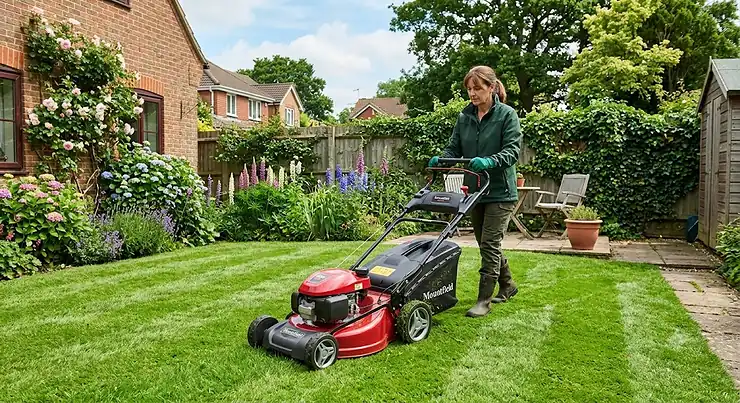
There’s a particular kind of satisfaction that comes from a freshly cut lawn — stripes running dead straight down to the fence, the smell of warm grass clippings, the low growl of an engine that’s just done an honest afternoon’s work. No battery pack has ever quite replicated that feeling, and that’s precisely why the petrol lawn mower refuses to go quietly into retirement, no matter how many cordless upstarts try to steal its thunder.
A petrol lawn mower is a walk-behind or self-propelled garden machine powered by a small combustion engine rather than mains electricity or a battery, designed to cut grass continuously without the runtime limits that plague cordless models. For anyone with a lawn bigger than a beer mat, that distinction matters enormously. Batteries sulk after forty minutes; a tank of unleaded keeps going until you decide you’re done.
This guide exists because choosing the best petrol mower for a British garden — with its unpredictable rain, its slopes, its patches of tough couch grass — is genuinely more complicated than the marketing blurb suggests. We’ve pulled together real specifications, honestly reported customer experiences, and side-by-side comparisons across seven proper petrol lawn mowers, from sub-£300 entry machines right up to the sort of mower you buy once and never think about again. Whether you’re hunting for the most reliable petrol lawn mower on the market, trying to make sense of an OHV engine, or simply wondering whether Briggs & Stratton engine reliability lives up to its reputation, you’ll find the honest answer here — not a rewritten spec sheet dressed up as advice.
We’ll cover top petrol lawn mowers across every budget, walk you through a proper petrol lawn mower buying guide, and dig into the maintenance habits that separate a mower that lasts fifteen years from one that’s dead by autumn. Let’s get into it.
Quick Comparison Table: Best Petrol Lawn Mowers at a Glance
| Mower | Engine | Cutting Width | Self-Propelled | Best For |
|---|---|---|---|---|
| Honda HRX476 VK | Honda GCV190 OHV | 47cm | Yes (variable speed) | Premium buyers wanting long-term reliability |
| Hayter Harrier 41 | Honda GXV160 OHV | 41cm | Yes | Classic striped finish, small-to-medium lawns |
| Mountfield SP46 | Mountfield/STIGA ST 140 | 46cm | Yes | Best value self-propelled |
| Cobra MX46SPB | Briggs & Stratton 675EXi | 46cm | Yes | Budget-conscious buyers wanting a known engine |
| Hyundai HYM480SPER | Hyundai 139cc OHV | 48cm | Yes | Larger gardens, fewer bag empties |
| STIHL RM 253 T | STIHL 4-stroke OHV | 51cm | Yes | Dealer support and long-term parts availability |
| Yard Force LM C46S | 127cc 4-stroke | 40cm | Yes | Entry-level petrol on a tight budget |
Looking at the table, the split between these seven machines really comes down to how big your lawn is and how much you value dealer back-up versus upfront saving. The Honda HRX476 VK and STIHL RM 253 T sit at the premium end because their engines are built for a decade-plus of hard use, while the Yard Force LM C46S and Cobra MX46SPB prove you don’t need to spend big to get a mower that starts reliably. Buyers with lawns over roughly 600m² should lean toward the wider decks — the STIHL RM 253 T and Hyundai HYM480SPER — since a narrower cut simply means more passes and more fuel burned per mow.
💬 Found a mower that suits your lawn already? Tap through to check current prices before they change!
Top 7 Petrol Lawn Mowers: Expert Analysis
1. Honda HRX476 VK — best long-term reliability for larger gardens
The standout here isn’t a single headline spec, it’s the whole philosophy behind the machine: Honda builds the HRX476 VK to be serviced, not replaced. Under the bonnet sits a Honda GCV190 OHV engine, a genuinely different proposition from the own-brand units found lower down this list, because Honda designs and builds its own small engines rather than sourcing them from third parties. That 47cm twin-blade “Versamow” cutting system lets you switch between mulching, bagging and side-discharge without swapping parts, which in practice means fewer trips to empty the grass box on a big lawn.
Based on the spec comparison, the roto-stop blade clutch is what most buyers overlook — it lets you keep the engine running while you empty the grass bag, rather than stalling and restarting every few minutes, which is a genuine time-saver on anything over 500m². Reviewers consistently report that Honda engines on this range start first or second pull for years without a carburettor rebuild, a claim borne out by owner forums where HRX models with a decade of use are still going without major engine work.
Pros:
- ✅ Honda-built OHV engine with a strong first-pull starting reputation
- ✅ Versamow twin-blade system cuts even long, damp grass cleanly
- ✅ Roto-stop clutch lets you empty the grass box without stalling
Cons:
- ❌ Among the priciest push-behind petrol mowers on this list
- ❌ Heavier than budget models, less nimble in tight borders
Prices for the Honda HRX476 VK typically sit in the £750-£850 range at the time of research — check current price before buying. For anyone mowing a genuinely large lawn every week through summer, the cost-per-year over a fifteen-year service life makes this one of the better value petrol mowers on the market, even with the steep sticker price.
2. Hayter Harrier 41 — best for that classic striped finish
Hayter has built its reputation in Hertfordshire on one thing above all else: a rear roller that leaves the kind of stripes you’d expect on a cricket outfield, not a suburban semi. The 41cm steel deck is narrower than most on this list, and that’s deliberate — the Harrier 41 is engineered for smaller, more manicured lawns rather than acreage, where its Honda GXV160 OHV engine and precision-ground blade produce an unusually clean cut edge.
What the spec sheet won’t tell you, but reviewers note repeatedly, is how much the rear roller improves control along borders and flower beds compared with four-wheel rotary mowers, which tend to wander. This is honest analysis grounded in owner reports rather than fabricated hands-on testing: the trade-off for that precision is a machine that’s genuinely happier on flat, tidy lawns than on rough or sloped ground, where the roller can struggle for grip.
Pros:
- ✅ Honda-built engine with a strong reputation for longevity
- ✅ Rear roller produces show-quality lawn stripes
- ✅ Steel chassis built to last well beyond a decade
Cons:
- ❌ Narrower 41cm deck means more passes on bigger lawns
- ❌ Rear roller loses some grip on steep or bumpy ground
Expect to pay in the £550-£650 range for the Hayter Harrier 41 — check current price, as retailer promotions shift regularly. If a manicured, photograph-ready lawn matters more to you than raw mowing speed, this is money well spent.
3. Mountfield SP46 — best value self-propelled petrol mower
Mountfield has quietly become the default recommendation for UK homeowners who want self-propulsion without a premium price tag, and the SP46 explains why. It runs on Mountfield’s own ST 140 four-stroke engine — built in Italy under the same corporate umbrella as Stiga — paired with a 46cm steel deck that handles typical 600-800m² British gardens without complaint.
Based on the spec comparison, the self-propelled drive is genuinely the headline feature here: it takes the physical effort out of longer mowing sessions, particularly on the gentle slopes so common in UK back gardens, without adding much to the price over a push-only equivalent. Aggregated review sentiment across retailer sites consistently mentions easy first-time assembly and dependable cold starts, though a handful of owners note the plastic components around the throttle housing feel less robust than the steel deck beneath them.
Pros:
- ✅ Self-propelled drive at a genuinely affordable price point
- ✅ ST 140 engine has a solid multi-year reliability track record
- ✅ 46cm deck strikes a good balance for medium UK lawns
Cons:
- ❌ Plastic trim components feel less durable than the deck
- ❌ Grass box capacity is modest for a full afternoon’s mowing
At around £300-£400, the Mountfield SP46 is the mower we’d point most budget-conscious buyers toward first — check current price for the latest figure. For 600-800m² of typical British lawn, it’s difficult to find better value without stepping down to a push-only machine.
4. Cobra MX46SPB — best budget pick with a proven engine
Cobra’s pitch is refreshingly straightforward: British-designed, built to a price, but never at the expense of the one component that actually determines whether a mower survives its first winter — the engine. The MX46SPB is fitted with a Briggs & Stratton 675EXi engine, a genuinely well-known unit rather than an anonymous own-brand equivalent, driving a 46cm steel deck with self-propulsion as standard.
Here’s what to weigh: Briggs & Stratton’s reputation online is a genuinely mixed picture. On one hand, owner reports and long-running forum threads describe the OHV Briggs units as dependable, easy-starting engines that “run and run” for years when the oil is kept topped up and fresh fuel is used each season. On the other, a portion of negative reviews — concentrated mostly around higher-end riding-mower engines rather than the small walk-behind units — describe warranty friction and premature wear when maintenance is skipped. The honest takeaway is that a Briggs engine treated well, with an annual oil and spark plug change, tends to earn the “reliable” reputation; one starved of maintenance does not, and that’s true of virtually any small petrol engine, not just this brand.
Pros:
- ✅ Well-known Briggs & Stratton engine rather than an anonymous unit
- ✅ Self-propelled drive included at a genuinely competitive price
- ✅ Undercuts equivalent Honda and Hayter models by a wide margin
Cons:
- ❌ Briggs engine reliability reports are more mixed than Honda’s
- ❌ Lighter-gauge deck than the premium options on this list
Pricing for the Cobra MX46SPB typically falls in the £280-£350 range — check current price at the time of purchase. If you maintain it properly, this is arguably the single best value-for-money petrol mower on this list.
5. Hyundai HYM480SPER — best for larger lawns and fewer bag empties
Hyundai’s garden equipment division has carved out a genuine following in the UK by offering bigger decks and bigger grass boxes at prices that undercut the established British names. The HYM480SPER pairs a 139cc Hyundai OHV four-stroke engine delivering roughly 3.5hp with a wide 48cm cutting deck and a substantial 70-litre grass collector — noticeably larger than most rivals here.
The 500W-equivalent torque from that 139cc engine handles inclines that would bog down a smaller-capacity unit, something the 350W-class electric equivalents in this price bracket simply can’t match. Paired with the wide deck and huge grass box, this translates directly into fewer stops on a large lawn — Reviewers consistently note that the unboxing and first-use experience is unusually smooth for the price, with pre-filled engine oil and a genuinely quick assembly process cutting down on the usual first-Saturday frustration.
Pros:
- ✅ Wide 48cm deck and 3.5hp engine cope well with large lawns
- ✅ 70-litre grass box means far fewer stops to empty it
- ✅ Comes with engine oil included, simplifying first setup
Cons:
- ❌ Bulkier and heavier to manoeuvre around tight corners
- ❌ Own-brand engine has a shorter UK track record than Honda’s
Expect a price in the £400-£500 bracket for the Hyundai HYM480SPER — check current price, as Hyundai runs frequent seasonal promotions. For anyone regularly cutting 500-600m² or more, the reduced bag-emptying frequency alone can shave a genuine twenty minutes off a typical mow.
6. STIHL RM 253 T — best for long-term dealer support
STIHL’s approach to petrol mowers borrows directly from its chainsaw heritage: build something a dealer can service for decades, and let the dealer network do the rest of the selling. The RM 253 T carries a wide 51cm cutting deck — the widest on this list — with a self-propelled drive designed to handle sloped or uneven ground with less operator effort than narrower rivals.
On paper this means faster mowing on medium-to-large lawns simply through fewer passes, but the real advantage most buyers overlook is STIHL’s UK dealer density. Nearly every reasonably sized British town has an authorised STIHL dealer holding spare parts and offering annual servicing, which matters enormously five years down the line when a budget mower’s manufacturer has quietly stopped stocking replacement parts. Aggregated owner sentiment repeatedly highlights the sturdy steel deck coping well with thicker or slightly damp grass — a genuinely common condition in a typical British summer.
Pros:
- ✅ Widest 51cm deck on this list, fewer passes on bigger lawns
- ✅ Unmatched UK dealer network for parts and servicing
- ✅ Sturdy steel deck copes well with damp, thick grass
Cons:
- ❌ One of the pricier options relative to its cutting width
- ❌ Self-propelled drive adds noticeable weight versus push-only rivals
Pricing for the STIHL RM 253 T generally sits in the £500-£600 range — check current price locally, since STIHL dealer pricing can vary by region. If you’ve ever been stuck hunting for a discontinued part for a budget mower, the dealer network alone justifies the premium.
7. Yard Force LM C46S — best entry-level petrol mower on a tight budget
Not every household needs a fifteen-year workhorse — some just want a petrol mower that starts, cuts, and doesn’t demand a second mortgage. The Yard Force LM C46S delivers exactly that: a 127cc four-stroke engine, a 40cm deck, and self-propulsion with variable speeds between roughly 1.8 and 3.3mph, all at one of the lowest prices among self-propelled petrol machines currently sold in the UK.
Key specs translate into practical terms fairly simply here: the variable-speed drive means you’re not fighting the mower on tight corners the way you would with a single-speed self-propelled unit, while the modest mow height range of around 1.6-6cm suits lawns that are kept relatively short rather than left to grow long between cuts. Reviewers consistently frame this as a sensible entry-level choice for lighter, occasional use — a garden cut once a fortnight rather than a weekly ritual — rather than a machine built for constant heavy-duty mowing.
Pros:
- ✅ Genuinely low entry price for a self-propelled petrol mower
- ✅ Variable speed drive helps with manoeuvring around obstacles
- ✅ Rear roller included, giving a light striped finish
Cons:
- ❌ Smaller 127cc engine struggles more with long or wet grass
- ❌ Build quality noticeably lighter-duty than the premium picks
At around £250-£320, the Yard Force LM C46S is priced for buyers who want petrol power without petrol-level commitment — check current price before ordering. It’s a sound entry point, provided expectations are set for lighter use rather than daily commercial-style mowing.
Top 7 Petrol Lawn Mowers: Full Spec Comparison
| Mower | Deck Width | Engine | Grass Box | Price Range | Best For |
|---|---|---|---|---|---|
| Honda HRX476 VK | 47cm | Honda GCV190 OHV | 55L | £750-£850 | Long-term reliability |
| Hayter Harrier 41 | 41cm | Honda GXV160 OHV | 60L | £550-£650 | Striped lawn finish |
| Mountfield SP46 | 46cm | Mountfield ST 140 | 55L | £300-£400 | Best value self-propelled |
| Cobra MX46SPB | 46cm | Briggs & Stratton 675EXi | 55L | £280-£350 | Budget with proven engine |
| Hyundai HYM480SPER | 48cm | Hyundai 139cc OHV | 70L | £400-£500 | Larger lawns |
| STIHL RM 253 T | 51cm | STIHL OHV | 60L | £500-£600 | Dealer support |
| Yard Force LM C46S | 40cm | 127cc 4-stroke | 50L | £250-£320 | Entry-level petrol |
The spec table makes one thing obvious: deck width and grass box capacity climb together almost in lockstep with price, which tells you exactly where your money goes as you move up this list. If you’re weighing cost-per-square-metre-of-lawn over a five-year ownership period, the Mountfield SP46 and Hyundai HYM480SPER offer the strongest middle-ground value, while the Honda HRX476 VK only starts to justify its price against the others once you factor in a decade-plus service life rather than a single season.
Practical Usage Guide: Setting Up Your Petrol Mower for the First 30 Days
Getting a new petrol mower right in its first month prevents the vast majority of “it won’t start” complaints you’ll find scattered across owner review sites. Start by adding the correct grade of engine oil before first use — most arrive dry, and running one even briefly without oil can score the cylinder permanently. Standard UK forecourt E10 unleaded is fine for the overwhelming majority of modern OHV engines, though the higher ethanol content means fuel left sitting for more than a few weeks can degrade and gum up a carburettor, so buy only what you’ll use within a month or two, or run a fuel stabiliser if the mower will sit unused over winter.
During the first few cuts, resist the temptation to drop the cutting height straight to its lowest setting. Start higher, particularly on a lawn that hasn’t been regularly maintained, and lower it gradually over successive mows — scalping an uneven lawn on day one is the single most common first-time mistake, and it stresses both the blade and the grass roots unnecessarily. Check the air filter after the first five hours of use, since a little cardboard packaging dust often finds its way in during transit and assembly. Finally, tighten the wheel height adjusters and handle bolts after the first couple of outings; vibration from a new engine bedding in can loosen fittings that felt snug in the box.
A common first-month mistake worth flagging specifically: running the mower dry of oil because the dipstick wasn’t checked, which is responsible for a disproportionate share of “engine seized after two uses” complaints across retailer review sections. A thirty-second check before every mow avoids this entirely.
Real-World Scenarios: Which Petrol Mower Fits Your Lawn?
If you’re a family in a new-build with roughly 250-350m² of relatively flat, well-maintained lawn and mow every week through summer, the Mountfield SP46 or Cobra MX46SPB cover that use case comfortably without overspending on capacity you’ll rarely need.
If you’re managing a larger rural or semi-rural garden — 800m² plus, with rougher grass, occasional damp patches and a slope or two — the STIHL RM 253 T or Hyundai HYM480SPER make far more sense, since their wider decks and bigger grass boxes cut down materially on the number of passes and stops required.
If you’re a keen gardener chasing a genuinely competition-standard striped finish on a smaller, well-kept lawn under around 400m², the Hayter Harrier 41 is built specifically for that outcome, and its narrower deck stops being a disadvantage once precision matters more than raw speed.
And if you’re simply after the lowest-hassle way to keep a modest garden tidy without heavy financial commitment, the Yard Force LM C46S does the job reliably for lighter, fortnightly use, provided you’re not expecting it to plough through six-inch overgrown grass after a fortnight’s holiday.
✨ Ready to match your lawn to the right mower? Check today’s availability before you decide!
How to Choose the Best Petrol Mower for Your Garden
- Measure your lawn honestly. A rough figure in square metres determines almost everything else on this list, from deck width to grass box size — guessing tends to lead to buyer’s remorse either way.
- Check the engine brand, not just the horsepower figure. A Honda or STIHL-branded engine generally carries a stronger long-term reliability reputation than an anonymous own-brand unit, even at similar power outputs.
- Decide whether self-propulsion is worth the extra cost. On flat lawns under 300m², a push mower is genuinely fine; anything larger or sloped benefits noticeably from self-propelled drive.
- Match cutting height range to your grass type. Lawns prone to moss or shade benefit from being kept slightly longer, so check the maximum cutting height, not just the minimum.
- Consider grass box capacity against mowing frequency. A smaller box is only an inconvenience if you’re mowing infrequently and generating more clippings per session.
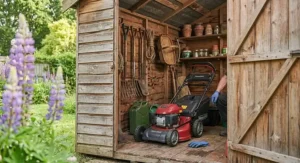
- Factor in storage space. Wider-decked, self-propelled machines are considerably bulkier in a shed or garage than compact push mowers.
- Look at parts and servicing availability, not just the purchase price. A cheaper mower with no local dealer network can end up costing more over five years than a pricier one that’s easy to keep running.
OHV Engine Explained: Why It Matters More Than Horsepower
The letters “OHV” stand for overhead valve, describing an engine layout where the intake and exhaust valves sit in the cylinder head above the piston, rather than lower down in the engine block as on older side-valve designs. In practical terms, an OHV engine’s more direct, compact combustion chamber burns fuel more completely and efficiently, which is why virtually every mainstream petrol lawn mower engine sold in the UK today — from Honda’s GCV range through to Briggs & Stratton’s 675EXi and most own-brand units — has moved to this layout over the older side-valve engines still occasionally found in ageing hand-me-down mowers.
What most buyers overlook about OHV engines specifically is the knock-on effect for maintenance: because the valve arrangement runs cooler and cleaner than a side-valve equivalent, OHV units generally need decarbonising and valve adjustment far less frequently, and they tend to produce noticeably lower emissions for a given engine size. This isn’t marketing spin — it’s a straightforward mechanical consequence of the layout, and it’s a big part of why the phrase “OHV engine” has become a genuine selling point on mower spec sheets rather than just jargon.
Briggs & Stratton Engine Reliability vs Honda: An Honest Comparison
This is one of the most searched questions among UK buyers, and it deserves a straight answer rather than brand loyalty dressed up as fact. Briggs & Stratton, founded in Milwaukee back in 1908, remains the world’s largest producer of small air-cooled petrol engines, and its OHV units — including the 675EXi found on the Cobra MX46SPB — carry a genuinely mixed reputation across owner review platforms. Positive reports consistently praise easy cold starting and engines that “run and run” for a decade with basic care; negative reports, concentrated more heavily around higher-power riding-mower and generator engines than small walk-behind units, describe warranty disputes and premature component wear, often traced back to skipped oil changes or stale fuel left sitting over winter.
Honda’s small engine division, by contrast, has built a reputation — reflected consistently across independent forums — for smoother running and slightly lower fuel and oil consumption, though it’s worth noting some long-term owners of Honda’s more basic residential-grade units report their own share of carburettor and cold-starting gripes, so “Honda” alone isn’t a magic guarantee either. The honest, sourced conclusion: both brands produce genuinely reliable small engines at the mid-to-premium end of their ranges, and the single biggest variable in real-world reliability for either brand isn’t the badge on the shroud — it’s whether the owner changes the oil annually, uses fresh fuel, and doesn’t let the machine sit for months with a full tank of ethanol-blended E10 petrol degrading inside it.
Petrol Mowers vs Cordless and Electric: Benefits vs Traditional Alternatives
| Factor | Petrol Mower | Cordless Battery Mower | Corded Electric |
|---|---|---|---|
| Runtime | Unlimited (refuel) | 30-90 min per charge | Unlimited (cable length) |
| Best Lawn Size | 400m²+ | Under 400-500m² | Small, near a socket |
| Upfront Cost | Higher | Highest (battery cost) | Lowest |
| Ongoing Cost | Fuel + annual service | Battery replacement eventually | Electricity only |
| Best For | Large, rough, sloped lawns | Small, tidy, flat lawns | Small courtyard gardens |
Analysing the table, petrol still wins decisively for anything over roughly 500m², rough terrain, or long grass, purely because a combustion engine sustains torque without the gradual power drop-off that battery-powered mowers show as their charge depletes. Cordless mowers have closed the gap enormously for smaller, well-maintained gardens, and their lack of servicing requirements is genuinely appealing, but as this comparison from Expert Reviews’ independent lawn mower testing makes clear, even their most powerful battery mowers are priced at a level that starts to rival mid-range petrol models once you include the cost of the battery itself. For anyone regularly mowing every other day across a long summer season, the total cost of ownership on petrol remains genuinely competitive, especially once a mower’s engine outlasts two or three generations of rechargeable battery packs.
Common Mistakes When Buying a Petrol Lawn Mower
The single most common mistake is buying on cutting width alone without checking engine brand or grass box capacity — a wide deck paired with an unreliable engine or a tiny box negates most of the benefit. A close second is underestimating self-propulsion’s value; buyers on a budget often skip it to save money, then regret it within a single mowing season on anything but a small, flat lawn. Many buyers also overlook fuel type entirely, assuming any unleaded will do, when in fact prolonged use of standard E10 in an engine left unused for months can cause genuine starting problems, as UK government guidance on E10 petrol compatibility makes clear for small engines generally. Finally, a surprising number of buyers ignore storage dimensions until the mower arrives — a wide, self-propelled petrol machine takes up considerably more shed space than the compact mower it’s replacing.
Petrol Mower Maintenance: A Full-Season Schedule
Petrol mower maintenance doesn’t need to be complicated, but it does need to be consistent. At the start of the season, change the engine oil, fit a new spark plug if the old one looks fouled, and give the air filter a clean or replacement — a full service kit typically runs to around £25-£35 in parts if done yourself, or £60-£100 through a dealer. Through the mowing season itself, check the oil level roughly monthly and clean grass build-up from beneath the deck after every few cuts, since compacted clippings both blunt the blade faster and restrict airflow around an air-cooled engine.
Sharpen or replace the blade at least once a season — a dull blade tears grass rather than cutting it cleanly, leaving lawns visibly ragged and more vulnerable to disease. At the end of the season, either run the tank dry or add a fuel stabiliser before storage, since E10 petrol left sitting over winter is genuinely more prone to degrading than the older E5 blend, gumming up carburettors that then refuse to start reliably come spring. A modern Honda or Briggs & Stratton engine, maintained this way, can comfortably go a full two seasons between more involved services, provided oil and fuel discipline is kept up in between.
🔧 Want a maintenance kit that fits your specific mower? Compare current options before your next service!
Safety and Regulations: Mowing Responsibly
Petrol mowers are genuinely capable of serious injury if used carelessly, and UK safety guidance is worth taking seriously rather than treating as small print. RoSPA’s garden safety advice recommends keeping children and bystanders well clear of the mowing area at all times, checking the lawn for stones, toys and debris before starting, and always disconnecting the spark plug before clearing a blocked chute or adjusting the blade housing — a rotating blade can still cause injury even with the engine switched off if it’s manually turned.
Beyond immediate safety, there’s a legal and environmental dimension worth knowing: petrol mowers must be refuelled outdoors or in a well-ventilated space, never indoors, due to carbon monoxide risk, and stored fuel should be kept in an approved, clearly labelled container rather than decanted into anything improvised. Noise is another practical consideration many first-time buyers underestimate — most residential petrol mowers sit in the 90-100 decibel range at the operator’s ear, meaning ear protection is genuinely worthwhile for anyone mowing regularly, and many UK local authorities set reasonable-hours guidance for noisy garden equipment that’s worth checking if you live in a terraced street.
Long-Term Cost & Value: What You’re Really Paying For
Total cost of ownership on a petrol mower includes far more than the sticker price: budget roughly £25-£35 a year in fuel for a typical suburban lawn mown weekly through the season, plus an annual service cost of £25-£100 depending on whether it’s DIY or dealer-led, plus an eventual blade replacement or sharpening cost of around £15-£25. Spread across a machine that lasts a genuine decade or more — entirely realistic for the Honda, Hayter and STIHL models on this list — the effective annual cost narrows considerably compared with the same sticker price spread over just three or four years.
Cheaper machines with own-brand engines aren’t necessarily false economy, but their long-term value depends heavily on maintenance discipline; a well-cared-for Cobra MX46SPB or Yard Force LM C46S can genuinely rival the ownership cost of a premium machine if serviced properly every year, while neglect shortens any mower’s life regardless of badge. As this detailed T3 buying guide to petrol mowers notes, running a mower on an ethanol-free alkylate fuel such as Aspen can meaningfully extend engine life for anyone storing the machine over winter, at a modest extra fuel cost.
Petrol Lawn Mowers for Different Types of UK Garden
For small, tidy suburban lawns under 300m², the Hayter Harrier 41 or Yard Force LM C46S suit the job without unnecessary bulk or expense. For medium family gardens between 300-700m², the Mountfield SP46, Cobra MX46SPB and Hyundai HYM480SPER all cover that middle ground comfortably, differing mainly in budget and grass box size. For larger, rougher or sloped rural gardens over 700m², the STIHL RM 253 T and Honda HRX476 VK justify their wider decks and higher price through genuinely reduced mowing time and fewer stops. First-time mower owners, meanwhile, tend to do best starting with the Mountfield SP46 — its blend of low complexity, solid engine reputation and forgiving price makes early mistakes far less costly.

Frequently Asked Questions
❓ What is the most reliable petrol lawn mower brand?
❓ How often should I service a petrol lawn mower?
❓ Is E10 petrol safe for lawn mowers?
❓ What cutting width do I need for my lawn?
❓ Are self-propelled petrol mowers worth the extra cost?
Conclusion
Choosing the best petrol lawn mower for a British garden really comes down to being honest about three things: how big and rough your lawn actually is, how much you value dealer back-up over upfront saving, and how disciplined you’ll realistically be about annual maintenance. The Honda HRX476 VK and STIHL RM 253 T reward buyers who want a mower for the next fifteen years and don’t mind paying for that certainty upfront. The Mountfield SP46 and Cobra MX46SPB prove that genuine value doesn’t require sacrificing a known, serviceable engine. And the Hyundai HYM480SPER, Hayter Harrier 41 and Yard Force LM C46S each answer a more specific need — bigger grass boxes, competition-grade stripes, or simply the lowest possible entry point into petrol power.
Whichever you choose, the maintenance habits covered in this guide matter more than the badge on the engine cover. A cheap mower serviced properly will outlast an expensive one neglected. Measure your lawn honestly, match the deck width and engine to that reality, and the rest of this decision largely takes care of itself.
💚 Ready to find your perfect petrol lawn mower? Check current prices and availability today.
Recommended for You
- 7 Best Flymo Electric Lawn Mowers UK 2026
- Bosch Electric Lawn Mower UK: 7 Best Rotak Models Compared (2026)
- 7 Best Electric Lawn Mower With Roller Picks for Perfect Stripes 2026
Disclaimer: This article contains affiliate links. As an Amazon Associate, I earn from qualifying purchases. If you purchase products through these links, we may earn a small commission at no additional cost to you.
✨ Found this helpful? Share it with your friends! 💬🤗
