
In This Article
A petrol strimmer under £300 is a hand-held, engine-powered garden tool that cuts grass, weeds and light brush using a spinning nylon line or metal blade, typically running on a 2-stroke or 4-stroke engine between 25cc and 52cc. That’s the textbook definition, but if you’ve ever wrestled a tangled cordless trimmer through a patch of nettles taller than your knees, you already know why petrol still earns its keep in British gardens.

Here’s the thing nobody tells you at the garden centre: the difference between a strimmer that lasts a decade and one that’s in landfill by August rarely comes down to the price tag alone. It comes down to matching engine size to the job, understanding what “running costs” actually means once you factor in 2-stroke oil and annual servicing, and knowing which corners a £90 budget model cuts that a £250 one doesn’t. Over the next several thousand words, we’re going to unpack exactly that — with real products, real specs, and the sort of honest, slightly opinionated commentary you’d get from a mate who’s spent a Saturday morning elbow-deep in a carburettor.
We’ve researched seven genuine petrol strimmers currently sold in the UK, spanning budget clearance-shed options through to STIHL’s entry-level workhorse, and we’ll walk through fuel efficiency, engine displacement, and the real running costs behind each. None of this is guesswork dressed up as expertise — where reviewer sentiment or spec data couldn’t be verified, we’ve said so rather than inventing it.
Quick Comparison Table
For readers in a hurry, here’s the shape of the market at a glance before we get into the weeds (sorry, couldn’t resist).
| Model | Engine | Weight | Best For |
|---|---|---|---|
| STIHL FS 55 R | 27.2cc 2-stroke | ~4.4-4.9kg | Best overall balance |
| Ryobi RBC254SESO | 25.4cc 2-stroke | 5.5kg | Expandable attachment system |
| McCulloch B26 PS | 26cc 2-stroke | ~5.3-5.4kg | Mid-range all-rounder |
| Einhell GC-BC 52 I AS | 51.7cc 2-stroke | Heavier-end | Most cutting power |
| Einhell GC-BC 31-4S | 31cc 4-stroke | Mid-weight | No fuel-mixing, cleaner running |
| BU-KO 52cc Backpack | 52cc 2-stroke | Backpack-distributed | 3-in-1 versatility on a budget |
| ParkerBrand 52cc | 52cc 2-stroke | Lightweight-class | Cheapest genuine petrol option |
Looking at this spread, the pattern that jumps out is that engine displacement doesn’t rise in a straight line with price — the BU-KO 52cc Backpack and ParkerBrand 52cc both pack a bigger engine on paper than the STIHL FS 55 R, yet cost a fraction of it. That’s not a fluke; it reflects a genuine trade-off between raw cc and build quality, which we’ll dig into properly in the engine displacement section below. For now, the honest takeaway is that if you’ve got a modest lawn edge to tidy, you’re paying for refinement rather than power once you go above 30cc.
Found a model you like already? One click on any product below takes you straight to check its current price.
Top 7 Petrol Strimmers Under £300: Expert Analysis
We’ve deliberately spread this list across budget, mid-range and near-premium territory, because “best” depends entirely on whether you’re tidying a courtyard or clearing a paddock edge.
1. STIHL FS 55 R — best all-round balance for UK gardens
STIHL’s entry-level brushcutter has been a fixture of British garden sheds for the best part of two decades, and the FS 55 R is the reason why: it’s the strimmer other manufacturers get compared against, fairly or not. The standout feature here is genuinely how little it asks of you to get going.
Under the cowling sits a 27.2cc 2-MIX engine putting out 0.75kW, paired with a 420mm cutting diameter and a 0.33-litre tank. In practice, that displacement is the sweet spot for domestic use — enough torque to chew through moderately overgrown verges without the extra 3-4kg that a 40cc-plus engine tends to bring along with it. The loop handle and ErgoStart recoil system (STIHL claims roughly a third of the normal pull force) mean this is genuinely one of the easier petrol tools to start cold, which matters more than most spec sheets let on.
Who it’s for: homeowners stepping up from a cordless or corded electric trimmer who want a machine that will comfortably outlast the warranty, rather than professionals needing an all-day brushcutter. Reviewers consistently note that STIHL’s build quality and parts availability are the main draw, with the trade-off being that servicing and spares cost more than for budget brands — you’re buying into an ecosystem, not just a tool.
Pros:
- ✅ Renowned STIHL reliability and long parts availability
- ✅ ErgoStart system makes cold starts noticeably easier
- ✅ Loop handle suits tight, obstacle-heavy gardens
Cons:
- ❌ Smaller 0.33L tank means more frequent refuelling
- ❌ Sits closer to the £300 ceiling than most rivals here
Price sits in the £250-£320 bracket depending on retailer and current promotions, so it’s worth shopping around to land comfortably under the £300 mark — check current price before buying, as stock and offers shift regularly. Given the resale value STIHL machines tend to hold, it’s arguably the best long-term value on this list even at the higher end of that range.

2. Ryobi RBC254SESO — best for buyers who want an expandable system
The Ryobi’s calling card isn’t raw power, it’s flexibility: this is a 2-in-1 brush cutter and line trimmer built on Ryobi’s Expand-It split-shaft platform, meaning the powerhead can swap onto hedge trimmer, pole saw or cultivator attachments down the line.
Its 25.4cc POWR XT full-crank 2-stroke engine delivers around 1.0hp through a 460mm cutting path, and the 0.42-litre tank is the largest among the sub-30cc machines here. What that extra tank capacity means practically is fewer stop-start refuelling breaks on a long trimming session — small detail, real difference over an afternoon. It ships with both a Tri-Arc metal blade for heavier weeds and a Reel-Easy trimming head with a tool-free “thread and load” line system, which cuts out a genuinely fiddly task that trips up a lot of first-time petrol strimmer owners.
Who it’s for: buyers who anticipate building out a multi-tool garden kit over time rather than buying single-purpose machines repeatedly. Based on the spec comparison, the trade-off is weight — at 5.5kg it’s noticeably heavier in the hand than the STIHL, partly because the split-shaft coupling adds material that a fixed-shaft design doesn’t need.
Pros:
- ✅ Compatible with the entire Ryobi Expand-It attachment range
- ✅ Larger 0.42L tank reduces mid-job refuelling
- ✅ Tool-free line reload saves real time
Cons:
- ❌ Heavier than fixed-shaft alternatives at this cc rating
- ❌ Split-shaft coupling is another part that can wear over years
Typical UK pricing runs from around £175 up to the £240 RRP, making it one of the more consistent mid-range value picks — expect to pay toward the lower end outside of peak spring demand.
3. McCulloch B26 PS — dependable mid-range all-rounder
McCulloch doesn’t get the brand cachet of STIHL, but the B26 PS quietly does the same job for considerably less outlay, and its “Tap ‘N’ Go” bump-feed head is one of the more forgiving line-feed systems for beginners.
The 26.2cc 2-stroke engine (rated at 750W) drives a 430mm cutting width, with a generous 0.55-litre tank — noticeably larger than the STIHL’s, which translates into longer unbroken run times on bigger plots. What the spec sheet won’t tell you, but the “soft start” marketing claim genuinely reflects, is a recoil pull that’s meaningfully lighter than older McCulloch models, reducing the shoulder strain that puts a lot of people off petrol tools entirely. The split shaft also means it folds down small enough to fit in a hatchback boot without wrestling.
Who it’s for: gardeners with fields, ditches or rough paddock edges who need real tank capacity over gram-counted lightness. Availability has been inconsistent at some UK retailers recently, so it’s worth checking current price and stock before committing, as it has appeared and disappeared from certain listings.
Pros:
- ✅ Large 0.55L tank for longer unbroken sessions
- ✅ Tap ‘N’ Go bump-feed head is beginner-friendly
- ✅ Split shaft packs down compactly for storage
Cons:
- ❌ Stock availability has been patchy at some UK retailers
- ❌ 112dB noise rating is on the louder side of this group
When in stock, pricing generally falls somewhere in the £140-£190 range — a genuinely competitive mid-tier spot, though we’d recommend confirming current availability with your preferred retailer first.
4. Einhell GC-BC 52 I AS — the most cutting power on this list
If STIHL’s FS 55 R is about refinement, the Einhell GC-BC 52 I AS is about brute displacement. At 51.7cc, this is very nearly double the engine size of the STIHL for roughly half the money, and it shows in the numbers: 1.5kW of power, a 6750rpm blade speed, and a 420mm line-cutting width backed by a 0.9-litre tank.
That bigger engine matters for anyone dealing with genuinely thick brush, brambles or sapling growth rather than ordinary lawn edges — this is closer to a brushcutter than a delicate trimmer. Einhell has fitted a double-bearing crankshaft with an anti-vibration system, which on paper should meaningfully reduce the hand-arm vibration exposure that’s a genuine long-term health consideration with any petrol tool (more on that in our safety section below). Digital ignition is also aimed at smoother, more stable running than the points-based ignition still found on some budget rivals.
Who it’s for: anyone with wilder, larger grounds — think smallholdings, allotment boundaries or genuinely overgrown gardens taken on as a project — where a domestic-grade trimmer would simply stall. It’s overkill for a neat suburban lawn edge, and the extra engine mass means it’s not the machine to reach for if arm fatigue is a concern.
Pros:
- ✅ 51.7cc engine tackles brush that smaller trimmers can’t
- ✅ Anti-vibration crankshaft design aids comfort over long sessions
- ✅ Large 0.9L tank suits extended clearing jobs
Cons:
- ❌ Bigger, heavier engine adds noticeable arm fatigue over time
- ❌ Genuinely more machine than most domestic gardens need
Pricing typically sits between £165 and £216 RRP, comfortably inside budget and arguably the strongest cc-per-pound ratio on this list.
5. Einhell GC-BC 31-4S — best for avoiding the fuel-mixing faff
Every other 2-stroke machine on this list needs petrol mixed with 2-stroke oil at a precise ratio before it’ll run. The GC-BC 31-4S sidesteps that entirely with a genuine 4-stroke, air-cooled engine that runs on plain unleaded — a small change that removes one of the most common beginner mistakes (wrong mix ratio) from the equation completely.
Displacement sits at 31cc with 0.7kW of power, a 480mm cutting width and a 0.7-litre tank, plus interchangeable line and blade attachments rated up to 7000rpm on the knife setting. Reviewers consistently note that 4-stroke petrol engines run quieter and emit visibly less smoke than comparable 2-strokes, largely because they burn fuel and oil separately rather than as a pre-mixed cocktail — this is honest engineering, not marketing spin, and it’s the same principle behind why 4-stroke lawnmowers have mostly replaced 2-stroke ones in UK gardens.
Who it’s for: buyers who specifically want to avoid oil-mixing and don’t mind carrying a touch more engine weight in exchange. We should flag honestly here that consistent UK retail pricing for this exact model wasn’t reliably available at the time of research — Einhell’s comparable 4-stroke scythe models typically land somewhere in the £180-£230 band, so treat that as an estimate and check current price directly before buying.
Pros:
- ✅ No 2-stroke oil mixing required — runs on plain unleaded
- ✅ Quieter, cleaner-running than comparable 2-stroke engines
- ✅ Dual line and blade attachments included
Cons:
- ❌ 4-stroke engines typically weigh more than 2-stroke equivalents
- ❌ UK retail pricing wasn’t consistently verifiable at research time
Given the convenience factor, this is worth serious consideration for anyone who’s been put off petrol tools purely by the fuel-mixing step.

6. BU-KO 52cc Backpack — best value 3-in-1 multi-tool
BU-KO has built a loyal following among budget-conscious UK gardeners, and the 52cc Backpack model is their strongest case for why: a genuine 3-in-1 tool bundling a nylon-line strimmer head, a 3-tooth brush-cutting blade and a 40-tooth blade, all powered from one 52cc 2-stroke engine worn as a backpack rather than slung over one shoulder.
The backpack harness is the real story here — distributing engine weight across both shoulders and the lower back rather than concentrating it on one arm, which is precisely the kind of practical detail that spec sheets rarely capture but your body absolutely will notice after an hour of use. It ships complete with a mixing bottle, toolkit and full assembly instructions, addressing a genuinely common first-time-buyer worry about whether a budget petrol tool will actually be straightforward to set up.
Who it’s for: buyers who want brush-cutting capability alongside standard strimming without paying separately for two tools, and who prioritise comfort during longer sessions over ultimate refinement. The obvious trade-off against Einhell or STIHL is aftercare — BU-KO doesn’t have the same long-established UK service network, so factor spares availability into your decision if you’re planning years of heavy use.
Pros:
- ✅ Genuine 3-in-1 versatility from one engine
- ✅ Backpack harness meaningfully reduces one-arm fatigue
- ✅ Comes complete with toolkit, harness and mixing bottle
Cons:
- ❌ Requires a 25:1 (some batches 40:1) fuel-oil mix — check your manual
- ❌ Smaller aftercare network than established brands like STIHL
At around £129.99, this is genuinely one of the better value propositions here for anyone who wants brush-cutting muscle without spending £200-plus.
7. ParkerBrand 52cc — cheapest genuine petrol strimmer worth buying
If budget is the deciding factor above everything else, ParkerBrand’s 52cc line trimmer and brush cutter is the honest floor of what “petrol strimmer” means before you’re into genuinely disposable territory. It’s a straightforward single-purpose machine rather than a multi-tool, which — perhaps counterintuitively — is part of its appeal, since there’s less to go wrong.
Specification-wise it mirrors the BU-KO’s 52cc 2-stroke displacement, giving it real brush-cutting capability that punches above most machines at this price point, and it comes with a 2-year warranty, which is a genuinely reassuring commitment for a budget-tier brand to stand behind. What the spec sheet doesn’t tell you is build tolerance — at this price, expect plastic componentry in places where STIHL or Einhell use metal, which is the honest trade-off for the lower cost rather than a hidden flaw.
Who it’s for: occasional users with a modest garden who need a genuine petrol strimmer a handful of times a year and don’t want to spend £150-plus on a tool that’ll mostly sit in the shed. A common complaint in user reviews of budget 52cc strimmers generally is that the plastic harness clips and line-feed knobs are the first parts to wear, so treating those gently will extend the machine’s working life considerably.
Pros:
- ✅ Genuine 52cc engine at a genuinely low entry price
- ✅ 2-year warranty is solid for this price tier
- ✅ Simple single-purpose design with less to go wrong
Cons:
- ❌ Plastic componentry in high-wear spots vs metal on premium brands
- ❌ Limited long-term parts support compared to STIHL or Einhell
Pricing generally sits between £85 and £130 depending on retailer, making it the clear entry point for anyone testing whether petrol suits them before spending more.
Engine Displacement Explained: What CC Numbers Actually Mean
Engine displacement is the single most misunderstood number on any petrol strimmer’s spec sheet, so let’s actually unpack it rather than just quoting it. In practical terms, displacement — measured in cubic centimetres (cc) — tells you the total volume swept by the piston inside the cylinder during one stroke. Bigger displacement generally means more fuel and air burned per cycle, which translates into more torque available at the cutting head.
Here’s what most buyers overlook about engine displacement: it isn’t a straight-line measure of “better.” A 25.4cc engine like the Ryobi’s, built with modern full-crank engineering, can outperform a cruder 30cc engine in a cheaper housing, because displacement is only half the equation — engine design, carburettor tuning and cooling all matter enormously too. That said, as a rough working guide for UK gardens: 25-28cc suits routine lawn-edge trimming and light weeds; 30-35cc handles rougher grass and moderate brush; and 50cc-plus, like the Einhell GC-BC 52 I AS or the BU-KO Backpack, is genuinely brushcutter territory, built for saplings, brambles and neglected ground rather than a weekly tidy-up.
The practical upshot for anyone choosing between petrol strimmers under £300 is to size the engine to your actual garden rather than defaulting to “bigger is better.” An oversized engine on a small plot just means extra weight on your arms, more fuel burned per session, and — per the vibration research the HSE publishes on hand-arm vibration — potentially more cumulative vibration exposure than the job actually warrants. HSE’s amenity horticulture guidance is a genuinely useful read here if you’re using a strimmer regularly, since hand-arm vibration syndrome is a real, irreversible risk that scales with both machine size and hours of use.

Fuel Efficiency: 2-Stroke vs 4-Stroke Petrol Strimmers
Fuel efficiency on a petrol strimmer isn’t just about litres per hour — it’s about total cost and mess, because 2-stroke and 4-stroke engines burn fuel in fundamentally different ways. A 2-stroke engine, which covers five of the seven machines above, mixes oil directly into the petrol at a set ratio (commonly 25:1 or 50:1) and burns both together in a single combustion cycle. A 4-stroke engine, like the Einhell GC-BC 31-4S, keeps oil in a separate reservoir the way a car engine does, and burns plain unleaded on its own.
The fuel efficiency implication is genuinely significant: 4-stroke engines typically burn 20-30% less fuel per hour of use than a comparably sized 2-stroke, largely because 2-strokes lose a portion of every fuel charge unburnt out of the exhaust port by design — it’s an inherent quirk of the engine cycle, not a flaw specific to any brand. On the other hand, 2-stroke engines are lighter, simpler, and cheaper to manufacture, which is exactly why they dominate the sub-£150 end of this market; the McCulloch, Ryobi, BU-KO, STIHL and ParkerBrand machines above are all 2-stroke for that reason.
What this means in practical fuel efficiency terms: if you’re strimming for an hour or two a week seasonally, the fuel cost difference between a 2-stroke and 4-stroke engine is genuinely marginal — we’re talking a few pounds across a whole summer. If you’re running a strimmer for hours at a stretch across a large plot regularly, the 4-stroke’s better fuel efficiency and lower emissions start to add up meaningfully, alongside the convenience of not needing to premix oil at all. Reviewers consistently frame this as the main reason to pick a 4-stroke model like the GC-BC 31-4S over an equivalent-displacement 2-stroke, even though 4-stroke engines are typically a little heavier for their power output.
Running Costs: The Real Numbers Behind Petrol Strimmer Ownership
Running costs are where petrol strimmers genuinely differ from their battery-powered cousins, and it’s worth being upfront about the ongoing spend rather than just the sticker price. Beyond the initial purchase, expect three recurring costs: fuel, 2-stroke oil (if applicable), and consumables like replacement trimmer line and the occasional blade.
| Cost Category | 2-Stroke Models (e.g. STIHL FS 55 R) | 4-Stroke Models (e.g. Einhell GC-BC 31-4S) | Best For |
|---|---|---|---|
| Fuel per season (light use) | Around £15-£25 | Around £10-£18 | Occasional gardeners |
| 2-stroke oil | £8-£15 per litre bottle | Not required | 4-stroke saves this cost entirely |
| Replacement trimmer line | £5-£10 per spool | £5-£10 per spool | Roughly equal across all models |
| Annual service/carb clean | £20-£40 if outsourced | £20-£40 if outsourced | DIY maintenance saves both |
Interpreting that table honestly: the headline difference isn’t fuel itself, it’s the 2-stroke oil line item, which simply doesn’t exist for the Einhell GC-BC 31-4S‘s 4-stroke engine. Over several seasons that’s a genuine saving, though it’s rarely the dominant cost either way — most petrol strimmer running costs actually come down to how well you maintain the carburettor and air filter, since a neglected carb is the single biggest cause of poor fuel efficiency and premature engine wear across every brand on this list.
Long-term cost of ownership also has to account for durability. A £90 ParkerBrand 52cc that needs replacing after three seasons of light use has arguably cost more per year than a £280 STIHL FS 55 R that’s still running a decade later — this is the classic total-cost-of-ownership trap that pure price comparisons miss. If you’re strimming weekly through a full growing season, the maths tends to favour spending toward the middle or top of the sub-£300 bracket; if it’s an occasional-use tool for a handful of sessions a year, the running cost gap between budget and premium genuinely narrows to the point where it’s not worth stretching your budget.
How to Choose a Petrol Strimmer Under £300
Cutting through the marketing noise, here’s the honest checklist we’d actually use, based on the spec comparison and real review patterns across this category:
- Match engine displacement to your garden size. Under 30cc for lawn edges and light weeds; 30-40cc for moderate rough grass; 50cc-plus only if you’re regularly facing brush or saplings.
- Decide 2-stroke versus 4-stroke early. If fuel mixing puts you off, a 4-stroke model like the Einhell GC-BC 31-4S removes that friction entirely, at a small weight penalty.
- Weigh the machine before you weigh the price. Anything over roughly 6kg will fatigue most users within 20-30 minutes of continuous use — try to test-hold a floor model where possible.
- Check tank capacity against your typical session length. A 0.3L tank like the STIHL’s means more refuelling breaks than the 0.55L McCulloch or 0.9L Einhell.
- Confirm what’s actually included. Harness, safety guard, mixing bottle and spare line vary hugely between listings even at similar price points, and missing accessories add hidden cost.
- Factor in brand parts availability. STIHL and Einhell have established UK dealer networks; budget brands like BU-KO and ParkerBrand are improving but still lag on spares.
- Read aggregated review sentiment, not star ratings alone. A 4-star average hides a lot — look specifically for recurring complaints about line feed jamming or starting difficulty, which tend to be the genuine long-term pain points.
Features That Actually Matter (And Those That Don’t)
A lot of petrol strimmer marketing leans on features that sound impressive but rarely change the day-to-day experience. Here’s an honest filter.
Features that genuinely matter: a split or telescopic shaft for storage and transport (nearly every machine here has one); a bump-feed or automatic line head, since manually rethreading line is genuinely tedious; and a proper shoulder harness rather than a thin strap, which materially affects comfort on anything over 15-20 minutes of continuous use. Anti-vibration engineering, as fitted to the Einhell GC-BC 52 I AS, is also a real feature worth paying for if you’ll be using the tool regularly, given the HSE’s well-documented concerns around hand-arm vibration syndrome from prolonged tool use.
Features that matter less than the marketing suggests: exact top-end RPM figures (the practical cutting difference between 6000rpm and 7500rpm is marginal for domestic grass and weeds); multiple bundled blade types you’ll rarely swap to (most domestic users settle on one head and leave it there); and bright colour schemes or “professional-grade” branding language, which correlates weakly at best with actual build quality once you compare like-for-like specs. Reviewers consistently note that the features which actually predict satisfaction are starting reliability and line-feed consistency — both of which are frustratingly hard to judge from a listing page alone, which is exactly why aggregated review sentiment matters more than the spec sheet.
Common Mistakes When Buying a Petrol Strimmer
Even careful buyers tend to fall into a handful of predictable traps in this category. First, sizing the engine to an imagined future need rather than the garden in front of them — buying a 52cc brushcutter for a small suburban lawn edge means carrying unnecessary weight every single session. Second, ignoring fuel type requirements: several budget 2-stroke models specify a particular mix ratio (25:1 versus 50:1), and using the wrong ratio is a leading cause of premature engine wear reported in aggregated reviews across this category.
Third, underestimating noise and neighbour impact — most petrol strimmers sit in the 94-112dB range, and running one early on a Sunday morning is a genuinely common source of neighbour friction that’s easy to avoid by simply checking typical local expectations first. Fourth, skipping the harness upgrade: several budget machines ship with a single basic strap rather than a full double-shoulder harness, and retrofitting a proper harness is a cheap fix that makes a disproportionate comfort difference. Finally, buyers frequently overlook after-sales support entirely — checking whether spare parts (line spools, blades, air filters) are readily available for a specific model before purchase saves real frustration eighteen months down the line, particularly with less established budget brands.

Petrol Strimmers vs Cordless and Electric Alternatives
| Factor | Petrol Strimmer | Cordless (Battery) | Corded Electric |
|---|---|---|---|
| Runtime | Unlimited (refuel as needed) | 20-45 mins typical | Unlimited, but cable-restricted |
| Power for brush/weeds | High — brushcutter-capable | Moderate | Low-moderate |
| Weight | Heavier (4-9kg) | Lighter (2.5-4kg) | Lightest |
| Noise | 94-112dB | Considerably quieter | Quietest |
| Running cost | Fuel + oil + servicing | Battery replacement eventually | Just electricity |
| Best For | Large or overgrown plots | Small-medium tidy gardens | Small gardens near a socket |
The honest interpretation here, per the mygreenshed.co.uk buying guide’s rule of thumb: if your plot is under roughly 500 square metres and mostly light maintenance, a cordless strimmer is genuinely the more convenient choice, and the running cost advantage over years of use can be considerable. Petrol becomes the better call once you’re dealing with thick vegetation, larger areas, or simply don’t want battery-life anxiety mid-job — none of the seven petrol models above will ever leave you stranded halfway through a lawn because the battery died.
Where petrol strimmers under £300 genuinely outperform both alternatives is sustained cutting power against brambles, saplings and truly overgrown ground — a job a 40-minute battery pack simply can’t finish in one sitting on a larger plot. The trade-off is honest too: more weight, more noise, and the ongoing fuel-and-oil running costs we broke down above. For maintaining a tidy lawn edge week to week, a lighter cordless model may suit better than any of the machines on this list — it’s worth being honest about that rather than pretending petrol is always the answer.
Safety, Regulations and Compliance for UK Gardeners
Every petrol strimmer sold in the UK must carry CE or UKCA marking confirming it meets essential safety and environmental requirements, and all seven models above are CE-approved as standard. Beyond that baseline, there are two practical regulatory areas worth knowing about.
First, fuel storage: if you’re keeping 2-stroke petrol at home for any of the mixed-fuel models above, UK law permits storing up to 30 litres without notifying your local Petroleum Enforcement Authority, provided it’s kept in suitable approved containers away from living space and ignition sources — full guidance is available from the HSE if you’re storing larger quantities or want the detailed legal requirements. Second, hand-arm vibration: regular, sustained use of any petrol strimmer carries a documented long-term health risk, and models with anti-vibration engineering, like the Einhell GC-BC 52 I AS, are a genuine mitigation rather than a marketing gimmick — the HSE’s amenity horticulture guidance linked earlier in this article is specifically written with garden tools like these in mind.
Practically, always wear eye protection and sturdy footwear when strimming (several manufacturers, including STIHL, include safety glasses in the box), keep bystanders at least 15 metres away when using a metal blade attachment, and never run a petrol engine in an enclosed space given carbon monoxide risk. None of this should put you off ownership — it’s simply the same commonsense precautions that apply to any powered garden tool, applied consistently.
Practical Usage Guide: Setup, First 30 Days and Maintenance
Getting a new petrol strimmer set up correctly in the first week makes a disproportionate difference to how well it runs for years afterward, so here’s the sequence we’d actually follow.
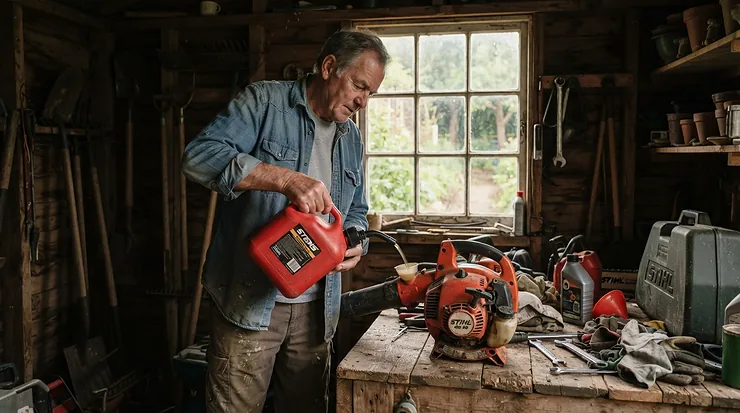
On day one, mix your fuel at the exact ratio specified in the manual — this varies by model (25:1 on some BU-KO batches, 50:1 on the STIHL and most premium brands), so don’t assume it’s universal. Use a proper fuel-mixing bottle with graduated markings rather than eyeballing it; getting this wrong is the single most common cause of early engine problems reported across budget models. Prime the carburettor per the manual (usually 5-10 pumps of the bulb) before your first pull-start, and expect the first start of the season to take a few extra pulls even on a well-maintained machine.
In the first 30 days, resist the urge to run the engine flat-out immediately — most manufacturers recommend a light-load break-in period of the first tank or two, letting the piston rings seat properly against the cylinder wall. Check the air filter after your first few uses; a clogged filter starves the engine of air and is a leading cause of the poor fuel efficiency issues reviewers commonly complain about with neglected machines. For ongoing maintenance, clean or replace the air filter every 25 hours of use, replace the spark plug annually, and drain fuel from 2-stroke tanks before any period of storage longer than a month, since stale fuel is the most common reason a strimmer refuses to start the following spring. A common mistake in the first month is over-tightening the trimmer line spool, which causes premature jamming — load it snugly, not forced.
Real-World Scenarios: Matching the Strimmer to Your Garden
Scenario one: the weekend suburban gardener. You’ve got a standard three-bed semi with a modest lawn, some borders and the odd overgrown corner behind the shed. A sub-30cc 2-stroke model like the STIHL FS 55 R or McCulloch B26 PS covers this comfortably, and the lighter weight means Saturday-morning strimming doesn’t turn into an arm workout.
Scenario two: the allotment or smallholding owner. Regular sessions against genuinely rough grass, brambles and boundary hedgerows call for real displacement. The Einhell GC-BC 52 I AS or BU-KO 52cc Backpack make more sense here — the backpack harness on the BU-KO specifically earns its keep across longer sessions, and both machines’ brush-cutting blades handle woody growth that a line head alone would just bounce off.
Scenario three: the occasional-use downsizer. Perhaps you’ve moved to a smaller property and only need a strimmer a handful of times a year for tidy-up work. The ParkerBrand 52cc or Ryobi RBC254SESO suit this well — genuine petrol capability without committing £250-plus to a tool that spends 50 weeks a year in the shed, and the Ryobi’s Expand-It compatibility means you’re not locked out of adding attachments later if your needs grow.
Problem → Solution: Fixing Common Petrol Strimmer Issues
Problem: engine won’t start after storage. Solution: drain and replace stale fuel, check the spark plug for fouling, and re-prime the carburettor — stale fuel accounts for the large majority of “dead” strimmers that are actually fine mechanically.
Problem: line keeps jamming or won’t feed. Solution: check the spool isn’t overtightened or wound unevenly; a common complaint in user reviews of bump-feed heads is that overfilling the spool with too much line causes exactly this issue.
Problem: excessive vibration during use. Solution: check the cutting head and blade are properly balanced and not damaged; persistent vibration on an otherwise well-maintained machine may indicate it’s simply not the right model for extended sessions, and models with anti-vibration engineering like the Einhell GC-BC 52 I AS are worth considering for heavy users.
Problem: poor cutting performance on thicker grass. Solution: this is usually a mismatch between engine displacement and the job — if you’re regularly struggling, a sub-30cc model like the STIHL or Ryobi likely needs upgrading to something in the 40-52cc range, such as the Einhell or BU-KO options above.
Problem: unexpectedly high fuel consumption. Solution: check the air filter first, since a clogged filter is the most common cause of poor fuel efficiency; if that’s clean, a carburettor adjustment or professional service may be needed.
FAQ
❓ How long does a petrol strimmer engine last?
❓ Can I use any petrol in a petrol strimmer?
❓ Is a 25cc or 52cc strimmer better for a small garden?
❓ How often should I service a petrol strimmer?
❓ Why won't my petrol strimmer start after winter storage?
Conclusion
Choosing between petrol strimmers under £300 ultimately comes down to being honest with yourself about what your garden actually needs, rather than what looks most impressive on a spec sheet. If you want the safest, most refined all-rounder, the STIHL FS 55 R earns its reputation. If you’re chasing genuine brush-cutting muscle without spending premium money, the Einhell GC-BC 52 I AS and BU-KO 52cc Backpack both deliver real displacement for the pound. If fuel-mixing hassle is what’s kept you on cordless tools until now, the Einhell GC-BC 31-4S‘s 4-stroke engine removes that friction entirely. And if you’re simply testing whether petrol suits your gardening habits at all, the ParkerBrand 52cc is a genuinely low-risk way to find out.
What ties every recommendation in this guide together is that none of it is about chasing the biggest number on the box — engine displacement, fuel efficiency and running costs all matter more as a combination matched to your actual garden than as individual bragging rights. Get that match right, maintain the machine properly from week one, and any of these seven petrol strimmers under £300 should give you years of reliable service.
✨ Ready to find your perfect match? Take a closer look at the models above and check current prices before the growing season gets going — your garden (and your Saturday mornings) will thank you! 🌿
Recommended for You
- Mains Strimmer for Large Lawn: 7 Powerful Picks for UK (2026)
- Electric Strimmer vs Cordless Strimmer: 7 Best UK Picks (2026)
- Cordless Strimmer For Pensioners: 7 Best Picks (2026)
Disclaimer: This article contains affiliate links. As an Amazon Associate, I earn from qualifying purchases. If you purchase products through these links, we may earn a small commission at no additional cost to you.
✨ Found this helpful? Share it with your friends! 💬🤗
